Computational Storage Market Size, Share & Trends

Computational Storage Market Size, Share & Trends by Offering (Hardware (Processor and SSD), Software), Type (Fixed Computational Storage and Programmable Computational Storage), End-use Industry, and Region - Global Forecast to 2032




Computational Storage Market Overview
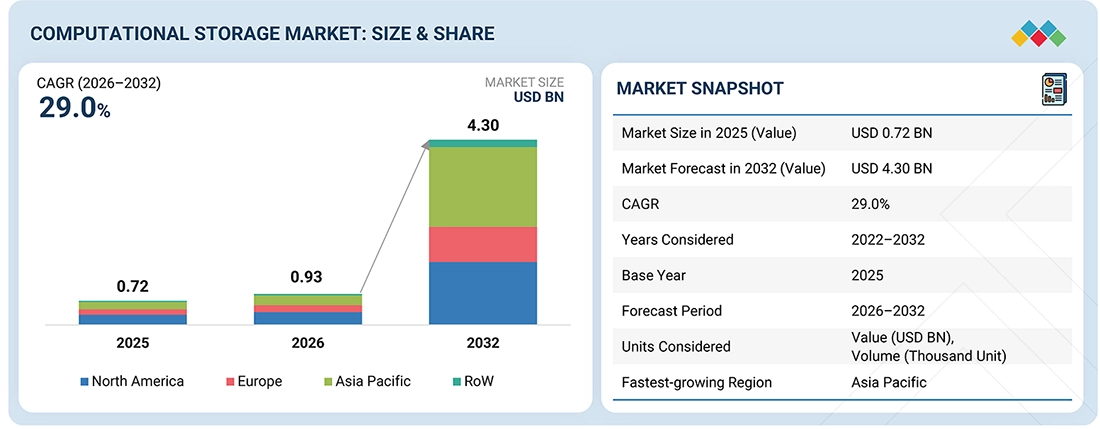
According to Marketsandmarkets, the computational storage market size is projected to reach USD 4.30 billion by 2032 from USD 0.93 billion in 2026, at a CAGR of 29.0% from 2026 to 2032. The demand for faster data processing and reduced latency in AI and big data workloads is driving the growth of the computational storage market.
MARKET SCOPE
| REPORT METRIC | DETAILS |
|---|---|
| Market Size in 2025 (Value) | USD 0.72 Billion |
| Market Forecast in 2032 (Value) | USD 4.30 Billion |
| Growth Rate | CAGR of 29.0% from 2026–2032 |
| Years Considered | 2022–2032 |
| Base Year | 2025 |
| Forecast Period | 2026–2032 |
| Units Considered | Value (USD Billion), Volume (Thousand Unit) |
| Report Coverage | Revenue Forecast, Company Ranking, Competitive Landscape, Growth Factors, and Trends |
| Top Companies |
|
| Growth Driver |
|
| Segments Covered |
|
| Regions Covered | North America, Asia Pacific, Europe, and RoW |
Market Size & Forecast
KEY TAKEAWAYS
-
By RegionNorth America accounted for the largest market share of 41.0% in 2025.
-
By OfferingBy offering, the software segment is expected to grow at the highest CAGR of 33.6% from 2026 to 2032.
-
By TypeBy type, fixed computational storage accounted for the largest market share of 66.8% in 2025.
-
BY End Use IndustryBy end-use Industry, enterprise storage is expected to lead the market in 2026.
-
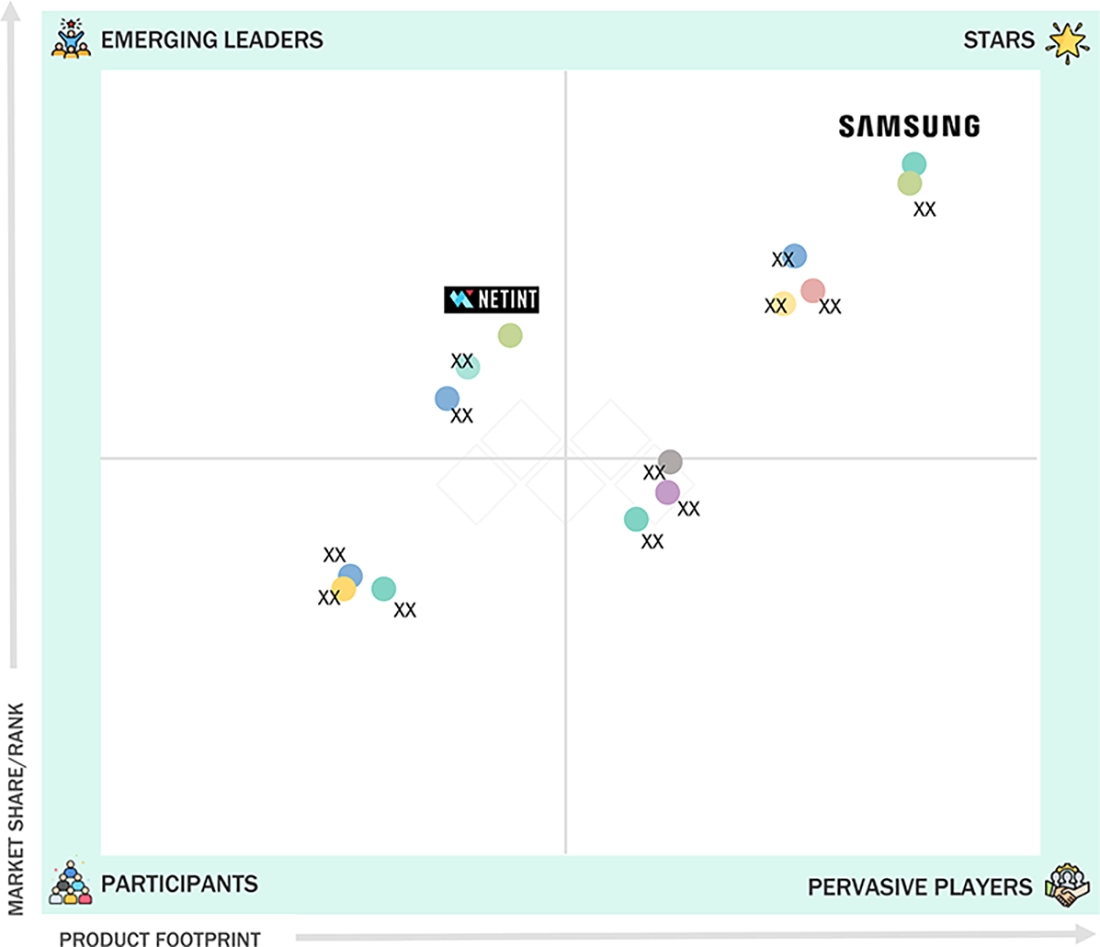
Competitive LandscapeSamsung Electronics Co., Ltd. (South Korea) and ScaleFlux (US) are identified as the star players in the computational storage market, given their strong market share and product footprint.
-
Competitive LandscapeNyriad (US) and Phison Electronics Corporation (Taiwan), among others, have distinguished themselves among startups and SMEs by securing strong footholds in specialized niche areas, underscoring their potential as emerging market leaders.
The computational storage market share presents significant opportunities driven by the growing demand for real-time data processing and advanced analytics. Increasing adoption of AI, machine learning, and big data applications is creating strong demand for intelligent storage solutions. Expansion of cloud computing and hyperscale data centers is further opening new avenues for market players. Advancements in storage software and processor technologies are enabling more efficient and scalable solutions. Companies can leverage these opportunities by investing in innovation, forming strategic partnerships, and offering customized solutions for enterprise and cloud customers.
Source: Secondary Research, Interviews with Experts, MarketsandMarkets Analysis
TRENDS & DISRUPTIONS IMPACTING CUSTOMERS' CUSTOMERS
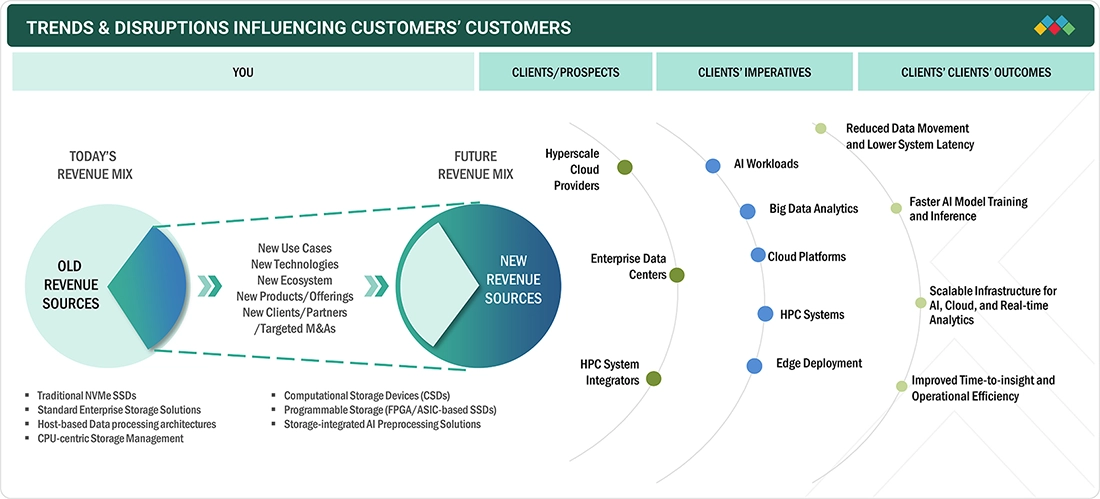
The computational storage market trends is undergoing a structural shift driven by the rapid growth of AI, big data analytics, and power-constrained data center environments. Traditional storage-centric revenue models are evolving toward programmable and intelligent storage architectures that enable near-data processing. This disruption is creating new revenue streams through advanced computational storage devices, software platforms, and cloud-focused solutions. Over the next 7–10 years, this transition is expected to improve system efficiency, reduce total cost of ownership, and accelerate performance across data-intensive computing environments.
Source: Secondary Research, Interviews with Experts, MarketsandMarkets Analysis
MARKET DYNAMICS

Level
-
Rising data-intensive workloads (AI, big data analytics, HPC)

-
Reduction of CPU and memory bottlenecks


Level
-
High initial implementation cost

-
Limited ecosystem maturity


Level
-
Adoption in data centers and cloud environments

-
Increasing use in AI/ML pipelines


Level
-
Lack of industry-wide standardization

-
Complex system integration

Source: Secondary Research, Interviews with Experts, MarketsandMarkets Analysis
Driver: Rising data-intensive workloads (AI, big data analytics, HPC)
Rapid growth in AI training, big data analytics, and HPC workloads is increasing data volumes and processing requirements. This is driving demand for near-data processing to reduce data movement, improve throughput, and lower latency in enterprise and hyperscale environments.
Restraint: High initial implementation cost
Computational storage requires specialized hardware such as FPGA- or ASIC-based SSDs along with customized firmware and software integration. The high upfront investment compared to conventional NVMe SSDs limits short-term adoption, especially among cost-sensitive enterprises.
Opportunity: Adoption in data centers and cloud environments
Hyperscale and enterprise data centers are increasingly adopting computational storage to improve performance, reduce data movement, and optimize power consumption across storage-intensive workloads.
Challenge: Lack of industry-wide standardization
Absence of unified standards for interfaces, programming models, and APIs limits interoperability across vendors, increasing vendor lock-in risks and slowing enterprise adoption.
COMPUTATIONAL STORAGE MARKET: COMMERCIAL USE CASES ACROSS INDUSTRIES
| COMPANY | USE CASE DESCRIPTION | BENEFITS |
|---|---|---|
 |
Integration of computational storage SSDs with embedded processors to accelerate data filtering, compression, and encryption at the storage level | Reduces data movement, lowers latency, improves system performance, and decreases CPU workload |
 |
Deployment of SmartSSD with FPGA-based processing for real-time analytics and AI inference within storage devices | Enhances processing speed, minimizes network traffic, and improves energy efficiency |
Logos and trademarks shown above are the property of their respective owners. Their use here is for informational and illustrative purposes only.
MARKET ECOSYSTEM
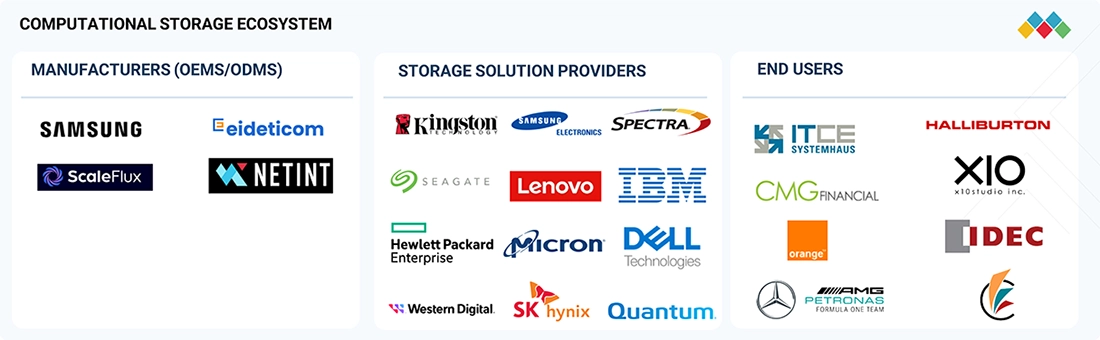
The computational storage ecosystem comprises a diverse set of participants, including manufacturers (OEMs/ODMs), storage solution providers, and end users. Leading OEMs such as Dell Technologies, HPE, Huawei, and IBM focus on developing advanced hardware platforms and integrated systems. Storage solution providers like Samsung, Seagate, Micron, and Western Digital drive innovation in intelligent storage devices and software solutions. End users across industries, including IT services, energy, automotive, and financial sectors, adopt computational storage to enhance data processing efficiency. This collaborative ecosystem enables continuous technological advancement and supports the widespread adoption of computational storage solutions.
Logos and trademarks shown above are the property of their respective owners. Their use here is for informational and illustrative purposes only.
MARKET SEGMENTS
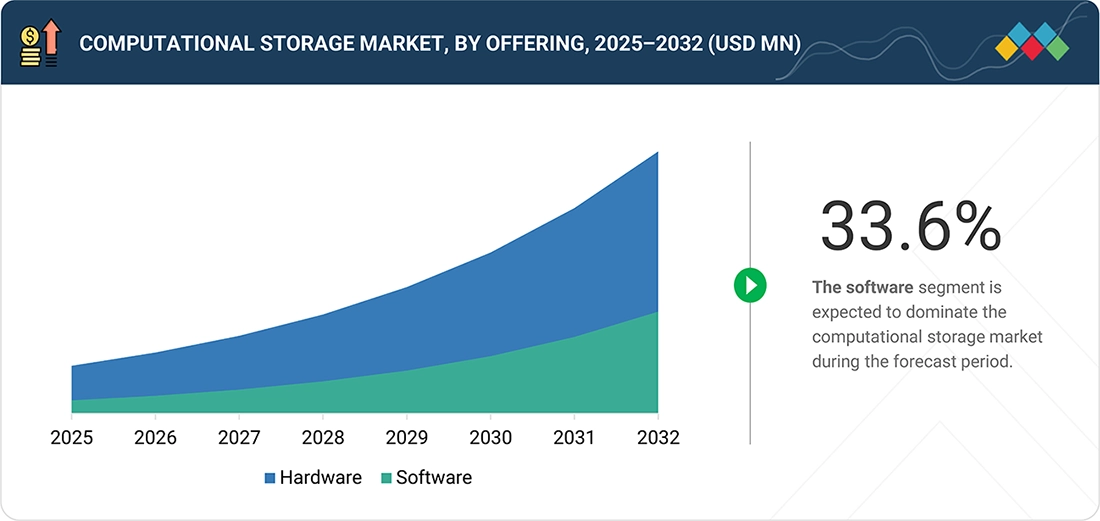
Source: Secondary Research, Interviews with Experts, MarketsandMarkets Analysis
Computational Storage Market, by Offering
Hardware is expected to account for the largest share of the computational storage market due to its essential role in enabling in-storage data processing. Components such as processors, controllers, and smart SSDs form the foundation of computational storage systems. Increasing investments in high-performance data centers and AI infrastructure are driving strong demand for advanced storage hardware. Additionally, enterprises prefer reliable, scalable hardware solutions to support data-intensive workloads, reinforcing hardware’s market dominance.
Computational Storage Market, by Type
Fixed computational storage is expected to hold the largest market share due to its high reliability and consistent performance in enterprise and data center environments. It is widely adopted for handling large-scale data processing, analytics, and AI workloads. Fixed storage solutions offer better integration with existing IT infrastructure, making deployment and management more efficient. Their ability to support high-capacity and high-speed operations further drives adoption among cloud and hyperscale providers. As a result, fixed computational storage continues to dominate the market across major end-use industries.
Computational Storage Market, by Type
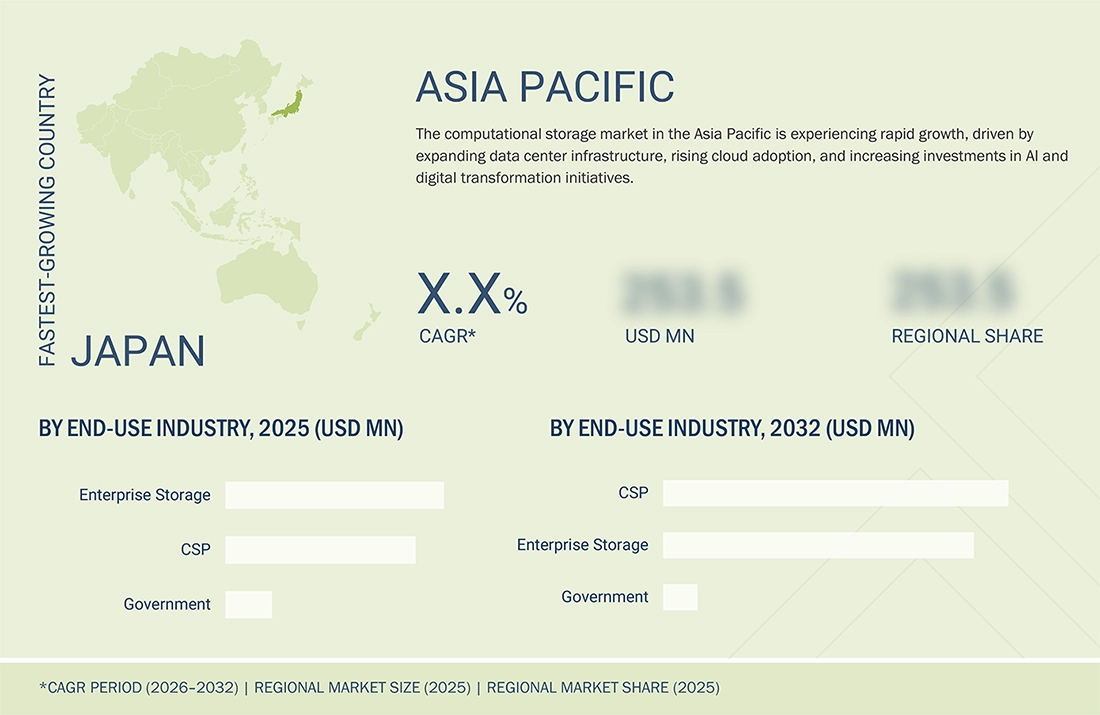
Enterprise storage is expected to hold the largest market share in the computational storage market due to rising demand for high-performance and secure data management solutions. Large organizations increasingly rely on computational storage to support AI, analytics, and mission-critical applications. Its ability to handle massive data volumes with low latency makes it ideal for enterprise environments. Additionally, strong investments in digital transformation and data center modernization are further driving adoption of enterprise storage solutions.
REGION
Asia Pacific to be fastest-growing region in global computational storage market during forecast period
Asia Pacific is expected to witness the fastest growth in the computational storage industry, driven by rapid digital transformation and expanding data center infrastructure. Rising adoption of cloud computing, AI, and big data analytics across countries such as China, India, and Japan is fueling market demand. Increasing investments by technology companies and governments in smart cities and digital initiatives are further supporting growth. The presence of emerging enterprises and growing startup ecosystems is accelerating the adoption of advanced storage solutions. As a result, Asia Pacific is becoming a key growth hub for the global computational storage market.
COMPUTATIONAL STORAGE MARKET: COMPANY EVALUATION MATRIX
In the computational storage companies matrix, stars are the leading market players in terms of new developments, such as product launches, innovative technologies, and the adoption of growth strategies. These players have a broad product portfolio, innovative product offerings, and a global presence. They have well-established partnership networks throughout the value chain. Samsung Electronics Co., Ltd. (South Korea) is a star player in the computational storage market. Emerging leaders are established vendors with effective business strategies and a good market presence. They follow the strategies of stars and have the potential to become market stars. Several companies in the computational storage market depend on their partner networks. NETINT Technologies (Canada) falls under this category.
Source: Secondary Research, Interviews with Experts, MarketsandMarkets Analysis
KEY MARKET PLAYERS
- Intel Corporation (US)
- ScaleFlux (US)
- Marvell Technology (US)
- Advanced Micro Devices (US)
- Samsung Electronics Co., Ltd. (South Korea)
- NGD Systems (US)
- Eideticom (Canada)
- NETINT Technologies (Canada)
- Pliops (Israel)
- ARM (UK)
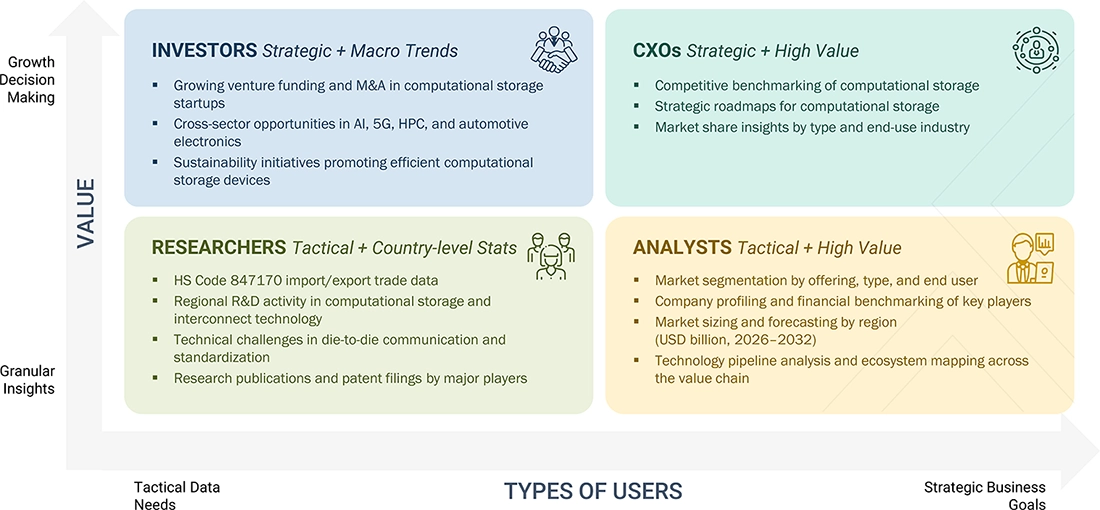
WHAT IS IN IT FOR YOU: COMPUTATIONAL STORAGE MARKET REPORT CONTENT GUIDE
DELIVERED CUSTOMIZATIONS
We have successfully delivered the following deep-dive customizations:
| CLIENT REQUEST | CUSTOMIZATION DELIVERED | VALUE ADDS |
|---|---|---|
| Computational Storage Market by Type, Architecture, and Interface | Detailed segmentation by storage type (fixed, removable), architecture (CSD, CSP, CSX), and interface (NVMe, SATA, SAS) | Identified high-growth segments and key technology adoption trends |
| Regional Analysis of Computational Storage Adoption | Assessment of computational storage deployment across data centers, cloud providers, and enterprises in North America, Europe, and Asia Pacific | Provided regional competitiveness mapping and ecosystem analysis |
| Application-wise Demand Assessment | Analysis of computational storage usage in AI/ML, big data analytics, databases, and edge computing applications | Highlighted high-potential application areas driving market demand |
| Competitive Landscape and Vendor Benchmarking | Evaluation of key players based on product portfolio, performance, pricing, and strategic initiatives | Enabled clients to identify market leaders and partnership opportunities |
| Technology Roadmap and Future Outlook | Analysis of emerging technologies such as AI-accelerated storage, programmable SSDs, and in-storage processing | Supported long-term investment and product development strategies |
RECENT DEVELOPMENTS
- August 2026: ScaleFlux continued expanding its storage-and-memory technology portfolio around data-intensive AI infrastructure, with its computational storage architecture positioning processing closer to stored data to reduce data movement and improve storage efficiency. The company's current portfolio includes NVMe storage solutions with onboard data-processing capabilities designed for AI and enterprise workloads. However, I could not verify a new August 2026 product launch or announcement specifically introducing a new computational-storage product, so this is not strong enough to count as a qualifying recent development under the strict activity rules.
- January 2026: Eideticom expanded its NoLoad computational-acceleration portfolio through a collaboration with Silicom involving the Silicom Accelerated Crypto Adapter with NoLoad, designed to provide post-quantum cryptography acceleration. The solution offloads compute-intensive cryptographic operations from the CPU to dedicated hardware, extending NoLoad's data-processing acceleration capabilities for secure data-center infrastructure. While the announcement is focused on cryptographic acceleration rather than a new computational-storage drive, it is directly relevant to Eideticom's computational-storage/near-data-processing technology platform.
- December 2025: AMD strengthened partnerships with storage vendors, OEMs, and cloud service providers to support computational storage architectures through reference designs and optimized platforms, accelerating adoption across enterprise and hyperscale data centers.
Table of Contents
 Exclusive indicates content/data unique to MarketsandMarkets and not available with any competitors.
Methodology
The study involved four major activities in estimating the size of the computational storage market. Exhaustive secondary research was done to collect information on the market, peer market, and parent market. The next step was to validate these findings, assumptions, and sizing with industry experts across value chains through primary research. The bottom-up approach was employed to estimate the overall market size. After that, market breakdown and data triangulation were used to estimate segment and subsegment market sizes.
Secondary Research
In the secondary research process, sources such as annual reports, press releases, investor presentations of companies, white papers, and articles by recognized authors were referred to. Secondary research was done to obtain key information about the market’s supply chain, the market’s value chain, the pool of key market players, and market segmentation according to industry trends, region, and developments from both market and technology perspectives.
Primary Research
Extensive primary research has been conducted after understanding and analyzing the computational storage market scenario through secondary research. Several primary interviews have been conducted with key opinion leaders from both demand- and supply-side vendors across four major regions—North America, Europe, Asia Pacific, and the RoW. Approximately 25% of primary interviews have been conducted with the demand side and 75% with the supply side. This primary data has been collected through telephonic interviews, questionnaires, and emails.
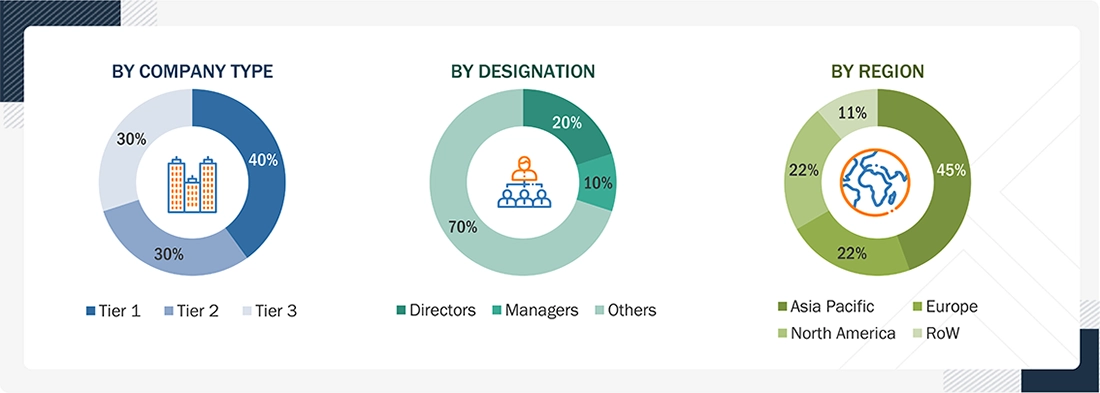
Note: “Others” include sales, marketing specialists, and product managers. The 3 tiers of the companies are defined based on their total revenue as of 2024; tier 1: revenue greater than USD 1 billion, tier 2: revenue between USD 500 million and USD 1 billion, and tier 3: revenue less than USD 500 million.
To know about the assumptions considered for the study, download the pdf brochure
Market Size Estimation
In the complete market engineering process, top-down and bottom-up approaches and several data triangulation methods have been used to estimate and forecast the market size for the overall market segments and subsegments listed in this report. Extensive qualitative and quantitative analyses have been conducted across the complete market engineering process to present key information/insights throughout the report.
The key players in the market have been identified through secondary research, and their market shares in the respective regions have been determined through primary and secondary research. This entire procedure includes studying the annual and financial reports of the top players, as well as extensive interviews with industry experts (such as CEOs, VPs, directors, and marketing executives) to provide key insights (both quantitative and qualitative) on the computational storage market. All percentage shares, splits, and breakdowns have been determined using secondary sources and verified through primary sources. All the possible parameters that affect the markets covered in this research study have been accounted for, viewed in extensive detail, verified through primary research, and analyzed to get the final quantitative and qualitative data. This data has been consolidated and supplemented with detailed inputs and analysis from MarketsandMarkets and presented in this report.
Computational Storage Market : Top-Down and Bottom-Up Approach
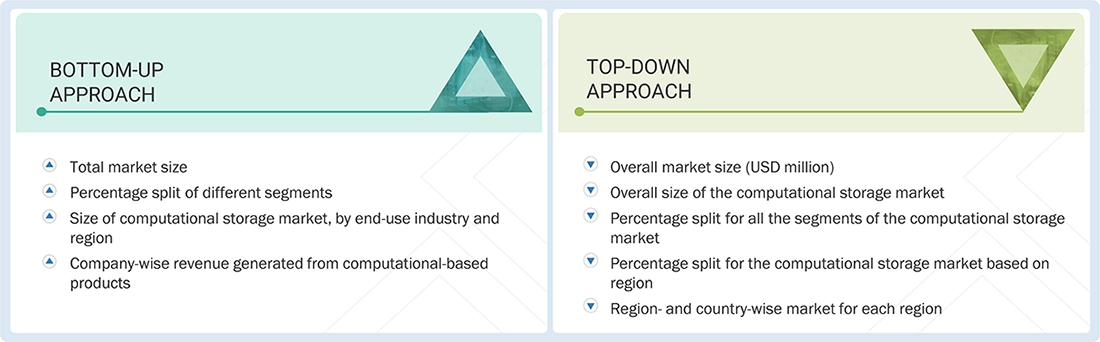
In the top-down approach, the overall market size has been used to estimate the size of the individual markets (mentioned in the market segmentation) through percentage splits from secondary and primary research. For the calculation of specific market segments, the most appropriate immediate parent market size has been used to implement the top-down approach. The bottom-up approach has also been implemented for the data obtained from the secondary research to validate the market size of various segments. Each company’s market share has been estimated to verify the revenue shares used earlier in the bottom-up approach. With the data triangulation procedure and validation of the data through primaries, the overall parent market size and each individual market size have been determined and confirmed in this study.
Data Triangulation
After arriving at the overall market size through the above process, the overall market has been split into several segments. To complete the overall market engineering process and arrive at the exact statistics for all the segments, market breakdown, and data triangulation procedures have been employed, wherever applicable. The data has been triangulated by studying various factors and trends from both the demand and supply sides. The market has also been validated using both top-down and bottom-up approaches.
Market Definition
Computational storage refers to an advanced storage architecture that integrates processing capabilities directly within the storage device, allowing data to be processed where it is stored rather than being transferred to a separate CPU. This approach reduces latency, offloads workloads from the central processor, and improves overall system efficiency, especially in data-intensive applications such as AI, big data analytics, and high-performance computing. By combining storage and computation, computational storage enables faster data handling, real-time analytics, and optimized performance for enterprises and cloud data centers. It represents a shift from traditional storage solutions toward intelligent, workload-aware storage systems.
Key Stakeholders
- Raw material suppliers
- Storage manufacturers
- Semiconductor manufacturers
- Research institutes and government organizations
- Traders, distributors, and suppliers of electronic devices
- Logic device manufacturers
- Semiconductor industry players
Report Objectives
- To define, describe, and forecast the computational storage market based on offering, type, end-use industry, and region
- To forecast the market size across four major regions, namely North America, Europe, Asia Pacific, and the Rest of the World (RoW), along with their respective countries, in terms of value
- To describe and forecast the computational storage market size in terms of volume
- To present detailed information regarding the major factors influencing the market (drivers, restraints, opportunities, and challenges)
- To provide an analysis of the market ecosystem, case studies, patents, technologies, pricing analysis, Porter’s five forces, and regulations pertaining to the market
- To offer a comprehensive overview of the value chain of the computational storage market ecosystem
- To critically analyze micromarkets with respect to individual growth trends, prospects, and contributions to the total market
- To strategically profile the key players and comprehensively analyze their market shares and core competencies
- To assess the opportunities in the market for stakeholders and describe the competitive landscape of the market
- To analyze competitive developments, such as collaborations, acquisitions, partnerships, and product developments, in the market
- To analyze the impact of AI/GenAI, the 2025 US tariff, and the macroeconomic outlook for each region covered under the study
Available customizations:
Based on the given market data, MarketsandMarkets offers customizations tailored to the company’s specific needs. The following customization options are available for the report:
Company Information
- Detailed analysis and profiling of 25 market players
Key Questions Addressed by the Report
What is the current size of the Computational Storage Market?
The global Computational Storage Market is projected to reach USD 4.30 billion by 2032 from USD 0.93 billion in 2026.
What is the projected market size of the Computational Storage Market by 2032?
The market is expected to reach USD 4.30 billion by 2032, driven by growing demand for data-intensive applications, AI workloads, and edge computing infrastructure.
What is the CAGR of the Computational Storage Market during the forecast period?
The Computational Storage Market is projected to grow at a CAGR of 29.0% from 2025 to 2032.
What are the major growth drivers of the Computational Storage Market?
Key growth drivers include the exponential growth of unstructured data, increasing adoption of artificial intelligence and machine learning, rising deployment of edge computing, and the need to reduce data movement between storage and processors.
Which storage type segment holds a significant share of the Computational Storage Market?
Computational SSDs hold a major market share due to their ability to perform data processing directly within storage devices, reducing latency and improving system efficiency.
Which end-use industry is driving demand for computational storage solutions?
The IT & telecommunications sector is a major adopter of computational storage technologies due to increasing data center workloads, cloud computing expansion, and high-performance computing requirements.
What technology trends are shaping the Computational Storage Market?
Emerging trends include the integration of AI accelerators within storage devices, growth of smart data processing architectures, adoption of NVMe-based computational storage, and increasing use of storage-class memory technologies.
Which region dominates the Computational Storage Market?
North America holds the largest market share due to the presence of leading cloud service providers, hyperscale data centers, semiconductor manufacturers, and strong investments in AI infrastructure.
Who are the leading companies operating in the Computational Storage Market?
Major market participants include Samsung Electronics, Kioxia Corporation, Western Digital Corporation, ScaleFlux Inc., Eideticom Inc., and NGD Systems.
What opportunities are highlighted in the Computational Storage Market report?
Significant opportunities include expanding AI and machine learning deployments, increasing adoption of edge analytics, growth in hyperscale data centers, demand for real-time data processing, and rising investments in next-generation storage architecture


Personalize This Research
- Triangulate with your Own Data
- Get Data as per your Format and Definition
- Gain a Deeper Dive on a Specific Application, Geography, Customer or Competitor
- Any level of Personalization
Let Us Help You
- What are the Known and Unknown Adjacencies Impacting the Computational Storage Market
- What will your New Revenue Sources be?
- Who will be your Top Customer; what will make them switch?
- Defend your Market Share or Win Competitors
- Get a Scorecard for Target Partners

Custom Market Research Services
We Will Customise The Research For You, In Case The Report Listed Above Does Not Meet With Your Requirements
Get 10% Free CustomisationTESTIMONIALS

Tetsuya Ohhira
Business Development Manager-Technology Business
Nikon Corporation,
Leading Japanese MNC specializing in optics and imaging productswww.nikon.com
MarketsandMarkets™ response
is quick. Their attitude is flexible and positive. Analyst Insights are globally considered and
significant. Client Services quickly respond to our inquiry and demand. Their wide range of global
surveys help us make our strategic plan.
We hope Knowledge Store will be easier to search
for a report.
VP - Marketing & Business Development
Leading Provider of Process Control Solutions
We engaged with MarketsandMarkets on a study to perform an analysis and recommend a Go-To-Market strategy for metrology and process control in the semiconductor market. The study was tailored to our targets and needs with well-defined milestones. Our overall experience with the MarketsandMarkets team was very good throughout the project in all aspects including the analysis methodologies used, the quality and depth of primary and secondary data sets, the professionalism and flexibility of the team and the ability to meet the target schedule and milestones. We want to thank MarketsandMarkets team for a job well done.
- US Computational Storage Market
- Canada Computational Storage Market
- Mexico Computational Storage Market
- UK Computational Storage Market
- Germany Computational Storage Market
- France Computational Storage Market
- Italy Computational Storage Market
- Poland Computational Storage Market
- Spain Computational Storage Market
- China Computational Storage Market
- Japan Computational Storage Market
- South Korea Computational Storage Market
- India Computational Storage Market
- Australia Computational Storage Market
- Nordics Computational Storage Market
- Rest Of Europe Computational Storage Market
- Rest Of Asia Pacific Computational Storage Market






Growth opportunities and latent adjacency in Computational Storage Market