
Asia Pacific Crypto Cooling Market (2025-2030)

The Asia Pacific Crypto Cooling Market was valued at $314.7 Million in 2025 and projected to reach to $889.3 Million by 2030, representing a compound annual growth rate of 16.0%. Asia Pacific's crypto cooling market is poised for exceptional growth, driven by the region's dominance in cryptocurrency mining operations and accelerating data center development.


| Market Size in | USD 26.32 MN |
| Market Forecast in | |
| CAGR | |
| Forecast Period | |
| Units Considered | Value (USD MN) |
Asia Pacific Crypto Cooling Market Trends and Insights
- Asia Pacific's rapid cryptocurrency mining adoption and data center proliferation are driving demand for advanced thermal management solutions across the region.
- The 16.0% compound annual growth rate reflects Asia Pacific's strategic position as a global hub for blockchain infrastructure and digital asset operations. Asia Pacific's dominance in cryptocurrency mining activity has intensified the need for efficient cooling technologies to manage heat dissipation in high-density computing environments.
- Between 2025 and 2030, Asia Pacific is expected to capture significant market share as regulatory frameworks stabilize and energy efficiency becomes a competitive priority.
- The region's investment in sustainable cooling solutions positions Asia Pacific as a critical market for chemical and material innovations in thermal management..
Key Market Statistics
- CAGR (2025-2030) 16.0% CAGR
- Market Size, 2025 ~USD 314.7 Million
- Forecast, 2030 ~USD 889.3 Million
- Geography Asia Pacific
Asia Pacific Crypto Cooling Market Overview
Market Valuation & Growth :
Asia Pacific crypto cooling market valued at $314.7 million in 2025, expanding to $889.3 million by 2030 at a 16.0% CAGR, outpacing many global regions in thermal management adoption.
Mining Hub Expansion :
China dominates with $433.4 million market share, leveraging its position as a global cryptocurrency mining powerhouse. The region's mining infrastructure drives sustained demand for advanced cooling technologies.
Data Center Proliferation :
Rapid expansion of data centers across Asia Pacific, particularly in China, Malaysia, and emerging markets, creates substantial opportunities for crypto cooling solutions and thermal management systems.
Regional Growth Drivers :
Strategic positioning in crypto mining, government infrastructure investments, and increasing energy efficiency regulations across Asia Pacific nations accelerate adoption of specialized cooling solutions.
Asia Pacific Crypto Cooling Market Dynamics
- China's substantial $433.4 million market contribution anchors regional expansion, while emerging markets like Malaysia and Thailand present untapped opportunities for thermal management solutions.
- The 16.0% CAGR reflects strong fundamentals in mining infrastructure and digital asset processing. Looking ahead to 2030, Asia Pacific will capture increasing market share as energy efficiency becomes critical and mining operations scale.
- Government support for blockchain technology, coupled with rising electricity costs driving demand for advanced cooling systems, will sustain robust growth.
- The region's competitive advantage in manufacturing and technology adoption positions it as the global leader in crypto cooling innovation and deployment..
Market Ecosystem
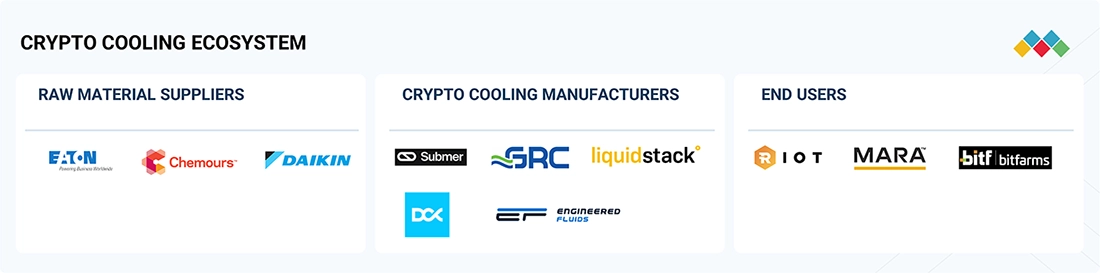
CRYPTO COOLING MARKET: COMMERCIAL USE CASES ACROSS INDUSTRIES
| COMPANY | USE CASE DESCRIPTION | BENEFITS |
|---|---|---|
 |
Submer offers two types of immersion cooling solutions for high-density cryptocurrency mining operations and blockchain data centers. The company uses its SmartPod system and its modular immersion tanks to provide cooling solutions for ASIC mining equipment used in both hyperscale and edge mining operations. | The system allows for extremely high power capacity to be distributed throughout the entire rack system while reducing energy usage through lower PUE values and eliminating the need for standard HVAC systems, leading to extended ASIC operational time, reduced system noise, and lower space requirements. |
 |
GRC uses dielectric liquid immersion cooling systems to operate its high-performance computing crypto data centers. The company uses its sealed immersion enclosures to enable direct underwater cooling of ASIC miners in specially developed fluids. | The system achieves stable hash rate output by maintaining thermal conditions throughout the mining process, reducing cooling-related energy expenses, preventing equipment damage from overheating, and supporting the establishment of expandable mining facilities. |
 |
LiquidStack delivers its advanced two-phase immersion cooling systems as essential cooling solutions for both cryptocurrency mining facilities and data centers that need to handle extreme heat emission. The technology operates in high-density environments that use both ASIC and GPU mining equipment. | The system manages extreme thermal design power requirements | The system supports users who want to overclock their devices | The system improves energy efficiency while achieving sustainable results | The system uses less water than traditional cooling systems | The system helps organizations meet their carbon-reduction objectives. |
 |
DCX Liquid Cooling Systems provides customized liquid cooling systems which include direct-to-chip cooling systems and immersion-based cooling systems for crypto mining facilities and blockchain data centers that are switching from air-cooling systems. | The system achieves multiple benefits through its design, which enhances thermal management in updated mining facilities, improves operational uptime, and requires less space. The system delivers more accurate cooling for high-density ASIC racks through its advanced cooling design. |
 |
Engineered Fluids develops advanced single-phase liquid-immersion cooling tank systems that maintain optimal performance for their cryptocurrency mining operations and blockchain data center activities. The company designs its immersion systems to efficiently dissipate heat from high-density ASIC mining equipment through its advanced fluid dynamics and chemically stable, non-conductive cooling materials. | The system uses non-conductive, chemically stable fluids to extend hardware durability, reduce the risk of oxidation and contamination, and enhance energy efficiency while maintaining operational reliability during extended immersion periods. |
Logos and trademarks shown above are the property of their respective owners. Their use here is for informational and illustrative purposes only.
Related Ecosystem
Equipment Machine And Tooling
- Wastewater Treatment
- Air Cooled Heat Exchangers
- Diaphragm Pumps
- Fiberglass
- HVAC System
- Alfa Laval Corporate AB
- Veolia
- Daikin Industries,Ltd.
- Johnson Controls International plc
- Parker-Hannifin Corporation
Key Takeaways
- Asia Pacific crypto cooling market valued at $314.7M in 2025, expanding to $889.3M by 2030 at 16.0% CAGR
- Asia Pacific's cryptocurrency mining concentration drives urgent demand for advanced thermal management solutions
- Energy efficiency regulations in Asia Pacific are accelerating adoption of innovative cooling technologies
- Asia Pacific represents the fastest-growing regional opportunity for crypto cooling chemical and material suppliers
Crypto Cooling Market Report Scope
| Report Metric | Details |
|---|---|
| Base Year | 2025 |
| Fastest Growing Segment | –IMMERSION COOLING (Type Of Cooling) |
| Forecast Period | 2025–2030 |
| Growth Rate | CAGR of 16.5% from 2025 to 2030 |
| Largest Segment | ASIC MINING (Hardware Type) |
| Market Size Base Year (Billions) | ~USD 1.27 (2025) |
| Revenue Forecast (Billions) | ~USD 2.72 (2030) |
| Segments Covered | Type Of Cooling, Hardware Type |
Asia Pacific Crypto Cooling Market Report Segmentation
2 segment dimensions are covered across the global market.
By Type Of Cooling
- Air Cooling
- Liquid Cooling
- –Direct To Chip
- –Direct-To-Chip
- –Immersion Cooling
By Hardware Type
- Asic Mining
- Cpu Mining
- Gpu Mining
Target Audience
- Mining Operations & Operators : Mining companies across Asia Pacific require detailed market data to optimize cooling infrastructure investments, reduce operational costs, and maintain competitive advantage in the region's high-density mining clusters.
- Data Center Providers : Data center operators and developers need Asia Pacific market insights to design efficient crypto-hosting facilities, select appropriate cooling technologies, and forecast infrastructure demand across the region.
- Cooling Solution Manufacturers : HVAC and thermal management equipment manufacturers require regional market analysis to identify growth opportunities, develop localized products, and establish distribution networks across Asia Pacific markets.
- Investment & Private Equity Firms : Investors evaluating crypto infrastructure opportunities need comprehensive Asia Pacific market data to assess portfolio companies, identify acquisition targets, and evaluate sector growth potential through 2030.
- Technology & Infrastructure Consultants : Consulting firms advising clients on blockchain infrastructure require detailed Asia Pacific market forecasts and competitive intelligence to develop strategic recommendations and feasibility studies for regional expansion.
Countries within Asia Pacific - compare and drill down
| Country | 2025 size (native) |
|---|---|
| China | USD 433.4 Million |
| Malaysia | USD 40.4 Million |
| Thailand | USD 12.6 Million |
| Indonesia | USD 5 Million |
| Australia | USD 8.7 Million |
| Rest Of Asia Pacific | USD 159.8 Million |
Country market size visualization
Reasons to Buy this Report
- Regional Market Intelligence : Gain comprehensive insights into Asia Pacific's $314.7M crypto cooling market with country-level breakdowns, competitive dynamics, and localized growth drivers specific to China, Malaysia, and emerging economies.
- Investment & Expansion Strategy : Identify high-growth opportunities across Asia Pacific with detailed forecasts to 2030, enabling strategic market entry, partnership development, and resource allocation in the region's fastest-expanding thermal management segment.
- Competitive Positioning : Understand Asia Pacific's competitive landscape, key players, technology trends, and market consolidation patterns to benchmark performance and develop differentiated cooling solutions for regional mining operations.
- Regulatory & Compliance Insights : Navigate country-specific regulations, energy efficiency standards, and environmental policies across Asia Pacific nations that impact crypto cooling adoption, helping ensure compliant market entry and operations.
- Demand Forecasting : Leverage detailed 5-year projections showing Asia Pacific market growth from $314.7M to $889.3M, enabling accurate demand planning, supply chain optimization, and revenue forecasting for cooling solution providers.
Frequently asked questions
What is the current size of the Asia Pacific crypto cooling market?
The Asia Pacific crypto cooling market is valued at $314.7 million in 2025 and is projected to grow to $889.3 million by 2030.
What is the growth rate for crypto cooling in Asia Pacific?
Asia Pacific's crypto cooling market is growing at a compound annual growth rate (CAGR) of 16.0% from 2025 to 2030.
Why is Asia Pacific a key market for crypto cooling solutions?
Asia Pacific dominates global cryptocurrency mining operations, creating substantial demand for efficient thermal management solutions to handle high-density computing environments.
What factors are driving growth in Asia Pacific's crypto cooling market?
Key drivers include rapid cryptocurrency mining expansion, data center proliferation, energy efficiency regulations, and increasing investment in sustainable cooling technologies across Asia Pacific.
Which countries in Asia Pacific are leading the crypto cooling market?
Major cryptocurrency mining hubs within Asia Pacific, including China, Vietnam, and other Southeast Asian nations, are driving significant demand for advanced cooling solutions in the region.
RESEARCH METHODOLOGY
The research methodology used to estimate the current size of the crypto cooling market consisted of four major activities. Extensive secondary research was conducted to obtain detailed information on the market, peer markets, and parent markets. These findings, assumptions, and metrics were verified through primary research with experts from both the demand and supply sides of the crypto cooling value chain. Both top-down and bottom-up approaches were used to estimate the total market size. The market sizes for various segments and subsegments were finalized using full market segmentation and data triangulation.
Secondary Research
The research methodology for estimating and forecasting the crypto cooling market begins with gathering data on key vendors' revenues by doing secondary research. The secondary research process involves consulting a range of secondary sources, including Hoover's, Bloomberg Businessweek, Factiva, the World Bank, and industry-specific journals. These secondary sources encompass press releases, investor presentations, white papers, certified publications, articles from recognized authors, regulatory notifications, trade directories, and databases. Also, vendor offerings are taken into consideration to inform market segmentation.
Primary Research
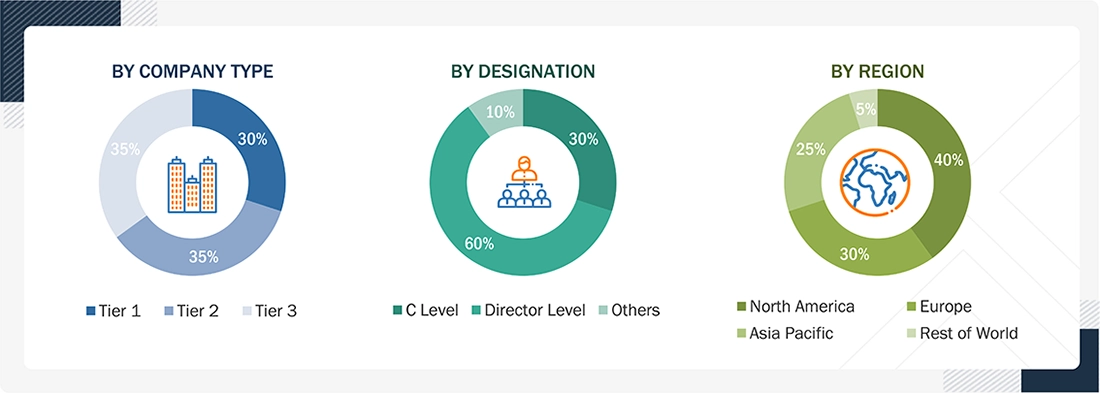
The crypto cooling market comprises several stakeholders across the supply chain, including raw material suppliers, processors, end-product manufacturers, and regulatory organizations. The demand side of this market is characterized by the development of various industries, including types of cooling and hardware types. The supply side is characterized by technological advancements and a wide range of diverse applications. Various primary sources from both the supply and demand sides of the market were interviewed to obtain qualitative and quantitative information. The following is the breakdown of the primary respondents:
The following is a breakdown of the primary respondents:
To know about the assumptions considered for the study, download the pdf brochure
Market Size Estimation
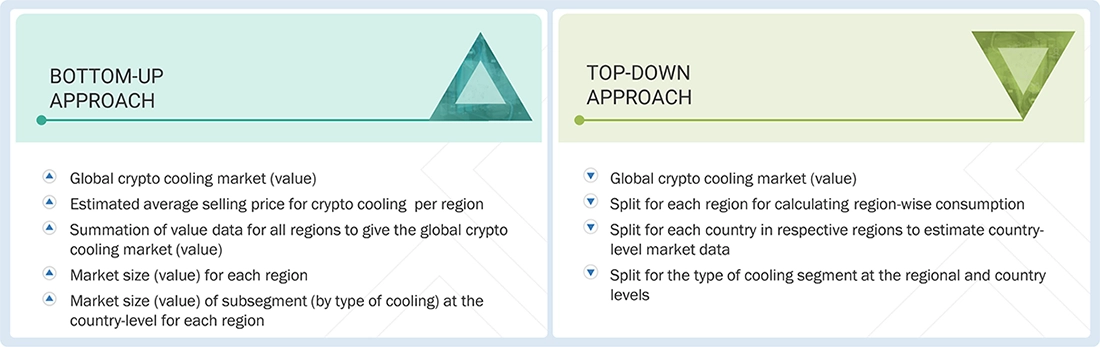
The top-down and bottom-up approaches have been used to estimate and validate the total size of the crypto cooling market. These approaches have also been used extensively to estimate the size of various dependent market subsegments. The research methodology used to estimate the market size included the following.
- Extensive primary and secondary research was done to identify the key players.
- The value chain and market size in terms of value of the crypto cooling market were determined through primary and secondary research.
- All percentage shares, splits, and breakdowns were collected through secondary sources and verified through primary sources.
- All possible parameters that affect the market were covered in this research study and are viewed in extensive detail, verified through primary research, and analyzed to obtain the final quantitative and qualitative data.
- The study of reports, reviews, and newsletters of top market players, along with extensive interviews for opinions from key leaders, such as CEOs, directors, and marketing executives, is included in this research.
Crypto Cooling Market Size: Bottom-Up & Top-Down Approach
Data Triangulation
After estimating the overall market size using the above estimation process, the market was split into various segments and subsegments. Data triangulation and market segmentation techniques, along with the market engineering process, were employed to obtain precise market analysis data for each segment and its subsegments.
Market Definition
Crypto cooling refers to thermal management solutions that dissipate the substantial heat generated by cryptocurrency mining equipment, including CPUs, GPUs, and ASICs. The system requires effective cooling because all electrical energy used for hashing is converted to heat, which causes performance instability, hardware damage, and operational shutdowns. Air cooling is the traditional method, using high-velocity fans and ventilation systems to remove heat. However, this system requires excessive power, produces loud noise, and fails to work effectively in environments with high mining activity. Direct-to-chip cooling, also known as liquid cooling, uses water or water-glycol mixtures that flow through cold plates attached directly to heat-producing components to achieve superior heat transfer compared to conventional air cooling methods. The entire mining equipment operates underwater within non-conductive dielectric fluids, which provide better heat absorption and temperature regulation capabilities than traditional cooling systems. The system performs better in power efficiency, higher rack density, and better temperature management than air-based systems. The advanced methods enable controlled overclocking while maintaining hardware durability during extended operational periods. The adoption of liquid-based crypto cooling systems has increased because mining operations need energy-efficient solutions that provide dependable performance throughout their operational lifetime.
Key Stakeholders
- Raw material manufacturers who provide crypto cooling in air cooling, and liquid cooling (immersion and direct to chip cooling)
- Manufacturers of crypto cooling systems
- Manufacturers of CPU, GPU, and ASIC
- Traders, distributors, and suppliers of crypto cooling systems
- ASHRAE (American Society of Heating, Refrigerating and Air Conditioning Engineers), Open Compute Project (OCP), Uptime Institute, The Green Grid, Data Center Dynamics, Bitcoin Mining Council, Blockchain Infrastructure Alliance, Liquid Cooling Coalition, European Data Centre Association (EUDCA), Asia Pacific Data Centre Association (APDCA)
- Contract manufacturing organizations (CMOs)
- NGOs, governments, investment banks, venture capitalists, and private equity firms
Report Objectives
- To define, describe, and forecast the size of the crypto cooling market, in terms of value, based on type of cooling, hardware type, and region
- To provide detailed information regarding the key factors, such as drivers, restraints, opportunities, and industry–specific challenges, influencing the growth of the CRYPTO cooling market
- To strategically analyze micromarkets1 with respect to individual growth trends, prospects, and their contribution to the total market
- To analyze opportunities in the market for stakeholders and provide a competitive landscape of the market leaders
- To project the size of the market and its submarkets, in terms of value, with respect to four main regions (along with their respective key countries), namely, North America, Asia Pacific, Europe, and Rest of World.
- To provide ecosystem analysis, case study analysis, value chain, patent analysis, technology analysis, pricing analysis, Porter’s Five Forces analysis, key stakeholders and buying criteria, investment and funding scenario, trade analysis, impact of AI/Gen AI and 2025 US tariff, key conferences and events, regulatory bodies, government agencies, and regulations pertaining to the market under study
- To strategically profile the key players and comprehensively analyze their core competencies
- To analyze competitive developments such as acquisitions, partnerships, and product launches in the crypto cooling market
- To provide the macroeconomic outlook for all regions considered under the study
Available customizations:
Based on the given market data, MarketsandMarkets offers customizations tailored to client-specific needs.
The following customization options are available for the report:
1) Additional country-level analysis of the crypto cooling market
2) Profiling of additional market players (up to 5)
Product Analysis
Product matrix, which provides a detailed comparison of each company's product portfolio.
Get the Full Crypto Cooling Market Report
Full forecast, segment splits, and company analysis for all Crypto Cooling Market.
- US Crypto Cooling Market
- Canada Crypto Cooling Market
- Mexico Crypto Cooling Market
- Germany Crypto Cooling Market
- Ireland Crypto Cooling Market
- Norway Crypto Cooling Market
- Russia Crypto Cooling Market
- Sweden Crypto Cooling Market
- Australia Crypto Cooling Market
- China Crypto Cooling Market
- Indonesia Crypto Cooling Market
- Malaysia Crypto Cooling Market
- Thailand Crypto Cooling Market
- Rest Of Europe Crypto Cooling Market
- Kazakhstan Crypto Cooling Market
- Rest Of Asia Pacific Crypto Cooling Market
Need a Tailored Report?
Customize this report to your needs
Get 10% FREE Customization
Customize This Report
