
Canada Cybersecurity Insurance Market (2025-2030)

The Canada Cybersecurity Insurance Market was valued at $100.3 Million in 2025 and projected to reach to $221.2 Million by 2030, representing a compound annual growth rate of 17.1%. Canada's cybersecurity insurance market is positioned for sustained growth through 2030, driven by evolving regulatory requirements and heightened awareness of cyber threats among enterprises.


| Market Size in | USD 26.32 MN |
| Market Forecast in | |
| CAGR | |
| Forecast Period | |
| Units Considered | Value (USD MN) |
Canada Cybersecurity Insurance Market Trends and Insights
- This represents a compound annual growth rate of 17.1%, significantly outpacing global trends as Canadian organizations increasingly recognize the critical need for cyber risk protection.
- Canada's market growth is driven by rising regulatory requirements, heightened threat landscapes, and growing awareness among enterprises of the financial and reputational risks associated with cyber incidents. The Canadian cybersecurity insurance sector reflects strong demand across multiple industries, including financial services, healthcare, and technology.
- Canada's position as a digital economy leader and its stringent data protection regulations are accelerating adoption of cyber insurance policies among mid-market and enterprise organizations.
- Between 2025 and 2030, Canada is expected to see substantial investment in specialized cyber coverage products, enhanced claims management capabilities, and expanded underwriting expertise tailored to the Canadian regulatory environment. Canada's cybersecurity insurance market dynamics are shaped by evolving threat sophistication, ransomware incidents, and compliance mandates such as PIPEDA and sector-specific regulations.
- As Canada continues to strengthen its cybersecurity posture, insurers are innovating coverage solutions to address emerging risks, positioning Canada as a key growth market within North America's broader cyber insurance landscape..
Key Market Statistics
- CAGR (2025-2030) 17.1% CAGR
- Market Size, 2025 ~USD 100.3 Million
- Forecast, 2030 ~USD 221.2 Million
- Country Canada
Canada Cybersecurity Insurance Market Overview
Rapid Market Expansion :
Canada's cybersecurity insurance market is growing at 17.1% CAGR, significantly outpacing the global rate of 14.2%, reflecting accelerating demand for cyber risk protection among Canadian enterprises.
Regulatory Compliance Drivers :
Stringent Canadian privacy regulations, including PIPEDA and provincial data protection laws, are compelling organizations to adopt cybersecurity insurance as a critical risk management tool.
Market Valuation Growth :
The Canadian market is projected to more than double from $100.3 million in 2025 to $221.2 million by 2030, representing a $120.9 million increase in market opportunity.
Enterprise Risk Awareness :
Canadian organizations are increasingly recognizing cyber threats as a material business risk, driving adoption of insurance solutions across financial services, healthcare, and technology sectors.
Canada Cybersecurity Insurance Market Dynamics
- The 17.1% CAGR reflects strong organizational investment in comprehensive cyber risk management strategies.
- Canadian insurers are expanding policy offerings to address sector-specific vulnerabilities, particularly in financial services and critical infrastructure.
- Market maturation is expected as more mid-market companies recognize insurance as essential to their risk portfolios.
- Government initiatives promoting cybersecurity standards will further accelerate adoption rates across all business sizes..
Market Ecosystem
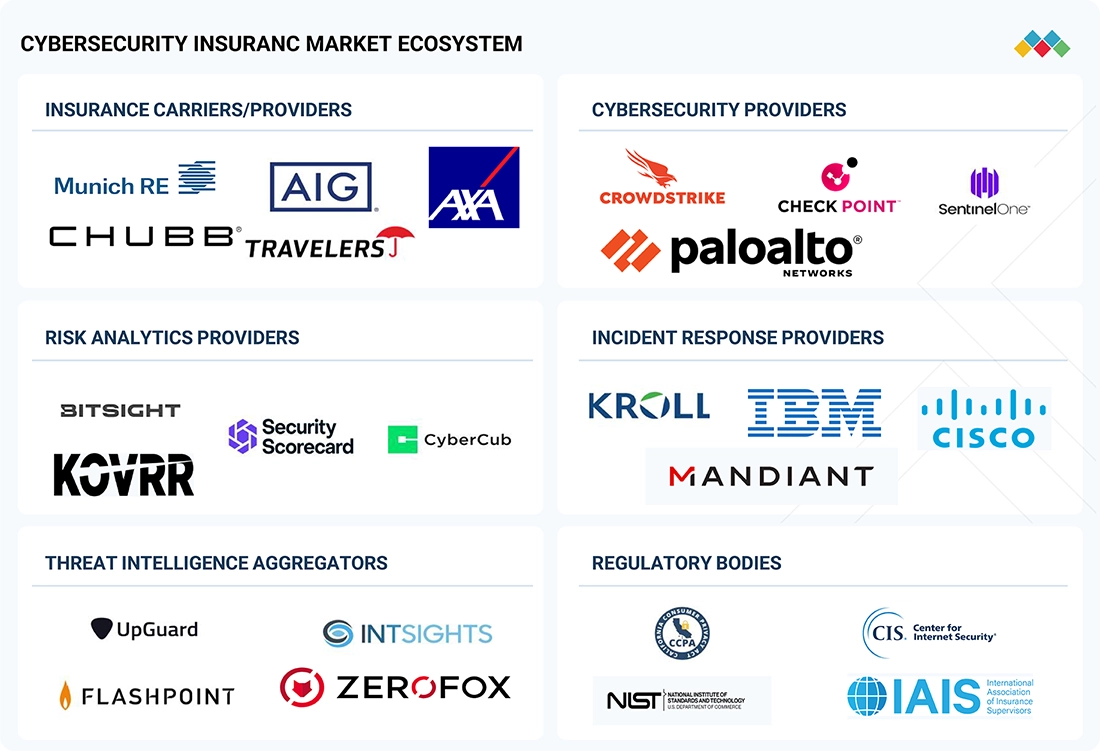
Cybersecurity Insurance Market: COMMERCIAL USE CASES ACROSS INDUSTRIES
| COMPANY | USE CASE DESCRIPTION | BENEFITS |
|---|---|---|
 |
Fubon utilized SecurityScorecard to assess the security posture of potential customers, enabling them to identify low-risk candidates for cyber insurance. By reviewing the scores, Fubon determined if a prospect is profitable for coverage and incorporates the risk level into the premium. Additionally, it used ratings to raise risk awareness among current customers, helping them decide if cyber insurance is a valuable addition. | SecurityScorecard provided Fubon with the necessary insight into a customer’s potential risk, enabling a thorough evaluation process. By incorporating SecurityScorecard in its assessment, Fubon effectively lowered the risk of unexpected insurance payouts. Furthermore, Fubon used the ratings to educate its customers about their cyber risk, thereby increasing their awareness of cybersecurity as a critical business concern. |
 |
The country mutual insurance company used CyberArk’s features and functionalities, such as secured privileged credentials in a vault, credential rotation, shared service accounts, credentials used by applications, managing third-party remote access, and monitoring privileged sessions. To secure user credentials and ensure security in line with productivity and manage unaudited third-party and remote vendor access with adherence to strong compliance requirements. | Country Mutual Insurance Company used CyberArk to manage and secure its privileged accounts and credentials. The cost and time required to manage and maintain privileged accounts and credentials were reduced |
Logos and trademarks shown above are the property of their respective owners. Their use here is for informational and illustrative purposes only.
Related Ecosystem
Insurance
- Cloud Security
- Security Analytics
- Battery Electric Vehicle (BEV)
- Big Data Analytics
- Black Box
- International Business Machines Corporation
- MICROSOFT CORPORATION
- ROLAND BERGER
- SAP SE
- Oracle Corporation
Cyber Security
- Cloud Security
- Biometric Systems
- Data Loss Prevention (DLP)
- Multi-Factor Authentication
- Security Analytics
- International Business Machines Corporation
- MITSUI BUSSAN SECURE DIRECTIONS INC
- Cisco Systems, Inc.
- MICROSOFT CORPORATION
- Allot Ltd.
Network Security
- Cloud Security
- Critical Communication Network
- Surveillance System
- Video Surveillance Systems
- Biometric Security and Authentication System
- Cisco Systems, Inc.
- International Business Machines Corporation
- Fortinet, Inc.
- MICROSOFT CORPORATION
- PALO ALTO NETWORKS, INC
Key Takeaways
- Canada's cybersecurity insurance market is valued at $100.3 million in 2025 and projected to grow to $221.2 million by 2030, representing a 17.1% CAGR.
- Canada's market growth outpaces global averages, driven by regulatory compliance requirements, increasing cyber threats, and heightened organizational risk awareness.
- Canadian insurers are developing specialized coverage solutions addressing ransomware, data breaches, and business interruption risks specific to Canada's regulatory environment.
- Canada's digital economy maturity and stringent data protection laws like PIPEDA are accelerating cyber insurance adoption across financial services, healthcare, and technology sectors.
Cybersecurity Insurance Market Report Scope
| Report Metric | Details |
|---|---|
| Base Year | 2025 |
| Fastest Growing Segment | SECURITY AWARENESS TRAINING (Service) |
| Forecast Period | 2025-2030 |
| Growth Rate | CAGR of 14.2% from 2025 to 2030 |
| Largest Segment | LARGE ENTERPRISES (Organization Size) |
| Market Size Base Year (Billions) | ~USD 16.57 (2025) |
| Revenue Forecast (Billions) | ~USD 32.19 (2030) |
| Segments Covered | Offering, Solution, Service, Insurance Coverage, Insurance Type, Provider Type, Vertical, Solution Type, Deployment Mode, Organization Size, Security Type, End User, Technology, Application |
Canada Cybersecurity Insurance Market Report Segmentation
14 segment dimensions are covered across the global market.
By Offering
- Services
- Software
- Solutions
By Solution
- Cybersecurity Insurance Analytics Platforms
- Cybersecurity Solutions
- Disaster Recovery And Business Continuity
By Service
- Consulting/Advisory
- Other Services
- Security Awareness Training
By Insurance Coverage
- Cyber Liability
- Data Breach
By Insurance Type
- Health Insurance
- Life & Annuity Insurance
- Other Insurance Types
- P&C Insurance
- Packaged
- Specialty Insurance
- Standalone
By Provider Type
- Insurance Provider
- Technology Provider
By Vertical
- Aerospace And Defense
- Bfsi
- Energy And Utilities
- Financial Services
- Government
- Healthcare & Life Science
- Healthcare And Life Sciences
- It & Ites
- It And Ites
- Manufacturing
- Media & Entertainment
- Other Verticals
- Retail & Ecommerce
- Retail And Ecommerce
- Telecom
- Telecommunication
- Transportation & Logistics
- Travel, Tourism, And Hospitality
By Solution Type
- Antivirus/Antimalware
- Compliance & Policy Management
- Encryption & Tokenization
- Firewall
- Iam
- Log Management & Siem
- Other Solution Types
- Patch Management
By Deployment Mode
- Cloud
- Hybrid
- On-Premises
By Organization Size
- Large Enterprises
- Smes
By Security Type
- Application Security
- Cloud Security
- Endpoint & IoT Security
- Network Security
By End User
- Insurance Agencies & Brokers
- Insurance Companies
- Other End Users
- Third-Party Administrators
By Technology
- AI & Analytics
- Blockchain
- Cloud Computing
- IoT
- Other Technologies
By Application
- Billing & Payments
- Claims Management
- Compliance & Reporting
- Crm
- Data Analytics
- Digital Engagement & Portals
- Insurance Workflow Automation
- Other Applications
- Policy Administration, Collection, And Disbursement
- Predictive Modeling/Extreme Event Forecasting
- Sales & Marketing
- Underwriting & Rating
CANADA: CYBERSECURITY INSURANCE MARKET, BY VERTICAL, 2025–2030
| Segment | 2025 | 2026 | 2027 | 2028 | 2029 | 2030 | CAGR (%) |
|---|---|---|---|---|---|---|---|
| FINANCIAL SERVICES | 410.3 | 452.6 | 509.5 | 575.8 | 652.1 | 740.1 | 12.5 |
| HEALTHCARE AND LIFE SCIENCES | 272 | 314 | 369.7 | 436.8 | 517.1 | 613.3 | 17.7 |
| IT AND ITES | 277.7 | 309.3 | 351.7 | 401.5 | 459.5 | 527.2 | 13.7 |
| OTHER VERTICALS | 181 | 205.8 | 238.7 | 278 | 324.5 | 379.8 | 16 |
| RETAIL AND ECOMMERCE | 136 | 150.3 | 169.5 | 191.9 | 217.8 | 247.7 | 12.7 |
| TELECOM | 129.6 | 146.6 | 169.3 | 196.3 | 228.2 | 266 | 15.5 |
| TRAVEL, TOURISM, AND HOSPITALITY | 79.8 | 91.5 | 107.1 | 125.7 | 148 | 174.6 | 16.9 |
| TOTAL | 1486.4 | 1670.2 | 1915.4 | 2206 | 2547.2 | 2948.7 | 14.7 |
Target Audience
- Insurance Providers & Underwriters : Canadian and international insurers need market sizing and growth forecasts to develop competitive products, set pricing strategies, and allocate capital to the high-growth Canadian cyber insurance segment.
- Enterprise Risk & Compliance Officers : Canadian C-suite executives require market data to justify cyber insurance investments, benchmark coverage against industry peers, and demonstrate due diligence in regulatory compliance and risk mitigation.
- Cybersecurity & Insurance Consultants : Risk advisors serving Canadian clients need credible market intelligence to recommend appropriate insurance solutions, validate client concerns, and position cyber insurance within comprehensive risk strategies.
- Investment & Private Equity Firms : Investors evaluating opportunities in Canadian insurtech, cybersecurity, and risk management sectors require market forecasts and growth metrics to assess portfolio companies and identify acquisition targets.
- Government & Policy Makers : Canadian regulatory bodies and policy organizations need market data to understand industry trends, assess regulatory effectiveness, and develop informed cybersecurity and insurance policy frameworks.
Reasons to Buy this Report
- Market Size & Growth Validation : Quantified market data demonstrating Canada's cybersecurity insurance market growing at 17.1% CAGR provides credible benchmarking for investment decisions and competitive positioning strategies.
- Regulatory Landscape Intelligence : Detailed insights into Canadian regulatory drivers (PIPEDA, provincial laws) help insurers and enterprises understand compliance-driven demand and tailor offerings to meet evolving legal requirements.
- Competitive Market Opportunity : Forecast data through 2030 enables strategic planning for market entry, expansion, and product development in a high-growth segment with $120.9 million incremental opportunity.
- Sector-Specific Insights : Canada-focused analysis identifies key verticals (financial services, healthcare, technology) driving adoption, enabling targeted sales and marketing strategies for insurance providers and risk consultants.
- Risk Management Strategy Development : Comprehensive market intelligence supports C-suite decision-making on cyber insurance procurement, coverage adequacy, and integration with broader enterprise risk management frameworks.
Frequently asked questions
What is the current size of Canada's cybersecurity insurance market?
Canada's cybersecurity insurance market is valued at $100.3 million in 2025 and is projected to reach $221.2 million by 2030, growing at a 17.1% compound annual growth rate.
What factors are driving growth in Canada's cybersecurity insurance market?
Canada's market growth is driven by increasing regulatory compliance requirements, rising cyber threat sophistication, organizational awareness of financial and reputational risks, and stringent data protection laws such as PIPEDA.
Which industries in Canada are adopting cybersecurity insurance most rapidly?
Financial services, healthcare, and technology sectors in Canada are leading cyber insurance adoption due to their exposure to sensitive data, regulatory scrutiny, and high-value cyber risks.
How does Canada's cybersecurity insurance market compare to global trends?
Canada's market is growing at 17.1% CAGR, which significantly outpaces the global cybersecurity insurance market CAGR of 14.2%, reflecting stronger regional demand and regulatory drivers.
What types of cyber risks are Canadian insurers covering?
Canadian insurers are providing coverage for ransomware attacks, data breaches, business interruption, liability claims, regulatory fines, and incident response costs tailored to Canada's specific regulatory environment.
RESEARCH METHODOLOGY
This research study on the cybersecurity insurance market involved extensive secondary sources, directories, and several journals, databases, such as D&B Hoovers, Bloomberg Businessweek, and Factiva, to identify and collect information useful for this technical, market-oriented, and commercial study of the cybersecurity insurance market. Primary sources were industry experts from core and related industries, preferred system developers, service providers, resellers, partners, and organizations related to the various segments of the industry’s value chain. In-depth interviews were conducted with different primary respondents, including key industry participants and subject-matter experts, to obtain and verify critical qualitative and quantitative information, as well as to assess the market’s prospects. These included key industry participants, subject-matter experts, C-level executives of key companies, and industry consultants. Primary sources were mainly industry experts from the core and related industries, preferred cybersecurity insurance providers, third-party service providers, consulting service providers, end users, and other commercial enterprises. In-depth interviews were conducted with various primary respondents, including key industry participants and subject matter experts, to obtain and verify critical qualitative and quantitative information and assess growth prospects.
Secondary Research
The market size of companies offering cybersecurity insurance solutions and services was determined based on secondary data available through paid and unpaid sources. It was also arrived at by analyzing the product portfolios of major companies and rating the companies based on their performance and quality.
In the secondary research process, various sources were referred to for identifying and collecting information for this study. Secondary sources included annual reports, press releases, and investor presentations of companies; white papers, journals, and certified publications; and articles from recognized authors, directories, and databases. The data was also collected from other secondary sources, such as journals and related magazines. Cybersecurity insurance spending of various countries was extracted from the respective sources. Secondary research was mainly used to obtain the key information related to the industry’s value chain and supply chain to identify key players, market classification, and segmentation according to offerings of major players; industry trends related to offering, insurance coverage, insurance type, provider type, vertical, and regions; and key developments from both market and technology-oriented perspectives.
Primary Research
In the primary research process, various primary sources from both the supply and demand sides were interviewed to obtain qualitative and quantitative information for the report. The primary sources from the supply side included industry experts, such as Chief Executive Officers (CEOs), Vice Presidents (VPs), marketing directors, technology and innovation directors, and related key executives from various key companies and organizations providing cybersecurity insurance solutions and services. The primary sources from the demand side included end users, such as Chief Information Officers (CIOs), consultants, service professionals, technicians and technologists, and managers at public and investor-owned utilities.
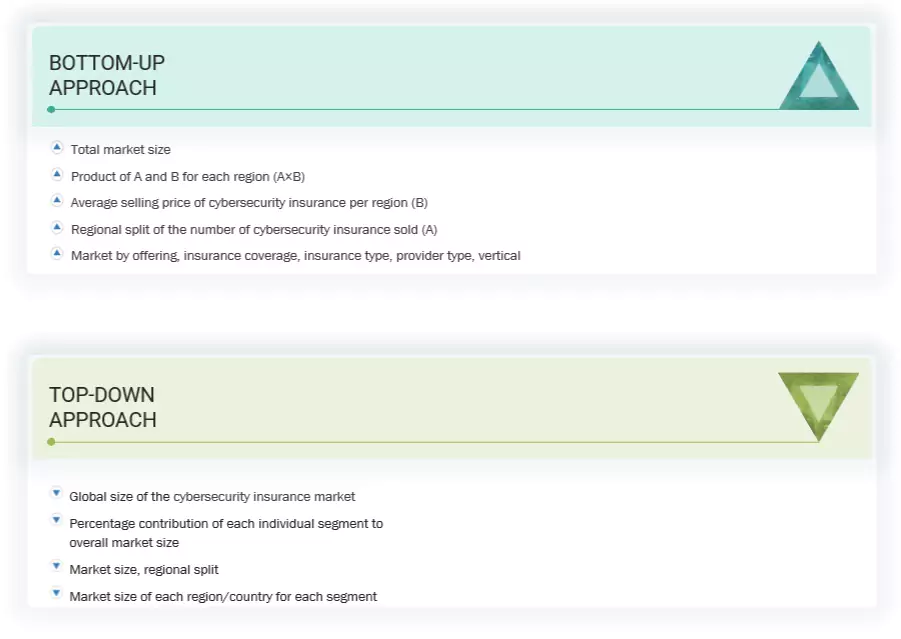
In the market engineering process, top-down and bottom-up approaches were extensively used, along with several data triangulation methods, to perform market estimation and market forecasting for the overall market segments and subsegments listed in the report. Extensive qualitative and quantitative analyses were performed on the complete market engineering process to list key information/insights throughout the report.
After the complete market engineering (including calculations for market statistics, market breakup, market size estimations, market forecasting, and data triangulation), extensive primary research was conducted to gather information. Primary research was conducted to identify the segmentation, industry trends, key players, competitive landscape, and key market dynamics, such as drivers, restraints, opportunities, challenges, industry trends, and key strategies
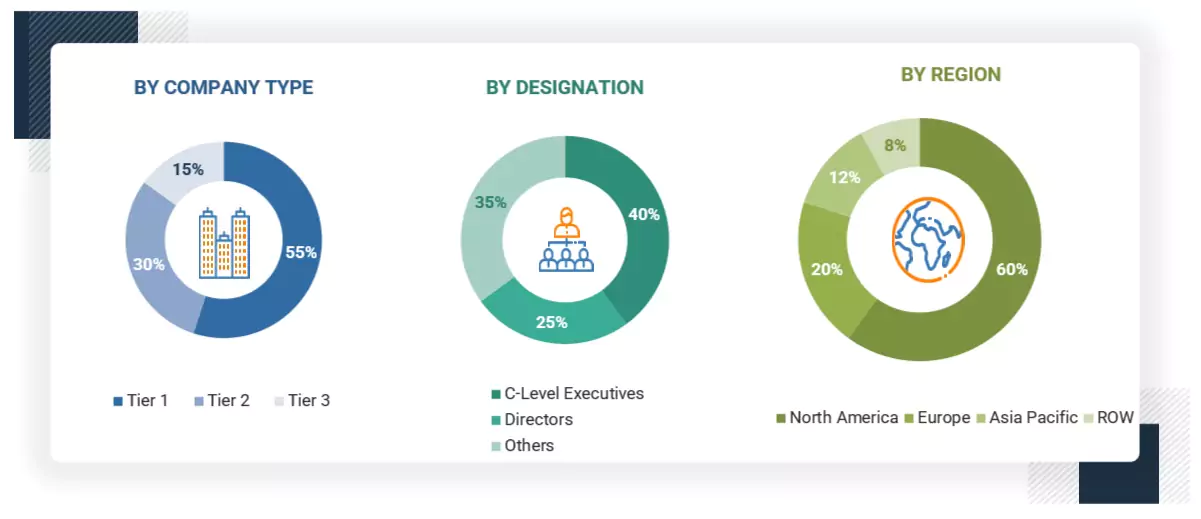
Note 1: Tier 1 companies have revenues greater than USD 10 billion; tier 2 companies' revenues range
between USD 1 and 10 billion; and tier 3 companies' revenues range between USD 500 million and 1 billion
Note 2: Others include sales, marketing, and product managers.
Source: Secondary Literature, Interviews with Experts, and MarketsandMarkets Analysis
To know about the assumptions considered for the study, download the pdf brochure
Market Size Estimation
Multiple approaches were adopted to estimate and forecast the cybersecurity insurance market. The first approach involved estimating the market size by summing up the companies’ revenue generated through the sale of solutions and services.
The research methodology used to estimate the market size included the following:
- We used primary and secondary research to determine the revenue contributions of the major market participants in each country after secondary research helped identify them.
- Throughout the process, we obtained critical insights by conducting in-depth interviews with industry professionals, including directors, CEOs, VPs, and marketing executives, and by reading the annual and financial reports of the top firms in the market.
- We used primary sources to verify all percentage splits and breakups, which we calculated using secondary sources.
Cybersecurity Insurance Market : Top-Down and Bottom-Up Approach
Data Triangulation
Once the overall market size was determined, we divided the market into segments and subsegments using the previously described market size estimation procedures. When required, market breakdown and data triangulation procedures were employed to complete the market engineering process and specify the exact figures for every market segment and subsegment. The data was triangulated by examining several variables and patterns from the government entities' supply and demand sides.
Market Definition
Cybersecurity insurance, also referred to as cyber risk insurance, is a specialized line of coverage designed to protect organizations from the financial impact of cyber incidents. These incidents may include data breaches, ransomware attacks, network intrusions, business interruption, and regulatory penalties.
The cybersecurity insurance market size is measured in terms of Gross Written Premiums (GWP), which represent the sum of premiums collected by insurers before deductions for reinsurance and administrative expenses. This includes both primary insurance premiums and premiums ceded to reinsurers, making reinsurance an integral part of the market's overall value.
There are two aspects of cybersecurity insurance:
- Technology provider: They assist insurance companies in building cybersecurity insurance products. They offer cyber risk and resiliency assessments of enterprises/businesses that aim to procure cybersecurity insurance coverage for their data and assets.
- Insurance provider: They underwrite the actual cybersecurity insurance policy for enterprises/businesses based on the security risk assessment of the technology provider.
Stakeholders
- Government agencies
- Insurance associations and agencies
- Cybersecurity insurance vendors
- Insurance providers
- Underwriters and reinsurers
- Independent software vendors
- Security agencies
- Cybersecurity vendors
- Value-added Resellers (VARs)
- Information Technology (IT) security agencies
- Managed Security Service Providers (MSSPs)
Report Objectives
- To define, describe, and forecast the cybersecurity insurance market in terms of value
- To provide detailed information regarding drivers, restraints, opportunities, and challenges influencing the growth of the market
- To forecast the market by offering (solutions, services), insurance coverage, insurance type, provider type, vertical, and region
- To forecast the market size of segments for five main regions: North America, Europe, Asia Pacific, the Middle East & Africa, and Latin America
- To analyze opportunities in the market and provide details of the competitive landscape for stakeholders and market leaders
- To profile the key market players, including top vendors and startups; provide a comparative analysis based on business overviews, regional presence, product offerings, business strategies, and key financials; and provide a detailed competitive landscape of the market
- To analyze competitive developments, such as mergers & acquisitions (M&A), product launches/enhancements, agreements, partnerships, collaborations, expansions, and R&D activities, in the market.
Available Customizations
MarketsandMarkets provides customizations based on the company's unique requirements using market data. The following customization options are available for the report:
Product Analysis
- The product matrix provides a detailed comparison of each company's portfolio.
Geographic Analysis as per Feasibility
- Further breakup of the cybersecurity insurance market
Company Information
- Detailed analysis and profiling of five additional market players
Get the Full Cybersecurity Insurance Market Report
Full forecast, segment splits, and company analysis for all Cybersecurity Insurance Market.
- US Cybersecurity Insurance Market
- UK Cybersecurity Insurance Market
- Germany Cybersecurity Insurance Market
- France Cybersecurity Insurance Market
- China Cybersecurity Insurance Market
- Japan Cybersecurity Insurance Market
- UAE Cybersecurity Insurance Market
- Brazil Cybersecurity Insurance Market
- Mexico Cybersecurity Insurance Market
- Italy Cybersecurity Insurance Market
- Nordics Cybersecurity Insurance Market
- Rest Of Europe Cybersecurity Insurance Market
- Spain Cybersecurity Insurance Market
- Anz Cybersecurity Insurance Market
- India Cybersecurity Insurance Market
- Rest Of Apac Cybersecurity Insurance Market
- Sea Cybersecurity Insurance Market
- Rest Of Latin America Cybersecurity Insurance Market
- Ksa Cybersecurity Insurance Market
- South Africa Cybersecurity Insurance Market
Need a Tailored Report?
Customize this report to your needs
Get 10% FREE Customization
Customize This Report
