
Australia Data Center Immersion Cooling Fluids Market (2025-2030)

The Australia Data Center Immersion Cooling Fluids Market was valued at $82 Million in 2025 and projected to reach to $338 Million by 2030, representing a compound annual growth rate of 22.5%. Australia's data center immersion cooling fluids market is positioned for substantial growth as the nation invests heavily in digital infrastructure to support cloud computing, AI, and edge computing applications.


| Market Size in | USD 26.32 MN |
| Market Forecast in | |
| CAGR | |
| Forecast Period | |
| Units Considered | Value (USD MN) |
Australia Data Center Immersion Cooling Fluids Market Trends and Insights
- This acceleration reflects Australia's increasing investment in high-density data center infrastructure and the nation's commitment to energy-efficient cooling technologies.
- Australia's market expansion is driven by rising demand from hyperscale data center operators and growing awareness of immersion cooling's superior thermal management capabilities compared to traditional air-cooling systems. The Australian market benefits from the country's strategic position in the Asia-Pacific region and its robust digital economy.
- Australia's data center operators are increasingly adopting immersion cooling fluids to address power density challenges and reduce operational costs.
- Between 2025 and 2030, Australia is expected to see significant capital deployment in next-generation cooling infrastructure, positioning the nation as a key growth market within the Asia-Pacific region for immersion cooling solutions..
Key Market Statistics
- CAGR (2025-2030) 22.5% CAGR
- Market Size, 2025 ~USD 82 Million
- Forecast, 2030 ~USD 338 Million
- Country Australia
Australia Data Center Immersion Cooling Fluids Market Overview
Market Valuation :
Australia's data center immersion cooling fluids market is valued at $82.0 million in 2025, with strong momentum driven by regional digital infrastructure expansion and sustainability initiatives.
Explosive Growth Trajectory :
The market is projected to reach $338.0 million by 2030, representing a 22.5% CAGR—outpacing many developed markets due to Australia's rapid data center modernization and energy efficiency mandates.
Energy Efficiency Focus :
Australian data centers are increasingly adopting immersion cooling to reduce operational costs and carbon footprint, aligning with the nation's renewable energy targets and climate commitments.
Infrastructure Investment :
Growing demand from hyperscale data center operators and cloud service providers in Australia is accelerating adoption of advanced cooling technologies to support high-density computing environments.
Australia Data Center Immersion Cooling Fluids Market Dynamics
- The 22.5% CAGR reflects increasing recognition among Australian data center operators of immersion cooling's superior thermal efficiency and cost-effectiveness compared to traditional air cooling methods. Key drivers include Australia's geographic isolation creating demand for local data processing capabilities, government incentives for energy-efficient technologies, and major tech companies establishing regional data centers.
- The market will benefit from rising electricity costs, stricter environmental regulations, and the need to support emerging technologies requiring intensive computational power, positioning Australia as a significant growth market within the Asia-Pacific region..
Market Ecosystem
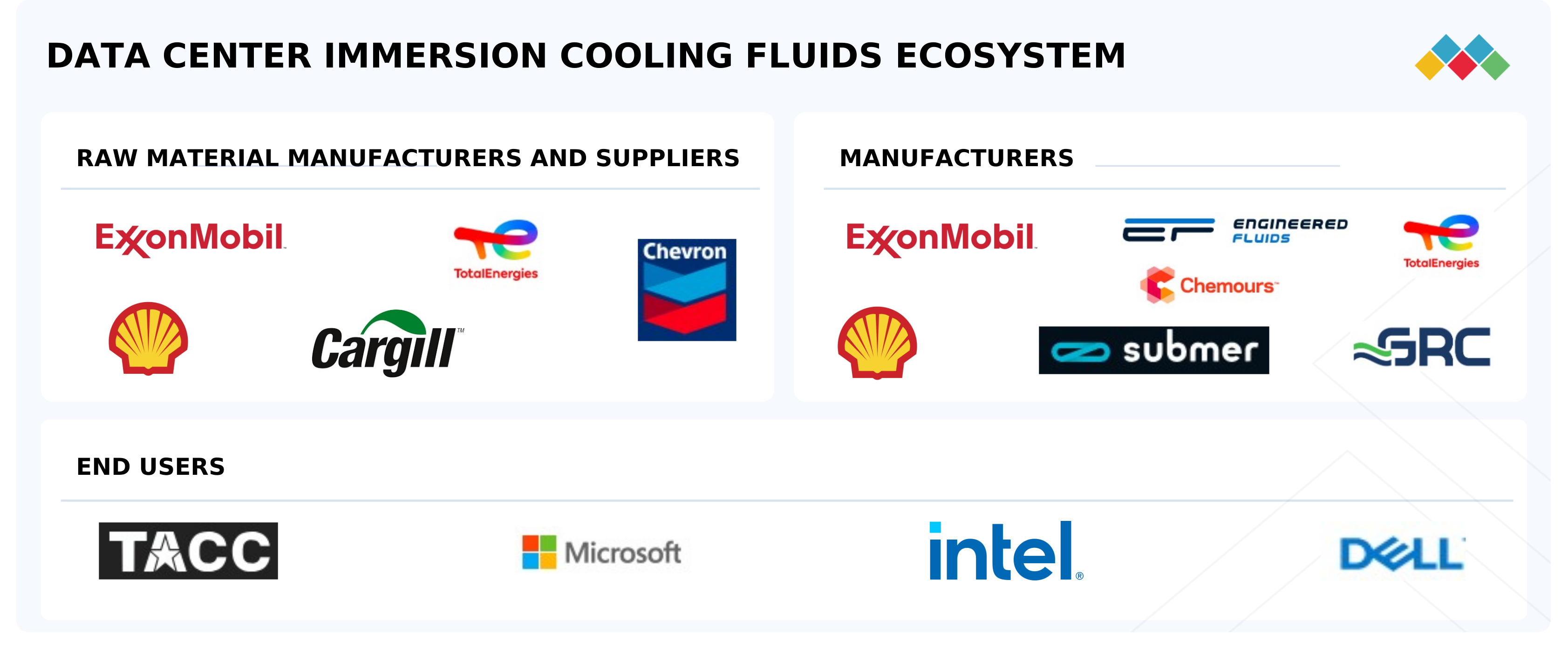
Data Center Immersion Cooling Fluids Market: COMMERCIAL USE CASES ACROSS INDUSTRIES
| COMPANY | USE CASE DESCRIPTION | BENEFITS |
|---|---|---|
 |
Single-phase dielectric immersion cooling fluids used to effectively dissipate extreme heat loads from CPUs and GPUs | These fluids efficiently absorb and transport heat away from CPUs and GPUs, enabling reliable cooling at power levels up to and beyond 1000W TDP per chip, which is essential for modern AI and HPC deployments. |
 |
GRC’s ElectroSafe immersion fluid is used, which is specifically formulated for single-phase immersion cooling in data centers. | The consistent temperature maintenance of immersion fluid lowers heat stress on components, significantly reducing failure rates compared to conventional cooling methods. |
 |
Shell installed a single-phase immersion cooling system in its Amsterdam data center (2022), using Shell’s specially developed Immersion Cooling Fluid S5 X | The Shell Immersion Cooling Fluid S5 X improves data center performance by reducing energy use, costs, and carbon footprint while enhancing cooling efficiency, hardware lifespan, and sustainability. |
 |
LLNL adopted an immersion cooling solution for its HPC systems, submerging the server racks directly in a non-conductive cooling fluid. | Liquid cooling effectively transferred heat away from critical components, enabling LLNL to run their supercomputers at higher power densities while maintaining optimal performance. |
Logos and trademarks shown above are the property of their respective owners. Their use here is for informational and illustrative purposes only.
Related Ecosystem
Speciality Chemicals
- Corrosion Inhibitors
- Polyetheretherketone (PEEK)
- Acrylonitrile Butadiene Styrene (ABS)
- Epoxy Resin
- Polycarbonate
- Basf se
- DOW CHEMICAL COMPANY
- Evonik industries ag
- Clariant ag.
- Solvay sa
Key Takeaways
- Australia's immersion cooling fluids market will grow from $82.0M (2025) to $338.0M (2030) at a 22.5% CAGR.
- Australia's hyperscale data center expansion is the primary driver of immersion cooling fluid adoption.
- Australia's energy efficiency regulations and sustainability mandates are accelerating market penetration.
- Australia's strategic Asia-Pacific location positions it as a regional hub for advanced cooling technology deployment.
Data Center Immersion Cooling Fluids Market Report Scope
| Report Metric | Details |
|---|---|
| Base Year | 2025 |
| Fastest Growing Segment | SYNTHETIC FLUIDS (Type) |
| Forecast Period | 2025-2030 |
| Growth Rate | CAGR of 23.9% from 2025 to 2030 |
| Largest Segment | CRYPTOCURRENCY MINING DATA CENTERS (Data Center Type) |
| Market Size Base Year (Billions) | ~USD 0.19 (2025) |
| Revenue Forecast (Billions) | ~USD 0.55 (2030) |
| Segments Covered | Type, Technology, Data Center Type |
Australia Data Center Immersion Cooling Fluids Market Report Segmentation
3 segment dimensions are covered across the global market.
By Type
- Fluorocarbon-Based Fluids
- Mineral Oil
- Other Types
- Synthetic Fluids
By Technology
- Single-Phase Cooling
- Two-Phase Cooling
By Data Center Type
- AI/ML Data Centers
- Cryptocurrency Mining Data Centers
- Hyperscale Data Centers
- Other Data Centers
Target Audience
- Data Center Operators & Facility Managers : Need market intelligence to evaluate immersion cooling adoption, benchmark operational costs against competitors, and plan infrastructure upgrades aligned with Australia's energy efficiency trends.
- Cooling Fluid Manufacturers & Suppliers : Require detailed market sizing, growth forecasts, and competitive positioning data to develop product strategies, identify distribution channels, and capture market share in Australia's expanding sector.
- Technology & Infrastructure Investors : Seek comprehensive market analysis to assess investment opportunities in Australian data center cooling solutions, evaluate portfolio companies, and identify acquisition targets in this high-growth segment.
- Cloud & Hyperscale Operators : Need regional market insights to optimize cooling technology decisions, manage operational expenses, and align infrastructure investments with Australia's sustainability and energy cost dynamics.
- Strategic Consultants & Business Advisors : Require Australia-specific market data to advise clients on market entry strategies, competitive positioning, regulatory compliance, and long-term growth opportunities in immersion cooling technologies.
Reasons to Buy this Report
- Market-Specific Sizing & Forecasts : Access precise valuation data for Australia's immersion cooling fluids market with detailed 2025-2030 projections, enabling accurate budgeting and investment planning tailored to regional growth dynamics.
- Competitive Landscape Intelligence : Understand key players, market share distribution, and competitive strategies specific to Australia's data center sector, helping identify partnership and expansion opportunities in this high-growth market.
- Regulatory & Policy Insights : Gain clarity on Australia's energy efficiency standards, environmental regulations, and government incentives driving immersion cooling adoption, critical for compliance and strategic positioning.
- End-User Demand Analysis : Identify specific demand drivers from Australian hyperscalers, cloud providers, and enterprise data centers, enabling targeted product development and go-to-market strategies for the region.
- Investment Decision Support : Make informed capital allocation decisions with comprehensive market data, growth forecasts, and risk assessments specific to Australia's immersion cooling fluids sector and broader data center ecosystem.
Frequently asked questions
What is the current market size of immersion cooling fluids in Australia?
Australia's data center immersion cooling fluids market was valued at $82.0 million in 2025.
What is the projected market size for Australia by 2030?
Australia's market is forecast to reach $338.0 million by 2030, representing a 22.5% CAGR.
Why is Australia's immersion cooling market growing faster than traditional cooling solutions?
Australia's data center operators are adopting immersion cooling to improve energy efficiency, reduce operational costs, and manage higher power densities in hyperscale facilities.
Which sectors are driving demand for immersion cooling fluids in Australia?
Australia's hyperscale data center operators, cloud service providers, and enterprise data centers are the primary demand drivers for immersion cooling solutions.
How does Australia's market compare to the broader Asia-Pacific region?
Australia's 22.5% CAGR is competitive within Asia-Pacific, reflecting strong digital infrastructure investment and regulatory support for energy-efficient cooling technologies.
RESEARCH METHODOLOGY
The study involved four major activities in estimating the current market size of data center immersion cooling fluids. Exhaustive secondary research was done to collect information on the market, peer, and parent markets. The next step was to validate these findings, assumptions, and sizes with industry experts across the value chain of data center immersion cooling fluids through primary research. Both top-down and bottom-up approaches were employed to estimate the complete market size. After that, market breakdown and data triangulation were used to estimate the size of the segments and sub-segments of the market.
Secondary Research
The research methodology used to estimate and forecast the access control market begins with capturing data on the revenues of key vendors in the market through secondary research. In the secondary research process, various secondary sources, such as Hoovers, Bloomberg BusinessWeek, Factiva, World Bank, and Industry Journals, were referred to for identifying and collecting information for this study. These secondary sources included annual reports, press releases & investor presentations of companies; white papers; certified publications; articles by recognized authors; notifications by regulatory bodies; trade directories; and databases. Vendor offerings have also been taken into consideration to determine market segmentation.
Primary Research
The data center immersion cooling fluids market comprises stakeholders, such as raw material suppliers, processors, recycling companies, data center immersion cooling fluids manufacturers, and regulatory organizations in the supply chain. Various primary sources from the supply and demand sides of the market were interviewed to obtain qualitative and quantitative information. Primary sources from the supply side included industry experts such as Chief Executive Officers (CEOs), vice presidents, marketing directors, technology and innovation directors, and related key executives from various key companies and organizations operating in the data center immersion cooling fluids market. Primary sources from the demand side included directors, marketing heads, and purchase managers from various sourcing industries.
The following is the breakdown of the primary respondents:
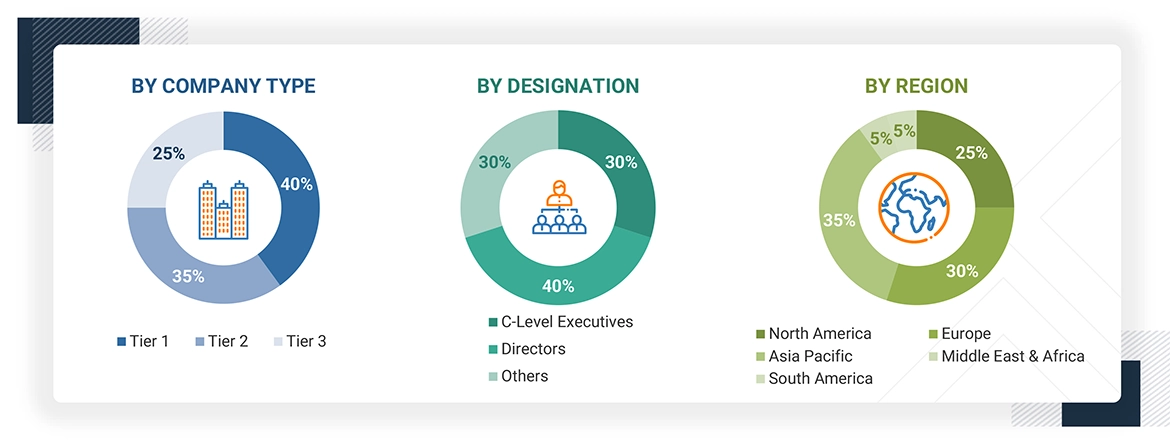
To know about the assumptions considered for the study, download the pdf brochure
Market Size Estimation
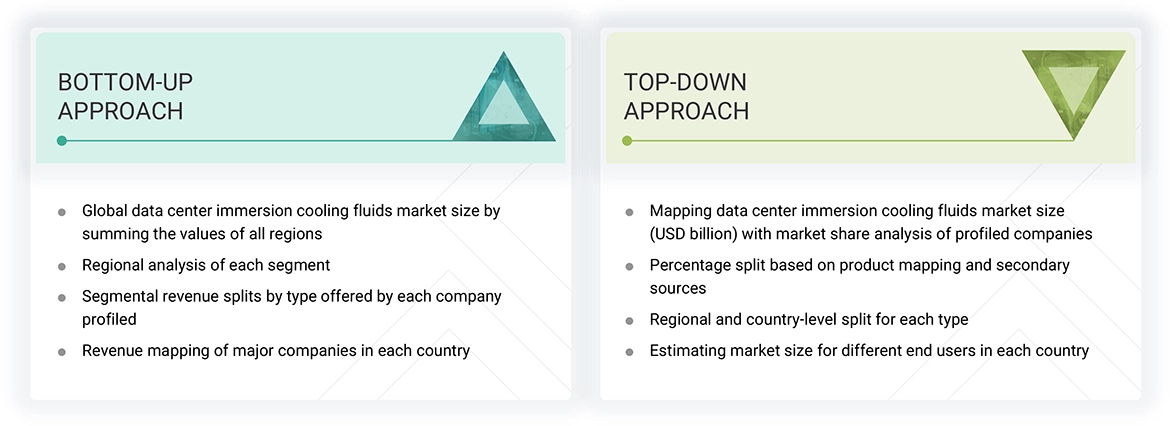
The top-down and bottom-up approaches have been used to estimate and validate the total size of the data center immersion cooling fluids market. These approaches have also been used extensively to estimate the size of various dependent market subsegments. The research methodology used to estimate the market size included the following:
The following segments provide details about the overall market size estimation process employed in this study:
- The key players in the market were identified through secondary research.
- The market shares in the respective regions were identified through primary and secondary research.
- Primary and secondary research determined the value chain and market size of the data center immersion cooling fluids market.
- All percentage shares, splits, and breakdowns were determined using secondary sources and verified through primary sources.
- All possible parameters that affect the market covered in this research study were accounted for, viewed in extensive detail, verified through primary research, and analyzed to obtain the final quantitative and qualitative data.
- The research included studying the annual and financial reports of the top market players and interviewing industry experts, such as CEOs, VPs, directors, sales managers, and marketing executives, for key insights, both quantitative and qualitative.
Global Data Center Immersion Cooling Fluids Market Size: Bottom-Up Approach and Top-Down Approach
Data Triangulation
The market was split into several segments and sub-segments after arriving at the overall market size using the market size estimation processes as explained above. To complete the overall market engineering process and arrive at the exact statistics of each market segment and subsegment, the data triangulation and market breakdown procedures were employed, wherever applicable. The data was triangulated by studying various factors and trends from both the demand and supply sides in the oil & gas sector.
Market Definition
An immersion cooling fluid dielectric is an electrically non-conducting fluid with a very high electric breakdown resistance at even high voltages. Mineral, fluorocarbon, synthetic, silicone, bio-oil, vegetable, and deionized water are dielectric fluids in immersion cooling systems. Immersion cooling is a thermal management process widely used as a cooling practice in various kinds of equipment, such as transformers, data centers, and EV batteries. Such equipment is submerged in a thermally conducting but electrically insulating dielectric fluid. Such dielectric fluids may directly contact components, transferring heat directly from the source more effectively than indirect cooling mechanisms such as air cooling, cold plates, and heat sinks. Low pour points of such dielectric fluids offer optimum thermal performance. Bio-based oils can restrict fire hazards and are non-toxic and readily biodegradable, thereby minimizing environmental footprints.
Stakeholders
- Manufacturers of immersion cooling fluids
- Traders, distributors, and suppliers of immersion cooling fluids
- OEMs
- Associations and industrial bodies
- Research and consulting firms
- R&D institutions
- Investment banks and private equity firms
- Manufacturers in end-use industries
Report Objectives
- To define, describe, and forecast the global data center immersion cooling fluids market based on technology, type, end-use, and region
- To provide detailed information regarding major factors influencing the growth of the market (drivers, restraints, opportunities, and challenges)
- To strategically analyze micromarkets concerning individual growth trends, prospects, and contributions to the total market
- To forecast the market size concerning five central regions, namely, North America, Europe, Asia Pacific, the Middle East & Africa, and Latin America
- To track and analyze competitive developments such as joint ventures, mergers & acquisitions, product launches, and research & development (R&D) activities in the data center immersion cooling fluids market
- To strategically profile the key market players and comprehensively analyze their core competencies
Get the Full Data Center Immersion Cooling Fluids Market Report
Full forecast, segment splits, and company analysis for all Data Center Immersion Cooling Fluids Market.
- China Data Center Immersion Cooling Fluids Market
- India Data Center Immersion Cooling Fluids Market
- Japan Data Center Immersion Cooling Fluids Market
- South Korea Data Center Immersion Cooling Fluids Market
- Malaysia Data Center Immersion Cooling Fluids Market
- Germany Data Center Immersion Cooling Fluids Market
- UK Data Center Immersion Cooling Fluids Market
- France Data Center Immersion Cooling Fluids Market
- Spain Data Center Immersion Cooling Fluids Market
- Russia Data Center Immersion Cooling Fluids Market
- Italy Data Center Immersion Cooling Fluids Market
- Turkey Data Center Immersion Cooling Fluids Market
- Saudi Arabia Data Center Immersion Cooling Fluids Market
- US Data Center Immersion Cooling Fluids Market
- Canada Data Center Immersion Cooling Fluids Market
- Mexico Data Center Immersion Cooling Fluids Market
Need a Tailored Report?
Customize this report to your needs
Get 10% FREE Customization
Customize This Report
