
South America Data Center Plastic Pipes Market (2026-2031)

The South America Data Center Plastic Pipes Market was valued at $47.2 Million in 2026 and projected to reach to $105.4 Million by 2031, representing a compound annual growth rate of 14.3%. South America's data center plastic pipes market is positioned for sustained growth as the region continues to invest heavily in digital infrastructure and cloud computing capabilities.


| Market Size in | USD 26.32 MN |
| Market Forecast in | |
| CAGR | |
| Forecast Period | |
| Units Considered | Value (USD MN) |
South America Data Center Plastic Pipes Market Trends and Insights
- This 14.3% compound annual growth rate reflects South America's accelerating digital infrastructure investments and the region's increasing adoption of advanced cooling and fluid management systems in data centers.
- South America's market growth is driven by rising cloud computing demand, expanding hyperscale facility deployments, and the cost-effectiveness of plastic piping solutions compared to traditional materials. The forecast period through 2031 demonstrates South America's strategic importance in the global data center ecosystem.
- South America's plastic pipes market benefits from regional economic recovery, foreign direct investment in technology infrastructure, and the region's competitive advantages in hosting data centers.
- Key markets within South America are witnessing heightened competition among suppliers, with emphasis on corrosion-resistant materials and sustainable manufacturing practices that align with environmental regulations..
Key Market Statistics
- CAGR (2026-2031) 14.3% CAGR
- Market Size, 2026 ~USD 47.2 Million
- Forecast, 2031 ~USD 105.4 Million
- Geography South America
South America Data Center Plastic Pipes Market Overview
Strong Regional Growth Trajectory :
South America's data center plastic pipes market is expanding at 14.3% CAGR, significantly outpacing many mature markets. The region is projected to grow from $47.2 million in 2026 to $105.4 million by 2031, driven by increasing cloud infrastructure investments and digital transformation initiatives across the continent.
Brazil Leads Market Expansion :
Brazil dominates South America's market with $54.7 million in current valuation, representing the largest data center infrastructure investments in the region. The country's growing tech ecosystem and multinational data center operations are primary growth catalysts for plastic pipe adoption.
Cooling System Modernization :
South American data centers are increasingly adopting advanced liquid cooling and thermal management systems, driving demand for specialized plastic piping solutions. This shift reflects the region's commitment to energy-efficient infrastructure and reduced operational costs.
Emerging Market Opportunities :
Argentina and other developing South American economies present untapped growth potential as digital infrastructure investments accelerate. Rising internet penetration and e-commerce expansion are creating new data center development opportunities across the region.
South America Data Center Plastic Pipes Market Dynamics
- The 14.3% CAGR reflects growing demand from hyperscale data center operators and regional technology companies seeking reliable, cost-effective fluid management solutions.
- Brazil's market leadership combined with emerging opportunities in Argentina and other nations suggests a diversifying customer base. Looking ahead to 2031, South America's market expansion will be fueled by increasing data localization requirements, rising adoption of AI and machine learning applications, and the region's strategic importance as a secondary hub for global cloud providers.
- Investment in sustainable cooling technologies and compliance with environmental regulations will further drive plastic pipe adoption, positioning South America as a high-growth market within the global data center infrastructure landscape..
Market Ecosystem

DATA CENTER PLASTIC PIPES MARKET: COMMERCIAL USE CASES ACROSS INDUSTRIES
| COMPANY | USE CASE DESCRIPTION | BENEFITS |
|---|---|---|
 |
The company develops piping systems for chilled water distribution and liquid-cooling systems for high-density data center spaces. The systems operate in primary and secondary cooling loops to establish controlled fluid movement throughout their entire system. The solutions become part of both modular data center projects and large-scale data center construction initiatives. The systems enable proper thermal management for essential computing operations in vital mission-critical facilities. | The system improves cooling efficiency while maintaining constant fluid movement throughout its network infrastructure. The system provides better protection against corrosion and scaling for its entire operational lifespan. The system decreases maintenance needs while maintaining essential infrastructure operation. The system extends the operational life of its cooling distribution systems. |
 |
The company provides polypropylene-random (PP-R) piping systems for chilled water distribution and liquid-cooling applications in data centers. Its piping solutions support cooling water transport between cooling plants, cooling distribution units (CDUs), and IT equipment in both traditional and high-density computing environments. | The system improves cooling system reliability through corrosion-free water distribution and consistent flow performance. The lightweight construction reduces installation complexity and project timelines compared with conventional metal piping systems. |
 |
The company provides thermoplastic piping systems which support data center cooling systems that operate with both chilled water and glycol-based systems used in closed loop liquid cooling environments. The systems operate throughout modern data centers to support cooling, drainage and fluid transport functions. | The system provides piping solutions that resist corrosion and maintain light weight, which results in better installation speed and longer system reliability. The system improves leak security through its advanced containment system and monitoring system, which decreases maintenance expenses while keeping cooling systems operational. |
 |
The company manufactures advanced composite and thermoplastic piping systems used in large-scale cooling water networks for data centers. Its solutions are applied in chilled water distribution, district cooling connections, and cooling infrastructure supporting hyperscale and AI-focused facilities. | The system provides high corrosion resistance and durability in continuous cooling operations. Its lightweight design simplifies transportation, handling, and installation, helping reduce construction costs and schedules. |
 |
The company provides high-purity piping systems and valves and flow control solutions, which prove essential for chilled water and liquid cooling systems used in data centers. The systems control fluid flow and support temperature control while enabling both standard and modern cooling systems to function properly. | The system provides accurate flow regulation together with heat distribution control, which results in better cooling performance and protects essential systems from overheating. The system achieves improved protection measures through its ability to distribute fluids in a dependable and efficient manner, which decreases operational interruptions and maintains system functionality. |
Logos and trademarks shown above are the property of their respective owners. Their use here is for informational and illustrative purposes only.
Related Ecosystem
Equipment Machine And Tooling
- Wastewater Treatment
- Air Cooled Heat Exchangers
- Diaphragm Pumps
- Fiberglass
- HVAC System
- Alfa Laval Corporate AB
- Johnson Controls International plc
- Daikin Industries,Ltd.
- Veolia
- Carrier Global Corporation
Key Takeaways
- South America's data center plastic pipes market will more than double from $47.2M (2026) to $105.4M (2031), representing a 14.3% CAGR.
- South America's market growth is fueled by expanding hyperscale data center deployments and increased cloud infrastructure investments across the region.
- South America demonstrates strong demand for cost-effective, corrosion-resistant plastic piping solutions in cooling and fluid management applications.
- South America's regulatory environment and sustainability focus are driving adoption of environmentally compliant plastic pipe materials among data center operators.
Data Center Plastic Pipes Market Report Scope
| Report Metric | Details |
|---|---|
| Base Year | 2026 |
| Fastest Growing Segment | PEX (CROSS-LINKED POLYETHYLENE) (Pipe Material) |
| Forecast Period | 2026-2031 |
| Growth Rate | CAGR of 21.2% from 2026 to 2031 |
| Largest Segment | COOLING SYSTEMS (Applications) |
| Market Size Base Year (Billions) | ~USD 2.06 (2026) |
| Revenue Forecast (Billions) | ~USD 5.39 (2031) |
| Segments Covered | Pipe Type, Pipe Material, Data Center Type, Applications, Application |
South America Data Center Plastic Pipes Market Report Segmentation
5 segment dimensions are covered across the global market.
By Pipe Type
- Flexible Pipes
- Pre-Insulated
- Pre-Insulated Pipes
- Rigid
- Rigid Pipes
By Pipe Material
- Hdpe
- Hdpe (High-Density Polyethylene)
- Other Materials
- Others (Abs, Pe, Etc)
- Pex
- Pex (Cross-Linked Polyethylene)
- Polyvinyl Chloride Pvc (Upvc, Cpvc)
- Pp
- Pp (Polypropylene)
- Pvc (Upvc, Cpvc)
By Data Center Type
- Colocation Data Centers
- Enterprise Data Centers
- Hyperscale Data Centers
By Applications
- Cooling Systems
- Drainage And Waste
- Fire Suppression
- Fuel Supply
- Other Applications
By Application
- Cooling Systems
- Drainage And Waste
- Fire Suppression
- Fuel Supply
Target Audience
- Data Center Operators & Facility Managers : South American data center operators need market intelligence on plastic piping solutions to optimize cooling systems, reduce operational costs, and meet growing capacity demands. This report provides specifications, supplier options, and regional best practices.
- Plastic Pipe Manufacturers & Suppliers : Manufacturers seeking to expand into South America require detailed market sizing, growth forecasts, and competitive positioning data. Understand regional demand drivers, customer preferences, and distribution channels specific to data center applications.
- System Integrators & Engineering Firms : Regional engineering and integration companies need comprehensive market data to identify opportunities, develop service offerings, and support data center clients. Gain insights into emerging technologies and regional infrastructure trends.
- Investment & Private Equity Firms : Investors evaluating opportunities in South America's data center infrastructure sector require market validation and growth projections. This report provides financial forecasts and market dynamics to support investment decisions and portfolio strategy.
- Government & Policy Makers : Regional government agencies and infrastructure planners need market intelligence to support digital economy initiatives and data center development policies. Understand investment trends and infrastructure requirements for South America's growing tech sector.
Countries within South America - compare and drill down
| Country | 2025 size (native) |
|---|---|
| Brazil | USD 54.7 Million |
| Argentina | USD 9.5 Million |
| Rest Of South America | USD 41.1 Million |
Country market size visualization
Reasons to Buy this Report
- Regional Market Penetration Strategy : Gain detailed insights into South America's specific market dynamics, including country-level breakdowns for Brazil and Argentina. Identify high-growth segments and develop targeted go-to-market strategies for the region's expanding data center sector.
- Competitive Landscape Analysis : Understand regional competitors, market consolidation trends, and emerging players in South America's plastic pipes market. Benchmark your offerings against regional leaders and identify partnership opportunities with local distributors and integrators.
- Investment Decision Support : Make informed capital allocation decisions with comprehensive market sizing and growth projections through 2031. Evaluate South America's attractiveness relative to other regions and prioritize expansion investments in high-potential markets like Brazil.
- Customer Demand Insights : Access detailed analysis of South American data center operators' specific requirements for cooling systems, fluid management, and sustainability. Tailor product development and marketing messaging to regional preferences and regulatory requirements.
- Risk Mitigation & Forecasting : Leverage regional economic indicators, infrastructure investment trends, and technology adoption patterns to forecast demand and mitigate market entry risks. Understand regulatory environments and growth drivers specific to South American markets.
Frequently asked questions
What is the current size of South America's data center plastic pipes market?
South America's data center plastic pipes market is valued at $47.2 million in 2026 and is expected to grow to $105.4 million by 2031.
What is the projected growth rate for South America's market through 2031?
South America's data center plastic pipes market is projected to grow at a compound annual growth rate (CAGR) of 14.3% from 2026 to 2031.
What factors are driving growth in South America's data center plastic pipes market?
South America's market growth is driven by increasing cloud computing adoption, hyperscale data center expansion, cost advantages of plastic piping, and rising foreign direct investment in technology infrastructure.
Which applications dominate South America's data center plastic pipes market?
South America's market is primarily driven by cooling systems, fluid management, and thermal distribution applications within modern data center facilities.
How does South America's market compare to global trends?
While the global data center plastic pipes market grows at 21.2% CAGR, South America's 14.3% growth rate reflects the region's developing infrastructure maturity and emerging market dynamics relative to established markets.
RESEARCH METHODOLOGY
The study involved four major activities in estimating the current size of the data center plastic pipes market. Exhaustive secondary research was done to collect information on the market, peer markets, and parent market. The next step was to validate these findings, assumptions, and sizing with the industry experts across the Data center plastic pipes value chain through primary research. Both top-down and bottom-up approaches were employed to estimate the complete market size. Thereafter, market breakdown and data triangulation were used to estimate the market size of segments and subsegments.
Secondary Research
Secondary sources for this research study include annual reports, press releases, and investor presentations of companies; white papers; certified publications; articles by recognized authors; gold- and silver-standard websites; data center plastic pipe manufacturing companies; regulatory bodies; trade directories; and databases. The secondary research was mainly used to obtain key information about the industry’s supply chain, the total pool of key players, market classification, and segmentation according to industry trends to the bottom-most level and regional markets. It has also been used to obtain information about key developments from a market-oriented perspective.
Primary Research
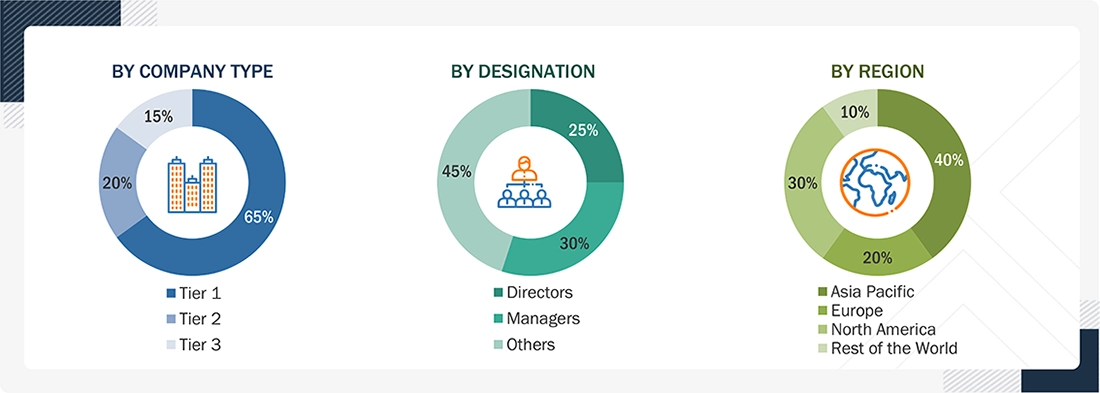
The data center plastic pipes market comprises several stakeholders, such as raw material suppliers, technology support providers, lithium-ion battery recyclers, and regulatory organizations, in the supply chain. Various primary sources from both the supply and demand sides of the market were interviewed to obtain qualitative and quantitative information. Primary sources from the supply side included industry experts such as chief executive officers (CEOs), vice presidents, marketing directors, technology and innovation directors, and related key executives from various key companies and organizations operating in the Data center plastic pipes market. Primary sources from the demand side included directors, marketing heads, and purchase managers from various sourcing industries. Following is the breakdown of the primary respondents:
To know about the assumptions considered for the study, download the pdf brochure
Market Size Estimation
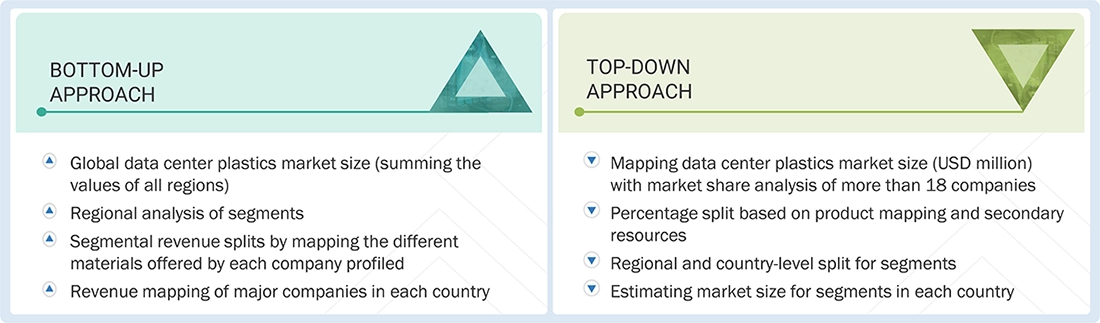
The top-down and bottom-up approaches were employed to estimate and validate the total size of the data center plastic pipes market. These approaches have also been used extensively to estimate the size of various dependent market subsegments. The research methodology used to estimate the market size included the following:
The following segments provide details about the overall market size estimation process employed in this study:
- Extensive primary and secondary research was done to identify the key players.
- The value chain and market size of the data center plastic pipes market, in terms of value, were determined through primary and secondary research.
- All percentage shares, splits, and breakdowns were collected through secondary sources and verified through primary sources.
- All possible parameters that affect the market were covered in this research study and were viewed in extensive detail, verified through primary research, and analyzed to obtain the final quantitative and qualitative data.
- The study of reports, reviews, and newsletters of top market players, along with extensive interviews for opinions from key leaders, such as CEOs, directors, and marketing executives, is included in this research.
Data Center Plastic Pipes Market : Top-Down and Bottom-Up Approach
Data Triangulation
After arriving at the overall market size using the market size estimation processes as explained above, the market was split into several segments and sub-segments. To complete the overall market engineering process and arrive at the exact statistics of each market segment and subsegment, the data triangulation and market breakdown procedures were employed, wherever applicable. The data was triangulated by studying various factors and trends from both the demand and supply sides.
Market Definition
Data center plastic pipes are specialized piping systems used to transport cooling fluids, chilled water, condensate, and other utility media essential for maintaining optimal operating conditions within data center facilities. Manufactured from materials such as PVC, HDPE, PP, and PEX, these pipes are valued for their durability, chemical resistance, lightweight properties, and ability to support efficient thermal management systems. The future growth of the market is expected to be driven by the accelerating deployment of artificial intelligence (AI) workloads, increasing demand for high-performance computing infrastructure, and the expansion of hyperscale data centers worldwide. Furthermore, the transition toward liquid cooling technologies, growing investments in sustainable and energy-efficient facilities, and the rising need for reliable infrastructure capable of supporting higher rack power densities are anticipated to create significant opportunities for plastic pipe adoption in the coming years.
Key Stakeholders
- Data Center Plastic Pipe Manufacturers, Processors, and Recycling Technology Providers
- Research Institutions, Standards Organizations, and Regulatory Agencies such as ASTM, EDQM, and Others
- NGOs, Governments, Investment Banks, Venture Capitalists, and Private Equity Firms
Report Objectives
- To define, describe, and forecast the market size of data center plastic pipes, in terms of value and volume.
- To provide detailed information regarding the key factors, such as drivers, restraints, opportunities, and industry-specific challenges, influencing the growth of the market
- To analyze and forecast the global market on the basis of type, Application, material, and region
- To analyze the opportunities in the market for stakeholders and provide details of a competitive landscape for market leaders
- To forecast the size of various market segments based on five major regions, North America, Asia Pacific, Europe, the Middle East & Africa, and South America, along with their respective key countries
- To track and analyze the competitive developments, such as acquisitions, partnerships, collaborations, agreements and expansions in the market
- To strategically profile the key players and comprehensively analyze their market shares and core competencies
Available customizations:
With the given market data, MarketsandMarkets offers customizations according to the client-specific needs.
The following customization options are available for the report:
? Additional country-level analysis of the data center plastic pipes market
? Profiling of additional market players (up to five)
Product Analysis
-
Product matrix, which provides a detailed comparison of each company's product portfolio.
Get the Full Data Center Plastic Pipes Market Report
Full forecast, segment splits, and company analysis for all Data Center Plastic Pipes Market.
- US Data Center Plastic Pipes Market
- Canada Data Center Plastic Pipes Market
- Mexico Data Center Plastic Pipes Market
- Germany Data Center Plastic Pipes Market
- UK Data Center Plastic Pipes Market
- France Data Center Plastic Pipes Market
- Italy Data Center Plastic Pipes Market
- Russia Data Center Plastic Pipes Market
- Netherlands Data Center Plastic Pipes Market
- Spain Data Center Plastic Pipes Market
- China Data Center Plastic Pipes Market
- Japan Data Center Plastic Pipes Market
- India Data Center Plastic Pipes Market
- South Korea Data Center Plastic Pipes Market
- Thailand Data Center Plastic Pipes Market
- Indonesia Data Center Plastic Pipes Market
- Australia Data Center Plastic Pipes Market
- Saudi Arabia Data Center Plastic Pipes Market
- UAE Data Center Plastic Pipes Market
- South Africa Data Center Plastic Pipes Market
- Brazil Data Center Plastic Pipes Market
- Argentina Data Center Plastic Pipes Market
- Rest Of Europe Data Center Plastic Pipes Market
- Rest Of Asia Pacific Data Center Plastic Pipes Market
- Rest Of GCC Countries Data Center Plastic Pipes Market
- Rest Of South America Data Center Plastic Pipes Market
Need a Tailored Report?
Customize this report to your needs
Get 10% FREE Customization
Customize This Report
