
Canada Data Center Plastics Market (2026-2031)

The Canada Data Center Plastics Market was valued at $44.8 Million in 2026 and projected to reach to $111.2 Million by 2031, representing a compound annual growth rate of 16.3%. Canada's data center plastics market is positioned for exceptional growth through 2031, driven by substantial investments in cloud infrastructure, artificial intelligence capabilities, and edge computing networks.


| Market Size in | USD 26.32 MN |
| Market Forecast in | |
| CAGR | |
| Forecast Period | |
| Units Considered | Value (USD MN) |
Canada Data Center Plastics Market Trends and Insights
- This represents a compound annual growth rate of 16.3%, significantly outpacing global trends.
- Canada's strategic position as a North American technology hub, combined with increasing investments in cloud infrastructure and edge computing facilities, is driving demand for specialized plastic materials used in cooling systems, cable management, and structural components within data centers. The Canadian market benefits from the country's abundant hydroelectric power, favorable regulatory environment, and proximity to major U.S.
- markets, attracting substantial data center development.
- Between 2026 and 2031, Canada is expected to see accelerated adoption of advanced plastic polymers and composites that enhance thermal management and sustainability in data center operations.
- This growth trajectory reflects Canada's commitment to supporting digital infrastructure while maintaining environmental standards, positioning the nation as a key player in the North American data center plastics supply chain..
Key Market Statistics
- CAGR (2026-2031) 16.3% CAGR
- Market Size, 2026 ~USD 44.8 Million
- Forecast, 2031 ~USD 111.2 Million
- Country Canada
Canada Data Center Plastics Market Overview
Exceptional Growth Trajectory :
Canada's data center plastics market is expanding at 16.3% CAGR, outpacing the global rate of 14.5%, driven by accelerating digital infrastructure investments across the country.
North American Tech Hub Status :
Canada's strategic position as a leading North American technology center attracts major cloud providers and hyperscalers, fueling demand for advanced plastic materials in data center construction and operations.
Cloud & Edge Computing Surge :
Rapid expansion of cloud infrastructure and edge computing facilities across Canadian provinces is creating sustained demand for high-performance plastics in cooling systems, cable management, and structural components.
Market Valuation Growth :
The Canadian market is valued at $44.8 million in 2026 and projected to reach $111.2 million by 2031, representing a 148% increase over the five-year forecast period.
Canada Data Center Plastics Market Dynamics
- The country's competitive advantages—including proximity to major U.S.
- markets, reliable power infrastructure, and favorable regulatory environment—continue to attract global technology companies establishing or expanding data center operations.
- This infrastructure buildout directly translates to increased consumption of specialized plastics for thermal management, electrical insulation, and structural applications.
- Regional players and international suppliers are capitalizing on this momentum by developing Canada-specific solutions tailored to local climate conditions and regulatory requirements, further accelerating market penetration and innovation..
Market Ecosystem
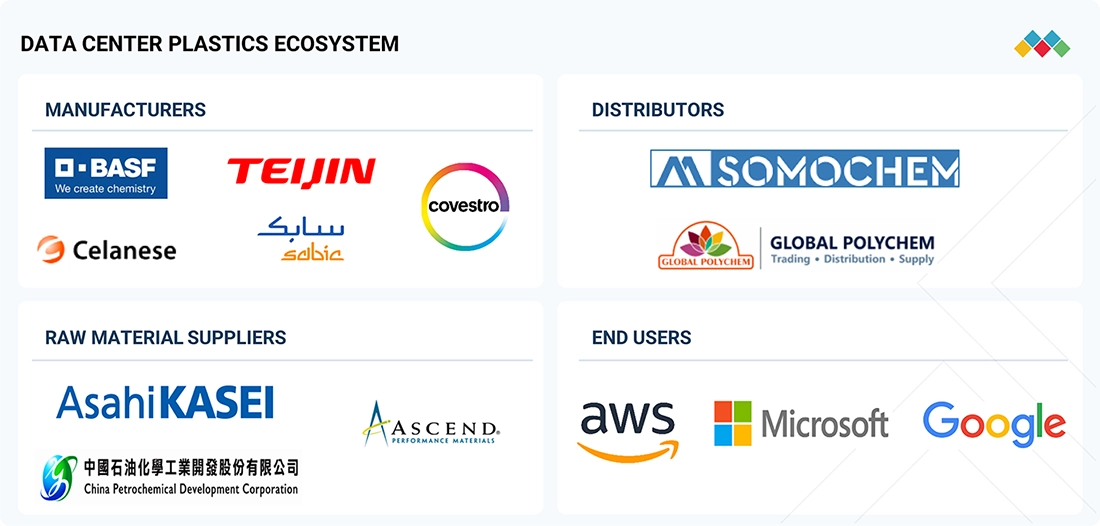
DATA CENTER PLASTICS MARKET: COMMERCIAL USE CASES ACROSS INDUSTRIES
| COMPANY | USE CASE DESCRIPTION | BENEFITS |
|---|---|---|
 |
Supplies LEXAN polycarbonate, CYCOLOY PC/ABS, and specialty engineering thermoplastics for data center server enclosures, rack components, cable management systems, power distribution units (PDUs), connectors, switchgear housings, and electrical infrastructure | Supports high-performance plastics for cooling systems, energy distribution equipment, and network hardware applications | Provides high impact strength and thermal stability for mission-critical infrastructure | Enhances flame retardancy and electrical safety compliance | Reduces equipment weight while maintaining durability | Supports reliable operation in high-temperature, high-density computing environments |
 |
Supplies engineering plastics such as Ultramid, Ultradur, and Ultrason for electrical connectors, cable management systems, switchgear, circuit breakers, terminal blocks, power distribution equipment, and data center electrical infrastructure | Supports molded components used in networking, control systems, and power management applications | Improves electrical insulation and flame-retardant performance | Enhances dimensional stability and mechanical strength under thermal stress | Supports reliable power distribution and protection systems | Contributes to long-term operational safety and infrastructure reliability |
 |
Manufactures engineered thermoplastics, including polyamide, PBT, and specialty compounds for connectors, cable assemblies, power management components, cooling system parts, and electronic housings used in data center infrastructure | Supplies materials for high-performance electrical and networking applications | Delivers heat resistance and dimensional stability | Enhances durability in continuous-operation environments | Improves electrical performance and mechanical reliability |
 |
Produces ABS, PC/ABS, polycarbonate, and engineering plastics used in server housings, network equipment enclosures, electrical cabinets, cable management products, and cooling system components | Supports manufacturers of electronic and power infrastructure equipment serving hyperscale and enterprise data centers | Provides strong impact resistance and processability | Supports lightweight and durable equipment designs | Enhances fire safety and thermal performance | Improves longevity and reliability of critical infrastructure components |
 |
Supplies Makrolon polycarbonate and advanced engineering materials for AI data center power distribution units, switchgear, controllers, sensors, server components, storage systems, cooling controls, and transparent monitoring panels | Supports thermal management and low-carbon infrastructure initiatives | Offers excellent flame retardancy and heat resistance | Improves dimensional stability near high-temperature zones | Supports efficient thermal management and equipment protection | Enables lightweight, durable, and sustainable data center designs with reduced carbon footprint |
Logos and trademarks shown above are the property of their respective owners. Their use here is for informational and illustrative purposes only.
Related Ecosystem
Equipment Machine And Tooling
- Wastewater Treatment
- Air Cooled Heat Exchangers
- Diaphragm Pumps
- Fiberglass
- HVAC System
- Alfa Laval Corporate AB
- Johnson Controls International plc
- Daikin Industries,Ltd.
- Veolia
- Carrier Global Corporation
Key Takeaways
- Canada's data center plastics market will grow from $44.8M (2026) to $111.2M (2031) at a 16.3% CAGR, outpacing global growth rates.
- Canada's competitive advantages in renewable energy and regulatory framework are attracting major data center investments that drive plastic material demand.
- Advanced thermal management plastics and sustainable polymer solutions are becoming critical differentiators in Canada's data center infrastructure.
- Canada's proximity to U.S. markets and role in North American digital infrastructure positions it as a strategic hub for data center plastics innovation.
Data Center Plastics Market Report Scope
| Report Metric | Details |
|---|---|
| Base Year | 2026 |
| Fastest Growing Segment | PLASTIC PIPE & OTHERS (Application) |
| Forecast Period | 2026-2031 |
| Growth Rate | CAGR of 14.5% from 2026 to 2031 |
| Largest Segment | INJECTION MOLDING (Processing Technology) |
| Market Size Base Year (Billions) | ~USD 1.53 (2026) |
| Revenue Forecast (Billions) | ~USD 3 (2031) |
| Segments Covered | Data Center Type, Material, Processing Technology, Application |
Canada Data Center Plastics Market Report Segmentation
4 segment dimensions are covered across the global market.
By Data Center Type
- Colocation
- Edge
- Enterprise
- Hyperscale
- Other Data Center Types
By Material
- Acrylonitrile Butadiene Styrene (Abs)
- Other Materials
- Polycarbonate (Pc)
- Polyethylene (Pe)
- Polyethylene Terephthalate (Pet)
- Polypropylene (Pp)
- Polyvinyl Chloride (Pvc)
By Processing Technology
- Extrusion
- Injection Molding
- Other Processing Technologies
By Application
- Cable & Wire Management
- Cooling & Ventilation Systems
- Plastic Pipe & Others
- Power Distribution Systems
- Structural Components
- -Busbar Insulators & Busways
- -Cable Trays
- -Conduits
- -Flooring Systems
- -Hot & Cold Aisles
- -Insulation
- -Linear Plastic Enclosures
- -Panels
- -Plastic Ducts & Louvers
- -Racks
- -Tubing
Target Audience
- Data Center Operators & Facility Managers : Need market insights to optimize material procurement strategies, evaluate supplier capabilities, and plan infrastructure upgrades aligned with Canada's rapid data center expansion.
- Plastic Material Manufacturers & Suppliers : Require detailed Canadian market data to identify growth opportunities, develop region-specific product portfolios, and establish strategic partnerships with local data center operators.
- Technology & Cloud Infrastructure Companies : Seek market intelligence on Canadian data center plastic demand to inform facility design decisions, supply chain planning, and investment strategies for North American expansion.
- Investment & Private Equity Firms : Need comprehensive market analysis to evaluate investment opportunities in Canadian data center infrastructure, material suppliers, and technology companies serving this high-growth sector.
- Consulting & Engineering Firms : Require Canada-specific market data to advise clients on data center design optimization, material selection, cost forecasting, and competitive positioning in the North American market.
Reasons to Buy this Report
- Market-Specific Growth Intelligence : Gain detailed insights into Canada's 16.3% CAGR trajectory, significantly outpacing global trends, enabling strategic investment and expansion decisions tailored to this high-growth market.
- Competitive Landscape Analysis : Understand Canadian market dynamics, local supplier ecosystems, and competitive positioning specific to data center plastic applications across provinces and major technology hubs.
- Infrastructure Investment Tracking : Access comprehensive data on cloud infrastructure and edge computing facility expansions across Canada, identifying key growth drivers and investment opportunities in plastic material demand.
- Regulatory & Regional Compliance : Navigate Canada-specific regulatory requirements, environmental standards, and regional preferences for plastic materials in data center applications with localized market intelligence.
- Forecast-Driven Strategic Planning : Leverage precise 2026-2031 market projections ($44.8M to $111.2M) to develop long-term supply chain strategies, capacity planning, and market entry initiatives for Canadian operations.
Frequently asked questions
What is the current size of Canada's data center plastics market?
Canada's data center plastics market is valued at $44.8 million in 2026 and is expected to grow to $111.2 million by 2031.
What is the growth rate for Canada's data center plastics market?
Canada's data center plastics market is growing at a compound annual growth rate (CAGR) of 16.3% from 2026 to 2031.
What factors are driving growth in Canada's data center plastics market?
Key drivers include increased cloud infrastructure investments, edge computing expansion, Canada's renewable energy advantages, favorable regulatory environment, and proximity to major U.S. markets.
Which plastic materials are most in demand in Canada's data center sector?
Advanced thermal management polymers, cable management systems, cooling solution components, and sustainable composite materials are experiencing the highest demand in Canada's data centers.
How does Canada's market growth compare to global trends?
Canada's 16.3% CAGR significantly exceeds the global data center plastics market CAGR of 14.5%, reflecting Canada's accelerated data center development and infrastructure investments.
RESEARCH METHODOLOGY
The study involved four major activities in estimating the current size of the data center plastics market. Exhaustive secondary research was done to collect information on the market, peer markets, and parent market. The next step was to validate these findings, assumptions, and sizing with the industry experts across the data center plastics value chain through primary research. Both top-down and bottom-up approaches were employed to estimate the complete market size. Thereafter, market breakdown and data triangulation were used to estimate the market size of segments and subsegments.
Secondary Research
Secondary sources for this research study include annual reports, press releases, and investor presentations of companies; white papers; certified publications; and articles by recognized authors; gold- and silver-standard websites; data center plastics manufacturing companies, regulatory bodies, trade directories, and databases. The secondary research was mainly used to obtain key information about the industry’s supply chain, the total pool of key players, market classification, and segmentation according to industry trends to the bottom-most level and regional markets. It has also been used to obtain information about key developments from a market-oriented perspective.
Primary Research
The data center plastics market comprises several stakeholders, such as raw material suppliers, technology support providers, data center plastic manufacturers, and regulatory organizations in the supply chain. Various primary sources from both the supply and demand sides of the market were interviewed to obtain qualitative and quantitative information. Primary sources from the supply side included industry experts such as Chief Executive Officers (CEOs), vice presidents, marketing directors, technology and innovation directors, and related key executives from various key companies and organizations operating in the data center plastics market. Primary sources from the demand side included directors, marketing heads, and purchase managers from various sourcing industries. The following is the breakdown of the primary respondents:
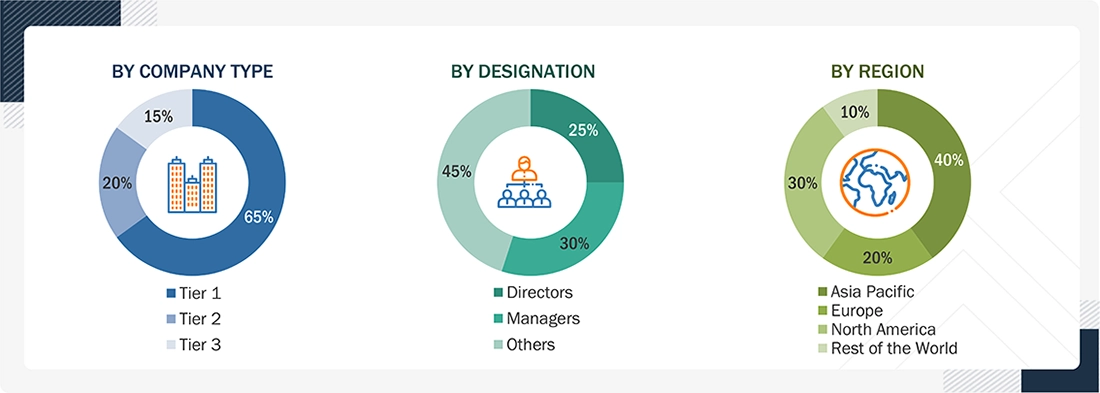
To know about the assumptions considered for the study, download the pdf brochure
Market Size Estimation
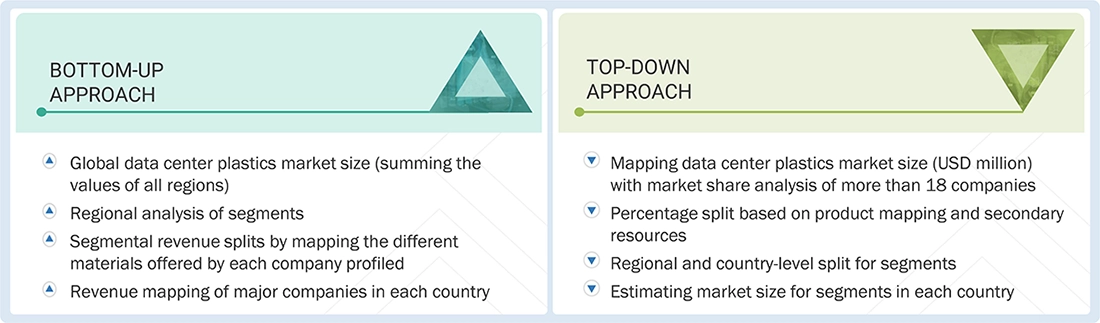
The top-down and bottom-up approaches have been employed to estimate and validate the total size of the data center plastics market. These approaches have also been used extensively to estimate the size of various dependent market subsegments. The research methodology used to estimate the market size included the following:
The following segments provide details about the overall market size estimation process employed in this study:
- Extensive primary and secondary research was done to identify the key players.
- The value chain and market size of the data center plastics market, in terms of value, were determined through primary and secondary research.
- All percentage shares, splits, and breakdowns were collected through secondary sources and verified through primary sources.
- All possible parameters that affect the market were covered in this research study and are viewed in extensive detail, verified through primary research, and analyzed to obtain the final quantitative and qualitative data.
- The study of reports, reviews, and newsletters of top market players, along with extensive interviews for opinions from key leaders, such as CEOs, directors, and marketing executives, is included in this research.
Data Triangulation
After arriving at the overall market size using the market size estimation processes as explained above, the market was split into several segments and sub-segments. To complete the overall market engineering process and arrive at the exact statistics of each market segment and subsegment, the data triangulation and market breakdown procedures were employed, wherever applicable. The data was triangulated by studying various factors and trends from both the demand and supply sides.
Market Definition
The global data center plastics market comprises the production, consumption, and trade of plastic materials and plastic-based components used in data center construction, cooling, power distribution, and infrastructure management. Key materials include polycarbonate (PC), acrylonitrile butadiene styrene (ABS), polyvinyl chloride (PVC), and others selected for their durability, flame retardancy, electrical insulation, and lightweight properties. These materials are used in applications such as aisle containment systems, cable management, server racks, and other applications. The market serves hyperscale, colocation, enterprise, and edge data centers and is driven by growing investments in cloud computing, artificial intelligence, 5G networks, and digital infrastructure expansion worldwide.
Key Stakeholders
- Data center plastics manufacturers, processors, and recycling technology providers
- Research institutions, standards organizations, and regulatory agencies such as ASTM, ISO, and others
- NGOs, governments, investment banks, venture capitalists, and private equity firms
Report Objectives
- To define, describe, and forecast the market size of data center plastics in terms of value
- To provide detailed information regarding the key factors, such as drivers, restraints, opportunities, and industry-specific challenges, influencing the growth of the data center plastics market
- To analyze and forecast the global data center plastics market on the basis of material, type, application, processing technology, and region
- To analyze the opportunities in the market for stakeholders and provide details of a competitive landscape for market leaders
- To forecast the size of various market segments based on four major regions: North America, Asia Pacific, Europe, and Rest of the World, along with their respective key countries
- To track and analyze the competitive developments, such as product launches, expansions, and others, in the market
- To strategically profile the key players and comprehensively analyze their market shares and core competencies.
Customization Options:
With the given market data, MarketsandMarkets offers customizations according to the client-specific needs.
The following customization options are available for the report:
- Additional country-level analysis of the data center plastics market
- Profiling of additional market players (up to five)
Product Analysis
- Product matrix, which provides a detailed comparison of each company's product portfolio
Get the Full Data Center Plastics Market Report
Full forecast, segment splits, and company analysis for all Data Center Plastics Market.
- China Data Center Plastics Market
- Japan Data Center Plastics Market
- India Data Center Plastics Market
- South Korea Data Center Plastics Market
- Malaysia Data Center Plastics Market
- Australia Data Center Plastics Market
- Germany Data Center Plastics Market
- UK Data Center Plastics Market
- France Data Center Plastics Market
- Mexico Data Center Plastics Market
- US Data Center Plastics Market
- Rest Of Europe Data Center Plastics Market
- Rest Of Asia Pacific Data Center Plastics Market
- South America Data Center Plastics Market
Need a Tailored Report?
Customize this report to your needs
Get 10% FREE Customization
Customize This Report
