
Japan Data Security Market (2026-2031)

The Japan Data Security Market was valued at $1827.9 Million in 2026 and projected to reach to $3155 Million by 2031, representing a compound annual growth rate of 11.5%. Japan's data security market is poised for sustained expansion driven by digital transformation initiatives and stringent regulatory frameworks.


| Market Size in | USD 26.32 MN |
| Market Forecast in | |
| CAGR | |
| Forecast Period | |
| Units Considered | Value (USD MN) |
Japan Data Security Market Trends and Insights
- This expansion reflects Japan's increasing digital transformation initiatives and heightened regulatory compliance requirements across enterprises.
- Japan faces mounting cybersecurity threats that are driving organizations to invest heavily in advanced data protection solutions and infrastructure security measures. The Japanese market benefits from strong government support for cybersecurity initiatives and a mature technology sector.
- Japan's enterprises are prioritizing data breach prevention and regulatory adherence, particularly in financial services, healthcare, and manufacturing sectors.
- Between 2026 and 2031, Japan is expected to see accelerated adoption of cloud-based security solutions and AI-driven threat detection systems as organizations modernize their security postures. Japan's competitive landscape includes both global security vendors and domestic players offering localized solutions.
- The country's emphasis on data sovereignty and privacy compliance continues to shape market dynamics, with enterprises seeking solutions that meet Japan's stringent regulatory standards and cultural preferences for data protection..
Key Market Statistics
- CAGR (2026-2031) 11.5% CAGR
- Market Size, 2026 ~USD 1827.9 Million
- Forecast, 2031 ~USD 3155 Million
- Country Japan
Japan Data Security Market Overview
Market Valuation Growth :
Japan's data security market is valued at $1,827.9 million in 2026 and is projected to reach $3,155.0 million by 2031, representing a robust 11.5% CAGR over the forecast period.
Digital Transformation Catalyst :
Japan's accelerating digital transformation initiatives across enterprises are driving substantial investments in data security solutions to protect critical business assets and customer information.
Regulatory Compliance Pressure :
Heightened regulatory compliance requirements, including Japan's Act on Protection of Personal Information (APPI) and industry-specific mandates, are compelling organizations to strengthen their data security posture.
Rising Cybersecurity Threats :
Japan faces mounting cybersecurity threats targeting enterprises across sectors, prompting organizations to invest heavily in advanced data security technologies and managed security services.
Japan Data Security Market Dynamics
- Organizations across manufacturing, finance, healthcare, and technology sectors are prioritizing data protection investments to mitigate evolving cyber threats and ensure compliance with APPI and sector-specific regulations.
- The market will benefit from increased adoption of cloud-based security solutions, AI-powered threat detection, and managed security services as enterprises modernize their infrastructure. The forecast period through 2031 will see accelerated growth as Japanese enterprises recognize data security as a strategic business imperative.
- Government initiatives promoting cybersecurity awareness, combined with rising incidents of data breaches and ransomware attacks, will drive demand for comprehensive security solutions.
- Investment in advanced technologies and skilled security personnel will remain critical for organizations seeking to maintain competitive advantage and customer trust in Japan's increasingly digital economy..
Market Ecosystem

DATA SECURITY MARKET: COMMERCIAL USE CASES ACROSS INDUSTRIES
| COMPANY | USE CASE DESCRIPTION | BENEFITS |
|---|---|---|
 |
Protegrity implemented a customized data security platform integrating database and application protection with attribute-based access controls to secure sensitive insurance information across on-premises systems and planned cloud migration. | Enabled HIPAA and NACHA compliance, supported secure external data sharing, protected $12 billion in revenue, and delivered $100 million in annual operational cost savings through customized data protection. |
 |
Bethany Children’s Health Center adopted Cohesity to centralize backup management, protect patient information, and improve data recovery across healthcare systems facing cyberattacks and operational disruptions. | Simplified data restoration, strengthened ransomware resilience through immutable backups and AI-driven threat detection, improved visibility across backup environments, and helped clinicians maintain access to critical patient information. |
 |
Syncreon deployed Commvault Cloud Autonomous Recovery across four data centers to consolidate six legacy backup products, centralize server and endpoint protection, and streamline global data management. | Saved nearly $500,000 over three years and up to $24,000 annually in cloud storage costs, while securing 2,500 laptops and improving backup management and IT productivity. |
 |
A leading construction and facilities firm implemented the Varonis Data Security Platform to classify sensitive cloud and on-premises data, monitor access, enforce retention policies, and implement least-privilege controls. | Improved data visibility and policy enforcement, reduced time required for data subject access requests, strengthened compliance, and enabled proactive incident response that helped thwart a ransomware attack. |
|
|
A multinational energy provider consolidated five disparate data protection products onto Cohesity Data Cloud, integrating threat protection, AI-powered data classification, and isolated recovery across hybrid IT environments. | Achieved 4:1 infrastructure consolidation, reduced data management time by 50%, saved nearly $7 million over three years, and strengthened ransomware recovery through immutable cloud-based backups. |
Logos and trademarks shown above are the property of their respective owners. Their use here is for informational and illustrative purposes only.
Related Ecosystem
Key Takeaways
- Japan's data security market will grow from $1,827.9M (2026) to $3,155.0M (2031) at an 11.5% CAGR.
- Japan's regulatory environment and digital transformation drive enterprise investment in advanced security solutions.
- Japan prioritizes cloud-based and AI-driven security technologies to address evolving cyber threats.
- Japan's market combines global vendors with domestic players offering localized, compliance-focused solutions.
Data Security Market Report Scope
| Report Metric | Details |
|---|---|
| Base Year | 2026 |
| Fastest Growing Segment | TRAINING AND EDUCATION (Professional Service) |
| Forecast Period | 2026-2031 |
| Growth Rate | CAGR of 11.4% from 2026 to 2031 |
| Largest Segment | SOLUTIONS (Offering) |
| Market Size Base Year (Billions) | ~USD 32.94 (2026) |
| Revenue Forecast (Billions) | ~USD 56.52 (2031) |
| Segments Covered | Offering, Solution, Service, Professional Service, Deployment Mode, Organization Size, Vertical |
Japan Data Security Market Report Segmentation
7 segment dimensions are covered across the global market.
By Offering
- Services
- Solutions
By Solution
- Data Access Control & Governance
- Data Backup And Recovery
- Data Discovery & Classification
- Data Encryption & Tokenization
- Data Loss Prevention (Dlp)
- Data Security Posture Management (Dspm)
- Other Solutions
By Service
- Managed Security Services
- Managed Services
- Professional Services
By Professional Service
- Design, Consulting & Implementation
- Risk And Threat Assessment
- Support & Maintenance
- Training And Education
By Deployment Mode
- Cloud
- Hybrid
- On-Premises
By Organization Size
- Large Enterprises
- Smes
By Vertical
- Aerospace & Defense
- Bfsi
- Energy & Utilities
- Government
- Healthcare & Life Sciences
- It & Ites
- Manufacturing
- Media & Entertainment
- Other Verticals
- Retail & Ecommerce
- Telecommunications
- Transportation & Logistics
Target Audience
- Enterprise Security Decision-Makers : CISOs and security leaders in Japan need market intelligence to justify budget allocations, evaluate vendor solutions, and align security investments with regulatory compliance and business objectives.
- Data Security Solution Providers : Software vendors and security service providers require Japan market data to assess market opportunity, identify customer segments, and develop localized product strategies for competitive entry.
- Management Consulting Firms : Consultants advising Japanese enterprises on digital transformation and risk management need market insights to provide credible recommendations and benchmark client security investments.
- Investment & Private Equity Firms : Investors evaluating cybersecurity and data protection companies targeting Japan need market forecasts and growth drivers to assess portfolio opportunities and valuation multiples.
- Government & Regulatory Bodies : Japanese policymakers and regulatory agencies benefit from market data to understand industry compliance trends, assess cybersecurity readiness, and inform national digital security strategies.
Reasons to Buy this Report
- Market Size & Growth Validation : Obtain precise valuation data for Japan's data security market with verified CAGR of 11.5%, enabling accurate financial forecasting and investment decision-making for the 2026-2031 period.
- Japan-Specific Regulatory Insights : Understand how APPI compliance and Japan-specific regulatory requirements are shaping market dynamics, helping you tailor solutions and go-to-market strategies for local enterprises.
- Competitive Positioning Strategy : Identify growth opportunities and market gaps specific to Japan's digital transformation landscape, enabling you to benchmark against competitors and optimize resource allocation.
- Sector-Specific Demand Analysis : Access detailed insights into which Japanese industries (manufacturing, finance, healthcare, technology) are driving security investments, allowing targeted sales and marketing initiatives.
- Risk Mitigation & Threat Intelligence : Leverage Japan-specific cybersecurity threat data and emerging attack patterns to develop relevant security offerings and demonstrate value to risk-conscious Japanese enterprises.
Frequently asked questions
What is the projected size of Japan's data security market in 2031?
Japan's data security market is projected to reach $3,155.0 million by 2031, growing from $1,827.9 million in 2026.
What is the CAGR for Japan's data security market?
Japan's data security market is expected to grow at a compound annual growth rate (CAGR) of 11.5% between 2026 and 2031.
What are the primary drivers of growth in Japan's data security market?
Japan's market growth is driven by digital transformation initiatives, regulatory compliance requirements, increasing cyber threats, and enterprise demand for advanced protection solutions.
Which sectors are leading data security investments in Japan?
Japan's financial services, healthcare, and manufacturing sectors are leading investments in data security solutions due to regulatory requirements and sensitivity of data assets.
What technologies are gaining traction in Japan's data security market?
Cloud-based security solutions and AI-driven threat detection systems are gaining significant traction in Japan as organizations modernize their security infrastructure.
RESEARCH METHODOLOGY
Secondary research was conducted to collect information useful for this technical, market-oriented, and commercial study of the data security market. The next step involved validating these findings, assumptions, and sizing with industry experts across the value chain using primary research. Different approaches, including top-down and bottom-up methods, were employed to estimate the total market size. After that, the market breakup and data triangulation procedures were used to estimate the market size of the segments and subsegments of the data security market.
Secondary Research
During the secondary research process, various secondary sources were consulted to identify and collect information relevant to the study. The secondary sources included annual reports, press releases, investor presentations of data security vendors, forums, certified publications, and whitepapers. The secondary research was mainly used to obtain key information about the industry's supply chain, the total pool of key players, market classification and segmentation according to industry trends to the bottom-most level, regional markets, and key developments from both market- and technology-oriented perspectives, all of which were further validated by primary sources.
Primary Research
In the primary research process, various primary sources from both the supply and demand sides were interviewed to obtain qualitative and quantitative information for this report. The primary sources from the supply side included various industry experts, including chief executive officers (CEOs), vice presidents (VPs), marketing directors, technology and innovation directors, and related key executives from various key companies and organizations operating in the data security market.
In the market engineering process, top-down and bottom-up approaches were extensively used, along with several data triangulation methods, to perform market estimation and forecasting for the overall market segments and subsegments listed in this report. Extensive qualitative and quantitative analysis was performed on the complete market engineering process to list key information/insights throughout the report.
After the complete market engineering process (including calculations for market statistics, market breakups, market size estimations, market forecasts, and data triangulation), extensive primary research was conducted to gather information and verify & validate the critical numbers arrived at. Primary research was also conducted to identify the segmentation types, industry trends, competitive landscape of data security market players, and key market dynamics, such as drivers, restraints, opportunities, challenges, industry trends, and key strategies.
Following is the breakup of the primary study:
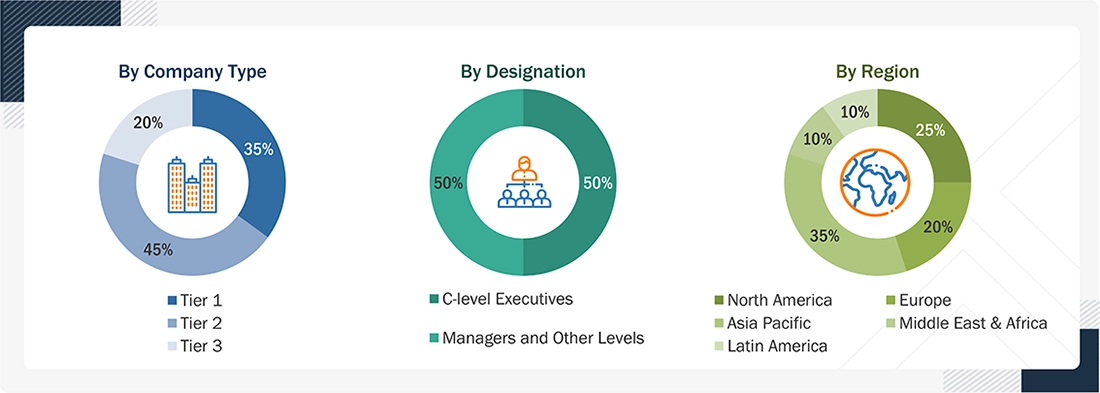
Note: Tier 1 companies receive revenues higher than USD 10 billion; Tier 2 companies' revenues range between USD 1 and 10 billion; and Tier 3 companies' revenues range between USD 500 million and USD 1 billion. Other designations include sales, marketing, and product managers.
Source: Industry Experts
To know about the assumptions considered for the study, download the pdf brochure
Market Size Estimation
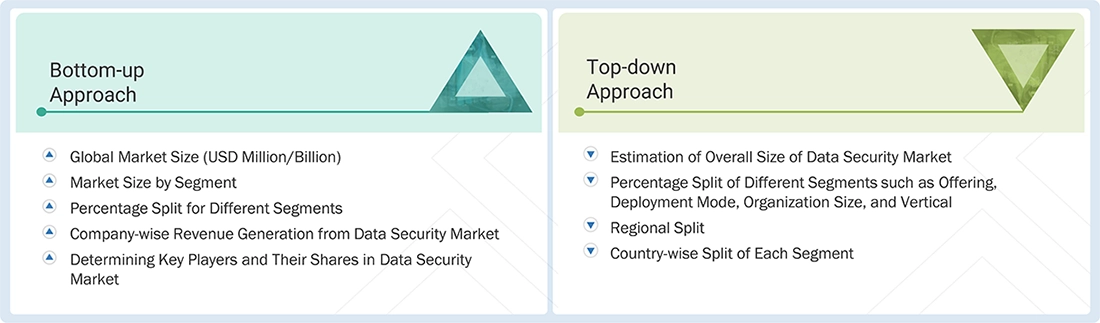
Top-down and bottom-up approaches were employed to estimate and validate the size of the data security market, as well as the size of various dependent sub-segments within the overall data security market. The research methodology used to estimate the market size includes the following details: critical players in the market were identified through secondary research, and their market shares in the respective regions were determined through primary and secondary research. This entire procedure involved studying the annual and financial reports of the top market players, and extensive interviews were conducted with key industry leaders, including CEOs, VPs, directors, and marketing executives, to gather valuable insights.
All percentage splits and breakdowns were determined using secondary sources and verified through primary sources. All possible parameters that affect the market covered in this research study were accounted for, viewed in extensive detail, verified through primary research, and analyzed to get the final quantitative and qualitative data. This data was consolidated and added to detailed inputs and analysis from MarketsandMarkets.
Data Security Market: Top-Down and Bottom-Up Approach
Data Triangulation
The market was split into several segments and subsegments after arriving at the overall market size using the market size estimation processes explained above. The data triangulation and market breakup procedures were employed, wherever applicable, to complete the overall market engineering process and arrive at the exact statistics of each market segment and subsegment. The data was triangulated by studying various factors and trends from both the demand and supply sides.
Market Definition
The data security market comprises revenues generated from hardware, software, and directly associated professional and managed services designed to protect enterprise data against unauthorized access, exposure, disclosure, leakage, modification, corruption, loss, and destruction.
Key Stakeholders
- Chief Information Officers (CIOs), Chief Technology Officers (CTOs) & Chief Information Security Officers (CISOs)
- Chief Data Officers (CDOs), Chief Privacy Officers (CPOs) & Data Governance Leaders
- Chief Risk Officers (CROs), Compliance Officers & Legal Teams
- Business Unit Leaders, Data Owners & Data Custodians
- Data Security Architects, Engineers & Information Security Teams
- Data Protection, Data Loss Prevention (DLP) & Data Classification Teams
- Database Administrators, Cloud Security Architects & IT Infrastructure Teams
- Security Operations, Incident Response & Digital Forensics Teams
- Privacy Analysts, Data Governance Specialists & Regulatory Compliance Teams
- Data Security Software, Platform & Appliance Vendors
- Data Discovery, Classification & Security Posture Management (DSPM) Providers
- Data Loss Prevention, Encryption, Tokenization & Data Masking Providers
- Database Security, Cloud Data Protection & Access Governance Providers
- Data Privacy, Consent Management & Privacy-Enhancing Technology Providers
- Cloud Service Providers, Hyperscalers & Data Center Operators
- Systems Integrators, Cybersecurity Consultants & Professional Services Providers
- Managed Security Service Providers (MSSPs) & Managed Data Protection Providers
- Large Enterprises & Small and Medium-sized Enterprises (SMEs)
- Standards Organizations, Industry Associations & Cybersecurity Research Institutions
- Investors, Venture Capital Firms & Private Equity Firms
Report Objectives
- To define, describe, and forecast the data security market based on offering, deployment mode, organization size, vertical, and region
- To provide detailed information about the major factors, such as drivers, opportunities, restraints, and challenges, influencing the growth of the market
- To forecast the size of the market segments with respect to five main regions: North America, Europe, Asia Pacific, the Middle East & Africa, and Latin America
- To analyze subsegments of the market with respect to individual growth trends, prospects, and contributions to the overall market
- To profile the key players of the market and comprehensively analyze their market shares and core competencies
- To analyze the opportunities in the market for stakeholders and provide the competitive landscape details of major players
- To map the competitive intelligence based on company profiles, key players' strategies, and game-changing developments, such as product enhancements/launches, collaborations, and acquisitions
- To track and analyze the competitive developments, such as product enhancements/launches, acquisitions, partnerships, and collaborations, in the data security market globally
Available customizations:
With the given market data, MarketsandMarkets offers customizations based on company-specific needs. The following customization options are available for the report:
Geographic Analysis
- Further breakup of the Asia Pacific market into countries contributing to the rest of the regional market size
- Further breakup of the North American market into countries contributing to the rest of the regional market size
- Further breakup of the Latin American market into countries contributing to the rest of the regional market size
- Further breakup of the Middle East & African market into countries contributing to the rest of the regional market size
- Further breakup of the European market into countries contributing to the rest of the regional market size
Company Information
- Detailed analysis and profiling of additional market players (up to 5)
Get the Full Data Security Market Report
Full forecast, segment splits, and company analysis for all Data Security Market.
- Canada Data Security Market
- US Data Security Market
- UK Data Security Market
- Germany Data Security Market
- France Data Security Market
- Italy Data Security Market
- China Data Security Market
- India Data Security Market
- UAE Data Security Market
- Brazil Data Security Market
- Mexico Data Security Market
- Rest Of Europe Data Security Market
- Rest Of Asia Pacific Data Security Market
- Rest Of Latin America Data Security Market
- Africa Data Security Market
- GCC Data Security Market
- Rest Of Middle East Data Security Market
- Ksa Data Security Market
- Rest Of GCC Data Security Market
Need a Tailored Report?
Customize this report to your needs
Get 10% FREE Customization
Customize This Report
