
Germany DERMS Architecture & Edge Control Market (2026-2031)

The Germany DERMS Architecture & Edge Control Market was valued at $12.3 Million in 2026 and projected to reach to $31.3 Million by 2031, representing a compound annual growth rate of 20.5%. Germany's DERMS Architecture & Edge Control Market is poised for accelerated growth through 2031, driven by the country's ambitious renewable energy integration goals and digital grid transformation initiatives.


| Market Size in | USD 26.32 MN |
| Market Forecast in | |
| CAGR | |
| Forecast Period | |
| Units Considered | Value (USD MN) |
Germany DERMS Architecture & Edge Control Market Trends and Insights
- This accelerated expansion reflects Germany's commitment to grid modernization and renewable energy integration, positioning the country as a critical hub for distributed energy resource management solutions in Europe.
- Germany's advanced industrial infrastructure and regulatory framework supporting decentralized energy systems are driving adoption of sophisticated edge control technologies. The German market benefits from the country's Energiewende (energy transition) initiative, which mandates increased renewable penetration and grid flexibility.
- Germany's investments in smart grid infrastructure and demand-side management create substantial opportunities for DERMS vendors and system integrators.
- By 2031, Germany is expected to lead European adoption of edge control architectures, supported by strong government incentives, utility modernization programs, and growing demand from industrial and commercial sectors seeking real-time energy optimization capabilities..
Key Market Statistics
- CAGR (2026-2031) 20.5% CAGR
- Market Size, 2026 ~USD 12.3 Million
- Forecast, 2031 ~USD 31.3 Million
- Country Germany
Germany DERMS Architecture & Edge Control Market Overview
Strong CAGR Growth :
Germany's DERMS Architecture & Edge Control Market is growing at 20.5% CAGR, outpacing the global average of 18.8%, driven by aggressive renewable energy targets and grid modernization initiatives.
Market Valuation Expansion :
The market is projected to grow from $12.3 million in 2026 to $31.3 million by 2031, representing a 155% increase over five years, reflecting strong investment in distributed energy resource management.
Grid Modernization Leadership :
Germany's commitment to Energiewende (energy transition) and integration of renewable sources positions the country as a critical hub for DERMS technology adoption and edge control solutions.
Regulatory & Infrastructure Support :
German government policies supporting decentralized energy systems, coupled with existing advanced grid infrastructure, create favorable conditions for DERMS architecture deployment across utilities and prosumers.
Germany DERMS Architecture & Edge Control Market Dynamics
- The market's 20.5% CAGR reflects increasing demand for sophisticated edge control technologies that enable real-time management of distributed energy resources across residential, commercial, and industrial segments. Key growth catalysts include Germany's commitment to achieving climate neutrality by 2045, expanding solar and wind capacity, and modernizing legacy grid infrastructure.
- Investment in smart grid technologies, coupled with supportive regulatory frameworks and utility digitalization programs, will continue to drive DERMS adoption.
- The market presents significant opportunities for technology providers, system integrators, and energy service companies targeting Germany's transition to a decentralized, renewable-powered energy ecosystem..
Market Ecosystem
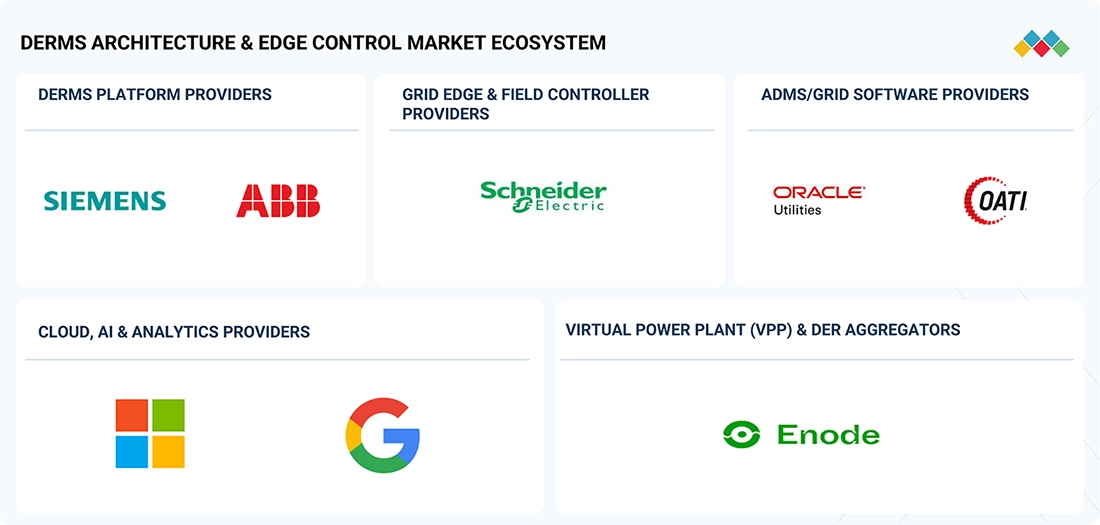
DERMS ARCHITECTURE & EDGE CONTROL MARKET: COMMERCIAL USE CASES ACROSS INDUSTRIES
| COMPANY | USE CASE DESCRIPTION | BENEFITS |
|---|---|---|
 |
North Carolina Electric Membership Corporation (NCEMC) deployed OATI webSmartEnergy® DERMS to coordinate distributed energy resources across its network of 26 electric cooperatives. The platform enables utilities to monitor, dispatch, and manage distributed assets, including battery storage, microgrids, rooftop solar, and smart thermostats, via a unified operational dashboard, while supporting real-time demand response and grid flexibility. | The deployment improved visibility and control of distributed energy resources, enabled centralized management of demand response programs across multiple cooperatives, enhanced grid reliability, and supported faster dispatch decisions during peak demand events. The solution also simplified DER integration and improved operational efficiency and system flexibility. |
 |
EnergyHub partnered with Oracle Utilities to integrate Mercury DERMS with Oracle's utility network management platform, enabling utilities to monitor and orchestrate customer-owned distributed energy resources, such as smart thermostats, electric vehicles, batteries, and solar systems. The integrated platform extends real-time visibility and control from customer devices to utility distribution operations. | The integrated solution improved customer participation in distributed energy programs, increased visibility into behind-the-meter assets, enabled real-time DER dispatch for load and voltage management, and helped utilities optimize distribution operations while supporting greater renewable energy integration and grid flexibility. |
Logos and trademarks shown above are the property of their respective owners. Their use here is for informational and illustrative purposes only.
Related Ecosystem
Smart Energy And Digital Solutions
- Cellular Network
- Analytics Software
- Geographical Information System (GIS)
- Meter Data Management (MDM)
- Smart Meters
- Siemens ag
- SCHNEIDER ELECTRIC SE
- ABB India Limited
- General Electric Company
- Eaton Corporation plc
Smart Grid
- Meter Data Management (MDM)
- Sensors
- Workforce Management
- Cellular Network
- Customer Analytics
- SCHNEIDER ELECTRIC SE
- Siemens ag
- ABB India Limited
- Eaton Corporation plc
- Hitachi Energy India Limited
Key Takeaways
- Germany's DERMS market will grow from $12.3M (2026) to $31.3M (2031) at a 20.5% CAGR, outpacing global growth rates.
- Germany's Energiewende policy and renewable energy targets are primary catalysts driving DERMS Architecture adoption across utilities and industrial operators.
- Edge control technologies are becoming essential in Germany as distributed solar and wind resources require real-time grid balancing and demand response capabilities.
- Germany's strong manufacturing base and digital infrastructure position it as a leading market for DERMS solutions and a testing ground for European grid modernization strategies.
DERMS Architecture & Edge Control Market Report Scope
| Report Metric | Details |
|---|---|
| Base Year | 2026 |
| Fastest Growing Segment | INDUSTRIAL MICROGRID OWNERS (Distributed Energy Asset Owner Type) |
| Forecast Period | 2026-2031 |
| Growth Rate | CAGR of 18.8% from 2026 to 2031 |
| Largest Segment | DISTRIBUTION SYSTEM OPERATORS (End User) |
| Market Size Base Year (Billions) | ~USD 1.72 (2026) |
| Revenue Forecast (Billions) | ~USD 4.07 (2031) |
| Segments Covered | Type, Application, Grid Flexibility & Network Optimization Application, End User, Distributed Energy Asset Owner Type, End User 2021-2025, Type 2021-2025, End User 2026-2031 |
Germany DERMS Architecture & Edge Control Market Report Segmentation
8 segment dimensions are covered across the global market.
By Type
- Field Edge Controller
- Field Edge Controllers
- Grid Derms
- Hierarchical Derms
By Application
- Distributed Energy Resource Coordination
- Grid Flexibility & Network Optimization
- Grid Services & Demand Flexibility
- Microgrid & Local Energy Management
By Grid Flexibility & Network Optimization Application
- Active Network Management (Anm)
- Flexible Connections
By End User
- Distributed Energy Asset Owners
- Distribution System Operators
By Distributed Energy Asset Owner Type
- Industrial Microgrid Owners
- Utility-Scale Der Owners
By End User 2021-2025
- Distributed Energy Asset Owners
- Distribution System Operators
By Type 2021-2025
- Field Edge Controllers
- Grid Derms
- Hierarchical Derms
By End User 2026-2031
- Distributed Energy Asset Owners
- Distribution System Operators
Target Audience
- Utility Companies & Grid Operators : German utilities need DERMS market intelligence to modernize grid infrastructure, integrate renewable sources efficiently, and comply with Energiewende regulations while optimizing operational costs and grid stability.
- Renewable Energy Developers : Solar, wind, and distributed generation operators require market insights to understand DERMS adoption trends, edge control technology requirements, and revenue opportunities in Germany's expanding renewable sector.
- Technology & Software Vendors : DERMS solution providers need Germany-specific market data to validate product-market fit, identify customer segments, benchmark competitive positioning, and develop localized go-to-market strategies.
- Energy Service Companies & Integrators : System integrators and ESCOs require market forecasts and growth drivers to plan service offerings, allocate resources, and identify partnership opportunities in Germany's rapidly evolving DERMS landscape.
- Investment & Strategy Consultants : Private equity, venture capital, and management consultants need Germany market data to evaluate investment opportunities, assess portfolio company growth potential, and develop strategic recommendations for energy sector clients.
Reasons to Buy this Report
- Market Size & Growth Validation : Quantified market data for Germany showing $12.3M (2026) to $31.3M (2031) growth enables accurate business planning, investment decisions, and revenue forecasting specific to the German DERMS market.
- Competitive Positioning Intelligence : Understand Germany's market dynamics, regulatory environment, and technology adoption rates to identify competitive advantages, partnership opportunities, and market entry strategies tailored to German utilities and energy companies.
- Investment & Expansion Planning : Data-driven insights into Germany's 20.5% CAGR and market trajectory support capital allocation decisions, facility expansion, R&D investment, and go-to-market strategies for DERMS solutions in Europe's largest economy.
- Customer & Segment Targeting : Identify high-growth customer segments within Germany including utilities, renewable operators, and prosumers, enabling precise marketing campaigns, product development, and sales strategies aligned with local market demands.
- Risk Mitigation & Forecasting : Leverage Germany-specific market forecasts and growth drivers to mitigate business risks, anticipate market shifts, and develop contingency strategies for regulatory changes, technology evolution, and competitive pressures.
Frequently asked questions
What is the current market size of DERMS Architecture & Edge Control in Germany?
Germany's DERMS Architecture & Edge Control Market was valued at $12.3 million in 2026 and is projected to reach $31.3 million by 2031.
What is the expected growth rate for Germany's DERMS market?
Germany's DERMS market is expected to grow at a compound annual growth rate (CAGR) of 20.5% between 2026 and 2031.
Why is Germany a key market for DERMS solutions?
Germany's Energiewende energy transition policy, high renewable energy penetration, advanced grid infrastructure, and regulatory support for distributed energy resources make it a leading DERMS market in Europe.
What sectors are driving DERMS adoption in Germany?
Utilities modernizing grid infrastructure, industrial facilities optimizing energy consumption, commercial enterprises implementing demand response, and renewable energy operators managing distributed resources are primary drivers of DERMS adoption in Germany.
How does Germany's DERMS market compare to global trends?
Germany's 20.5% CAGR significantly exceeds the global DERMS market CAGR of 18.8%, reflecting Germany's accelerated grid modernization and renewable energy integration efforts.
RESEARCH METHODOLOGY
The research process for this technical, market-oriented, and commercial study of the DERMS architecture and edge control market involved systematic collection, validation, and analysis of information on distributed energy resource management technologies, grid-edge control solutions, and utility digitalization initiatives. Extensive secondary research drew on annual reports, investor presentations, technical papers, regulatory publications, industry databases, company websites, and financial reports to identify key market participants, technology trends, and competitive developments. Findings were further validated through primary interviews with executives from DERMS software providers, utilities, system integrators, and industry experts to confirm market estimates, technology adoption trends, and competitive positioning. Key market players and their market positions were established through a combination of secondary research and primary validation with senior executives, business development managers, and technology specialists across the DERMS ecosystem.
Secondary Research
In the secondary research process, various sources were consulted to identify and collect information relevant to this study. Secondary sources included annual reports, investor presentations, press releases, company websites, technical white papers, industry journals, regulatory publications, and recognized databases. Publications from organizations such as the US Department of Energy (DOE), National Renewable Energy Laboratory (NREL), Federal Energy Regulatory Commission (FERC), International Energy Agency (IEA), Electric Power Research Institute (EPRI), and IEEE were also reviewed to understand grid modernization initiatives, DER integration, and evolving DERMS architectures. Secondary research was primarily conducted to obtain information on the DERMS value chain, key market participants, technology trends, architecture evolution, market segmentation, regional adoption patterns, and recent developments from both market and technology perspectives.
Primary Research
During the primary research phase, key stakeholders from both the supply and demand sides were interviewed to obtain qualitative and quantitative information for this report. Throughout the market engineering process, a combination of top-down and bottom-up approaches, supported by data triangulation, was employed to estimate market sizes and forecast the value of all segments and subsegments covered in the study. Extensive primary discussions were conducted to validate market estimates, technology adoption trends, competitive positioning, and regional demand patterns. Following the market engineering process, which included market sizing, forecasting, segmentation, and data validation, interviews with industry experts were used to verify critical data points and refine the final estimates. Primary research also helped identify emerging technology trends, key applications, competitive developments, and the evolving adoption of DERMS architecture & edge control solutions across utilities, renewable energy developers, industrial microgrids, and other end users.
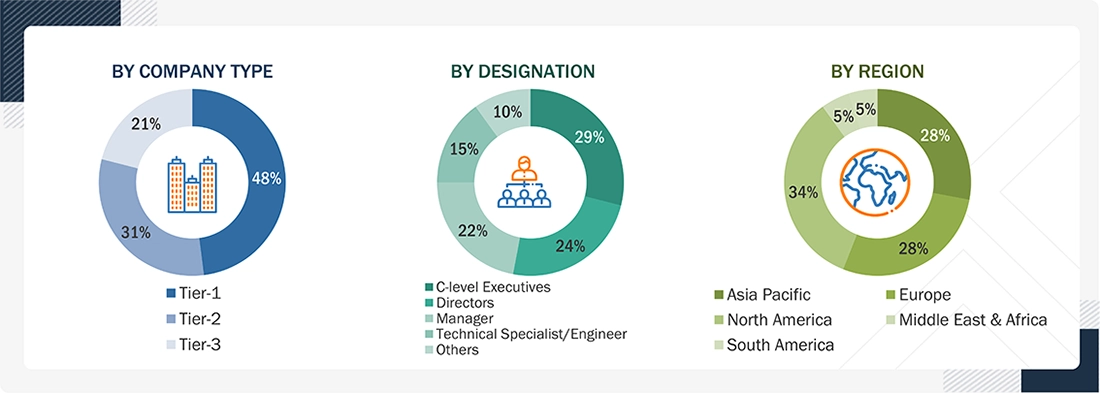
Note: Managers include sales managers, production managers, and regional managers.
Tier 1 company: revenue >USD 5 billion; tier 2 company: revenue between USD 1 and USD 5 billion; and tier 3 company: revenue <USD 1 billion in 2025
To know about the assumptions considered for the study, download the pdf brochure
Market Size Estimation
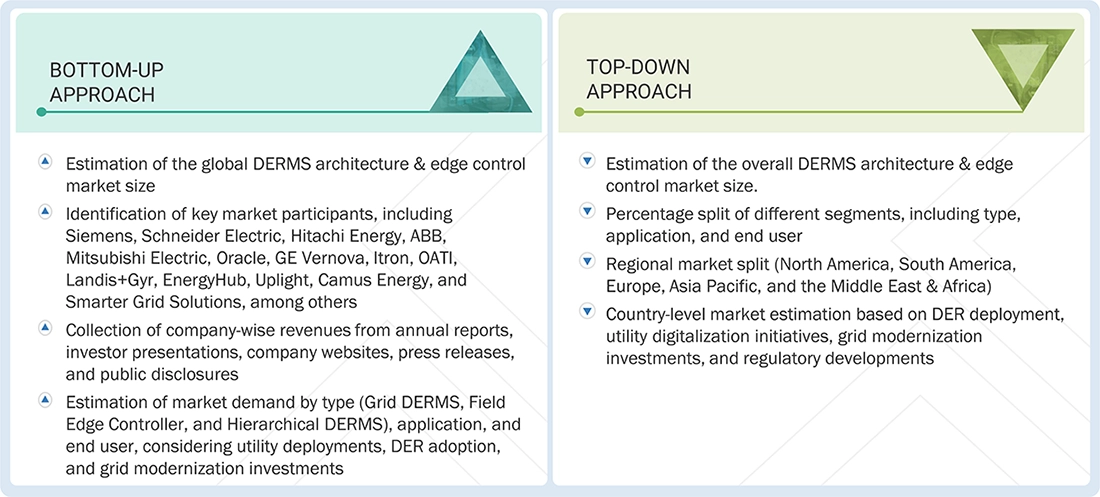
Bottom-up Approach
- Estimating the market size across architecture types, applications, and end-user segments by analyzing revenues generated from DERMS architecture & edge control solutions and consolidating them to derive the overall market size.
- Mapping leading market participants, including Siemens, Schneider Electric, Hitachi Energy, ABB, Mitsubishi Electric, Oracle, GE Vernova, Itron, OATI, Landis+Gyr, EnergyHub, Uplight, Camus Energy, and Smarter Grid Solutions, among others.
- Collecting segment-wise revenue information from annual reports, investor presentations, company websites, press releases, regulatory filings, and other publicly available disclosures.
- Estimating demand across major applications, including grid flexibility & network optimization (active network management and flexible connections), distributed energy resource coordination, microgrid & local energy management, and grid services & demand flexibility, based on utility deployments, project announcements, and technology adoption.
- Incorporating qualitative factors such as grid modernization investments, distributed energy resource penetration, utility digitalization initiatives, interoperability requirements, regulatory developments, and technology advancements into the market forecasting model.
Top-down Approach
- Estimating the overall DERMS architecture & edge control market by analyzing global investments in grid modernization, distributed energy resources (DERs), utility digitalization, and grid-edge technologies.
- Allocating the market across type (Grid DERMS, Field Edge Controller, and Hierarchical DERMS), application (Grid Flexibility & Network Optimization, Distributed Energy Resource Coordination, Microgrid & Local Energy Management, and Grid Services & Demand Flexibility), and end user (Distribution System Operators, Distributed Energy Asset Owners, Utility-scale DER Owners, Industrial Microgrid Owners, and Data Centers).
- Distributing market estimates across North America, South America, Europe, Asia Pacific, and the Middle East & Africa, followed by country-level analysis based on DER deployment, utility digitalization initiatives, grid modernization investments, and regulatory developments.
- Validating the final market estimates through primary interviews with DERMS software providers, utilities, system integrators, technology vendors, and industry experts, followed by data triangulation to ensure consistency and accuracy.
DERMS Architecture & Edge Control Market : Top-Down and Bottom-Up Approach
Data Triangulation
The process of determining the overall market size involved the methodologies described earlier, followed by segmenting the market into multiple segments and subsegments. To finalize the comprehensive market analysis and obtain precise statistics for each market segment and subsegment, data triangulation and market breakdown procedures were applied, wherever appropriate. Data triangulation was accomplished by examining various factors and trends from both the demand and supply sides of the DERMS architecture & edge control ecosystem, including technology adoption, utility investments, distributed energy resource deployment, competitive developments, and regional market dynamics.
Market Definition
The DERMS architecture & edge control market comprises revenues generated from software platforms, edge control solutions, and related services that enable utilities and grid operators to monitor, coordinate, and optimize distributed energy resources (DERs) across electricity distribution networks. The market includes Grid DERMS, Field Edge Controllers, and Hierarchical DERMS deployed to support grid flexibility, distributed energy resource coordination, microgrid and local energy management, and grid services. These solutions are used by distribution system operators, distributed energy asset owners, utility-scale DER owners, industrial microgrid operators, and data centers to improve grid visibility, reliability, and operational efficiency while enabling higher penetration of distributed energy resources.
Key Stakeholders
- Utilities & Distribution System Operators (DSOs)
- Utility-scale DER Owners
- Industrial Microgrid Operators
- Renewable Energy Developers
- Grid Technology Vendors
- System Integrators
- EPC & Engineering Firms
- Government & Regulatory Bodies
- Industry Associations
- Consulting & Advisory Firms
Report Objectives
- To describe and forecast the DERMS architecture & edge control market by type, application, and end user, in terms of value
- To forecast the market size across North America, South America, Europe, Asia Pacific, and the Middle East & Africa, along with country-level analysis for key markets
- To provide detailed information regarding the major drivers, restraints, opportunities, and challenges influencing market growth
- To analyze adoption trends across Grid DERMS, Field Edge Controllers, and Hierarchical DERMS architectures and identify high-growth application areas
- To analyze market opportunities for stakeholders and provide a comprehensive competitive landscape of key market participants
- To profile leading companies by evaluating their product portfolios, market positioning, competitive strategies, and core competencies
- To analyze competitive developments, including partnerships, agreements, collaborations, product launches, investments, and acquisitions undertaken by key players
Available customizations:
With the given market data, MarketsandMarkets offers customizations based on the company’s specific needs. The following customization options are available for the report:
Product Analysis
- Product Matrix, which provides a detailed comparison of the product portfolio of each company
Company Information
-
Detailed analyses and profiling of additional market players (up to 5)
Get the Full DERMS Architecture & Edge Control Market Report
Full forecast, segment splits, and company analysis for all DERMS Architecture & Edge Control Market.
- US DERMS Architecture & Edge Control Market
- Canada DERMS Architecture & Edge Control Market
- Mexico DERMS Architecture & Edge Control Market
- Denmark DERMS Architecture & Edge Control Market
- UK DERMS Architecture & Edge Control Market
- France DERMS Architecture & Edge Control Market
- China DERMS Architecture & Edge Control Market
- Australia DERMS Architecture & Edge Control Market
- South Korea DERMS Architecture & Edge Control Market
- Japan DERMS Architecture & Edge Control Market
- Brazil DERMS Architecture & Edge Control Market
- Argentina DERMS Architecture & Edge Control Market
- South Africa DERMS Architecture & Edge Control Market
- Rest Of Europe DERMS Architecture & Edge Control Market
- Rest Of Asia Pacific DERMS Architecture & Edge Control Market
- GCC DERMS Architecture & Edge Control Market
- Rest Of South America DERMS Architecture & Edge Control Market
Need a Tailored Report?
Customize this report to your needs
Get 10% FREE Customization
Customize This Report
