
Rest Of Europe Diffractive Optical Element Market (2024-2029)

The Rest Of Europe Diffractive Optical Element Market was valued at $5.3 Million in 2024 and projected to reach to $7.7 Million by 2029, representing a compound annual growth rate of 6.3%. Rest Of Europe's diffractive optical element market is positioned for steady expansion through 2029, driven by increasing technological adoption in telecommunications infrastructure and consumer electronics manufacturing.


| Market Size in | USD 26.32 MN |
| Market Forecast in | |
| CAGR | |
| Forecast Period | |
| Units Considered | Value (USD MN) |
Rest Of Europe Diffractive Optical Element Market Trends and Insights
- Rest Of Europe represents a developing segment within the broader European optical technology landscape, driven by increasing adoption in telecommunications, consumer electronics, and industrial applications.
- The region's growth trajectory reflects rising demand for advanced optical components and miniaturization trends across manufacturing sectors. Rest Of Europe's market expansion is supported by technological advancements in diffractive optical element fabrication and growing investment in semiconductor-related industries.
- The 6.3% compound annual growth rate through 2029 indicates moderate but consistent market development in Rest Of Europe, as regional manufacturers and suppliers enhance their capabilities.
- Rest Of Europe's positioning within Europe's optical ecosystem continues to strengthen through innovation and cross-border collaboration..
Key Market Statistics
- CAGR (2024-2029) 6.3% CAGR
- Market Size, 2024 ~USD 5.3 Million
- Forecast, 2029 ~USD 7.7 Million
- Country Rest Of Europe
Rest Of Europe Diffractive Optical Element Market Overview
Steady Regional Growth :
Rest Of Europe's diffractive optical element market is growing at 6.3% CAGR, expanding from $5.3 million in 2024 to $7.7 million by 2029, reflecting consistent demand across emerging European markets.
Key Application Drivers :
Telecommunications, consumer electronics, and industrial applications are primary growth catalysts in Rest Of Europe, with increasing adoption of advanced optical technologies in these sectors.
Developing Market Segment :
Rest Of Europe represents a developing segment within the broader European optical technology landscape, offering untapped growth potential compared to mature Western European markets.
Regional Market Positioning :
While growing slower than the global 9.9% CAGR, Rest Of Europe maintains strategic importance as a secondary market with emerging opportunities in optical component manufacturing and integration.
Rest Of Europe Diffractive Optical Element Market Dynamics
- The region's growth trajectory reflects rising investments in optical technologies and expanding industrial applications across Central and Eastern European markets.
- Key drivers include infrastructure modernization, growing demand for advanced optical components, and increasing integration of diffractive elements in next-generation devices.
- Market participants are focusing on localized production capabilities and partnerships to capture emerging opportunities in this developing segment..
Market Ecosystem
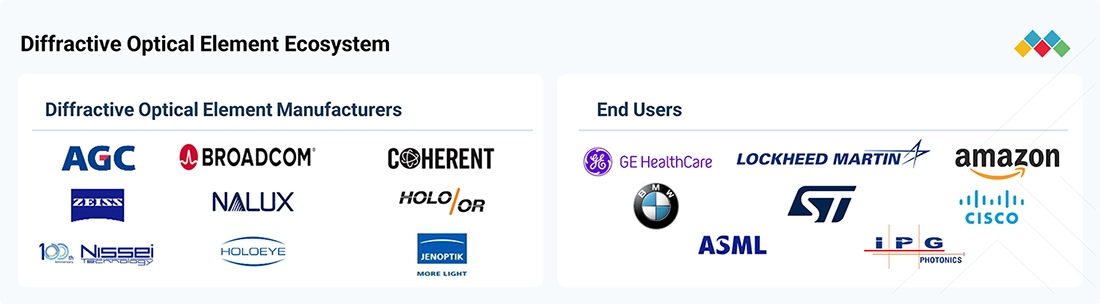
DIFFRACTIVE OPTICAL ELEMENT MARKET SIZE, SHARE AND TRENDS: COMMERCIAL USE CASES ACROSS INDUSTRIES
| COMPANY | USE CASE DESCRIPTION | BENEFITS |
|---|---|---|
 |
ZEISS develops high-precision micro-optical and diffractive solutions, including DOEs, diffraction gratings, beam shapers, and beam splitters for applications across automotive, aerospace, consumer electronics, and scientific systems. | Enables precise light modulation and beam shaping | Supports compact optical and holographic systems | Improves optical performance and integration | Enables advanced sensing, display, and illumination applications |
 |
AGC develops glass-based DOEs and diffusers for sensing, AR/VR/MR, LiDAR, projectors, lighting, optical communications, and laser beam shaping. Its solutions use precision glass micro-processing and are designed for high-efficiency and reliable optical performance. | Enables accurate laser beam shaping and pattern generation | Supports 3D sensing, LiDAR, and AR/VR applications | Provides high efficiency and durability | Enables large-FOV and high-density dot projection |
 |
Coherent provides customized DOEs, beam shapers, splitters, diffusers, flat lenses, and lenslet arrays for industrial laser processing, 3D sensing, consumer electronics, autonomous vehicles, and optical communications. | Enables precise beam shaping, splitting, and homogenization | Improves laser-processing efficiency and consistency | Supports compact optical systems and 3D sensing | Reduces optical-system complexity and component count |
 |
Jenoptik develops application-specific DOEs for laser material processing, biomedical devices, LiDAR/LADAR, lithography, optical sensing, metrology, and communications. Its solutions include beam shapers, beam splitters, diffusers, and line generators. | Enables efficient and precise laser beam shaping and splitting | Improves process uniformity and optical performance | Supports LiDAR, semiconductor, medical, and industrial applications | Enables customized optical solutions from design through production |
 |
Broadcom provides customized DOEs and micro-optics for fiber-optic communications, semiconductor lithography, industrial machine vision, sensing, illumination, and consumer electronics. Its DOE portfolio includes beam shapers, pattern generators, beam splitters, homogenizers, and spot-array generators. | Enables precise light control and pattern generation | Supports semiconductor lithography and inspection | Improves machine-vision and sensing performance | Enables compact optical solutions for communications and consumer applications |
Logos and trademarks shown above are the property of their respective owners. Their use here is for informational and illustrative purposes only.
Related Ecosystem
Electrical System And Components
- Natural Language Processing (NLP)
- Sensors
- Machine Learning
- Temperature Sensors
- Actuators
- ABB India Limited
- Siemens ag
- SCHNEIDER ELECTRIC SE
- Eaton Corporation plc
- Lenovo
Display Technology
- Augmented Reality
- Liquid Crystal Display (LCD)
- Sensors
- Virtual Reality Devices
- Liquid Crystal on Silicon (LCOS)
- VIVITEK CORPORATION
- Samsung
- Lenovo
- Panasonic Holdings Corporation
- Lg corp
Key Takeaways
- Rest Of Europe's diffractive optical element market is valued at $5.3 million in 2024 and expected to reach $7.7 million by 2029.
- The region demonstrates a 6.3% CAGR, reflecting steady but moderate growth compared to global expansion rates.
- Rest Of Europe's market growth is driven by telecommunications, consumer electronics, and industrial miniaturization demands.
- Rest Of Europe benefits from technological innovation and increased semiconductor industry investment across the region.
Diffractive Optical Element Market Report Scope
| Report Metric | Details |
|---|---|
| Base Year | 2024 |
| Fastest Growing Segment | LASER MATERIAL PROCESSING (Application) |
| Forecast Period | 2024-2029 |
| Growth Rate | CAGR of 9.9% from 2024 to 2029 |
| Largest Segment | DIFFRACTIVE BEAM SHAPERS/DIFFUSERS (Type) |
| Market Size Base Year (Billions) | ~USD 0.22 (2024) |
| Revenue Forecast (Billions) | ~USD 0.35 (2029) |
| Segments Covered | Type, Component, Application, End-Use Sector |
Rest Of Europe Diffractive Optical Element Market Report Segmentation
4 segment dimensions are covered across the global market.
By Type
- Diffractive Beam Shapers/Diffusers
- Diffractive Beam Splitters
- Diffractive Pattern Generators
- Flat Top
- Line Top
- Spot Array
By Component
- Binary/Multilevel Doe
- Diffractive Lenses
- Diffusing Materials
- Gratings
By Application
- Aberration Correction
- Ar/Vr
- Biomedical Devices
- Holography
- Illumination Systems
- Imaging & Sensing
- Laser Material Processing
- Lidar
- Lightweight Optics
- Metrology & Industrial Inspection
- Rapid Optical Prototyping
- Spectroscopy
By End-Use Sector
- Aerospace & Defense
- Automotive
- Consumer Electronics
- Healthcare
- Industrial
- It & Telecommunication
- Semiconductor
Target Audience
- Regional Business Managers : Need Rest Of Europe-specific market data to develop regional strategies, allocate budgets, and set realistic growth targets for optical component divisions.
- Market Entry Strategists : Require detailed regional insights to evaluate market attractiveness, identify entry barriers, and assess competitive dynamics before expanding into Rest Of Europe markets.
- Product Development Teams : Need application-specific demand patterns in Rest Of Europe to prioritize product development roadmaps and tailor optical solutions for regional telecommunications and industrial sectors.
- Investment & M&A Professionals : Require regional market sizing and growth forecasts to evaluate acquisition targets, assess portfolio fit, and identify consolidation opportunities in developing European markets.
- Sales & Distribution Partners : Need Rest Of Europe market intelligence to identify high-potential customer segments, forecast revenue opportunities, and optimize channel strategies for regional expansion.
Reasons to Buy this Report
- Regional Market Sizing & Forecasts : Obtain precise market valuation for Rest Of Europe ($5.3M in 2024) with detailed 5-year projections to $7.7M, enabling accurate regional business planning and investment decisions.
- Growth Trajectory Analysis : Understand Rest Of Europe's 6.3% CAGR performance relative to global 9.9% growth, identifying regional market dynamics and competitive positioning within the broader European landscape.
- Application-Specific Insights : Access detailed breakdown of diffractive optical element adoption across telecommunications, consumer electronics, and industrial sectors specific to Rest Of Europe markets.
- Market Entry & Expansion Strategy : Leverage region-specific intelligence to develop targeted go-to-market strategies, identify key growth segments, and prioritize investment opportunities in developing European markets.
- Competitive Intelligence : Gain actionable insights into Rest Of Europe's market structure, key players, and emerging opportunities to benchmark performance and identify differentiation strategies.
Frequently asked questions
What is the current market size of diffractive optical elements in Rest Of Europe?
Rest Of Europe's diffractive optical element market was valued at $5.3 million in 2024 and is projected to grow to $7.7 million by 2029.
What is the expected growth rate for Rest Of Europe's diffractive optical element market?
Rest Of Europe's market is expected to grow at a compound annual growth rate of 6.3% from 2024 to 2029.
Which industries drive demand for diffractive optical elements in Rest Of Europe?
Rest Of Europe's demand is primarily driven by telecommunications, consumer electronics, industrial manufacturing, and optical sensing applications.
How does Rest Of Europe's growth compare to the global diffractive optical element market?
Rest Of Europe's 6.3% CAGR is lower than the global average of 9.9%, indicating a more moderate regional growth trajectory.
What factors support market expansion in Rest Of Europe?
Rest Of Europe's growth is supported by technological advancements in optical fabrication, semiconductor industry investment, and increasing miniaturization trends across manufacturing sectors.
RESEARCH METHODOLOGY
The study involved four major activities in estimating the current size of the diffractive optical element market. Extensive secondary research was conducted to gather information on the market, adjacent industries, and the broader optics, photonics, micro-optics, laser technology, and optical component ecosystem. This was followed by primary research with industry stakeholders across the value chain, including DOE manufacturers, optical component suppliers, micro-optics manufacturers, laser technology providers, system integrators, distributors, technology developers, and end users across automotive, consumer electronics, semiconductor, healthcare, aerospace & defense, and industrial applications, to validate assumptions and market sizing. Both top-down and bottom-up approaches were used to estimate the overall market size. Market breakdowns and data triangulation techniques were then applied to derive the size of individual segments and subsegments. Secondary and primary sources were jointly used to support a comprehensive technical and commercial analysis of the diffractive optical element market.
Secondary Research
Various secondary sources were referred to during the secondary research process to identify and collect information relevant to the diffractive optical element market. These sources included annual reports, press releases, investor presentations of key companies, product catalogs, technical datasheets, white papers, industry journals, certified publications, patents, industry associations, company websites, trade directories, government databases, and optical and photonics industry sources. Secondary research was conducted to obtain key insights into the market's supply chain, value chain, competitive landscape, and segmentation across type, component, application, end-use sector, and region. It also helped analyze industry trends, adoption of diffractive beam splitters, pattern generators, beam shapers, diffusers, diffractive lenses, binary and multi-level diffractive optical elements, and gratings, along with their applications in 3D sensing, LiDAR, AR/VR, laser material processing, imaging, metrology, semiconductor manufacturing, and healthcare. The collected data was further analyzed to estimate the overall market size and validate findings, which were subsequently refined through primary research with industry experts and key stakeholders.
Primary Research
Extensive primary research was conducted after gaining knowledge about the current scenario of the diffractive optical element market through secondary research. Several primary interviews were conducted with experts from the demand and supply sides across four major regions: North America, Europe, Asia Pacific, and RoW. This primary data was collected through questionnaires, emails, and telephonic interviews.
Breakdown of Primary Interviews
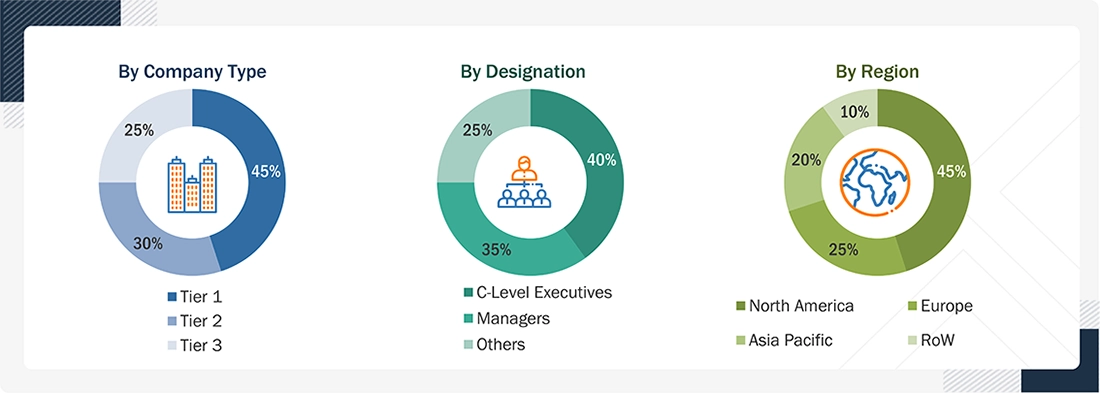
Note: The three tiers of companies are defined based on their total revenue in 2025: Tier 1 - revenue greater than or equal to USD 1 billion; Tier 2 - revenue between USD 100 million and USD 1 billion; and Tier 3 - revenue less than or equal to USD 100 million. Other designations include sales managers, marketing managers, and product managers.
To know about the assumptions considered for the study, download the pdf brochure
Market Size Estimation
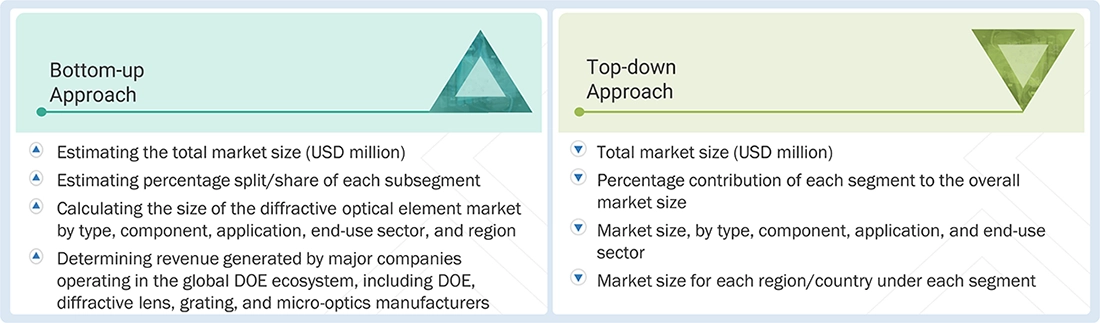
Both top-down and bottom-up approaches were used to estimate and validate the total size of the diffractive optical element market. These methods have also been used extensively to estimate the size of various subsegments in the market. The following research methodology was used to estimate the market size:
- Major players in the diffractive optical element industry and related markets were identified through extensive secondary research.
- The industry’s value chain and market size (in terms of value) were determined through primary and secondary research processes.
- All percentage shares, splits, and segment-level breakdowns were determined using secondary sources and verified through primary sources.
Diffractive Optical Element Market : Top-Down and Bottom-Up Approach
Data Triangulation
After arriving at the overall size of the diffractive optical element market from the market size estimation process explained above, the total market was split into several segments and subsegments. Data triangulation and market breakdown procedures were employed, wherever applicable, to complete the overall market engineering process and arrive at the statistics for all segments and subsegments of the market. The data was triangulated by studying various factors and trends from both the demand and supply sides, including type, component, application, end-use sector, and regional developments. Along with this, the market size was validated using both top-down and bottom-up approaches.
Market Definition
Diffractive optical elements (DOEs) refer to optical components that use diffraction to manipulate, distribute, shape, or control light by modifying the phase and propagation of incident optical waves. Diffractive optical elements enable functions such as beam splitting, pattern generation, beam shaping, light diffusion, and wavelength-dependent optical control and are used across consumer electronics, automotive, aerospace & defense, healthcare, semiconductor, IT & telecommunications, industrial, and other advanced optical applications. Diffractive optical elements can be designed as standalone optical components or integrated into laser systems, sensing modules, imaging systems, illumination systems, and other optical assemblies, depending on application requirements and optical performance specifications.
Diffractive optical elements play a critical role in applications requiring precise light manipulation, including 3D sensing, LiDAR, AR/VR, laser material processing, imaging, spectroscopy, metrology, industrial inspection, and biomedical devices. These optical components help generate controlled beam profiles and patterns, improve optical system compactness, enable efficient light distribution, and support precise sensing and measurement. A typical DOE may consist of binary or multi-level diffractive structures fabricated on glass, fused silica, polymers, or other optical materials, with configurations varying based on diffractive function, wavelength, diffraction efficiency, beam profile, pattern geometry, optical design, application, and operating environment.
Key Stakeholders
- Original equipment manufacturers
- Raw material suppliers
- Technology investors
- Electronic hardware equipment manufacturers
- Research organizations and consulting companies
- Government bodies such as regulatory authorities and policymakers
- Venture capitalists and private equity firms
- Associations, organizations, and alliances related to diffractive optical elements
Report Objectives
- To describe and forecast the diffractive optical element market size by type, component, application, end-use sector, and region in terms of value
- To describe and forecast the market for various segments across four main regions, namely, North America, Europe, Asia Pacific, and RoW, in terms of value
- To describe and forecast the market for diffractive optical element components in terms of volume
- To strategically analyze micromarkets with regard to individual growth trends, prospects, and contribution to the market
- To provide detailed information regarding drivers, restraints, opportunities, and challenges influencing the growth of the market
- To analyze opportunities for stakeholders by identifying high-growth segments in the market
- To provide a detailed overview of the value chain of the market
- To strategically analyze the key technologies, average selling price by key players, trends impacting customers, ecosystem, regulatory landscape, patent landscape, Porter’s Five Forces, import and export scenarios, trade landscape, and case studies pertaining to the market
- To strategically profile key players in the diffractive optical element market and comprehensively analyze their market share and core competencies
- To analyze competitive developments such as partnerships, acquisitions, expansions, collaborations, contracts, and product launches, along with R&D in the diffractive optical element market
Available customizations:
With the given market data, MarketsandMarkets offers customizations according to the company’s specific needs. The following customization options are available for the report:
Company Information
-
Detailed analysis and profiling of additional market players (up to 5)
Get the Full Diffractive Optical Element Market Report
Full forecast, segment splits, and company analysis for all Diffractive Optical Element Market.
- US Diffractive Optical Element Market
- Canada Diffractive Optical Element Market
- Mexico Diffractive Optical Element Market
- Germany Diffractive Optical Element Market
- UK Diffractive Optical Element Market
- France Diffractive Optical Element Market
- China Diffractive Optical Element Market
- Japan Diffractive Optical Element Market
- South Korea Diffractive Optical Element Market
- Rest Of Asia Pacific Diffractive Optical Element Market
- GCC Diffractive Optical Element Market
Need a Tailored Report?
Customize this report to your needs
Get 10% FREE Customization
Customize This Report
