
Europe Digital Key Cabinet Market (2024-2029)

The Europe Digital Key Cabinet Market was valued at $43 Million in 2024 and projected to reach to $57.9 Million by 2029, representing a compound annual growth rate of 6.2%. Europe's digital key cabinet market is poised for sustained growth through 2029, driven by heightened cybersecurity awareness and regulatory compliance requirements.


| Market Size in | USD 26.32 MN |
| Market Forecast in | |
| CAGR | |
| Forecast Period | |
| Units Considered | Value (USD MN) |
Europe Digital Key Cabinet Market Trends and Insights
- This expansion reflects Europe's increasing adoption of secure credential management solutions across enterprise and semiconductor sectors.
- Europe's regulatory environment and emphasis on cybersecurity standards are driving demand for advanced key management infrastructure. The European market benefits from strong technological infrastructure and heightened security awareness among organizations.
- Europe's digital key cabinet solutions are increasingly integrated with cloud platforms and enterprise security frameworks, supporting the region's digital transformation initiatives.
- By 2029, Europe is expected to maintain its position as a critical market for secure key management technologies, with sustained investment in cybersecurity infrastructure..
Key Market Statistics
- CAGR (2024-2029) 6.2% CAGR
- Market Size, 2024 ~USD 43 Million
- Forecast, 2029 ~USD 57.9 Million
- Geography Europe
Europe Digital Key Cabinet Market Overview
Market Valuation & Growth :
Europe's digital key cabinet market is valued at $43.0 million in 2024, with a projected CAGR of 6.2% through 2029, reaching $57.9 million. This steady growth trajectory reflects strong regional demand for secure credential management solutions.
Regulatory & Compliance Drivers :
Europe's stringent regulatory environment, including GDPR and NIS2 Directive compliance requirements, is a primary catalyst for digital key cabinet adoption. Organizations prioritize cybersecurity standards and secure credential management to meet evolving regulatory mandates.
Enterprise & Semiconductor Adoption :
The expansion is driven by increasing adoption across enterprise and semiconductor sectors in Europe. Organizations are investing in advanced key management solutions to protect sensitive data and intellectual property in highly regulated industries.
Regional Market Leaders :
France ($20.16M), UK ($20.0M), and Germany ($15.29M) represent the largest European markets, collectively accounting for the majority of regional demand. These mature markets demonstrate strong cybersecurity infrastructure investments and digital transformation initiatives.
Europe Digital Key Cabinet Market Dynamics
- The region's emphasis on data protection and secure credential management positions it as a critical market for key management solutions.
- Enterprise organizations across finance, healthcare, and manufacturing sectors are increasingly deploying digital key cabinets to safeguard sensitive operations and meet compliance obligations. The market outlook remains positive as European organizations continue digital transformation initiatives and strengthen cybersecurity postures.
- Investment in advanced key management infrastructure is expected to accelerate, particularly among large enterprises and semiconductor manufacturers.
- Regional support for cybersecurity innovation and compliance-driven spending will sustain market expansion through the forecast period..
Market Ecosystem
Related Ecosystem
Electronics System And Components
- Sensors
- Temperature Sensors
- Pressure Sensors
- Actuators
- Image Sensors
- Lenovo
- Samsung
- Texas Instruments Incorporated
- HONEYWELL INTERNATIONAL INC.
- Teledyne Technologies Incorporated
Security And Surveillance
- Face Recognition
- Video Surveillance as A Service (VSaaS)
- Voice Recognition
- Fingerprint Recognition
- IRIS Recognition
- HONEYWELL INTERNATIONAL INC.
- Thales group
- HID-GLOBAL
- Lenovo
- AXIS COMMUNICATIONS
Application Security
- Cloud Security
- Security Analytics
- Network Testing
- Security Testing
- Web Application Security
- REDINGTON
- International Business Machines Corporation
- MICROSOFT CORPORATION
- Cisco Systems, Inc.
- PALO ALTO NETWORKS, INC
Key Takeaways
- Europe's digital key cabinet market is valued at $43.0 million in 2024, growing to $57.9 million by 2029 at a 6.2% CAGR.
- Europe's regulatory compliance requirements and GDPR standards are primary drivers of digital key cabinet adoption.
- Enterprise organizations across Europe are increasingly prioritizing secure credential management as part of broader cybersecurity strategies.
- Europe's market growth is supported by integration with cloud infrastructure and enterprise security ecosystems.
Digital Key Cabinet Market Report Scope
| Report Metric | Details |
|---|---|
| Base Year | 2024 |
| Fastest Growing Segment | SOFTWARE & SERVICES (Offering) |
| Forecast Period | 2024-2029 |
| Growth Rate | CAGR of 7.1% from 2024 to 2029 |
| Largest Segment | HARDWARE (Offering) |
| Market Size Base Year (Billions) | ~USD 0.16 (2024) |
| Revenue Forecast (Billions) | ~USD 0.23 (2029) |
| Segments Covered | Offering, Capacity, Application, Type |
Europe Digital Key Cabinet Market Report Segmentation
4 segment dimensions are covered across the global market.
By Offering
- Hardware
- Software & Services
By Capacity
- 51-100 Keys
- Above 100 Keys
- Up To 50 Keys
By Application
- Commercial
- Government & Military
- Residential
By Type
- Banks
- Construction Sites
- Corporate Offices
- Data Centers
- Education Institutions
- Educational Institutions
- Hospitals
- Public Transportation Hubs
- Utilities
EUROPE: DIGITAL KEY CABINET MARKET, BY APPLICATION, 2024–2029
| Segment | 2024 | 2025 | 2026 | 2027 | 2028 | 2029 | CAGR (%) |
|---|---|---|---|---|---|---|---|
| COMMERCIAL | 29.79 | 32.42 | 34.98 | 37.39 | 39.59 | 41.71 | 7 |
| GOVERNMENT & MILITARY | 8.47 | 9.13 | 9.75 | 10.32 | 10.83 | 11.3 | 5.9 |
| RESIDENTIAL | 4.73 | 4.87 | 4.97 | 5.01 | 4.99 | 4.92 | 0.8 |
| TOTAL | 42.98 | 46.42 | 49.69 | 52.71 | 55.41 | 57.93 | 6.2 |
Target Audience
- Cybersecurity Solution Vendors : Key management and credential security vendors need Europe-specific market data to develop localized solutions, understand regulatory requirements, and identify high-value customer segments across the region.
- Enterprise IT Decision Makers : CIOs and IT security leaders in European organizations require market insights to benchmark digital key cabinet investments, evaluate vendor options, and align security infrastructure with compliance mandates.
- Semiconductor & Electronics Manufacturers : European semiconductor companies need market intelligence to understand secure credential management trends, competitive offerings, and best practices for protecting intellectual property and manufacturing operations.
- Investment & Strategy Consultants : Management consultants and investment firms analyzing the European cybersecurity market need detailed market sizing, growth forecasts, and regional dynamics to support client advisory and investment decisions.
- Regulatory & Compliance Officers : Compliance professionals in European enterprises require market insights to understand how peer organizations are addressing digital key cabinet requirements and implementing solutions to meet GDPR and NIS2 standards.
Countries within Europe - compare and drill down
| Country | 2025 size (native) |
|---|---|
| France | USD 20.16 Million |
| Germany | USD 15.29 Million |
| UK | USD 20 Million |
| Rest Of Europe | USD 2.43 Million |
Country market size visualization
Reasons to Buy this Report
- Regulatory Compliance Intelligence : Gain insights into how GDPR, NIS2, and other European regulatory frameworks are shaping digital key cabinet adoption. Understand compliance-driven market dynamics specific to European enterprises.
- Country-Level Market Breakdown : Access detailed market sizing for France, Germany, UK, and other European nations. Identify high-growth markets and regional variations in digital key cabinet demand and deployment patterns.
- Competitive Landscape Analysis : Understand the competitive positioning of key vendors in Europe's digital key cabinet market. Identify market leaders, emerging players, and differentiation strategies across the region.
- Sector-Specific Opportunities : Discover growth opportunities within European enterprise, semiconductor, finance, and healthcare sectors. Tailor market entry and expansion strategies based on sector-specific demand drivers.
- Strategic Market Forecasting : Leverage 5-year market projections (2024-2029) to inform investment decisions, product development roadmaps, and go-to-market strategies for the European digital key cabinet market.
Frequently asked questions
What is the current size of Europe's digital key cabinet market?
Europe's digital key cabinet market was valued at $43.0 million in 2024 and is forecast to reach $57.9 million by 2029.
What is the expected growth rate for Europe's digital key cabinet market?
Europe's digital key cabinet market is expected to grow at a compound annual growth rate (CAGR) of 6.2% from 2024 to 2029.
What factors are driving growth in Europe's digital key cabinet market?
Europe's market growth is driven by regulatory compliance requirements, GDPR standards, increased cybersecurity awareness, and enterprise digital transformation initiatives.
How is Europe's digital key cabinet market segmented?
Europe's market includes solutions for enterprise credential management, semiconductor security, cloud integration, and compliance-focused key management across various industry verticals.
What is the forecast market size for Europe's digital key cabinet market in 2029?
Europe's digital key cabinet market is projected to reach $57.9 million by 2029, representing significant growth from the 2024 baseline of $43.0 million.
RESEARCH METHODOLOGY
The study involved four major activities in estimating the digital key cabinet market size. Exhaustive secondary research has been carried out to collect information on the market, the peer markets, and the parent market. Both top-down and bottom-up approaches have been employed to estimate the total market size. Market breakdown and data triangulation methods have also been used to estimate the market for segments and subsegments.
Secondary Research
In the secondary research process, various secondary sources have been referred to for identifying and collecting information relevant to this study on the digital key cabinet market. The secondary sources included the Security Industry Association (SIA), Electronic Security Association (ESA), Association for Biometrics (AFB), International Biometric Society (IBS), annual reports, press releases, and investor presentations of companies; white papers, certified publications, and articles by recognized authors; directories; and databases.
The global size of the digital key cabinet market has been obtained from the secondary data available through paid and unpaid sources. It has also been determined by analyzing the product portfolios of the leading companies and rating them based on the quality of their offerings.
Secondary research has been used to gather key information about the industry's supply chain, the market’s monetary chain, the total number of key players, and market segmentation according to the industry trends to the bottom-most level, geographic markets, and key developments from both the market- and technology-oriented perspectives. It has also been conducted to identify and analyze the industry trends and key developments undertaken from both the market- and technology perspectives.
Primary Research
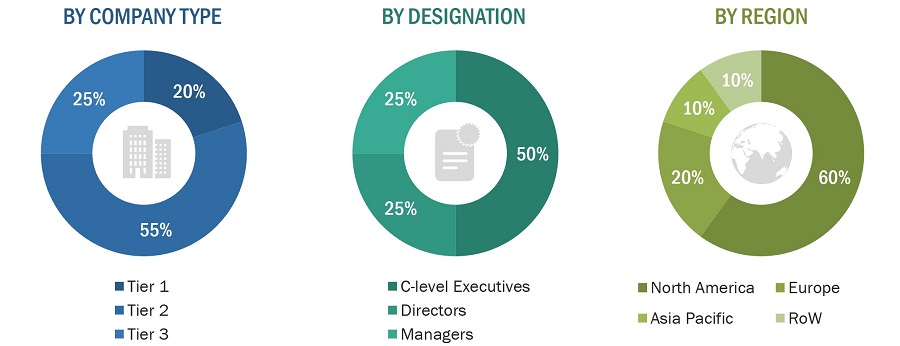
In the primary research process, various primary sources have been interviewed to obtain qualitative and quantitative information about the market across four main regions-Asia Pacific, North America, Europe, and the Rest of the World (the Middle East & Africa, and South America). Primary sources from the supply side include industry experts such as CEOs, vice presidents, marketing directors, technology directors, and other related key executives from major companies and organizations operating in the digital key cabinet market or related markets.
After completing market engineering, primary research was conducted to gather information and verify and validate critical numbers from other sources. Primary research has also been conducted to identify various market segments; industry trends; key players; competitive landscape; and key market dynamics, such as drivers, restraints, opportunities, and challenges, along with key strategies adopted by market players. Most primary interviews have been conducted with the market's supply side. This primary data has been collected through questionnaires, emails, and telephonic interviews.
To know about the assumptions considered for the study, download the pdf brochure
Market Size Estimation
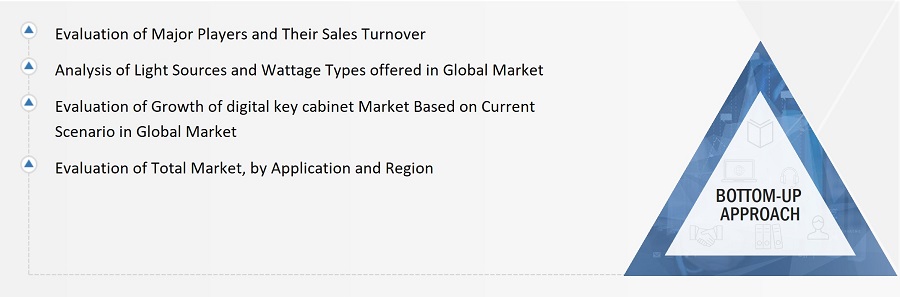
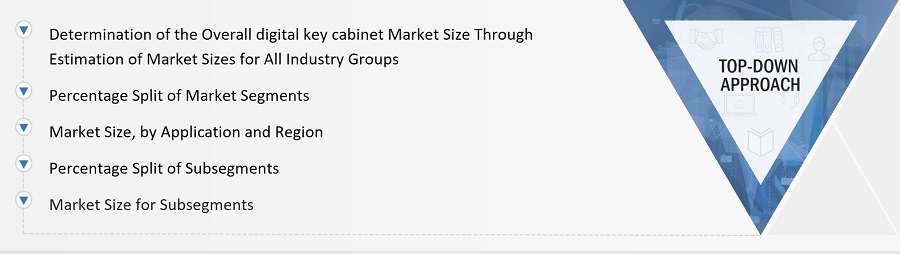
In the complete engineering process, both top-down and bottom-up approaches and several data triangulation methods have been used to estimate and validate the size of the overall digital key cabinet market and other dependent submarkets. Key players in the market have been identified through secondary research, and their market positions in the respective geographies have been determined through both primary and secondary research. This entire procedure includes studying top market players’ annual and financial reports and extensive interviews with industry leaders such as CEOs, VPs, directors, and marketing executives for key insights (qualitative and quantitative).
All percentage shares and breakdowns have been determined using secondary sources and verified through primary sources. All the possible parameters that affect the markets covered in this research study have been accounted for, viewed in detail, verified through primary research, and analyzed to obtain the final quantitative and qualitative data. This data has been consolidated and supplemented with detailed inputs and analysis from MarketsandMarkets and presented in this report.
Global Digital key cabinet Market Size: Bottom-Up Approach
Global Digital key cabinet Market Size: Top-Down Approach
Data Triangulation
After arriving at the overall market size from the estimation process explained above, the overall market has been split into several segments and subsegments. To complete the overall market engineering process and arrive at the exact statistics for all segments and subsegments, the market breakdown and data triangulation procedures have been employed, wherever applicable. Data has been triangulated by studying various factors and trends from both the demand and supply sides. Along with this, the market size has been validated using top-down and bottom-up approaches.
Market Definition
A digital key cabinet is a secure, electronically managed system designed for storing and controlling access to physical keys. It uses advanced technology such as RFID, biometrics, PIN codes, or card readers to track key usage, ensure authorized access, and provide detailed audit trails. These cabinets are often integrated with software that allows administrators to manage keys remotely, set access permissions, and receive alerts in case of unauthorized access or anomalies. Digital key cabinets enhance security, improve accountability, and streamline key management processes in various settings, including corporate offices, government institutions, hospitals, educational institutions, and industrial facilities.
Key Stakeholders
- Raw material suppliers
- Research organizations
- Original equipment manufacturers (OEMs)
- Technology investors
- Analysts and strategic business planners
- Government bodies, venture capitalists, and private equity firms
- End users
Report Objectives
- To define, describe, estimate, and forecast the digital key cabinet market, in terms of value, on the basis of offering, capacity, application, and geography
- To forecast the market size of concerned segments with respect to 4 main regions—North America, Europe, Asia Pacific (APAC), and the Rest of the World (RoW)
- To provide a detailed information regarding the major drivers, restraints, opportunities, and challenges influencing the growth of the market
- To analyze micromarkets1 with respect to individual growth trends, prospects, and contribution to the overall market
- To analyze the value chain, market ecosystem; trends/disruptions impacting customer’s business; technology analysis; pricing analysis; Porter’s five forces model; key stakeholders & buying criteria; case study analysis; trade analysis; patent analysis; key conferences & events, 2024–2025; regulations related to the digital key cabinet market; and investment and funding scenario.
- To profile key players and comprehensively analyze their market ranks and core competencies2, along with detailing the competitive landscape for market leaders
- To benchmark players within the market using the proprietary Company Evaluation Matrix framework, which analyzes market players on various parameters within the broad categories of market rank and product offering
- To track and analyze competitive developments such as product launches and acquisitions, and research and development (R&D) activities in the digital key cabinet market
- To analyze the opportunities in the market for stakeholders and provide details of the competitive landscape to the market leaders
Available customizations:
With the given market data, MarketsandMarkets offers customizations according to the specific requirements of companies. The following customization options are available for the report:
- Detailed analysis and profiling of additional market players (up to 5 players) based on various blocks of the supply chain
Get the Full Digital Key Cabinet Market Report
Full forecast, segment splits, and company analysis for all Digital Key Cabinet Market.
- Canada Digital Key Cabinet Market
- Mexico Digital Key Cabinet Market
- US Digital Key Cabinet Market
- France Digital Key Cabinet Market
- Germany Digital Key Cabinet Market
- UK Digital Key Cabinet Market
- China Digital Key Cabinet Market
- Japan Digital Key Cabinet Market
- South Korea Digital Key Cabinet Market
- Rest Of Europe Digital Key Cabinet Market
- Rest Of Asia Pacific Digital Key Cabinet Market
- GCC Countries Digital Key Cabinet Market
Need a Tailored Report?
Customize this report to your needs
Get 10% FREE Customization
Customize This Report
