
North America Digital Stethoscopes Market (2025-2030)

The North America Digital Stethoscopes Market was valued at $245.86 Million in 2025 and projected to reach to $363.44 Million by 2030, representing a compound annual growth rate of 5.7%. North America's digital stethoscopes market is positioned for sustained growth through 2030, driven by increasing healthcare digitalization, rising telemedicine adoption, and growing demand for remote diagnostic capabilities.


| Market Size in | USD 26.32 MN |
| Market Forecast in | |
| CAGR | |
| Forecast Period | |
| Units Considered | Value (USD MN) |
North America Digital Stethoscopes Market Trends and Insights
- In North America, the adoption of digital diagnostic tools is accelerating across hospitals, clinics, and telemedicine platforms, driven by increasing demand for remote patient monitoring and enhanced diagnostic accuracy.
- North America's healthcare infrastructure and regulatory environment support rapid integration of connected medical devices, positioning the region as a key growth market for digital stethoscope manufacturers and healthcare providers seeking to modernize clinical workflows..
Key Market Statistics
- CAGR (2025-2030) 5.7% CAGR
- Market Size, 2025 ~USD 245.86 Million
- Forecast, 2030 ~USD 363.44 Million
- Geography North America
North America Digital Stethoscopes Market Overview
Market Valuation & Growth :
North America's digital stethoscopes market is valued at $245.86 million in 2025, with a robust 5.7% CAGR projected through 2030, reaching $363.44 million and outpacing the global growth rate of 5.5%.
Telemedicine Integration :
Accelerating adoption of remote patient monitoring across North American hospitals, clinics, and telemedicine platforms is driving demand for digital diagnostic tools that enable real-time clinical decision-making and enhanced patient accessibility.
US Market Dominance :
The United States represents the largest market segment in North America at $266.24 million, reflecting strong healthcare infrastructure investment, regulatory support, and widespread adoption among healthcare providers.
Diagnostic Accuracy Enhancement :
North American healthcare systems are increasingly prioritizing digital stethoscopes for improved diagnostic accuracy, noise filtering capabilities, and seamless integration with electronic health records (EHR) systems.
North America Digital Stethoscopes Market Dynamics
- The region's advanced healthcare infrastructure, coupled with strong reimbursement policies and regulatory frameworks, supports widespread deployment across clinical settings.
- Healthcare providers are investing in digital diagnostic tools to enhance patient outcomes, reduce diagnostic errors, and improve operational efficiency in both urban and rural healthcare delivery models. The market expansion is further supported by technological advancements in acoustic processing, wireless connectivity, and AI-enabled diagnostic features.
- North American hospitals and clinics are prioritizing interoperability with existing healthcare IT systems, creating opportunities for vendors offering seamless integration solutions.
- Continued investment in healthcare innovation and patient-centric care delivery models will sustain market momentum through the forecast period..
Market Ecosystem
Related Ecosystem
Medical Devices
- Polymerase Chain Reaction (PCR)
- Magnetic Resonance Imaging (MRI)
- Disposable Autoinjectors
- Pulse Oximeters
- Blood Pressure Monitors
- Medtronic plc
- Abbott Laboratories
- Stryker Corporation
- Becton, Dickinson and Company
- JOHNSON & JOHNSON
Key Takeaways
- North America's digital stethoscopes market is valued at $245.86 million in 2025 and will grow to $363.44 million by 2030, representing a 5.7% CAGR.
- North America leads in digital health adoption, with telemedicine and remote diagnostics driving demand for connected stethoscope devices.
- North America's advanced healthcare infrastructure and favorable regulatory framework accelerate digital stethoscope market penetration.
- North America's market growth is supported by increasing physician adoption and integration with electronic health record (EHR) systems.
Digital Stethoscopes Market Report Scope
| Report Metric | Details |
|---|---|
| Base Year | 2025 |
| Fastest Growing Segment | HOME CARE SETTINGS (End User) |
| Forecast Period | 2025–2030 |
| Growth Rate | CAGR of 5.5% from 2025 to 2030 |
| Largest Segment | WIRELESS (Connectivity) |
| Market Size Base Year (Billions) | ~USD 0.49 (2025) |
| Revenue Forecast (Billions) | ~USD 0.64 (2030) |
| Segments Covered | Application, Connectivity, Design Type, End User, Connectivity 2023–2032 |
North America Digital Stethoscopes Market Report Segmentation
5 segment dimensions are covered across the global market.
By Application
- Abdominal Auscultation
- Cardiology Auscultation
- Pulmonary Auscultation
- Teleconsultation & Remote Monitoring
By Connectivity
- Wired
- Wireless
By Design Type
- Tube-Based
- Tubeless
By End User
- Ambulatory Care Centers
- Home Care Settings
- Hospitals & Clinics
- Other End Users
- Primary Care Centers
- Urgent Care Centers
By Connectivity 2023–2032
- Wired
- Wireless
Target Audience
- Medical Device Manufacturers : Manufacturers need North America-specific market data to develop region-tailored digital stethoscope products, optimize pricing strategies, and identify key distribution channels across US and Canadian healthcare systems.
- Healthcare IT & EHR Vendors : IT solution providers require insights into digital stethoscope integration requirements and interoperability standards to develop compatible platforms and capture the growing telemedicine market segment.
- Hospital & Clinic Networks : Healthcare facility operators need market intelligence on digital stethoscope ROI, clinical outcomes, and implementation best practices to make informed procurement decisions and improve diagnostic capabilities.
- Telemedicine & Remote Care Platforms : Telehealth service providers require data on digital stethoscope adoption trends and patient acceptance to enhance remote diagnostic offerings and expand service capabilities across North America.
- Healthcare Investors & Consultants : Investment firms and management consultants need comprehensive North America market analysis to identify growth opportunities, assess portfolio companies, and guide strategic healthcare technology investments.
Key Companies in the North America Digital Stethoscopes Market
| Company | HQ | Ownership | Strongest segments |
|---|---|---|---|
| SOLVENTUM | United States | Public Company | Tube-based Digital Stethoscopes,Tubeless Digital Stethoscopes,Wireless Connectivity, |
| TAIDOC TECHNOLOGY CORPORATION | Taiwan | Public Company | Tubeless, Wireless – Home Care & Ambulatory,Tubeless, Wireless – Hospitals & Urgent Care,Tube-based, Wired – Hospitals, |
| GS TECHNOLOGY | Australia | Public Company | Tube-based Digital Stethoscopes,Tubeless Digital Stethoscopes,Wireless Connectivity, |
| VISIONFLEX PTY LIMITED | Australia | Public Company | Tube-based Digital Stethoscopes,Tubeless Digital Stethoscopes,Wireless Connectivity, |
SOLVENTUM
Solventum is a publicly traded company founded in 2023 with 20,584 employees based in the United States.
TAIDOC TECHNOLOGY CORPORATION
Taidoc Technology Corporation is a publicly traded Taiwanese company founded in 1998 with 654 employees.
GS TECHNOLOGY
GS Technology is a publicly traded company based in Australia.
VISIONFLEX PTY LIMITED
Visionflex Pty Limited is a publicly traded company founded in 2009 based in Australia.
Countries within North America - compare and drill down
| Country | 2025 size (native) |
|---|---|
| US | USD 266.24 Million |
| Canada | USD 34.18 Million |
Country market size visualization
Reasons to Buy this Report
- Regional Market Sizing & Forecasts : Access precise market valuation data for North America ($245.86M in 2025) with country-level breakdowns for the US and Canada, enabling accurate budget allocation and market entry strategies.
- Competitive Landscape Intelligence : Understand North America-specific competitive dynamics, vendor positioning, and market share distribution to identify partnership opportunities and differentiation strategies in this high-growth region.
- Telemedicine & Remote Care Trends : Gain insights into North American adoption patterns of digital stethoscopes in telemedicine platforms and remote monitoring applications, critical for healthcare IT and medical device companies.
- Regulatory & Reimbursement Insights : Analyze North America's favorable regulatory environment and reimbursement policies that accelerate digital stethoscope adoption, informing product development and go-to-market strategies.
- Growth Opportunity Assessment : Identify high-potential segments and use cases within North American healthcare systems, from hospital networks to independent clinics, to prioritize expansion and investment decisions.
Frequently asked questions
What is the current size of North America's digital stethoscopes market?
North America's digital stethoscopes market is valued at $245.86 million in 2025 and is expected to grow to $363.44 million by 2030.
What is the projected growth rate for digital stethoscopes in North America?
North America's digital stethoscopes market is projected to grow at a compound annual growth rate (CAGR) of 5.7% from 2025 to 2030.
What factors are driving digital stethoscope adoption in North America?
North America's adoption is driven by telemedicine expansion, remote patient monitoring demand, EHR integration, and healthcare providers' focus on diagnostic accuracy and operational efficiency.
How does North America's digital stethoscopes market compare to other regions?
North America represents a mature and advanced market with higher adoption rates compared to global averages, supported by robust healthcare infrastructure and regulatory frameworks.
Which healthcare settings in North America are adopting digital stethoscopes most rapidly?
North America's hospitals, urgent care clinics, telemedicine platforms, and primary care practices are leading adoption, particularly in cardiology and pulmonology departments.
RESEARCH METHODOLOGY
This study utilized a wide range of both primary and secondary sources. The research process examined various factors influencing the industry to identify segmentation types, industry trends, key players, competitive dynamics, fundamental market drivers, and strategies of major players.
Secondary Research
The secondary research process relies heavily on a variety of secondary sources, including directories and databases such as Bloomberg Business, Factiva, and D&B Hoovers. This process also utilizes white papers, annual reports, company filings, investor presentations, SEC filings, and publications from government entities. Notable sources include the National Institutes of Health (NIH), US Census Bureau, World Health Organization (WHO), World Bank, Centers for Disease Control and Prevention (CDC), Food and Drug Administration (FDA), Health Canada, European Medicines Agency (EMA), Medicines and Healthcare Products Regulatory Agency (MHRA, UK), and professional organizations like the American College of Cardiology (ACC), European Respiratory Society (ERS), Telemedicine Journal and e-Health, Journal of Digital Health, American Hospital Association (AHA), American Medical Association (AMA), and American Telehealth Association (ATA).
These resources were referenced to gather information for a study on the global digital stethoscopes market. The research aimed to provide insights into key players, market classification, segmentation based on industry trends, developments in the market, and technological perspectives. Additionally, a database of industry leaders was created using the findings from secondary research.
Primary Research
In the primary research process for this report, interviews were conducted with various sources from both the supply and demand sides to gather qualitative and quantitative information. On the supply side, primary sources included industry experts such as CEOs, vice presidents, marketing and sales directors, technology and innovation directors, as well as other key executives from important companies and organizations in the digital stethoscopes market. On the demand side, the primary sources included hospitals, clinics, and home care settings. This primary research was essential for validating market segmentation, identifying key players in the market, and gathering insights into important industry trends and market dynamics.
A breakdown of the primary respondents is provided below:
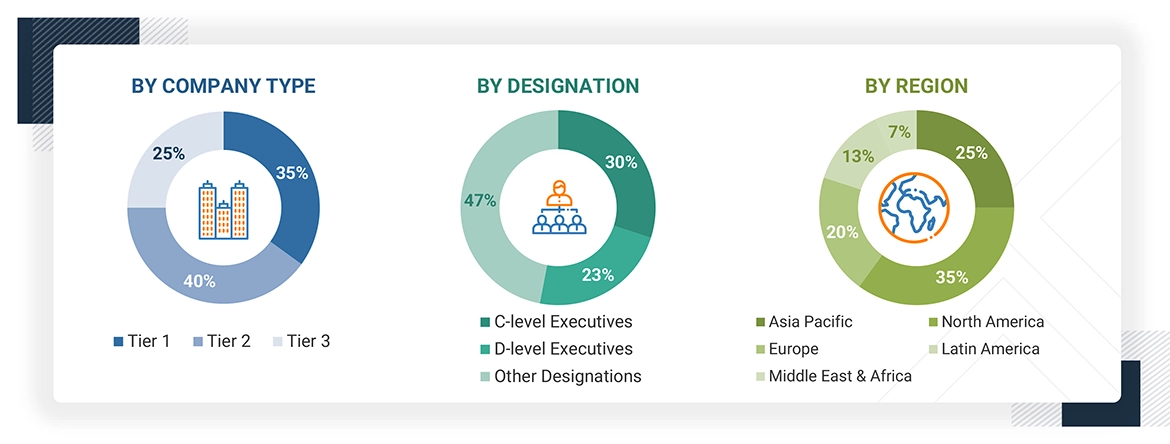
Note 1: C-level executives include CEOs, CFOs, COOs, and VPs.
Note 2: Other designations include sales managers, marketing managers, business development managers, product managers, distributors, and suppliers.
Note 3: Companies are classified into tiers based on their total revenue. As of 2024, Tier 1 = >USD 10 billion, Tier 2 = USD 1 billion to USD 10 billion, and Tier 3 = < USD 1 billion.
Source: MarketsandMarkets Analysis
To know about the assumptions considered for the study, download the pdf brochure
Market Size Estimation
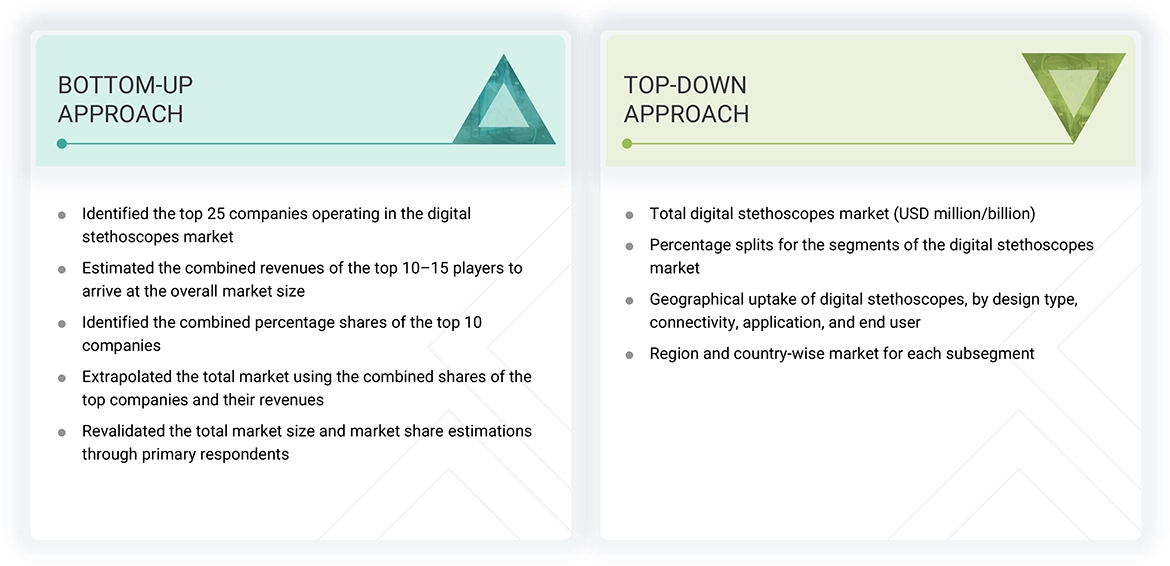
Annual revenues were calculated by mapping the earnings of major product manufacturers and OEMs engaged in the global digital stethoscopes market to determine the global market value. All key manufacturers were identified at both the global and regional levels. Revenue mapping was conducted for the relevant business segments and subsegments of these major players, who account for at least 70–75% of the overall market share. Additionally, the global digital stethoscopes market was divided into various segments and subsegments based on:
- A list of major players operating in the digital stethoscopes market at the regional and/or country level
- Product mapping of various digital stethoscope manufacturers at the regional and/or country level
- Mapping of annual revenues generated by listed major players from digital stethoscopes (or the nearest reported business unit/product category)
- Revenue mapping of major players to cover at least 70–75% of the global market share as of 2024
- Extrapolation of the revenue mapping of the listed major players to derive the global market value of the respective segments/subsegments
- Summation of the market value of all segments/subsegments to arrive at the global digital stethoscopes market
Market Size Estimation (Bottom-up Approach & Top-down Approach)
Data Triangulation
After determining the overall size of the global digital stethoscopes market using the methodology mentioned above, we divided the market into several segments and subsegments. Data triangulation and market breakdown procedures were applied, as needed, to finalize the overall market analysis and obtain precise market value data for the key segments and subsegments. The extrapolated market data was validated by examining various macroindicators and regional trends from both demand-side and supply-side participants.
Market Definition
A digital stethoscope is a modern medical device that transforms acoustic sound waves from the body, such as heartbeats and lung sounds, into electronic signals. These signals can be amplified, recorded, and transmitted. Unlike traditional acoustic stethoscopes, digital stethoscopes often include features like noise cancellation, Bluetooth connectivity, visual waveform displays, and data storage. These enhancements facilitate improved diagnosis, telemedicine applications, and remote patient monitoring.
Stakeholders
- Digital stethoscope manufacturers and distributors
- Healthcare institutions (hospitals and outpatient clinics)
- Research institutes
- Contract manufacturing organizations (CMOs)
- Market research and consulting firms
- Venture capitalists and investors
- Government bodies/municipal corporations
- Regulatory bodies
- Medical research institutes
- Business research and consulting service providers
Report Objectives
- To define, describe, and forecast the digital stethoscopes market by design type, connectivity, application, end user, and region
- To provide detailed information about the key factors influencing market growth, such as drivers, restraints, opportunities, challenges, and industry trends.
- To strategically analyze the regulatory scenario, value chain analysis, supply chain analysis, Porter’s Five Forces analysis, ecosystem analysis, trade analysis, pricing analysis, patent analysis, impact of AI, case study analysis, unmet needs/end-user expectations, impact of US tariff, and trends/disruptions impacting customer’s business on the market
- To analyze micromarkets with respect to individual growth trends, prospects, and contributions to the overall digital stethoscopes market
- To analyze market opportunities for stakeholders and provide details of the competitive landscape for key players
- To strategically profile the key players in this market and comprehensively analyze their market shares and core competencies
- To strategically analyze the digital stethoscopes market in five regions: North America, Europe, the Asia Pacific, Latin America, and the Middle East & Africa
- To track and analyze competitive developments such as acquisitions, product & service launches, partnerships, and expansions in the digital stethoscopes market
Get the Full Digital Stethoscopes Market Report
Full forecast, segment splits, and company analysis for all Digital Stethoscopes Market.
- US Digital Stethoscopes Market
- Canada Digital Stethoscopes Market
- Germany Digital Stethoscopes Market
- UK Digital Stethoscopes Market
- France Digital Stethoscopes Market
- Italy Digital Stethoscopes Market
- Spain Digital Stethoscopes Market
- China Digital Stethoscopes Market
- Japan Digital Stethoscopes Market
- India Digital Stethoscopes Market
- Australia Digital Stethoscopes Market
- South Korea Digital Stethoscopes Market
- Brazil Digital Stethoscopes Market
- Mexico Digital Stethoscopes Market
- Saudi Arabia Digital Stethoscopes Market
- UAE Digital Stethoscopes Market
- Rest Of Europe Digital Stethoscopes Market
- Rest Of Asia Pacific Digital Stethoscopes Market
- Other GCC Countries Digital Stethoscopes Market
- Rest Of Latin America Digital Stethoscopes Market
- GCC Countries Digital Stethoscopes Market
Need a Tailored Report?
Customize this report to your needs
Get 10% FREE Customization
Customize This Report
