
US Doors Market (2025-2030)

The US Doors Market was valued at $10758.6 Million in 2025 and projected to reach to $12378.5 Million by 2030, representing a compound annual growth rate of 2.8%. The US doors market demonstrates steady growth momentum through 2030, supported by sustained construction activity and industrial expansion.


| Market Size in | USD 26.32 MN |
| Market Forecast in | |
| CAGR | |
| Forecast Period | |
| Units Considered | Value (USD MN) |
US Doors Market Trends and Insights
- The US market benefits from robust construction activity, renovation demand, and industrial expansion across packaging, construction, mining, and gases sectors.
- In 2025, the US doors market reflects steady demand driven by commercial and residential building projects, with growth expected to accelerate through 2030 as infrastructure investments and modernization initiatives gain momentum. The US doors market demonstrates resilience supported by diverse end-use applications spanning construction, industrial facilities, and specialized environments.
- Between 2025 and 2030, the US market will experience incremental expansion fueled by technological advancements in door systems, sustainability requirements, and increased focus on energy-efficient solutions.
- The US doors market's moderate growth trajectory reflects mature market conditions balanced by ongoing renovation cycles and new construction starts across the country..
Key Market Statistics
- CAGR (2025-2030) 2.8% CAGR
- Market Size, 2025 ~USD 10758.6 Million
- Forecast, 2030 ~USD 12378.5 Million
- Country US
US Doors Market Overview
Market Size & Growth :
The US doors market is valued at $10,758.6 million in 2025 and is projected to reach $12,378.5 million by 2030, with a steady CAGR of 2.8%, reflecting consistent demand across multiple sectors.
Construction & Renovation Drivers :
Robust commercial and residential construction activity, coupled with strong renovation demand, continues to fuel the US doors market. Post-pandemic recovery and infrastructure investments support sustained growth.
Multi-Sector Applications :
The US doors market serves diverse industries including packaging, construction, mining, and gases sectors, creating multiple revenue streams and reducing dependency on any single end-use application.
Industrial Expansion Momentum :
Expanding industrial operations and manufacturing facilities across the US drive demand for specialized doors in mining, gas handling, and industrial packaging applications, supporting market resilience.
US Doors Market Dynamics
- Commercial real estate development, residential renovation cycles, and infrastructure modernization initiatives continue to drive demand across all sectors.
- The market benefits from technological advancements in door materials and energy-efficient designs, appealing to environmentally conscious builders and facility managers. Looking ahead, the US market is expected to maintain its 2.8% CAGR trajectory, with particular strength in specialized industrial doors for mining and gas applications.
- Supply chain stabilization, competitive pricing, and innovation in door manufacturing will support market penetration.
- Regional economic growth and continued investment in commercial infrastructure position the US as a stable, mature market with consistent long-term growth potential..
Market Ecosystem
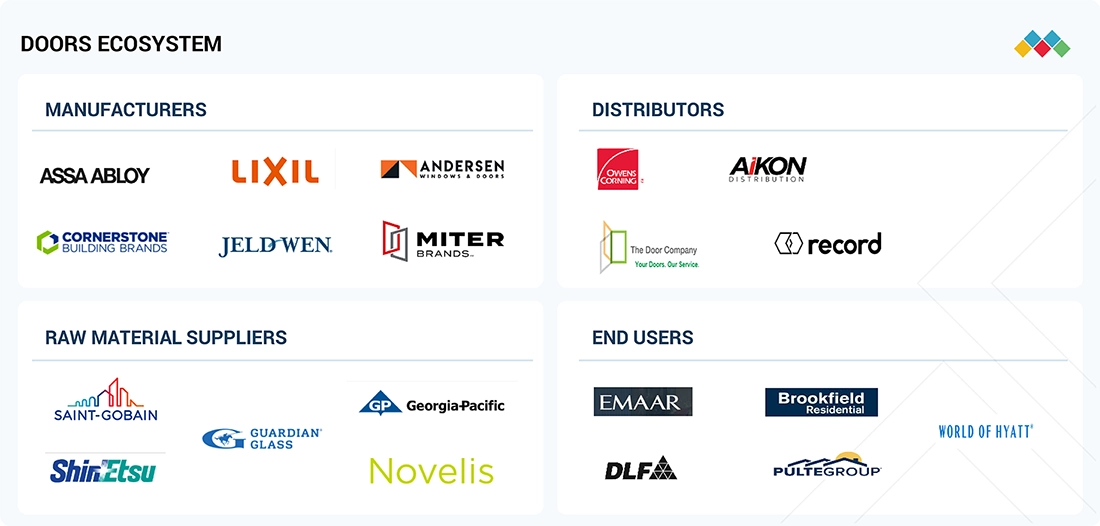
Doors Market: COMMERCIAL USE CASES ACROSS INDUSTRIES
| COMPANY | USE CASE DESCRIPTION | BENEFITS |
|---|---|---|
 |
A rural stone property in Yorkshire faced frequent door jamming and sill damage due to seasonal weather changes. It required a durable, low-maintenance front door that matched traditional architecture. | The Tavole front door in Honey Oak with engineered oak frame, PU foam insulation, and double-rebated edges provided weather resistance, eliminated maintenance issues, and enhanced the home’s exterior with a blend of contemporary design and rustic charm. |
 |
A FedEx distribution facility in Michigan faced frequent collisions and high maintenance costs with old roll-up steel doors, causing downtime and operational disruptions. | MaxSpeed high-performance rubber doors with breakaway system and fast opening speeds reduced downtime, enhanced safety, and delivered annual maintenance savings of USD 50,000, providing long-term operational efficiency with minimal intervention. |
 |
A Covent Garden parking facility in London experienced slow, unreliable roller shutter doors, causing security issues and service disruptions in a high-traffic environment. | PS Series fast-action doors improved operational flow, enhanced security, reduced unauthorized access, minimized litter and vermin ingress, and increased customer satisfaction with high-speed, reliable performance. |
Logos and trademarks shown above are the property of their respective owners. Their use here is for informational and illustrative purposes only.
Related Ecosystem
Building And Construction
- HVAC System
- Acoustic Insulation
- Alkyd Resins
- Fiberglass
- Thermal Insulation
- Snc-lavalin group inc.
- Saint-gobain
- LHOIST S.A
- USG CORPORATION
- Basf se
Key Takeaways
- The US Doors Market is valued at $10,758.6 million in 2025 and will reach $12,378.5 million by 2030 at a 2.8% CAGR.
- The US market is driven by construction activity, industrial expansion, and renovation demand across multiple sectors.
- Energy efficiency and sustainability standards are shaping product innovation in the US doors market.
- The US doors market reflects mature market dynamics with steady growth supported by infrastructure investments and modernization cycles.
Doors Market Report Scope
| Report Metric | Details |
|---|---|
| Base Year | 2025 |
| Fastest Growing Segment | METAL (Material) |
| Forecast Period | 2025–2030 |
| Growth Rate | CAGR of 3.8% from 2025 to 2030 |
| Largest Segment | RESIDENTIAL (End-Use Industry) |
| Market Size Base Year (Billions) | ~USD 81.59 (2025) |
| Revenue Forecast (Billions) | ~USD 98.32 (2030) |
| Segments Covered | Material, Mechanism, Product Type, Mode Of Application, Application, Product, Construction Type, End-Use Industry |
US Doors Market Report Segmentation
8 segment dimensions are covered across the global market.
By Material
- Composite
- Glass
- Metal
- Other Materials
- Plastic
- Wood
By Mechanism
- Folding Doors
- Other Mechanisms
- Overhead Doors
- Sliding Doors
- Swinging Doors
By Product Type
- Exterior Doors
- Interior Doors
By Mode Of Application
- Aftermarket
- New Construction
By Application
- Non-Residential
- Residential
By Product
- Doors
- Windows
By Construction Type
- Folding
- Other Construction Types
- Revolving
- Sliding
- Swinging
By End-Use Industry
- Commercial
- Industrial
- Residential
Target Audience
- Construction & Real Estate Developers : Need market data to forecast material costs, plan procurement strategies, and understand demand trends for residential and commercial door installations across US projects.
- Door Manufacturers & Suppliers : Require market sizing and growth forecasts to optimize production capacity, plan product portfolios, and identify expansion opportunities within the US doors market through 2030.
- Industrial & Mining Operators : Seek insights on specialized door demand in mining and gas sectors to plan facility upgrades, standardize equipment specifications, and budget for industrial door replacements.
- Investment & Private Equity Firms : Need comprehensive market analysis to evaluate acquisition targets, assess portfolio company growth potential, and identify consolidation opportunities in the US doors industry.
- Business Consultants & Analysts : Require verified market data and forecasts to support client strategy recommendations, competitive analysis, and market entry assessments for the US doors sector.
Key Companies in the US Doors Market
| Company | HQ | Ownership | Strongest segments |
|---|---|---|---|
| CRH PLC | Ireland | Public Company | Non-residential door-integrated precast and modular structures,Residential and light commercial building envelope and hardscape,Infrastructure and utility access products, |
| ALUPLAST | Germany | Private Company | Sliding doors,Swinging doors,Folding doors, |
| SOMFY GROUP | France | Private Company | Tubular motors and drives for doors and shutters,Control systems, sensors, and access management,Connected home and security solutions linked to doors, |
| LINDAB AB | Sweden | Public Company | Overhead and industrial doors (via steel profiles and envelope systems),Swinging doors (commercial and institutional, via façade and wall systems),Sliding and folding doors (industrial and agricultural, via structural profiles), |
| KODIAK | United States | Public Company | Autonomous long-haul trucking (driver-as-a-service),Industrial trucking and yard operations,Defense autonomous ground vehicles (AGVs), |
| ASSA ABLOY | Sweden | Public Company | Automatic sliding and swinging doors (including revolving and entrance systems),Wooden and steel doors (door leaves and frames),Door hardware and mechanical components, |
| LIXIL CORPORATION | Japan | Public Company | Residential doors (all mechanisms),Non-residential doors,Sliding and folding mechanisms, |
| CORNERSTONE BUILDING BRANDS, INC. | United States | Private Company | Residential entry doors (steel, wood, fiberglass),Residential patio doors (vinyl, aluminum, clad-wood),Non-residential doors (metal and integrated in metal building systems), |
| JELD-WEN, INC. | United States | Public Company | Residential exterior doors and patio systems (swinging, sliding, folding),Residential interior doors and molded door skins,Non-residential and specialty doors (including metal and composite), |
| ALLEGION PLC | Ireland | Public Company | Swinging door hardware and access (locks, exit devices, door controls),Electronic security, access control, and software linked to doors,Automatic and sliding door systems and services, |
| YKK AP | Japan | Private Company | Residential entrance and front doors,Residential sliding and interior doors,Non-residential aluminum entrance and swing doors, |
| OWENS CORNING | United States | Public Company | Residential exterior doors,Residential interior doors,Non-residential doors, |
| NOVOFERM GMBH | Germany | Subsidiary | Overhead and Sectional Doors,Sliding Doors (industrial, fire, and specialty),Swinging Doors (steel and security doors), |
CRH PLC
CRH PLC is a Dublin-based public company founded in 1936 that operates as a major building materials and construction products manufacturer. With 83,032 employees, the company serves customers across multiple continents through diverse product portfolios.
ALUPLAST
ALUPLAST is a German private company founded in 1982 specializing in building materials and construction products.
SOMFY GROUP
SOMFY GROUP is a French private company established in 1969 with 6,433 employees, operating in the building and construction sector.
LINDAB AB
LINDAB AB is a Swedish public company founded in 1959 with 4,979 employees, engaged in the manufacture and distribution of building materials and construction products.
KODIAK
KODIAK is a United States-based public company founded in 2018 with 342 employees operating in the building and construction industry.
ASSA ABLOY
ASSA ABLOY is a Swedish public company with roots dating back to 1881 and 63,939 employees, serving as a global leader in access solutions and building security products.
LIXIL CORPORATION
LIXIL CORPORATION is a Japanese public company with a heritage dating to 1875 and 48,073 employees, specializing in building materials, housing equipment, and construction products.
CORNERSTONE BUILDING BRANDS, INC.
CORNERSTONE BUILDING BRANDS, INC. is a United States-based private company founded in 1984 with 19,400 employees, operating in the building materials and construction sector.
JELD-WEN, INC.
JELD-WEN, INC. is a United States public company established in 1960 with 13,900 employees, manufacturing doors, windows, and related building products.
ALLEGION PLC
ALLEGION PLC is an Ireland-based public company founded in 2013 with 13,300 employees, specializing in security products and access solutions for buildings.
YKK AP
YKK AP is a Japanese private company founded in 1957 with 7,002 employees, manufacturing architectural products including windows and doors.
OWENS CORNING
OWENS CORNING is a United States public company founded in 1938 with 25,000 employees, specializing in building materials including insulation, roofing, and fiberglass products.
NOVOFERM GMBH
NOVOFERM GMBH is a German company founded in 1955 operating as a subsidiary in the building materials and construction products industry.
Reasons to Buy this Report
- Accurate Market Sizing : Obtain precise valuation data for the US doors market with verified figures for 2025 ($10.76B) and 2030 projections ($12.38B), enabling confident financial planning and investment decisions.
- Sector-Specific Insights : Understand demand patterns across packaging, construction, mining, and gases sectors specific to the US market, allowing targeted product development and market positioning strategies.
- Growth Trajectory Analysis : Leverage the 2.8% CAGR data to forecast revenue streams, plan capacity expansion, and identify optimal entry or expansion timing within the US doors market through 2030.
- Competitive Benchmarking : Compare your performance against US market growth rates and identify competitive gaps. Understand how the US market (2.8% CAGR) differs from global trends (3.8% CAGR) for strategic advantage.
- Investment & Stakeholder Confidence : Present data-backed market analysis to investors, board members, and stakeholders to justify capital allocation, M&A decisions, and strategic initiatives in the US doors sector.
Frequently asked questions
What is the current size of the US Doors Market in 2025?
The US Doors Market is estimated at $10,758.6 million in 2025.
What is the projected size of the US Doors Market by 2030?
The US Doors Market is projected to reach $12,378.5 million by 2030.
What is the CAGR for the US Doors Market from 2025 to 2030?
The US Doors Market is expected to grow at a compound annual growth rate of 2.8% between 2025 and 2030.
Which sectors drive demand in the US Doors Market?
The US Doors Market is driven by packaging, construction, mining, and gases industries, with significant demand from commercial and residential building projects.
What factors influence growth in the US Doors Market?
Growth in the US Doors Market is influenced by construction activity, renovation cycles, infrastructure investments, energy efficiency standards, and technological advancements in door systems.
RESEARCH METHODOLOGY
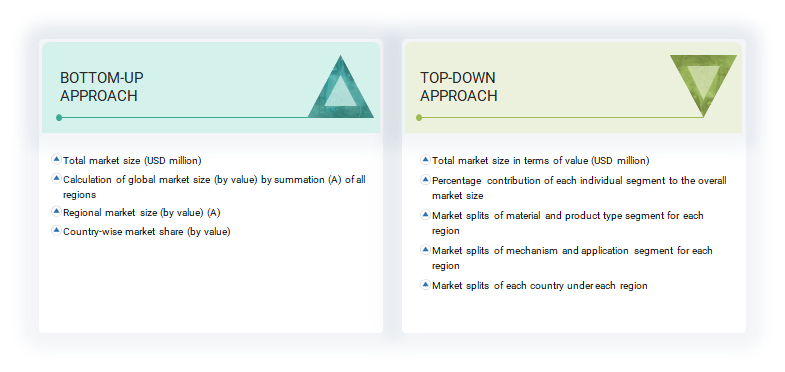
The study involved four major activities to estimate the current size of the global doors market. Exhaustive secondary research was carried out to collect information on the market, the peer product market, and the parent product group market. The next step was to validate these findings, assumptions, and sizes with the industry experts across the value chain of doors through primary research. The top-down and bottom-up approaches were employed to estimate the overall size of the doors market. After that, market breakdown and data triangulation procedures were used to determine the size of different segments and sub-segments of the market.
Secondary Research
The market for the companies offering doors is arrived at by secondary data available through paid and unpaid sources, analyzing the product portfolios of the major companies in the ecosystem, and rating the companies by their performance and quality. Various secondary sources, such as Business Standard, Bloomberg, World Bank, and Factiva, were referred to identify and collect information for this study on the doors market. In the secondary research process, various secondary sources were referred to identify and collect information related to the study. Secondary sources included annual reports, press releases, and investor presentations of door vendors, forums, certified publications, and whitepapers. The secondary research was used to obtain critical information on the industry’s value chain, the total pool of key players, market classification, and segmentation from the market and technology-oriented perspectives.
Primary Research
In the primary research process, various primary sources from both the supply and demand sides were interviewed to obtain qualitative and quantitative information for this report. The primary sources from the supply side included industry experts, such as Chief Executive Officers (CEOs), Vice Presidents (VPs), marketing directors, technology and innovation directors, and related key executives from several key companies and organizations operating in the doors market. After the complete market engineering (calculations for market statistics, market breakdown, market size estimations, market forecasting, and data triangulation), extensive primary research was conducted to gather information and verify and validate the critical numbers arrived at. Primary research was also conducted to identify the segmentation types, industry trends, competitive landscape of doors offered by various market players, and key market dynamics, such as drivers, restraints, opportunities, challenges, industry trends, and key player strategies. In the complete market engineering process, the top-down and bottom-up approaches and several data triangulation methods were extensively used to perform the market estimation and market forecasting for the overall market segments and subsegments listed in this report. Extensive qualitative and quantitative analysis was performed on the complete market engineering process to list the key information/insights throughout the report.
The following is the breakdown of primary respondents:
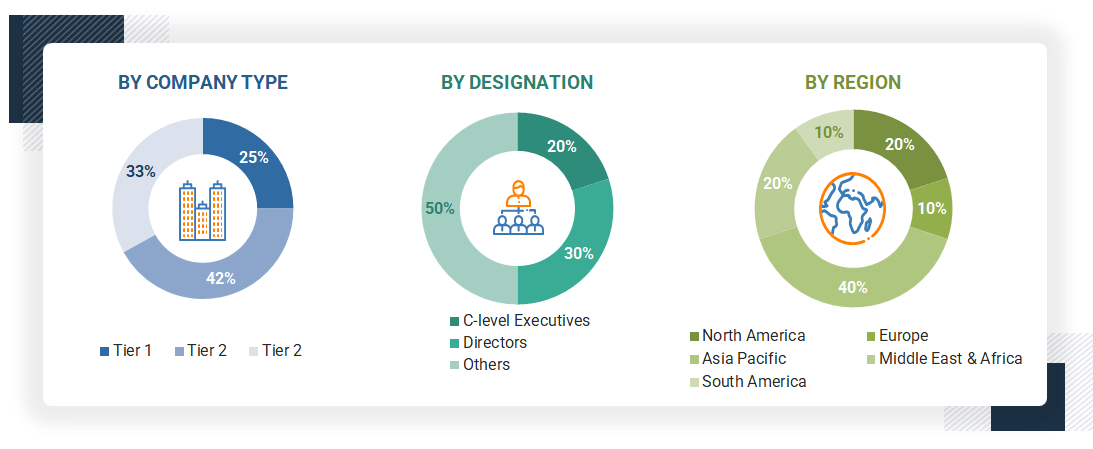
Notes: Other designations include sales, marketing, and product managers.
Tier 1: >USD 1 Billion; Tier 2: USD 500 million–1 Billion; and Tier 3: < USD 500 million.
To know about the assumptions considered for the study, download the pdf brochure
Market Size Estimation
The top-down and bottom-up approaches were used to estimate and validate the size of the global doors market. These approaches were also used extensively to estimate the size of various dependent market segments. The research methodology used to estimate the market size included the following:
Data Triangulation
After arriving at the overall market size using the market size estimation processes, the market was split into several segments and subsegments. The data triangulation and market breakup procedures were employed, wherever applicable, to complete the overall market engineering process and arrive at the exact statistics of each market segment and subsegment. The data was triangulated by studying various factors and trends from both the demand and supply sides.
Market Definition
A door is a movable structure intended to facilitate entry and departure to enclosed areas while regulating access, ensuring privacy, and safeguarding interiors from external factors such as weather, noise, and dust. Doors are typically made from wood, metal, glass, plastic, or composite materials and are available in various types, swinging, sliding, folding, or overhead, to suit residential and non-residential applications. Organizations such as the Window & Door Manufacturers Association (WDMA) and Builders Hardware Manufacturers Association (BHMA) define a door system as a complete assembly including one or more panels (or leaves), a supporting frame, and other accessories and necessary hardware, i.e., hinges, locks, and handles. It might also include accessories, glass, and seals intended to improve security, acoustics, and thermal performance.
Stakeholders
- Door manufacturers
- Raw material suppliers
- Converters & processors
- Distributors and traders
- Industry associations and regulatory bodies
- End users
Report Objectives
- To define, describe, and forecast the size of the global doors market based on material, product type, mechanism, mode of application, application, and region in terms of value and volume
- To provide detailed information on the significant drivers, restraints, opportunities, and challenges influencing the market
- To strategically analyze micromarkets concerning individual growth trends, prospects, and their contribution to the market
- To assess the growth opportunities in the market for stakeholders and provide details on the competitive landscape for market leaders
- To forecast the market size of segments and subsegments for North America, Europe, Asia Pacific, South America, and the Middle East & Africa
- To strategically profile key players and comprehensively analyze their market shares and core competencies
- To analyze competitive developments such as product launches, mergers, acquisitions, expansions, collaborations, and partnerships in the doors market
- To provide the impact of AI/Gen AI on the market
Get the Full Doors Market Report
Full forecast, segment splits, and company analysis for all Doors Market.
- China Doors Market
- India Doors Market
- Japan Doors Market
- Australia Doors Market
- Indonesia Doors Market
- Canada Doors Market
- Mexico Doors Market
- Germany Doors Market
- France Doors Market
- Italy Doors Market
- UK Doors Market
- Russia Doors Market
- Brazil Doors Market
- Argentina Doors Market
- South Africa Doors Market
- Rest Of Europe Doors Market
- Rest Of Asia Pacific Doors Market
- GCC Countries Doors Market
- –Rest Of GCC Doors Market
- Rest Of South America Doors Market
Need a Tailored Report?
Customize this report to your needs
Get 10% FREE Customization
Customize This Report
