
Rest Of Asia Pacific Drug Device Combination Products Market (2025-2030)

The Rest Of Asia Pacific Drug Device Combination Products Market was valued at $4659.5 Million in 2025 and projected to reach to $7203.3 Million by 2030, representing a compound annual growth rate of 9.1%. Rest Of Asia Pacific represents a compelling growth frontier for drug device combination products, with market expansion accelerating due to rising healthcare expenditures and increasing disease burden across the region.


| Market Size in | USD 26.32 MN |
| Market Forecast in | |
| CAGR | |
| Forecast Period | |
| Units Considered | Value (USD MN) |
Rest Of Asia Pacific Drug Device Combination Products Market Trends and Insights
- The region's market was valued at $4,659.5 million in 2025 and is projected to expand to $7,203.3 million by 2030, reflecting a compound annual growth rate of 9.1%.
- Rest Of Asia Pacific's growth trajectory is driven by increasing healthcare investments, rising chronic disease prevalence, and expanding pharmaceutical manufacturing capabilities across emerging economies. The drug device combination products sector in Rest Of Asia Pacific is characterized by growing adoption of integrated therapeutic solutions and regulatory framework improvements.
- Rest Of Asia Pacific's market expansion is supported by rising patient populations, improving healthcare infrastructure, and increased focus on innovative treatment modalities.
- The region's competitive landscape continues to attract both multinational and regional players seeking to capitalize on the substantial growth potential through 2030..
Key Market Statistics
- CAGR (2025-2030) 9.1% CAGR
- Market Size, 2025 ~USD 4659.5 Million
- Forecast, 2030 ~USD 7203.3 Million
- Country Rest Of Asia Pacific
Rest Of Asia Pacific Drug Device Combination Products Market Overview
Market Valuation Growth :
Rest Of Asia Pacific's drug device combination products market reached $4,659.5 million in 2025 and is projected to grow to $7,203.3 million by 2030, representing a robust 9.1% CAGR.
Healthcare Investment Surge :
Emerging economies across Rest Of Asia Pacific are significantly increasing healthcare infrastructure investments, creating favorable conditions for advanced combination product adoption and market expansion.
Chronic Disease Prevalence :
Rising incidence of chronic diseases including diabetes, cardiovascular conditions, and respiratory disorders in Rest Of Asia Pacific is driving demand for integrated drug-device solutions that improve patient outcomes.
Regulatory Framework Evolution :
Rest Of Asia Pacific countries are progressively strengthening regulatory pathways for combination products, facilitating faster market entry and encouraging innovation in this high-growth segment.
Rest Of Asia Pacific Drug Device Combination Products Market Dynamics
- The 9.1% CAGR reflects strong demand from both developed and emerging markets within the region, supported by improving healthcare infrastructure and growing patient awareness of advanced therapeutic solutions. The region's growth trajectory is further bolstered by favorable demographic trends, expanding middle-class populations with greater healthcare access, and government initiatives promoting pharmaceutical innovation.
- Strategic partnerships between multinational companies and local manufacturers are expected to enhance market penetration, while regulatory harmonization efforts will streamline product approvals and accelerate commercialization timelines across Rest Of Asia Pacific..
Market Ecosystem
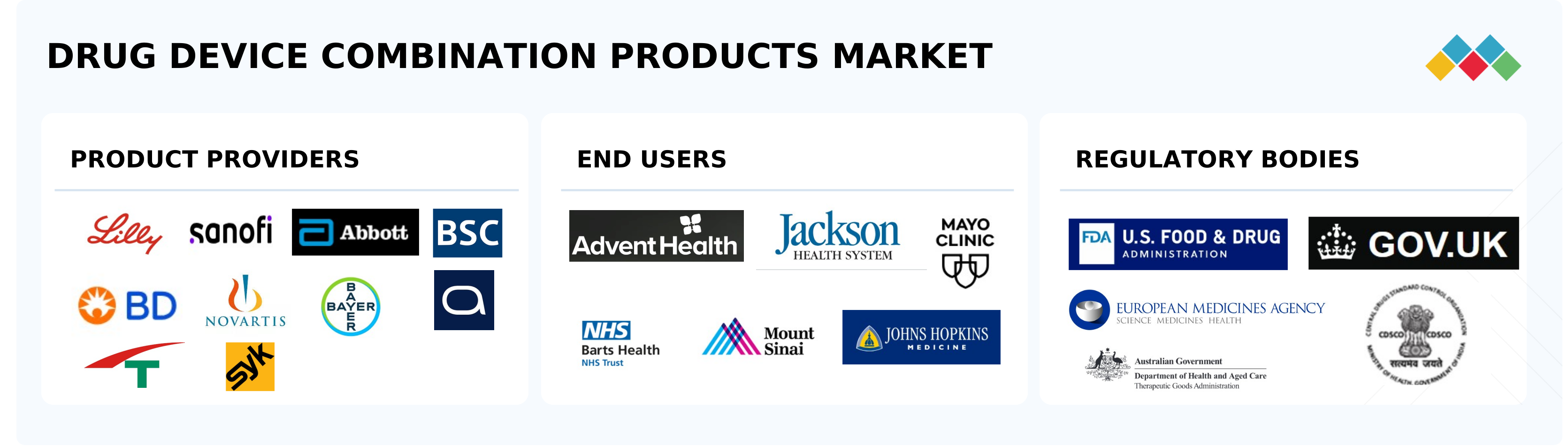
Drug Device Combination Products Market: COMMERCIAL USE CASES ACROSS INDUSTRIES
| COMPANY | USE CASE DESCRIPTION | BENEFITS |
|---|---|---|
 |
Broad portfolio in cardiovascular care and diabetes management; includes drug-eluting stents, drug-coated balloons, and integrated diagnostics | Enhanced patient outcomes through advanced therapy delivery, improved chronic disease management, global reach |
 |
Extensive combination therapies: drug-eluting stents, implantable infusion pumps, smart insulin pens. Innovation-driven, strong global footprint | Improved care for chronic conditions, innovation in minimally invasive therapies, global healthcare access |
 |
Develops minimally invasive drug-device products, especially in cardiac and vascular fields (e.g., drug-eluting stents) | Greater procedural efficacy, reduced complications, competitive portfolio in therapeutic delivery |
 |
Digital drug delivery (e.g., smart insulin pens), bespoke injection solutions for diabetes and biologics | Increased medication adherence, digital engagement, innovation for chronic disease management |
 |
Integrated pharmaceuticals and devices, focusing on chronic disease therapies (oncology, diabetes, etc.) | Personalized treatment options, enhanced therapy effectiveness, focus on next-generation products |
Logos and trademarks shown above are the property of their respective owners. Their use here is for informational and illustrative purposes only.
Related Ecosystem
Drug Delivery Devices
- Disposable Autoinjectors
- Reusable Autoinjectors
- Insulin Pumps
- Pen Injectors
- Transdermal Patches
- Becton, Dickinson and Company
- Novo nordisk a/s
- Terumo Corporation
- Medtronic plc
- Nipro Corporation
Medical Devices
- Polymerase Chain Reaction (PCR)
- Magnetic Resonance Imaging (MRI)
- Disposable Autoinjectors
- Pulse Oximeters
- Blood Pressure Monitors
- Medtronic plc
- Abbott Laboratories
- Stryker Corporation
- Becton, Dickinson and Company
- JOHNSON & JOHNSON
Key Takeaways
- Rest Of Asia Pacific's drug device combination products market is projected to grow from $4,659.5 million in 2025 to $7,203.3 million by 2030 at a 9.1% CAGR.
- Rest Of Asia Pacific benefits from expanding healthcare infrastructure and increasing chronic disease burden driving demand for combination therapies.
- Rest Of Asia Pacific's regulatory environment is evolving to support faster approval pathways for innovative drug device combinations.
- Rest Of Asia Pacific presents significant opportunities for both established multinational companies and emerging regional manufacturers through 2030.
Drug Device Combination Products Market Report Scope
| Report Metric | Details |
|---|---|
| Base Year | 2025 |
| Fastest Growing Segment | OBESITY MANAGEMENT (Application) |
| Forecast Period | 2025-2030 |
| Growth Rate | CAGR of 9.3% from 2025 to 2030 |
| Largest Segment | INJECTABLE DRUG DELIVERY DEVICES (Product Type) |
| Market Size Base Year (Billions) | ~USD 243.07 (2025) |
| Revenue Forecast (Billions) | ~USD 379.17 (2030) |
| Segments Covered | Product Type, Type, Application, End User |
Rest Of Asia Pacific Drug Device Combination Products Market Report Segmentation
4 segment dimensions are covered across the global market.
By Product Type
- Drug-Coated Balloons
- Drug-Eluting Stents
- Infusion Pumps
- Inhalers
- Injectable Drug Delivery Devices
- Other Product Types
- Transdermal Patches
By Type
- Autoinjectors
- Needle-Free Injectors
- Pen Injectors
- Prefilled Syringes
- Wearable Injectors
By Application
- Autoimmune Diseases
- Cardiovascular Diseases
- Diabetes Management
- Infectious Diseases
- Obesity Management
- Oncology
- Opthamology
- Other Applications
- Pain Management
- Respiratory Diseases
By End User
- Ambulatory Surgery Centers
- Home Care Settings
- Hospitals & Clinics
- Long-Term Care Facilities
- Other End Users
Target Audience
- Pharmaceutical Manufacturers : Need Rest Of Asia Pacific market data to identify growth opportunities, assess regional demand for combination products, and develop localized commercialization strategies for this high-growth segment.
- Medical Device Companies : Require detailed Rest Of Asia Pacific insights to evaluate market potential, understand regulatory requirements, and plan strategic partnerships for combination product development and distribution.
- Healthcare Investors & PE Firms : Seek Rest Of Asia Pacific market intelligence to evaluate investment opportunities, assess portfolio company growth potential, and identify acquisition targets in the combination products space.
- Healthcare Consultants & Advisors : Need Rest Of Asia Pacific-specific market data to provide clients with evidence-based strategic recommendations, competitive analysis, and market entry guidance for combination product initiatives.
- Regulatory & Compliance Professionals : Require Rest Of Asia Pacific market context and regulatory landscape information to navigate approval processes, ensure compliance, and optimize product development timelines across the region.
Reasons to Buy this Report
- Regional Market Sizing & Forecasts : Obtain precise market valuations specific to Rest Of Asia Pacific with detailed 2025-2030 projections, enabling accurate budget allocation and revenue forecasting for regional expansion strategies.
- Growth Driver Analysis : Understand the unique factors propelling 9.1% CAGR in Rest Of Asia Pacific, including healthcare investments, chronic disease prevalence, and regulatory developments specific to the region.
- Competitive Landscape Intelligence : Gain insights into regional market dynamics, key players, and competitive positioning within Rest Of Asia Pacific to identify partnership and investment opportunities.
- Market Entry Strategy Development : Leverage Rest Of Asia Pacific-specific data to develop targeted go-to-market strategies, regulatory compliance roadmaps, and localization approaches for combination product launches.
- Investment Decision Support : Make informed capital allocation decisions with comprehensive Rest Of Asia Pacific market analysis, risk assessments, and opportunity identification for portfolio expansion and M&A activities.
Frequently asked questions
What is the current market size of drug device combination products in Rest Of Asia Pacific?
Rest Of Asia Pacific's drug device combination products market was valued at $4,659.5 million in 2025.
What is the projected market size for Rest Of Asia Pacific by 2030?
Rest Of Asia Pacific's drug device combination products market is forecast to reach $7,203.3 million by 2030.
What is the CAGR for Rest Of Asia Pacific's drug device combination products market?
Rest Of Asia Pacific's drug device combination products market is expected to grow at a compound annual growth rate of 9.1% from 2025 to 2030.
What factors are driving growth in Rest Of Asia Pacific's market?
Rest Of Asia Pacific's market growth is driven by increasing healthcare investments, rising chronic disease prevalence, expanding pharmaceutical manufacturing capabilities, and improving regulatory frameworks.
Which segments are most prominent in Rest Of Asia Pacific?
Rest Of Asia Pacific's market includes diverse segments such as inhalers, injectable devices, transdermal systems, and diagnostic-therapeutic combinations serving various therapeutic areas.
RESEARCH METHODOLOGY
This study involved the extensive use of both primary and secondary sources. The research process involved the study of various factors affecting the industry to identify the segmentation types, industry trends, key players, competitive landscape, fundamental market dynamics, and key player strategies.
Secondary Research
The secondary research process involves the widespread use of secondary sources, directories, databases (such as Bloomberg Businessweek, Factiva, and D&B Hoovers), white papers, annual reports, company house documents, investor presentations, SEC filings of companies, and publications from government sources [such as National Institutes of Health (NIH), US FDA, US Census Bureau, World Health Organization (WHO), Centers for Disease Control and Prevention (CDC), European Federation of Pharmaceutical Industries and Associations (EFPIA), American Journal of Drug Delivery and Therapeutics, International Diabetes Federation (IDF), American Association of Diabetes Educators (AADE), Asian Association for the Study of Diabetes (AASD) and Parenteral Drug Association (PDA) were referred to identify and collect information for the global drug device combination products market study. It was also used to obtain important information about the key players and market classification & segmentation according to industry trends, to the bottom-most level, and key developments related to market and technology perspectives. A database of the key industry leaders was also prepared using secondary research.
Primary Research
In the primary research process, various supply and demand sources were interviewed to obtain qualitative and quantitative information for this report. The primary sources from the supply side include industry experts such as CEOs, vice presidents, marketing and sales directors, technology & innovation directors, and related key executives from various key companies and organizations in the drug device combination products market. The primary sources from the demand side include hospitals & clinics and home care settings. Primary research was conducted to validate the market segmentation, identify key players, and gather insights on key industry trends & key market dynamics.
A breakdown of the primary respondents is provided below:
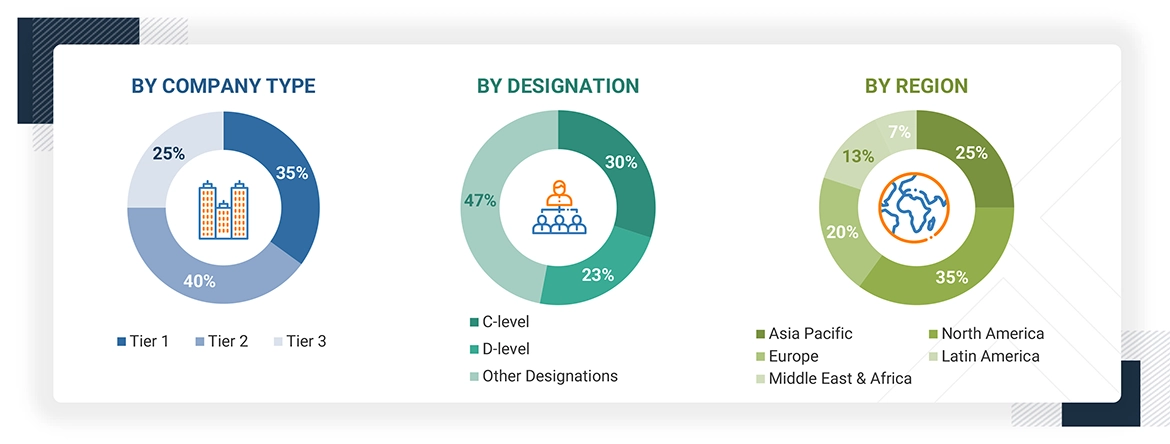
*C-levels include CEOs, CFOs, COOs, and VPs.
*Other designations include sales managers, marketing managers, business development managers, product managers, distributors, and suppliers.
Note: Companies are classified into tiers based on their total revenue. As of 2024, Tier 1 = >USD 10.00 billion, Tier 2 = USD 1.00 billion to USD 10.00 billion, and Tier 3 = < USD 1.00 billion.
Source: MarketsandMarkets Analysis
To know about the assumptions considered for the study, download the pdf brochure
Market Size Estimation
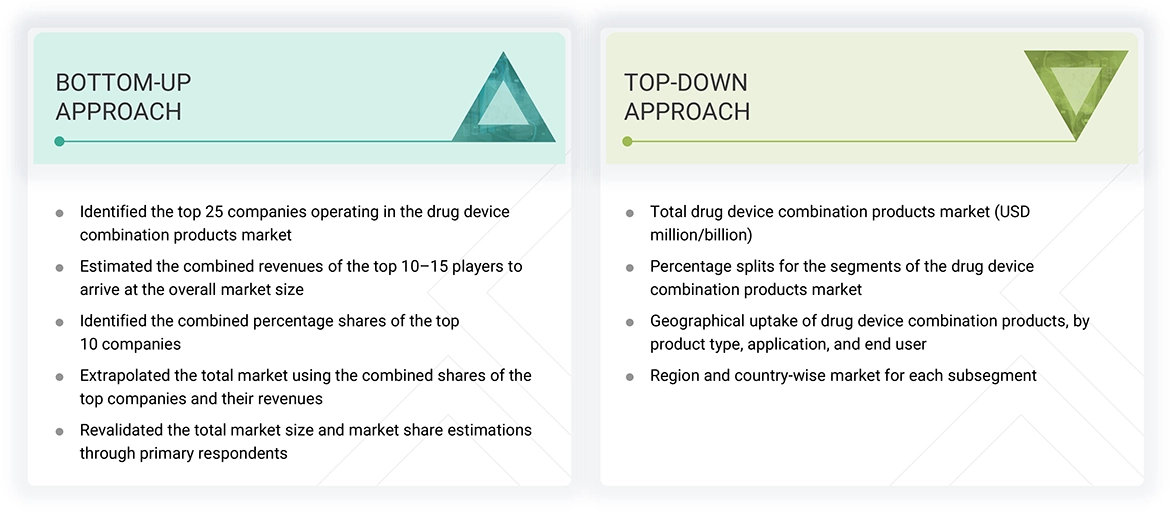
For the global market value, annual revenues were calculated based on the revenue mapping of major product manufacturers and OEMs active in the global drug device combination products market. All the major product manufacturers were identified at the global and/or country/regional level. Revenue mapping for the respective business segments/sub-segments was done for the major players (who contribute at least 70–75% of the market share at the global level). Also, the global drug device combination products market was split into various segments and sub-segments based on:
- List of major players operating in the drug device combination products market at the regional and/or country level
- Product mapping of various drug device combination product manufacturers at the regional and/or country level
- Mapping of annual revenue generated by listed major players from drug device combination products (or the nearest reported business unit/product category)
- Revenue mapping of major players to cover at least 70–75% of the global market share as of 2024
- Extrapolation of the revenue mapping of the listed major players to derive the global market value of the respective segments/subsegments
- Summation of the market value of all segments/subsegments to arrive at the global point-of-care diagnostics market
Market Size Estimation (Bottom-up approach and Top-down approach)
Data Triangulation
After arriving at the overall size of the global drug device combination products market through the above-mentioned methodology, this market was split into several segments and subsegments. The data triangulation and market breakdown procedures were employed, wherever applicable, to complete the overall market engineering process and arrive at the exact market value data for the key segments and subsegments. The extrapolated market data was triangulated by studying various macro indicators and regional trends from both demand- and supply-side participants.
Market Definition
A combination product is defined as any amalgamation of a drug and a device, a biological product and a device, a drug and a biological product, or a triad comprising a drug, device, and biological product. This category encompasses products that consist of two or more regulated entities—such as drug/device, biologic/device, drug/biologic, or drug/device/biologic—that are integrated or formulated as a single entity through various physical, chemical, or other methodologies. Moreover, combination products may also refer to distinct components that are packaged either as a single unit or as a collaborative assembly of biological and drug compounds, device-to-device pairings, or drug and device integrations.
Stakeholders
- Drug device combination products manufacturers and distributors
- Healthcare institutions (hospitals, medical schools, and outpatient clinics)
- Research institutes
- Contract manufacturing organizations (CMOs)
- Market research and consulting firms
- Venture capitalists and investors
- Market research and consulting firms
- Government Bodies/Municipal Corporations
- Regulatory Bodies
- Medical Research Institutes
- Business Research and Consulting Service Providers
Report Objectives
- To define, measure, and describe the global drug device combination products market by product type, application, end user, and region
- To provide detailed information about the major factors influencing market growth (drivers, restraints, challenges, and opportunities)
- To strategically analyze the regulatory analysis, pricing analysis, value chain analysis, supply chain analysis, ecosystem analysis, technology analysis, Porter’s Five Forces analysis, and patent analysis
- To analyze micromarkets with respect to individual growth trends, prospects, and contributions to the overall market
- To analyze market opportunities for stakeholders and provide details of the competitive landscape for key players
- To forecast the size of market segments in North America, Europe, the Asia Pacific, Latin America, and the Middle East & Africa
- To strategically analyze the market structure, profile the key players in the global drug device combination products market, and comprehensively analyze their core competencies
- To track and analyze company developments such as acquisitions, partnerships, expansions, and product launches and approvals in the drug device combination products market
- To track and analyze competitive developments such as mergers and acquisitions, new product developments, partnerships, agreements, collaborations, and expansions in the global drug device combination products market
Get the Full Drug Device Combination Products Market Report
Full forecast, segment splits, and company analysis for all Drug Device Combination Products Market.
- US Drug Device Combination Products Market
- Canada Drug Device Combination Products Market
- UK Drug Device Combination Products Market
- Germany Drug Device Combination Products Market
- France Drug Device Combination Products Market
- Italy Drug Device Combination Products Market
- Spain Drug Device Combination Products Market
- China Drug Device Combination Products Market
- Japan Drug Device Combination Products Market
- India Drug Device Combination Products Market
- South Korea Drug Device Combination Products Market
- Australia Drug Device Combination Products Market
- Brazil Drug Device Combination Products Market
- Mexico Drug Device Combination Products Market
- UAE Drug Device Combination Products Market
- Rest Of Europe Drug Device Combination Products Market
- Rest Of GCC Countries Drug Device Combination Products Market
- Rest Of Latin America Drug Device Combination Products Market
- Kingdom Of Saudi Arabia Drug Device Combination Products Market
Need a Tailored Report?
Customize this report to your needs
Get 10% FREE Customization
Customize This Report
