
Canada Embodied AI Market (2025-2030)

The Canada Embodied AI Market was valued at $244.5 Million in 2025 and projected to reach to $1134.9 Million by 2030, representing a compound annual growth rate of 35.9%. Canada's embodied AI market is positioned for exceptional growth through 2030, driven by critical labor market pressures and digital transformation initiatives across key industries.


| Market Size in | USD 26.32 MN |
| Market Forecast in | |
| CAGR | |
| Forecast Period | |
| Units Considered | Value (USD MN) |
Canada Embodied AI Market Trends and Insights
- This robust growth trajectory reflects Canada's strengthening position in robotics, autonomous systems, and edge AI deployment across manufacturing, healthcare, and logistics sectors.
- Canada's investment in AI infrastructure and talent development is driving adoption of embodied AI solutions among enterprises seeking competitive advantages through intelligent automation. The Canadian embodied AI ecosystem benefits from strong government support, academic research institutions, and a growing venture capital landscape focused on AI innovation.
- Between 2025 and 2030, Canada is expected to see increased commercialization of embodied AI applications in industrial automation and service robotics.
- Canada's proximity to North American markets and its skilled workforce position the country as a key hub for embodied AI development and deployment within the region..
Key Market Statistics
- CAGR (2025-2030) 35.9% CAGR
- Market Size, 2025 ~USD 244.5 Million
- Forecast, 2030 ~USD 1134.9 Million
- Country Canada
Canada Embodied AI Market Overview
Rapid Market Expansion :
Canada's embodied AI market is projected to grow from $244.5 million in 2025 to $1,134.9 million by 2030, with a CAGR of 35.9%, significantly outpacing many developed markets and reflecting strong domestic demand.
Key Sector Adoption :
Manufacturing, healthcare, and logistics sectors are leading embodied AI deployment in Canada, driven by labor shortages, automation needs, and the country's advanced robotics research ecosystem.
Edge AI Leadership :
Canada is establishing itself as a hub for edge AI and autonomous systems development, with major investments from tech companies and research institutions focusing on localized AI processing and real-time decision-making.
Government & Investment Support :
Federal and provincial initiatives, including AI research funding and innovation grants, are accelerating embodied AI commercialization and attracting venture capital to Canadian startups and established tech firms.
Canada Embodied AI Market Dynamics
- The country's strong research institutions, government support for AI innovation, and growing adoption of robotics in manufacturing and healthcare create a favorable environment for market expansion.
- Canadian enterprises are increasingly investing in autonomous systems to enhance productivity and operational efficiency.
- The convergence of edge computing capabilities, advanced robotics, and AI integration will unlock new applications in logistics automation and healthcare delivery, positioning Canada as a significant regional player in embodied AI technology development and deployment..
Market Ecosystem
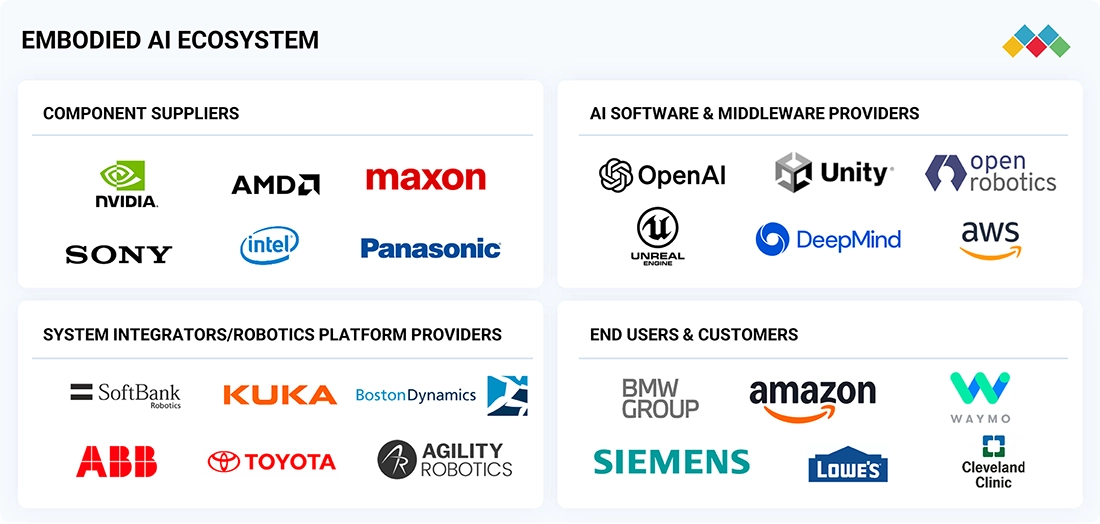
Embodied AI Market: COMMERCIAL USE CASES ACROSS INDUSTRIES
| COMPANY | USE CASE DESCRIPTION | BENEFITS |
|---|---|---|
 |
Developed an AI-driven collaborative robotics solution to automate infotainment system testing in Fiat 500 electric vehicles using the Racer5 COBOT mounted on an NJ-220 robot and MI.RA/Dexter software | 3× faster debugging process, consistent quality control, enhanced traceability and repeatability, reduced programming costs, and simplified operation without robotics expertise |
 |
Implemented an AI + 3D vision system using Mech-Eye PRO S camera, Mech-Vision, Mech-Viz, and Mech-DLK software integrated with a UR5e robot for halogen leak detection in air conditioner production | 100% detection accuracy, <4-second vision processing for four welding points, optimized cycle time with collision avoidance, increased productivity and safety, and reduced costs and downtime |
 |
Introduced the WILL mini welding cell featuring Panasonic’s TAWERS system and Genius WeldPro AI software for automated welding, enabling CAD-based weld path generation and offline DTPS programming | Reduced programming time, improved weld consistency and quality, enhanced flexibility for small batches, higher operational efficiency, and expanded market reach in transport manufacturing |
Logos and trademarks shown above are the property of their respective owners. Their use here is for informational and illustrative purposes only.
Related Ecosystem
Electronics System And Components
- Sensors
- Temperature Sensors
- Pressure Sensors
- Actuators
- Image Sensors
- Lenovo
- Samsung
- Texas Instruments Incorporated
- HONEYWELL INTERNATIONAL INC.
- Teledyne Technologies Incorporated
Industrial Automation
- Sensors
- Image Sensors
- Manufacturing Execution System (MES)
- Actuators
- Flow Sensors
- ABB India Limited
- Siemens ag
- Emerson Electric Co.
- HONEYWELL INTERNATIONAL INC.
- SCHNEIDER ELECTRIC SE
Key Takeaways
- Canada's embodied AI market will grow from $244.5M (2025) to $1,134.9M (2030) at a 35.9% CAGR
- Canada is leveraging government support and academic institutions to accelerate embodied AI adoption
- Manufacturing, healthcare, and logistics are primary growth sectors driving Canada's embodied AI expansion
- Canada's skilled workforce and strategic location strengthen its role as a North American embodied AI hub
Embodied AI Market Report Scope
| Report Metric | Details |
|---|---|
| Base Year | 2025 |
| Fastest Growing Segment | LEVEL 3: ADVANCED EMBODIMENT (Level Of Embodiment) |
| Forecast Period | 2025-2030 |
| Growth Rate | CAGR of 39% from 2025 to 2030 |
| Largest Segment | ROBOTS (Product Type) |
| Market Size Base Year (Billions) | ~USD 4.44 (2025) |
| Revenue Forecast (Billions) | ~USD 23.06 (2030) |
| Segments Covered | Product Type, Type, Level Of Embodiment, Vertical |
Canada Embodied AI Market Report Segmentation
4 segment dimensions are covered across the global market.
By Product Type
- Autonomous Systems
- Exoskeletons
- Robots
- Smart Appliances
By Type
- Cobots
- Humanoid Robots
- Industrial Robots
- Mobile Robots
- Service Robots
By Level Of Embodiment
- Level 1: Basic Embodiment
- Level 2: Intermediate Embodiment
- Level 3: Advanced Embodiment
By Vertical
- Automotive
- Defense & Security
- Education
- Healthcare
- Industrial Automation
- Logistics & Supply Chain
- Other Verticals
- Retail
Target Audience
- Technology & Robotics Companies : Manufacturers and developers of embodied AI systems need Canada-specific market data to identify expansion opportunities, assess competitive dynamics, and allocate R&D resources effectively in this high-growth region.
- Investment & Private Equity Firms : Investors evaluating Canadian AI and robotics startups require detailed market forecasts and sector analysis to validate investment theses, assess portfolio company growth potential, and identify emerging opportunities.
- Enterprise Buyers & Integrators : Manufacturing, healthcare, and logistics companies in Canada need market insights to justify automation investments, benchmark adoption trends, and make informed procurement decisions for embodied AI solutions.
- Government & Policy Makers : Canadian federal and provincial agencies require market intelligence to design effective innovation policies, allocate research funding, and support domestic AI and robotics industry development.
- Consultants & Strategic Advisors : Management consulting firms and business strategists need Canada-focused embodied AI market data to advise clients on digital transformation initiatives, competitive positioning, and technology adoption strategies.
Reasons to Buy this Report
- Market Size & Growth Validation : Confirm Canada's embodied AI market valuation ($244.5M in 2025) and validate 35.9% CAGR projections through 2030 to support strategic planning and investment decisions in the Canadian market.
- Sector-Specific Opportunity Mapping : Identify high-growth segments within manufacturing, healthcare, and logistics sectors in Canada to prioritize product development, partnerships, and go-to-market strategies tailored to regional demand.
- Competitive Landscape Intelligence : Understand Canada's embodied AI ecosystem, including key players, research institutions, and emerging startups, to benchmark competitive positioning and identify partnership or acquisition opportunities.
- Investment & Funding Trends : Access insights on government support programs, venture capital activity, and innovation funding mechanisms specific to Canada to optimize investment timing and secure growth capital.
- Regional Market Entry Strategy : Develop informed market entry or expansion strategies for Canada by understanding local adoption drivers, regulatory environment, and customer preferences in embodied AI applications.
Frequently asked questions
What is the current size of Canada's embodied AI market?
Canada's embodied AI market is valued at $244.5 million in 2025 and is projected to reach $1,134.9 million by 2030.
What is the growth rate of embodied AI in Canada?
Canada's embodied AI market is growing at a compound annual growth rate (CAGR) of 35.9% from 2025 to 2030.
Which industries are driving embodied AI adoption in Canada?
Manufacturing, healthcare, and logistics sectors are the primary drivers of embodied AI adoption in Canada, supported by enterprise demand for intelligent automation.
What factors support embodied AI growth in Canada?
Canada's embodied AI growth is supported by government initiatives, strong academic research institutions, venture capital investment, and a skilled AI workforce.
How does Canada's embodied AI market compare to North America?
Canada represents a significant portion of the North American embodied AI market, with its 35.9% CAGR reflecting strong regional demand and Canada's position as a key innovation hub.
RESEARCH METHODOLOGY
The study involved four major activities in estimating the current size of the embodied AI market. Exhaustive secondary research collected information on the market, peer, and parent markets. The next step was to validate these findings, assumptions, and sizing with industry experts across the value chain through primary research. Both top-down and bottom-up approaches were employed to estimate the complete market size. After that, market breakdown and data triangulation techniques were used to estimate the market size of segments and subsegments.
Secondary Research
The secondary research process has referred to various secondary sources to identify and collect necessary information for this study.
The secondary sources include annual reports, press releases, and investor presentations of companies; white papers; journals and certified publications; and articles from recognized authors, websites, directories, and databases. Secondary research was conducted to obtain critical information about the industry’s supply chain, the market’s value chain, the total pool of key players, market segmentation according to the industry trends (to the bottom-most level), regional markets, and key developments from market- and technology-oriented perspectives. The secondary data was collected and analyzed to determine the overall market size, further validated by primary research.
Primary Research
Extensive primary research was conducted after gaining knowledge about the current scenario of the embodied AI market through secondary research. Several primary interviews were conducted with experts from the demand and supply sides across four major regions: North America, Europe, the Asia Pacific, and the RoW. This primary data was collected through questionnaires, emails, and telephone interviews.
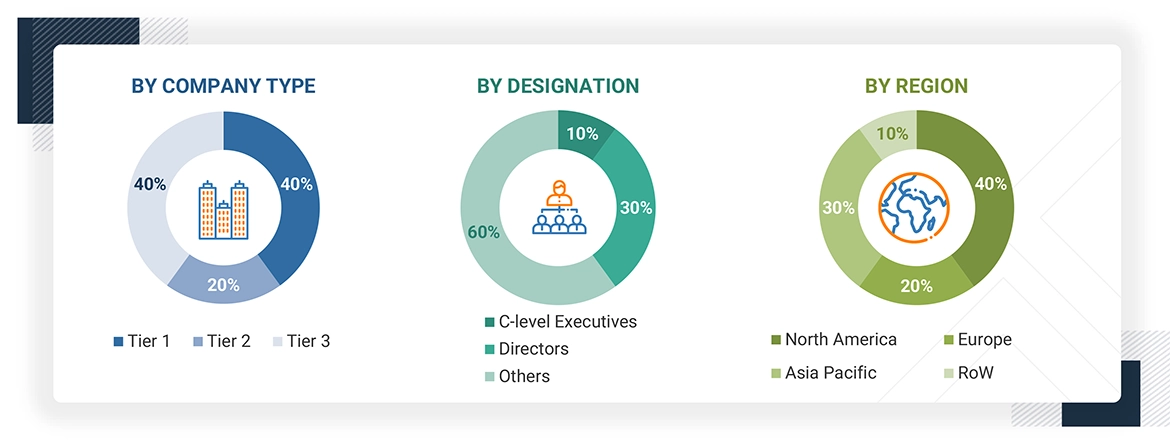
Note: Other designations include technology heads, media analysts, sales managers, marketing managers, and product managers.
The three tiers of the companies are based on their total revenues as of 2024 ? Tier 1: >USD 1 billion, Tier 2: USD 500 million–1 billion, and Tier 3: USD 500 million.
To know about the assumptions considered for the study, download the pdf brochure
Market Size Estimation
In the complete market engineering process, top-down and bottom-up approaches and several data triangulation methods were used to estimate and forecast the overall market segments and subsegments listed in this report. Key players in the market were identified through secondary research, and their market shares in the respective regions were determined through primary and secondary research. This entire procedure includes the study of annual and financial reports of the top market players and extensive interviews for key insights (quantitative and qualitative) with industry experts (CEOs, VPs, directors, and marketing executives).
All percentage shares, splits, and breakdowns were determined using secondary sources and verified through primary sources. All the parameters affecting the markets covered in this research study were accounted for, viewed in detail, verified through primary research, and analyzed to obtain the final quantitative and qualitative data. This data was consolidated and supplemented with detailed inputs and analysis from MarketsandMarkets and presented in this report.
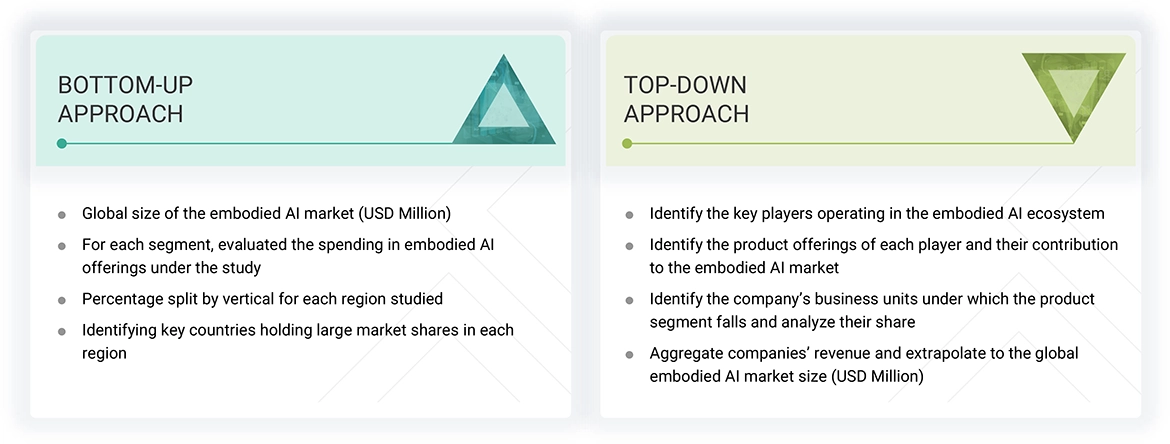
Bottom-Up Approach
- Identifying key countries contributing to the majority share of the embodied AI market in the region
- Analyzing major manufacturers of embodied AI, studying their portfolios, and understanding different types
- Analyzing trends pertaining to the use of embodied AI in different kinds of verticals
- Identifying and evaluating percentage splits by vertical for each region
- Evaluating the spending on embodied AI offerings for each segment
- Tracking the ongoing and upcoming developments in the market, such as investments, R&D activities, product/service launches, collaborations, and partnerships, and forecasting the market based on these developments and other critical parameters
- Carrying out multiple discussions with key opinion leaders to understand different types of embodied AI trends in the market, thereby analyzing the breakup of the scope of work carried out by major companies
- All estimates at each stage were confirmed through discussions with key opinion leaders, including corporate executives (CXOs), directors, sales heads, and industry experts from MarketsandMarkets.
- Arriving at the market estimates by analyzing the revenues of companies generated and then combining them to get the market estimate
- Segmenting the overall market into various other market segments
- Verifying and cross-checking the estimate at every level, from discussions with key opinion leaders such as CXOs, directors, and operations managers, and finally with the domain experts at MarketsandMarkets
- Studying various paid and unpaid sources of information, such as annual reports, press releases, white papers, and databases
Top-Down Approach
- Focusing initially on the top-line investments and expenditures being made in the ecosystem of the embodied AI market, further splitting the key market areas based on product type, level of embodiment, vertical, and region, and listing the key developments
- Identifying all leading players in the embodied AI market based on product type, level of embodiment, and vertical through secondary research and fully verifying them through a brief discussion with industry experts
- Identifying the product offerings of each player and their contribution toward the embodied AI market
- Understanding the company’s business units offering embodied AI products considered under the study
- Aggregating companies’ revenue and extrapolating to the global embodied AI market size (USD Million)
- Discussing splits with industry experts to validate the information and identify key growth pockets across all key segments.
Embodied AI Market : Top-Down and Bottom-Up Approach
Data Triangulation
After arriving at the overall market size, the market was split into several segments and subsegments using the market size estimation processes explained above. Data triangulation and market breakdown procedures were employed to complete the entire market engineering process and determine the exact statistics of each market segment and subsegment. The data was triangulated by studying various factors and trends from the demand and supply sides in the embodied AI market.
Market Definition
Embodied AI is a segment of artificial intelligence where intelligent systems are embedded in physical entities, such as robots, autonomous vehicles, or assistive machines, allowing them to perform context-aware tasks through real-world interaction. The embodied AI market encompasses various product types, such as humanoid, mobile, industrial, service, and collaborative robots (cobots), exoskeletons, autonomous systems (including drones, vehicles, and AGVs), and smart appliances. These systems are categorized across three levels of embodiment based on their cognitive and interactive complexity, from basic rule-based machines to highly adaptive agents capable of complex reasoning and multi-modal interaction.
Key Stakeholders
- Government bodies and policymakers
- Industry organizations, forums, alliances, and associations
- Market research and consulting firms
- Raw material suppliers and distributors
- Research institutes and organizations
- Traders and suppliers
- Raw material suppliers
- Original equipment manufacturers (OEMS)
- OEM technology solution providers
- Technology, service, and solution providers
- Intellectual property (IP) core and licensing providers
- Suppliers and distributors
- Forums, alliances, and associations
- Technology investors
- Research institutes and organizations
- Analysts and strategic business planners
- Market research and consulting firms
Report Objectives
- To describe and forecast the embodied AI market by product type, level of embodiment, vertical, and region
- To forecast the embodied AI market by product type in terms of volume
- To provide the market size estimation for North America, Europe, the Asia Pacific, and the Rest of the World (RoW), along with their respective country-level market sizes, in terms of value
- To provide detailed information regarding drivers, restraints, opportunities, and challenges influencing market growth
- To analyze the value chain, ecosystem, case studies, patent scenario, trade scenario, technologies, and pricing; identify key conferences and events; study key stakeholders & buying criteria; conduct Porter’s Five Forces analysis on the market; determine the investment & funding scenario; study regulations affecting the market: and explore the impact of the 2025 US tariffs on embodied AI
- To strategically analyze micromarkets with regard to individual growth trends, prospects, and contributions to the total market
- To analyze opportunities for stakeholders by identifying high-growth segments of the market
- To strategically profile the key players, comprehensively analyze their market positions in terms of ranking and core competencies2, and provide a competitive market landscape
- To analyze strategic approaches, such as product launches, expansions, and partnerships, in the embodied AI market
- To analyze the impact of the macroeconomic outlook for each region
Available customizations:
With the given market data, MarketsandMarkets offers customizations according to the specific requirements of companies. The following customization options are available for the report:
Regional Analysis:
- Further country-wise breakdown for the embodied AI market
- Further breakdown of the embodied AI market in industry-specific segments
Company Information:
- Detailed analysis and profiling of additional market players (up to five)
Get the Full Embodied AI Market Report
Full forecast, segment splits, and company analysis for all Embodied AI Market.
- US Embodied AI Market
- Mexico Embodied AI Market
- Germany Embodied AI Market
- UK Embodied AI Market
- France Embodied AI Market
- Italy Embodied AI Market
- Spain Embodied AI Market
- Poland Embodied AI Market
- China Embodied AI Market
- Japan Embodied AI Market
- South Korea Embodied AI Market
- India Embodied AI Market
- Australia Embodied AI Market
- Indonesia Embodied AI Market
- Malaysia Embodied AI Market
- Thailand Embodied AI Market
- Vietnam Embodied AI Market
- Nordics Embodied AI Market
- Rest Of Europe Embodied AI Market
- Rest Of Asia Pacific Embodied AI Market
- Other African Countries Embodied AI Market
- South Africa Embodied AI Market
- Bahrain Embodied AI Market
- Kuwait Embodied AI Market
- Oman Embodied AI Market
- Qatar Embodied AI Market
- Rest Of Middle East Embodied AI Market
- Saudi Arabia Embodied AI Market
- UAE Embodied AI Market
Need a Tailored Report?
Customize this report to your needs
Get 10% FREE Customization
Customize This Report
