
South Korea Emotion AI Market (2024-2029)

The South Korea Emotion AI Market was valued at $59.4 Million in 2024 and projected to reach to $196.2 Million by 2029, representing a compound annual growth rate of 22.0%. South Korea's Emotion AI market is poised for substantial growth through 2029, driven by the nation's commitment to becoming a global AI leader and its robust technology sector.


| Market Size in | USD 26.32 MN |
| Market Forecast in | |
| CAGR | |
| Forecast Period | |
| Units Considered | Value (USD MN) |
South Korea Emotion AI Market Trends and Insights
- This represents a compound annual growth rate of 22.0%, reflecting South Korea's strong technological infrastructure and early adoption of artificial intelligence solutions.
- South Korea's advanced digital ecosystem, coupled with significant investments in AI research and development, positions the nation as a key regional hub for emotion recognition technologies across consumer electronics, healthcare, and customer service applications. The growth trajectory in South Korea is driven by increasing demand for personalized user experiences and emotional intelligence capabilities in consumer devices and enterprise solutions.
- South Korea's tech-savvy population and competitive landscape among major electronics manufacturers accelerate the integration of emotion AI into smartphones, wearables, and smart home devices.
- Between 2024 and 2029, South Korea is expected to capture substantial market share within the Asia Pacific region, supported by government initiatives promoting AI innovation and the presence of leading technology companies investing heavily in emotion recognition research..
Key Market Statistics
- CAGR (2024-2029) 22.0% CAGR
- Market Size, 2024 ~USD 59.4 Million
- Forecast, 2029 ~USD 196.2 Million
- Country South Korea
South Korea Emotion AI Market Overview
Rapid Market Expansion :
South Korea's Emotion AI market is growing at 22% CAGR, outpacing the global average of 21.9%, driven by the country's advanced technological infrastructure and early AI adoption.
Strong Valuation Growth :
Market size is projected to grow from USD 59.4 million in 2024 to USD 196.2 million by 2029, representing a 230% increase over five years.
Digital Ecosystem Leadership :
South Korea's world-class digital infrastructure, high internet penetration, and tech-savvy population create an ideal environment for Emotion AI deployment across industries.
Strategic Investment Focus :
Significant government and private sector investment in AI research and development positions South Korea as a key hub for Emotion AI innovation and commercialization.
South Korea Emotion AI Market Dynamics
- The country's advanced digital infrastructure, coupled with strong consumer adoption of AI-powered solutions, creates favorable conditions for market expansion across retail, healthcare, entertainment, and customer service sectors. The 22% CAGR reflects South Korea's competitive advantages in semiconductor manufacturing, software development, and AI research capabilities.
- With major tech companies and startups investing heavily in Emotion AI applications, the market is expected to attract significant venture capital and corporate funding, accelerating innovation and market penetration throughout the forecast period..
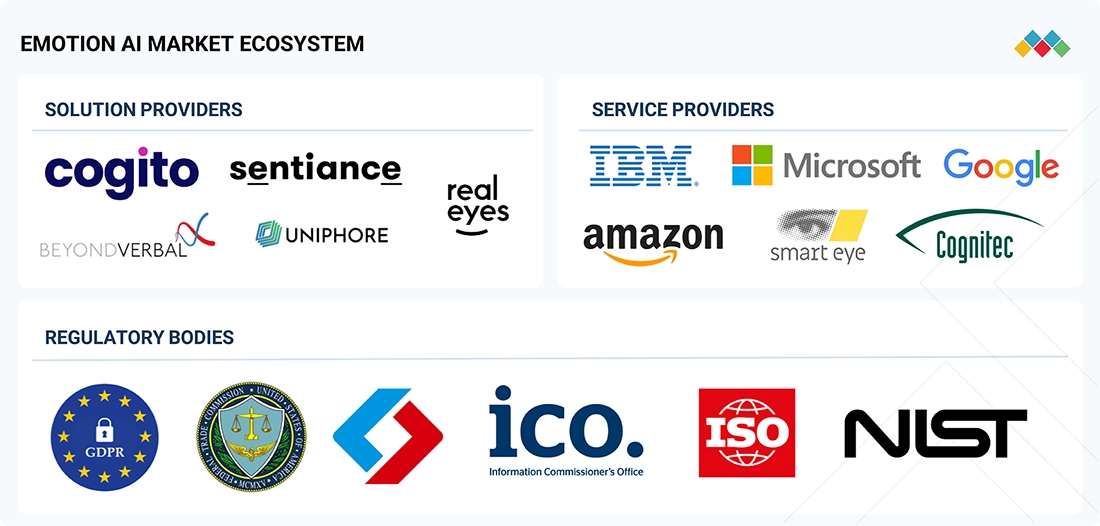
Market Ecosystem
EMOTION AI MARKET: COMMERCIAL USE CASES ACROSS INDUSTRIES
| COMPANY | USE CASE DESCRIPTION | BENEFITS |
|---|---|---|
 |
Large-scale attention study that measured viewers’ visual attention to video ads across seven app environments (feed, short-form, stream) using participants’ front-facing cameras to map how environment influences attention quality and brand outcomes. | Enables environment-specific creative optimization, reveals when high-quality attention occurs, informs placement strategy and benchmarks, improves media efficiency and creative performance, and supports data-driven ad testing and measurement. |
 |
Interactive app campaign for McDonald’s Portugal that used MorphCast’s real-time facial emotion detection to identify users’ moods and deliver mood-aligned coupons and content, driving personalized, emotionally relevant customer interactions. | Boosts engagement and completion rates, increases customer satisfaction, strengthens brand connection, delivers personalized offers at scale, generates measurable interaction metrics (330k+ camera requests, 93.53% completion), and creates memorable experiences. |
 |
Joint assistive-tech solution (Lumin-i) combining Smart Eye’s eye-tracking algorithms with Smartbox’s AAC software, enabling users with complex mobility needs to communicate via eye gaze, with fast response (≈25 ms), 60 fps capture and wide tracking area. | Restores independent communication for people with disabilities, offers high accuracy and responsiveness, works outdoors, tolerates head movement (large track box), integrates with Grid Pad AAC, and expands accessibility and user autonomy. |
 |
Hume’s Empathic Voice Interface powers Niantic Spatial’s location-aware AR companions (e.g., Project Jade’s Dot), delivering sub-second, emotionally adaptive speech that adjusts tone and responsiveness based on user engagement and geospatial context. | Creates natural, emotionally attuned dialogue, improves user immersion and retention, enables context-aware guidance, increases perceived companionship quality, simplifies API integration with geospatial stacks. |
 |
Lunavi integrated Uniphore’s Sales Interaction Agent to analyze visual, verbal and tonal cues in video sales calls, identify key moments and buyer pain points, and auto-populate insights into CRM to improve consultative selling. | Reduced sales onboarding time by 50%, doubled sales team productivity, improved win rates and deal management, surfaced actionable call insights, enabled better coaching and scalable knowledge transfer. |
Logos and trademarks shown above are the property of their respective owners. Their use here is for informational and illustrative purposes only.
Related Ecosystem
Software And Services
- Natural Language Processing (NLP)
- Machine Learning
- Supply Chain Management
- Predictive Analytics
- Image Sensors
- International Business Machines Corporation
- MICROSOFT CORPORATION
- Oracle Corporation
- SAP SE
- Amazon.com, Inc.
Key Takeaways
- South Korea's Emotion AI market is valued at USD 59.4 million in 2024 and projected to grow to USD 196.2 million by 2029, representing a 22.0% CAGR.
- South Korea's advanced technological infrastructure and early AI adoption position it as a regional leader in emotion recognition applications across multiple industries.
- Consumer electronics manufacturers in South Korea are driving market growth through integration of emotion AI in smartphones, wearables, and smart home devices.
- Government support for AI innovation and substantial R&D investments by major South Korean tech companies are key catalysts for sustained market expansion through 2029.
Emotion AI Market Report Scope
| Report Metric | Details |
|---|---|
| Base Year | 2024 |
| Fastest Growing Segment | MENTAL HEALTH & WELL-BEING MONITORING (Application) |
| Forecast Period | 2024-2029 |
| Growth Rate | CAGR of 21.9% from 2024 to 2029 |
| Largest Segment | SOFTWARE (Component) |
| Market Size Base Year (Billions) | ~USD 2.75 (2024) |
| Revenue Forecast (Billions) | ~USD 7.39 (2029) |
| Segments Covered | Offering, Solution, Service, Professional Service, Type, Technology, Application, Industry 2019-2023, Industry, Component, Software, Application Area, End User, Vertical, Deployment Mode, Organization Size |
South Korea Emotion AI Market Report Segmentation
16 segment dimensions are covered across the global market.
By Offering
- Hardware
- Services
- Software Solutions
- Solutions
By Solution
- Emotion AI Sdks & Apis
- Emotion Analytics
- Emotion Recognition
- Other Solutions
By Service
- Managed
- Professional
By Professional Service
- Deployment & System Integration
- Support & Maintenance
- Training & Development
By Type
- Text-Focused
- Video & Multimodal
- Voice-Focused
By Technology
- Computer Vision
- Machine Learning
- Natural Language Processing
- Physiological Signal Processing
By Application
- Customer Experience Management
- Driver Safety & Monitoring
- Finance & Payments
- Human Resources & Recruitment
- Marketing, Sales, And Advertising
- Mental Health & Well-Being Monitoring
- Other Applications
- Personal Assistance & Virtual Agents
- Personal Assistants & Virtual Agents
- Retail & Marketing
- Security & Access Control
By Industry 2019-2023
- Automotive
- Education, Academia, And Research
- Healthcare
- It & Ites
- Media & Entertainment
- Other Industries
- Retail & E-Commerce
- Travel & Hospitality
By Industry
- Automotive
- Education, Academia, And Research
- Healthcare
- It & Ites
- Media & Entertainment
- Other Industries
- Retail & E-Commerce
- Travel & Hospitality
By Component
- Services
- Software
By Software
- Biosensing Solutions And Apps
- Facial Expression Recognition
- Gesture And Posture Recognition
- Speech And Voice Recognition
By Application Area
- Entertainment And Consumer Electronics
- Law Enforcement, Surveillance, And Monitoring
- Marketing And Advertising
- Medical Emergency
- Other Application Areas
By End User
- Commercial
- Defense And Security Agency
- Enterprises
- Industrial
- Other End Users
By Vertical
- Academia And Research
- Automotive
- Bfsi
- Education
- Government
- Healthcare
- Healthcare And Social Assistance
- It And Ites
- Manufacturing
- Media & Entertainment
- Media And Entertainment
- Other Verticals
- Retail & Ecommerce
- Retail And Ecommerce
- Telecommunications
- Transportation & Utilities
By Deployment Mode
- Cloud
- On-Premises
By Organization Size
- Large Enterprises
- Smes
Target Audience
- Technology Companies & Startups : South Korea-based and international tech firms need market intelligence to identify growth opportunities, assess competitive positioning, and plan product launches in this rapidly expanding Emotion AI sector.
- Investment & Venture Capital Firms : Investors targeting South Korea's AI ecosystem require detailed market data to evaluate investment opportunities, assess portfolio company growth potential, and benchmark returns against market trends.
- Enterprise Buyers & Corporations : South Korean enterprises across retail, healthcare, and customer service sectors need market insights to justify Emotion AI investments, evaluate vendor solutions, and plan digital transformation initiatives.
- Government & Policy Makers : South Korean government agencies and policy bodies require market analysis to inform AI strategy, allocate R&D funding, and develop regulatory frameworks supporting the Emotion AI industry.
- Market Researchers & Consultants : Research firms and management consultants need South Korea-specific Emotion AI data to support client advisory work, competitive analysis, and strategic recommendations in the Korean market.
Reasons to Buy this Report
- Market-Specific Sizing & Forecasts : Access precise valuation data for South Korea's Emotion AI market with detailed 2024-2029 projections, enabling accurate investment planning and resource allocation decisions.
- Competitive Landscape Intelligence : Understand South Korea's unique competitive dynamics, key players, and market positioning to identify partnership opportunities and competitive advantages in this high-growth market.
- Sector-Specific Applications : Gain insights into how South Korean industries—retail, healthcare, entertainment, and customer service—are adopting Emotion AI, revealing targeted market entry strategies.
- Investment & Growth Drivers : Identify the specific factors fueling South Korea's 22% CAGR, including government initiatives, tech infrastructure, and consumer behavior trends unique to the Korean market.
- Strategic Market Entry Planning : Develop informed go-to-market strategies tailored to South Korea's regulatory environment, consumer preferences, and technology adoption patterns for successful market penetration.
Frequently asked questions
What is the current size of South Korea's Emotion AI market?
South Korea's Emotion AI market was valued at USD 59.4 million in 2024 and is expected to reach USD 196.2 million by 2029.
What is the projected growth rate for Emotion AI in South Korea?
South Korea's Emotion AI market is projected to grow at a compound annual growth rate (CAGR) of 22.0% from 2024 to 2029.
Which industries are driving Emotion AI adoption in South Korea?
South Korea's Emotion AI adoption is primarily driven by consumer electronics, healthcare, customer service, and smart device manufacturers integrating emotion recognition capabilities.
Why is South Korea a key market for Emotion AI?
South Korea possesses advanced technological infrastructure, a tech-savvy population, strong government AI support, and major electronics manufacturers investing heavily in emotion recognition research.
What factors will support Emotion AI market growth in South Korea through 2029?
South Korea's growth will be supported by government AI innovation initiatives, increasing demand for personalized user experiences, competitive electronics manufacturing, and substantial R&D investments by leading tech companies.
RESEARCH METHODOLOGY
The research study involved four major activities in estimating the Emotion AI market size. Exhaustive secondary research has been done to collect important information about the market and peer markets. The next step has been to validate these findings and assumptions and size them with the help of primary research with industry experts across the value chain. Both top-down and bottom-up approaches have been used to estimate the market size. Post which the market breakdown and data triangulation have been adopted to estimate the market sizes of segments and sub-segments.
Secondary Research
The market size of the companies offering Emotion AI solutions to various end users was arrived at based on the secondary data available through paid and unpaid sources and by analyzing the product portfolios of major companies in the ecosystem and rating the companies based on their performance and quality. In the secondary research process, various sources were referred to identify and collect information for the study. The secondary sources included annual reports, press releases, investor presentations of companies, white papers, journals, certified publications, and articles from recognized authors, directories, and databases.
Secondary research was mainly used to obtain critical information about industry insights, the market’s monetary chain, the overall pool of key players, market classification and segmentation according to industry trends to the bottom-most level, regional markets, and key developments from both market-oriented and technology-oriented perspectives.
Primary Research
In the primary research process, various sources from the supply and demand sides were interviewed to obtain qualitative and quantitative information for the report, Such as Chief Experience Officers (CXOs), Vice Presidents (VPs), directors from business development, marketing, and product development/innovation teams, and related key executives from Emotion AI solutions vendors, system integrators, professional and managed service providers, industry associations, independent consultants, and key opinion leaders.
Primary interviews were conducted to gather insights, such as market statistics, data on revenue collected from platforms and services, market breakups, market size estimations, market forecasts, and data triangulation. Stakeholders from the demand side, such as Chief Information Officers (CIOs), Chief Finance Officers (CFOs), Chief Strategy Officers (CSOs), and the installation team of end users who use Emotion AI solutions, were interviewed to understand buyers’ perspectives on suppliers, products, service providers, and their current usage of Emotion AI solutions which is expected to affect the overall Emotion AI market growth.
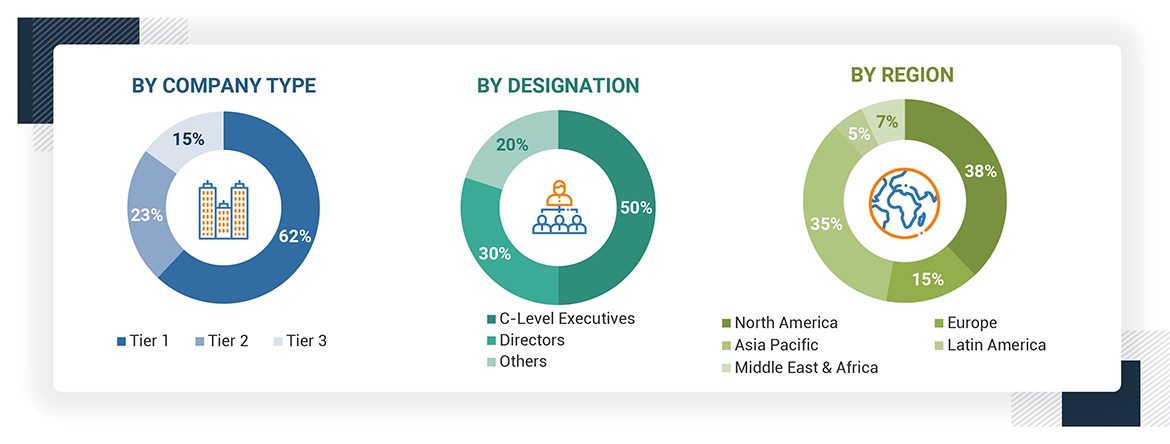
Note 1: Tier 1 companies have revenues over USD 1 billion, Tier 2 companies range between USD 500
million and 1 billion in overall revenues, and Tier 3 companies have revenues less than USD 500 million.
Other designations include sales managers, marketing managers, and product managers.
Source: Industry Experts
To know about the assumptions considered for the study, download the pdf brochure
Market Size Estimation
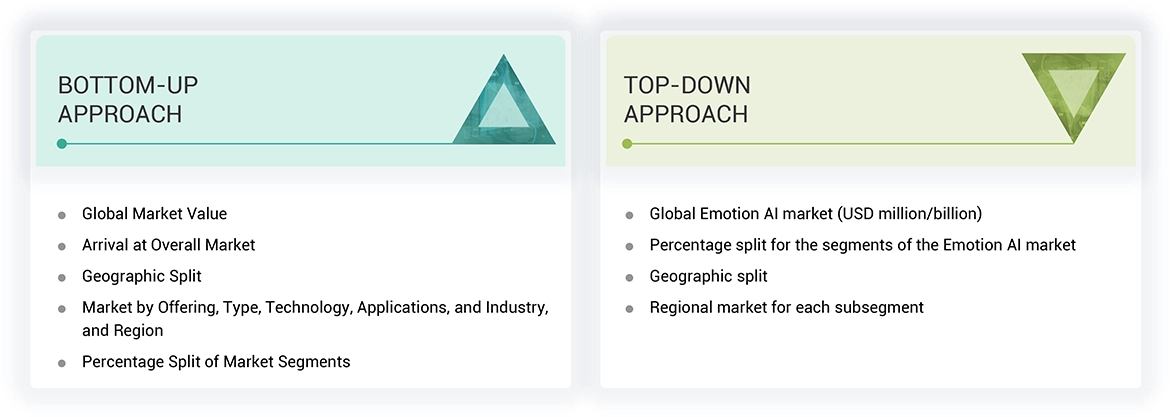
Both top-down and bottom-up approaches were used to estimate and validate the total size of the Emotion AI market. These methods were also used extensively to estimate the size of various subsegments in the market. The research methodology used to estimate the market size includes the following:
Emotion AI Market : Top-Down and Bottom-Up Approach
Data Triangulation
After arriving at the overall market size from the above estimation process, the Emotion AI market has been split into several segments and sub-segments. To complete the overall market engineering process and arrive at the exact statistics for all segments and sub-segments, data triangulation and market breakdown procedures have been used, wherever applicable. The data has been triangulated by studying various factors and trends from both the demand and supply sides. The Emotion AI market size has been validated using top-down and bottom-up approaches.
Market Definition
Emotion Al refers to artificial intelligence that detects and interprets human emotional signals in text (using natural language processing and sentiment analysis), audio (using voice emotion Al), video (using facial movement analysis, gait analysis, and physiological signals), or combinations thereof. Emotion Al is the implementation of software that detects, interprets, and responds to human emotions. This requires the union of psychology, computer science, and Al to interpret human expressions of emotions, often through textual natural language processing (NLP), facial recognition, auditory analysis, and other physiological signals monitoring. Emotion Al seeks to achieve and surpass human-level emotional interpretation through analysis of each of these channels. This enables the technology to support more personalized and emotionally aware interactions between humans and machines, as well as support existing human-human interactions by providing keen insights and recommendations in real time to aid productive interactions. These applications promise to enable enterprises to streamline their efforts across a wide variety of both customer-facing and internal interactions.
Stakeholders
- Emotion AI Solutions and Service providers
- Technology providers
- Hardware Manufacturers
- Regulators & Policymakers
- Legal and Compliance Experts
- Consulting service providers
- Enterprise end users
- Distributors and Value-added Resellers (VARs)
- Government agencies
- Independent Software Vendors (ISV)
- Managed service providers
- Support & maintenance service providers
- System Integrators (SIs)
- Industry Associations
Report Objectives
- To determine, segment, and forecast the Emotion AI market based on offering, type, technology, application, industry, and region
- To forecast the size of the market segments with respect to five main regions: North America, Europe, Asia Pacific, the Middle East & Africa, and Latin America
- To provide detailed information about the major factors (drivers, restraints, opportunities, and challenges) influencing the growth of the market
- To study the complete value chain and related industry segments and perform a value chain analysis of the market landscape
- To strategically analyze the macro and micro-marketsmicromarkets with respect to individual growth trends, prospects, and contributions to the total market
- To analyze the industry trends, pricing data, patents, and innovations related to the market
- To analyze the opportunities for stakeholders by identifying the high-growth segments of the market
- To profile the key players in the market and comprehensively analyze their market share/ranking and core competencies
- To track and analyze competitive developments, such as mergers & acquisitions, product launches & developments, partnerships, and collaborations, in the market
Available Customizations
With the given market data, MarketsandMarkets offers customizations per the company’s specific needs. The following customization options are available for the report:
Geographic Analysis as per Feasibility
- Further break-up of the Asia Pacific market into countries contributing 75% to the regional market size
- Further break-up of the North American market into countries contributing 75% to the regional market size
- Further break-up of the Latin American market into countries contributing 75% to the regional market size
- Further break-up of the Middle East African market into countries contributing 75% to the regional market size
- Further break-up of the European market into countries contributing 75% to the regional market size
Company Information
- Detailed analysis and profiling of additional market players (up to 5)
Get the Full Emotion AI Market Report
Full forecast, segment splits, and company analysis for all Emotion AI Market.
- Canada Emotion AI Market
- US Emotion AI Market
- UK Emotion AI Market
- Italy Emotion AI Market
- China Emotion AI Market
- India Emotion AI Market
- Brazil Emotion AI Market
- France Emotion AI Market
- Germany Emotion AI Market
- Nordics Emotion AI Market
- Rest Of Europe Emotion AI Market
- Spain Emotion AI Market
- Japan Emotion AI Market
- Rest Of Asia Pacific Emotion AI Market
- Mexico Emotion AI Market
- Rest Of Latin America Emotion AI Market
Need a Tailored Report?
Customize this report to your needs
Get 10% FREE Customization
Customize This Report
