
Asia Pacific Enterprise Monitoring Market (2024-2029)

The Asia Pacific Enterprise Monitoring Market was valued at $8599.3 Million in 2024 and projected to reach to $24744.4 Million by 2029, representing a compound annual growth rate of 23.5%. Asia Pacific's enterprise monitoring market is positioned for transformative growth through 2029, fueled by accelerating cloud adoption, increasing cybersecurity investments, and widespread digital infrastructure modernization across the region.


| Market Size in | USD 26.32 MN |
| Market Forecast in | |
| CAGR | |
| Forecast Period | |
| Units Considered | Value (USD MN) |
Asia Pacific Enterprise Monitoring Market Trends and Insights
- Asia Pacific's 23.5% compound annual growth rate significantly outpaces the global average of 18%, driven by accelerating digital transformation initiatives across the region's enterprises.
- The region's growth reflects increasing adoption of cloud infrastructure, rising cybersecurity concerns, and the proliferation of complex IT environments requiring sophisticated monitoring solutions. Asia Pacific organizations are investing heavily in enterprise monitoring to enhance operational visibility, reduce downtime, and ensure compliance with evolving regulatory standards.
- Between 2024 and 2029, Asia Pacific is expected to capture an increasingly larger share of global enterprise monitoring spending as economies mature and enterprises scale their digital operations.
- The region's diverse market landscape-spanning developed economies like Australia and Singapore alongside emerging markets-creates varied demand patterns that drive innovation and localized solution development..
Key Market Statistics
- CAGR (2024-2029) 23.5% CAGR
- Market Size, 2024 ~USD 8599.3 Million
- Forecast, 2029 ~USD 24744.4 Million
- Geography Asia Pacific
Asia Pacific Enterprise Monitoring Market Overview
Exceptional Growth Trajectory :
Asia Pacific enterprise monitoring market is expanding at 23.5% CAGR, significantly outpacing the global average of 18%, driven by rapid digital transformation across the region's enterprises.
Market Valuation Surge :
The region's market size is projected to grow from $8,599.3 million in 2024 to $24,744.4 million by 2029, representing a 188% increase over the five-year forecast period.
China's Market Dominance :
China leads Asia Pacific with $9,078.7 million in enterprise monitoring market value, representing over 105% of the regional 2024 baseline and driving significant regional growth momentum.
Emerging Market Opportunities :
India ($4,404.5M) and Japan ($4,404.5M) represent substantial secondary markets, while Australia & New Zealand and South Korea offer high-growth opportunities for enterprise monitoring solutions.
Asia Pacific Enterprise Monitoring Market Dynamics
- Major economies including China, India, and Japan are driving demand through enterprise digital transformation initiatives, creating substantial opportunities for monitoring solution providers. The region's 23.5% CAGR reflects strong enterprise spending on IT operations management, real-time performance monitoring, and integrated observability platforms.
- As organizations across Asia Pacific prioritize operational efficiency and system reliability, the market will continue to attract significant investment from both established vendors and emerging technology providers seeking to capture this high-growth segment..
Market Ecosystem
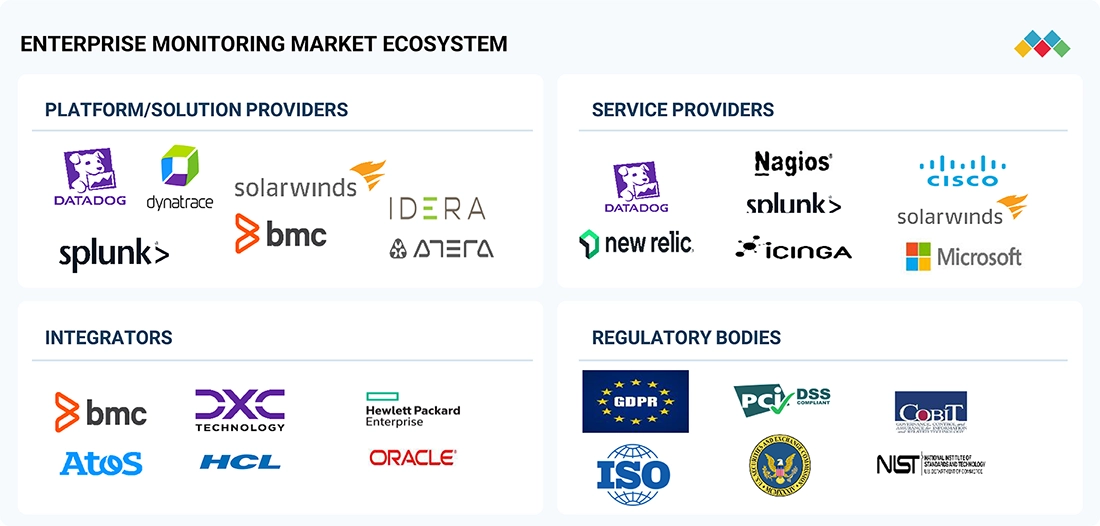
Enterprise Monitoring Market: COMMERCIAL USE CASES ACROSS INDUSTRIES
| COMPANY | USE CASE DESCRIPTION | BENEFITS |
|---|---|---|
 |
Sensirion, a leading Swiss manufacturer of high-quality sensors, faced challenges in unifying its monitoring capabilities across multiple sites and time zones. The company transitioned from using eight monitoring tools to a single solution with LogicMonitor. | With LogicMonitor, Sensirion achieved near-zero outages and eliminated the time-consuming process of managing multiple tools. The solution enhanced infrastructure availability and allowed for quick identification of root causes. This resulted in substantial time and cost savings, enabling Sensirion to focus on growth opportunities and streamline the onboarding of cloud technology. |
 |
VESCA, a credit card payment and marketing services provider in Japan, faced challenges in managing uncorrelated log data, which affected incident response and performance. It turned to Splunk for improved data analysis and compliance. | VESCA reduced incident management resources by 86% and incident response efforts by 99%. The platform enabled faster problem detection and improved customer service, allowing the team to shift from a reactive to a proactive approach to problem-solving. The supportive Splunk community also enhanced its operational capabilities. |
 |
Virgin Money, a financial services provider, faced challenges with ineffective monitoring across its systems, leading to reactive issue management. Dynatrace provided auto-discovery and instrumentation capabilities, enabling Virgin Money to achieve complete observability within two days. | Virgin Money significantly reduced troubleshooting time, saving hours of manpower. The observability platform enabled better decision-making across teams, improved operational efficiency, and facilitated proactive management of digital experiences, ultimately enhancing customer satisfaction and service delivery. The ease of deployment and comprehensive monitoring capabilities transformed its approach to IT management. |
Logos and trademarks shown above are the property of their respective owners. Their use here is for informational and illustrative purposes only.
Related Ecosystem
Analytics
- Natural Language Processing (NLP)
- Machine Learning
- Supply Chain Management
- Predictive Analytics
- Image Sensors
- International Business Machines Corporation
- MICROSOFT CORPORATION
- Oracle Corporation
- SAP SE
Network Security
- Cloud Security
- Critical Communication Network
- Surveillance System
- Video Surveillance Systems
- Biometric Security and Authentication System
- REDINGTON
- Cisco Systems, Inc.
- International Business Machines Corporation
- Fortinet, Inc.
- MICROSOFT CORPORATION
Software And Services
- Natural Language Processing (NLP)
- Machine Learning
- Supply Chain Management
- Predictive Analytics
- Image Sensors
- International Business Machines Corporation
- MICROSOFT CORPORATION
- Oracle Corporation
- SAP SE
- Amazon.com, Inc.
Key Takeaways
- Asia Pacific enterprise monitoring market will grow from $8.6B (2024) to $24.7B (2029) at a 23.5% CAGR, outpacing global growth.
- Asia Pacific's rapid digital transformation and cloud adoption are primary drivers of enterprise monitoring demand across the region.
- Regulatory compliance requirements and cybersecurity threats are accelerating Asia Pacific enterprise investment in monitoring solutions.
- Asia Pacific's diverse economic landscape creates differentiated demand, positioning the region as a critical growth engine for global vendors.
Enterprise Monitoring Market Report Scope
| Report Metric | Details |
|---|---|
| Base Year | 2024 |
| Fastest Growing Segment | SMES (Organization Size) |
| Forecast Period | 2024-2029 |
| Growth Rate | CAGR of 18% from 2024 to 2029 |
| Largest Segment | PLATFORMS (Offering) |
| Market Size Base Year (Billions) | ~USD 35.08 (2024) |
| Revenue Forecast (Billions) | ~USD 80.26 (2029) |
| Segments Covered | Offering, Platform, Service, Infrastructure Platform, Application Performance Platform, Security Platform, Digital Experience Platform, Workforce Operations Platform, Vertical, Component, Deployment Type, Access Type, Organization Size |
Asia Pacific Enterprise Monitoring Market Report Segmentation
13 segment dimensions are covered across the global market.
By Offering
- Platforms
- Services
By Platform
- Application Performance Platforms
- Digital Experience Platforms
- Infrastructure Platforms
- Security Platforms
- Workforce Management Platforms
- Workforce Operations Platforms
By Service
- Managed Services
- Professional Services
By Infrastructure Platform
- Network Management
- Other Infrastructure Platforms
- Server Management
- Storage Management
By Application Performance Platform
- Mobile Application Performance
- Other Application Performance Platforms
- Web Application Performance
By Security Platform
- Application Security
- Intrusion Detection And Prevention Systems (Idps)
- Other Security Platforms
- Vulnerability Assessment And Management
By Digital Experience Platform
- Other Digital Experience Platforms
- Real User Experience
- Synthetics
By Workforce Operations Platform
- Attendance Monitoring And Productivity
- Employee Engagement And Experience
- Other Workforce Operations Platforms
By Vertical
- Bfsi
- Energy & Utilities
- Government
- Government & Public Sector
- Government And Public Sector
- Healthcare & Life Sciences
- Healthcare And Life Sciences
- It & Ites
- It & Telecom
- It And Telecommunications
- Manufacturing
- Media & Entertainment
- Other Verticals
- Retail & Consumer Goods
- Retail & E-Commerce
- Retail And Consumer Goods
- Telecom
- Transportation & Logistics
By Component
- Products
- Services
- Solutions
By Deployment Type
- Cloud
- On-Premises
- Private Cloud
- Public Cloud
By Access Type
- Mobile
- Web
By Organization Size
- Large Enterprises
- Smes
Target Audience
- Enterprise Software Vendors : Monitor solution providers need Asia Pacific market intelligence to identify growth opportunities, understand regional customer requirements, and develop competitive strategies in the fastest-growing monitoring market globally.
- IT Services & Consulting Firms : Service providers require detailed Asia Pacific market data to develop enterprise monitoring service offerings, identify client needs across the region, and support digital transformation initiatives in high-growth markets.
- Investment & Private Equity Firms : Investors evaluating Asia Pacific technology opportunities need comprehensive market analysis to assess enterprise monitoring sector attractiveness, identify acquisition targets, and evaluate portfolio company growth potential.
- Technology Infrastructure Providers : Cloud and infrastructure vendors require Asia Pacific market insights to understand enterprise monitoring demand drivers, develop complementary solutions, and support customer digital transformation initiatives across the region.
- Corporate Strategy & Operations Teams : Enterprise decision-makers need Asia Pacific market intelligence to evaluate monitoring solution investments, benchmark against regional peers, and align IT operations strategies with market trends and best practices.
Countries within Asia Pacific - compare and drill down
| Country | 2025 size (native) |
|---|---|
| China | USD 9078.7 Million |
| India | USD 4404.5 Million |
| Japan | USD 4404.5 Million |
| South Korea | USD 2177.5 Million |
| Australia & New Zealand | USD 1484.7 Million |
| Rest Of Asia Pacific | USD 3194.5 Million |
Country market size visualization
Reasons to Buy this Report
- Regional Growth Intelligence : Gain comprehensive insights into Asia Pacific's 23.5% CAGR market expansion, understanding country-specific dynamics across China, India, Japan, and emerging markets to inform strategic expansion decisions.
- Competitive Positioning Data : Access detailed market sizing and forecasts for Asia Pacific enterprise monitoring to benchmark competitive positioning, identify market gaps, and develop targeted go-to-market strategies for the region.
- Investment Decision Support : Leverage comprehensive market analysis covering Asia Pacific's $8.6B current market and $24.7B 2029 forecast to support investment decisions, M&A strategies, and resource allocation across the region.
- Country-Level Market Breakdown : Understand granular market dynamics across China ($9.1B), India ($4.4B), Japan ($4.4B), and other Asia Pacific nations to prioritize market entry, partnerships, and localization strategies.
- Future Trend Forecasting : Anticipate market evolution through 2029 with detailed forecasts enabling proactive product development, service offerings, and customer acquisition strategies aligned with Asia Pacific's accelerating digital transformation.
Frequently asked questions
What is the current size of the Asia Pacific enterprise monitoring market?
The Asia Pacific enterprise monitoring market was valued at $8,599.3 million in 2024 and is projected to reach $24,744.4 million by 2029.
What is the growth rate for enterprise monitoring in Asia Pacific?
Asia Pacific's enterprise monitoring market is growing at a compound annual growth rate (CAGR) of 23.5% from 2024 to 2029, significantly exceeding the global average of 18%.
What factors are driving enterprise monitoring adoption in Asia Pacific?
Key drivers include accelerating digital transformation, widespread cloud infrastructure adoption, increasing cybersecurity threats, regulatory compliance requirements, and the complexity of modern IT environments across Asia Pacific enterprises.
How does Asia Pacific's growth compare to the global enterprise monitoring market?
Asia Pacific's 23.5% CAGR outpaces the global market's 18% CAGR, indicating the region is becoming an increasingly important market for enterprise monitoring solutions.
Which Asia Pacific countries are leading enterprise monitoring adoption?
Developed economies like Australia, Singapore, and Japan lead adoption, while emerging markets across Southeast Asia and India are rapidly increasing their enterprise monitoring investments.
RESEARCH METHODOLOGY
The research study involved four major activities in estimating the enterprise monitoring market size. Exhaustive secondary research has been done to collect important information about the market and peer markets. The next step has been to validate these findings and assumptions and size them with the help of primary research with industry experts across the value chain. Both top-down and bottom-up approaches have been used to estimate the market size. Post which the market breakdown and data triangulation have been adopted to estimate the market sizes of segments and sub-segments.
Secondary Research
The market size of the companies offering enterprise monitoring platforms to various end users was arrived at based on the secondary data available through paid and unpaid sources and by analyzing the product portfolios of major companies in the ecosystem and rating the companies based on their performance and quality. In the secondary research process, various sources were referred to identify and collect information for the study. The secondary sources included annual reports, press releases, investor presentations of companies, white papers, journals, certified publications, and articles from recognized authors, directories, and databases.
Secondary research was mainly used to obtain critical information about industry insights, the market’s monetary chain, the overall pool of key players, market classification and segmentation according to industry trends to the bottom-most level, regional markets, and key developments from both market-oriented and technology-oriented perspectives.
Primary Research
In the primary research process, various sources from the supply and demand sides were interviewed to obtain qualitative and quantitative information for the report, Such as Chief Experience Officers (CXOs), Vice Presidents (VPs), directors from business development, marketing, and product development/innovation teams, and related key executives from enterprise monitoring platform vendors, system integrators, professional and managed service providers, industry associations, independent consultants, and key opinion leaders.
Primary interviews were conducted to gather insights, such as market statistics, data on revenue collected from platforms and services, market breakups, market size estimations, market forecasts, and data triangulation. Stakeholders from the demand side, such as Chief Information Officers (CIOs), Chief Finance Officers (CFOs), Chief Strategy Officers (CSOs), and the installation team of end users who use enterprise monitoring, were interviewed to understand buyers’ perspectives on suppliers, products, service providers, and their current usage of enterprise monitoring platforms which is expected to affect the overall enterprise monitoring market growth.
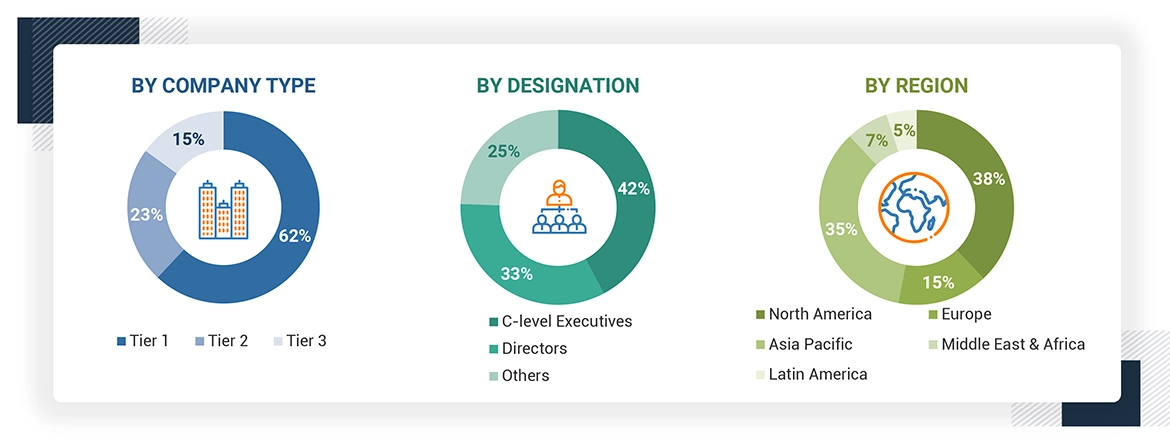
Note 1: Tier 1 companies have revenues over USD 1 billion, Tier 2 companies range between USD 500 million and 1 billion in overall revenues, and Tier 3 companies have revenues less than USD 500 million.
Other designations include sales managers, marketing managers, and product managers.
Source: Industry Experts
To know about the assumptions considered for the study, download the pdf brochure
Market Size Estimation
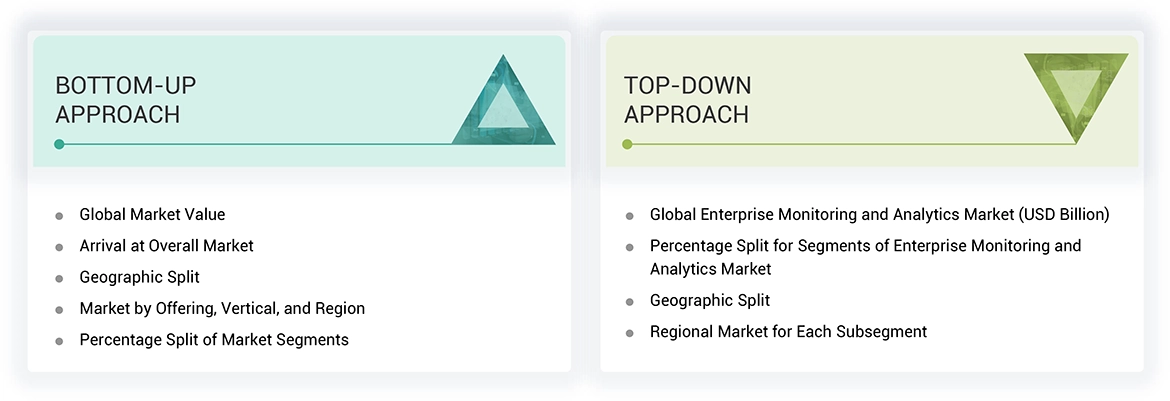
Both top-down and bottom-up approaches were used to estimate and validate the total size of the enterprise monitoring market. These methods were also used extensively to estimate the size of various subsegments in the market. The research methodology used to estimate the market size includes the following:
Enterprise Monitoring Market : Bottom-Up and Top-Down Approach
Data Triangulation
After arriving at the overall market size from the above estimation process, the market has been split into several segments and sub-segments. To complete the overall market engineering process and arrive at the exact statistics for all segments and sub-segments, data triangulation and market breakdown procedures have been used, wherever applicable. The data has been triangulated by studying various factors and trends from both the demand and supply sides. The enterprise monitoring market size has been validated using top-down and bottom-up approaches.
Market Definition
After arriving at the overall market size from the above estimation process, the market has been split into several segments and sub-segments. To complete the overall market engineering process and arrive at the exact statistics for all segments and sub-segments, data triangulation and market breakdown procedures have been used, wherever applicable. The data has been triangulated by studying various factors and trends from both the demand and supply sides. The enterprise monitoring market size has been validated using top-down and bottom-up approaches.
Stakeholders
- Investors and venture capitalists
- Enterprise Monitoring companies
- Technology services providers
- Government and research organizations
- Association and industry bodies
- Cloud services providers
- Technology consultants
- Value-added resellers
- Independent software vendors (ISVs)
Report Objectives
- To determine and forecast the global enterprise monitoring market by offering (platforms and services), infrastructure platform, application performance platform, security platform, digital experience platform, workforce operations platform, vertical, and region from 2024 to 2029, and analyze the various macroeconomic and microeconomic factors affecting the market growth.
- To forecast the size of the market segments concerning five central regions: North America, Europe, Asia Pacific (APAC), Middle East & Africa (MEA), and Latin America.
- To provide detailed information about the major factors (drivers, restraints, opportunities, and challenges) influencing the growth of the enterprise monitoring market.
- Analyze each submarket concerning individual growth trends, prospects, and contributions to the overall Enterprise monitoring market.
- To analyze the opportunities in the market for stakeholders by identifying the high-growth segments of the market.
- To profile the key market players; provide a comparative analysis based on business overviews, regional presence, product offerings, business strategies, and key financials; and illustrate the market’s competitive landscape.
- Track and analyze competitive developments in the market, such as mergers and acquisitions, product developments, partnerships and collaborations, and Research and Development (R&D) activities.
Available Customizations
With the given market data, MarketsandMarkets offers customizations per the company’s specific needs. The following customization options are available for the report:
Geographic Analysis
- Further break-up of the Asia Pacific market into countries contributing 75% to the regional market size
- Further break-up of the North American market into countries contributing 75% to the regional market size
- Further break-up of the Latin American market into countries contributing 75% to the regional market size
- Further break-up of the Middle East African market into countries contributing 75% to the regional market size
- Further break-up of the European market into countries contributing 75% to the regional market size
Company Information
- Detailed analysis and profiling of additional market players (up to 5)
Get the Full Enterprise Monitoring Market Report
Full forecast, segment splits, and company analysis for all Enterprise Monitoring Market.
- UK Enterprise Monitoring Market
- Italy Enterprise Monitoring Market
- China Enterprise Monitoring Market
- India Enterprise Monitoring Market
- Brazil Enterprise Monitoring Market
- US Enterprise Monitoring Market
- Canada Enterprise Monitoring Market
- France Enterprise Monitoring Market
- Germany Enterprise Monitoring Market
- Nordics Enterprise Monitoring Market
- Rest Of Europe Enterprise Monitoring Market
- Spain Enterprise Monitoring Market
- Japan Enterprise Monitoring Market
- Rest Of Asia Pacific Enterprise Monitoring Market
- South Korea Enterprise Monitoring Market
- Mexico Enterprise Monitoring Market
- Rest Of Latin America Enterprise Monitoring Market
- Ksa Enterprise Monitoring Market
- Kuwait Enterprise Monitoring Market
- Rest Of Middle East Enterprise Monitoring Market
- UAE Enterprise Monitoring Market
Need a Tailored Report?
Customize this report to your needs
Get 10% FREE Customization
Customize This Report
