
South America Epoxidized Soybean Oil Market (2023-2028)

The South America Epoxidized Soybean Oil Market was valued at $672.6 Million in 2023 and projected to reach to $788.8 Million by 2028, representing a compound annual growth rate of 4.0%. South America's epoxidized soybean oil market is positioned for steady growth through 2028, supported by the region's dominant soybean production capacity and established processing infrastructure.


| Market Size in | USD 26.32 MN |
| Market Forecast in | |
| CAGR | |
| Forecast Period | |
| Units Considered | Value (USD MN) |
South America Epoxidized Soybean Oil Market Trends and Insights
- South America benefits from abundant soybean production and established agricultural infrastructure, positioning the region as a key supplier of feedstock for epoxidized soybean oil manufacturing.
- The market in South America is driven by rising demand from plasticizers, coatings, and adhesive applications across automotive, construction, and consumer goods sectors. Growth in South America is supported by increasing regulatory pressure to adopt bio-based and sustainable alternatives to petroleum-derived chemicals.
- South America's chemical manufacturers are investing in capacity expansion and innovation to meet both domestic and export demand.
- The region's competitive advantage in raw material sourcing continues to attract investment, though South America faces competition from other bio-based chemical producers globally..
Key Market Statistics
- CAGR (2023-2028) 4.0% CAGR
- Market Size, 2023 ~USD 672.6 Million
- Forecast, 2028 ~USD 788.8 Million
- Geography South America
South America Epoxidized Soybean Oil Market Overview
Strong Soybean Production Base :
South America is the world's largest soybean producer, with Brazil and Argentina leading regional output. This abundant feedstock availability provides a competitive advantage for epoxidized soybean oil manufacturing and reduces raw material costs.
Established Agricultural Infrastructure :
The region benefits from mature agricultural supply chains and processing facilities, enabling efficient conversion of soybeans into epoxidized soybean oil for domestic and export markets.
Steady Market Growth :
South America's epoxidized soybean oil market is expanding at a 4.0% CAGR, growing from USD 672.6 million in 2023 to USD 788.8 million by 2028, driven by increasing demand in plasticizers and bio-based applications.
Bio-Based Product Adoption :
Growing environmental regulations and sustainability initiatives across South America are driving adoption of bio-based epoxidized soybean oil as an eco-friendly alternative to petroleum-derived plasticizers in coatings, adhesives, and polymers.
South America Epoxidized Soybean Oil Market Dynamics
- Brazil and Argentina will remain key market drivers, leveraging their agricultural advantages to supply both regional and global demand.
- The market is expected to benefit from increasing regulatory pressure favoring bio-based materials and growing industrial applications in coatings, adhesives, and flexible PVC products. The 4.0% CAGR reflects moderate but consistent expansion as manufacturers increasingly adopt epoxidized soybean oil to meet sustainability targets and reduce dependence on synthetic plasticizers.
- Investment in processing technology and capacity expansion will further strengthen South America's position as a leading supplier.
- However, price volatility in soybean markets and competition from alternative bio-based plasticizers may present challenges to sustained growth..
Market Ecosystem
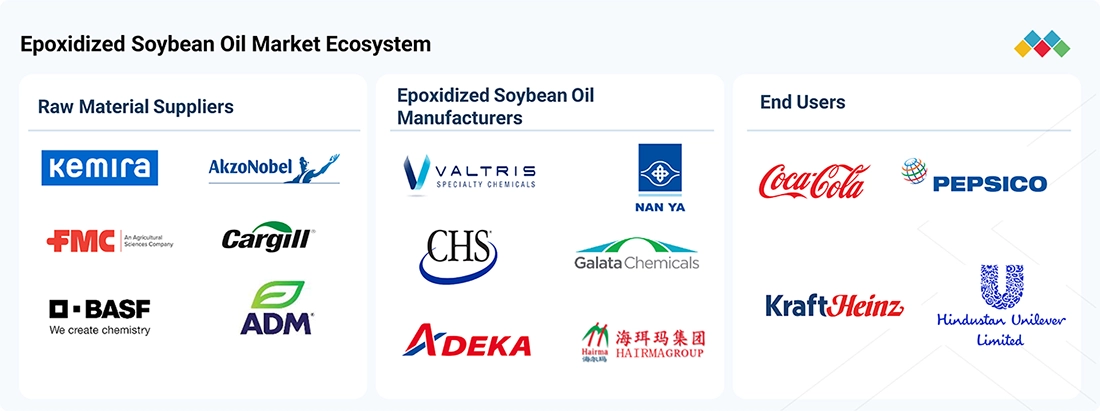
EPOXIDIZED SOYBEAN OIL MARKET: COMMERCIAL USE CASES ACROSS INDUSTRIES
| COMPANY | USE CASE DESCRIPTION | BENEFITS |
|---|---|---|
 |
The company developed a bio-based plasticizer derived from vegetable oils (including soybean oil) for halogen-containing polymers such as PVC. The patented technology produces vicinally diacylated fatty acid esters as a sustainable alternative to conventional plasticizers. | Provides a renewable, bio-based plasticizer option with improved compatibility and performance in PVC formulations; reduces reliance on petroleum-based plasticizers while maintaining or enhancing material properties. |
 |
High-performance epoxidized soybean oil (Vikoflex 7170) used as a dual-function plasticizer and heat/light stabilizer in flexible, semi-flexible, and rigid PVC compounds. Applied across floor coverings, coated fabrics (automotive & furniture), wire & cable, plastisols, extrusions, foams, and pigment dispersions. | Delivers efficient heat & light stabilization, low volatility, high detergent/oil/gas resistance, improved processing speed, excellent pigment wetting, and superior compatibility; acts as a polymeric plasticizer that reduces migration, extraction, and exudation while lowering formulation costs. |
Logos and trademarks shown above are the property of their respective owners. Their use here is for informational and illustrative purposes only.
Related Ecosystem
Key Takeaways
- South America's epoxidized soybean oil market is valued at USD 672.6 million in 2023 and will reach USD 788.8 million by 2028 at a 4.0% CAGR.
- South America's abundant soybean production and agricultural infrastructure provide a significant competitive advantage in feedstock sourcing and cost efficiency.
- Regulatory shifts toward sustainable and bio-based chemicals are accelerating adoption of epoxidized soybean oil across South America's plasticizer, coating, and adhesive markets.
- South America's chemical manufacturers are expanding capacity and innovation to capture growing domestic demand and strengthen export competitiveness.
Epoxidized Soybean Oil Market Report Scope
| Report Metric | Details |
|---|---|
| Base Year | 2023 |
| Fastest Growing Segment | FOOD & BEVERAGE (End-Use Industry) |
| Forecast Period | 2023-2028 |
| Growth Rate | CAGR of 5.6% from 2023 to 2028 |
| Largest Segment | PHTHALATES (Type) |
| Market Size Base Year (Billions) | ~USD 0.49 (2023) |
| Revenue Forecast (Billions) | ~USD 0.65 (2028) |
| Segments Covered | Raw Material, Application, End-Use Industry, Type |
South America Epoxidized Soybean Oil Market Report Segmentation
4 segment dimensions are covered across the global market.
By Raw Material
- Hydrogen Peroxide
- Other Raw Materials
- Soybean Oil
By Application
- Coated Fabrics
- Consumer Goods
- Films & Sheets
- Flavors & Fragrances
- Floorings & Wall Coverings
- Fuel Additives
- Functional Fluids
- Other Applications
- Pigment Dispersion Agents
- Plasticizers
- Uv Cure Applications
- Wires & Cables
By End-Use Industry
- Adhesives & Sealants
- Automotive & Transportation
- End-Use Industries
- Food & Beverage
- Other End-Use Industries
- Personal & Healthcare
By Type
- Non-Phthalates
- Phthalates
Target Audience
- Chemical Manufacturers & Processors : Producers of epoxidized soybean oil and downstream derivatives need regional market data to optimize production capacity, assess profitability, and identify expansion opportunities in South America.
- Agricultural & Agribusiness Companies : Soybean producers and agricultural cooperatives in Brazil and Argentina require market intelligence to understand demand for their feedstock and plan production volumes accordingly.
- Coatings & Adhesives Manufacturers : End-use producers seeking bio-based plasticizer alternatives need South America market insights to source epoxidized soybean oil competitively and meet sustainability commitments.
- Investment & Private Equity Firms : Investors evaluating opportunities in South America's chemical and bio-based materials sectors require detailed market forecasts and competitive analysis to assess returns and risk profiles.
- Trade & Export Organizations : Regional trade bodies and export promotion agencies need market data to support member companies in identifying growth opportunities and developing export strategies for epoxidized soybean oil.
Countries within South America - compare and drill down
| Country | 2025 size (native) |
|---|---|
| Brazil | USD 13.2 Million |
| Argentina | USD 5.8 Million |
| Rest Of South America | USD 10.5 Million |
Country market size visualization
Reasons to Buy this Report
- Regional Market Sizing & Forecasts : Obtain precise market valuations for South America (USD 672.6M in 2023, USD 788.8M in 2028) with country-level breakdowns for Brazil and Argentina to support investment and expansion decisions.
- Competitive Landscape Analysis : Understand key players, market share distribution, and competitive strategies specific to South America's epoxidized soybean oil sector to identify partnership and acquisition opportunities.
- Supply Chain & Feedstock Insights : Leverage detailed analysis of South America's soybean production capacity, processing infrastructure, and logistics networks to optimize sourcing and manufacturing operations in the region.
- Regulatory & Sustainability Trends : Access comprehensive coverage of environmental regulations, bio-based material mandates, and sustainability initiatives driving epoxidized soybean oil adoption across South American markets.
- End-Use Application Demand : Identify high-growth application segments (coatings, adhesives, flexible PVC) within South America with specific volume and value projections to prioritize product development and marketing efforts.
Frequently asked questions
What is the current market size of epoxidized soybean oil in South America?
South America's epoxidized soybean oil market was valued at USD 672.6 million in 2023 and is expected to grow to USD 788.8 million by 2028.
What is the projected growth rate for epoxidized soybean oil in South America?
South America's epoxidized soybean oil market is projected to grow at a CAGR of 4.0% from 2023 to 2028.
Why is South America a key region for epoxidized soybean oil production?
South America possesses abundant soybean production capacity, established agricultural infrastructure, and cost-competitive feedstock sourcing, making it an ideal hub for epoxidized soybean oil manufacturing and export.
What are the primary applications driving demand in South America?
In South America, epoxidized soybean oil is primarily used in plasticizers, coatings, adhesives, and sealants for automotive, construction, and consumer goods applications.
What regulatory factors are influencing South America's market growth?
Increasing regulatory pressure in South America to adopt sustainable and bio-based alternatives to petroleum-derived chemicals is driving adoption of epoxidized soybean oil across multiple industries.
RESEARCH METHODOLOGY
This study involved four major activities to estimate the current size of the epoxidized soybean oil market. Exhaustive secondary research was carried out to collect information on the market, the peer product market, and the parent product group market. The next step involved validating these findings, assumptions, and sizes with industry experts across the value chain of epoxidized soybean oil through primary research. The top-down and bottom-up approaches were employed to estimate the overall size of the epoxidized soybean oil market. After that, market breakdown and data triangulation procedures were used to determine the size of different segments of the market.
Secondary Research
The market for companies offering epoxidized soybean oil was determined by studying the secondary data available through paid and unpaid sources, analyzing the product portfolios of the major companies in the ecosystem, and rating the companies by their performance and quality. Various secondary sources, such as Business Standard, Bloomberg, World Bank, and Factiva, were referred to to identify and collect information for this study. Secondary sources also included annual reports, press releases, investor presentations, epoxidized soybean oil vendors, forums, certified publications, and white papers. The secondary research was used to obtain critical information on the industry’s value chain, the total pool of key players, market classification, and segmentation from the market and technology-oriented perspectives.
Primary Research
In the primary research process, various primary sources from the supply and demand sides were interviewed to obtain qualitative and quantitative information for this report. The primary sources from the supply side included industry experts, such as Chief Executive Officers (CEOs), Vice Presidents (VPs), marketing directors, technology and innovation directors, and related key executives from several key companies and organizations operating in the epoxidized soybean oil market. After the complete market engineering (calculations for market statistics, market breakdown, market size estimations, market forecasting, and data triangulation), extensive primary research was conducted to gather information and verify and validate the critical numbers arrived at. Primary research was also conducted to identify the segmentation types, industry trends, competitive landscape of epoxidized soybean oil offered by various market players, and key market dynamics, such as drivers, restraints, opportunities, challenges, industry trends, and key player strategies. In the complete market engineering process, the top-down and bottom-up approaches and several data triangulation methods were extensively used to perform the market estimation and market forecasting for the overall market segments and subsegments listed in this report. Extensive qualitative and quantitative analysis was performed on the complete market engineering process to list the key information/insights throughout the report.
The following is the breakdown of primary respondents:
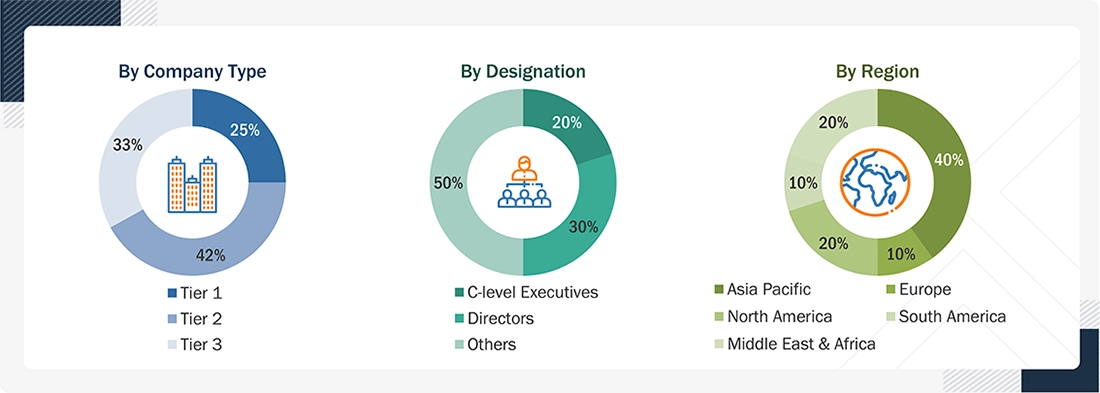
Note: Tier 1: >USD 1 billion; Tier 2: USD 500 million–1 billion; and Tier 3: <USD 500 million. Other designations include sales, marketing, and product managers.
To know about the assumptions considered for the study, download the pdf brochure
Market Size Estimation
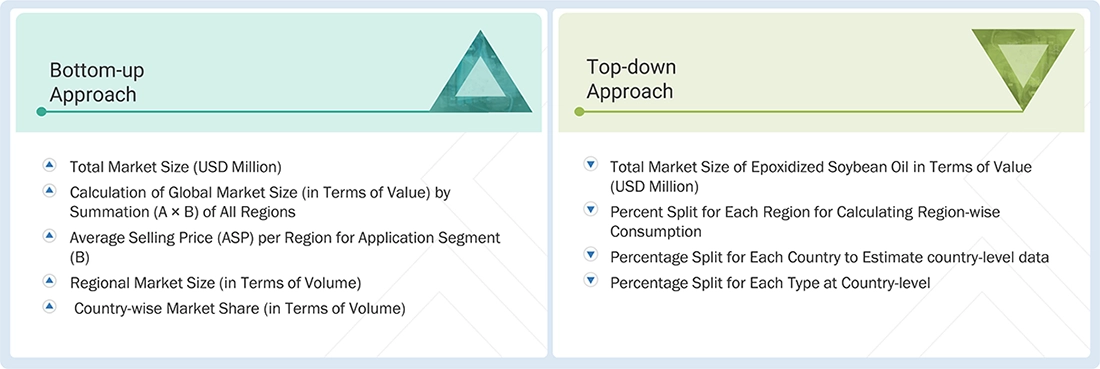
The top-down and bottom-up approaches were used to estimate and validate the size of the epoxidized soybean oil market. These approaches were also used extensively to estimate the size of various dependent market segments.
The research methodology used to estimate the market size included the following approaches:
Data Triangulation
After arriving at the overall market size using the market size estimation processes, the market was split into several segments and subsegments. The data triangulation and market breakup procedures were employed, wherever applicable, to complete the overall market engineering process and arrive at the exact statistics of each market segment and subsegment. The data were triangulated by studying various factors and trends from both the demand and supply sides.
Market Definition
Epoxidized Soybean Oil (ESBO), also known as ESBO or ESO, is a group of organic compounds derived through the epoxidation of soybean oil. This yellow, viscous fluid serves a dual purpose as a plasticizer and stabilizer in the production of Polyvinyl Chloride (PVC) plastic. The primary function of epoxidized soybean oil in PVC compounds and other plastic materials is to enhance and maintain their softness and flexibility. The production of epoxidized soybean oil involves the epoxidation of soybean oil, a process where hydrogen peroxide serves as an oxygen donor, and formic acid or acetic acid acts as a catalyst. This chemical transformation results in a versatile and eco-friendly product that finds widespread use in the plastics industry.
Key Stakeholders
- Epoxidized Soybean Oil Manufacturers
- Epoxidized Soybean Oil Suppliers
- Industry Associations and Regulatory Bodies
- Research & Development Entities
- Raw Material Suppliers
- End Users
Report Objectives
- To define, describe, and forecast the size of the epoxidized soybean oil market based on raw material, application, end-use industry, and region in terms of value and volume
- To provide detailed information on the significant drivers, restraints, opportunities, and challenges influencing the market growth
- To analyze and forecast the market based on raw material, application, and end-use industry
- To strategically analyze micro markets concerning individual growth trends, prospects, and their contribution to the market
- To assess the growth opportunities in the market for stakeholders and provide details on the competitive landscape for market leaders
- To forecast the market size of segments for North America, Europe, Asia Pacific, South America, and the Middle East & Africa
- To strategically profile key players and comprehensively analyze their market shares and core competencies
- To analyze competitive developments, such as expansions, product launches, partnerships, and acquisitions in the market
- To assess the impact of AI on the epoxidized soybean oil market
Available customizations:
With the given market data, MarketsandMarkets offers customizations according to client-specific needs.
The following customization options are available for the epoxidized soybean oil report:
Product Analysis
- A product matrix that gives a detailed comparison of the product portfolio of each company
Regional Analysis
- A further breakdown of the epoxidized soybean oil market for additional countries
Company Information
- Detailed analysis and profiling of additional market players (up to five)
Get the Full Epoxidized Soybean Oil Market Report
Full forecast, segment splits, and company analysis for all Epoxidized Soybean Oil Market.
- Canada Epoxidized Soybean Oil Market
- Mexico Epoxidized Soybean Oil Market
- US Epoxidized Soybean Oil Market
- Germany Epoxidized Soybean Oil Market
- France Epoxidized Soybean Oil Market
- UK Epoxidized Soybean Oil Market
- Italy Epoxidized Soybean Oil Market
- Russia Epoxidized Soybean Oil Market
- China Epoxidized Soybean Oil Market
- India Epoxidized Soybean Oil Market
- Japan Epoxidized Soybean Oil Market
- South Korea Epoxidized Soybean Oil Market
- Indonesia Epoxidized Soybean Oil Market
- South Africa Epoxidized Soybean Oil Market
- Brazil Epoxidized Soybean Oil Market
- Argentina Epoxidized Soybean Oil Market
- Rest Of Europe Epoxidized Soybean Oil Market
- Rest Of Asia Pacific Epoxidized Soybean Oil Market
- GCC Countries Epoxidized Soybean Oil Market
- -Rest Of GCC Countries Epoxidized Soybean Oil Market
- Rest Of South America Epoxidized Soybean Oil Market
Need a Tailored Report?
Customize this report to your needs
Get 10% FREE Customization
Customize This Report
