
Denmark Europe Perimeter Security Market (2026-2031)

The Denmark Europe Perimeter Security Market was valued at $893.7 Million in 2026 and projected to reach to $1228.6 Million by 2031, representing a compound annual growth rate of 6.6%. Denmark's perimeter security market demonstrates steady expansion driven by increasing awareness of security threats and regulatory mandates.


| Market Size in | USD 26.32 MN |
| Market Forecast in | |
| CAGR | |
| Forecast Period | |
| Units Considered | Value (USD MN) |
Denmark Europe Perimeter Security Market Trends and Insights
- This growth trajectory reflects Denmark's increasing investment in critical infrastructure protection and cybersecurity resilience across both public and private sectors.
- Denmark's commitment to digital transformation and regulatory compliance is driving demand for advanced perimeter security solutions. The Danish market benefits from strong government initiatives and a mature technology landscape that prioritizes border and facility protection.
- Denmark's strategic position in Northern Europe and its emphasis on data protection regulations create favorable conditions for perimeter security adoption.
- Between 2026 and 2031, Denmark is expected to see accelerated deployment of integrated security systems, reflecting broader European trends toward comprehensive threat mitigation. Denmark's perimeter security sector is characterized by high technology adoption rates and investment in smart infrastructure.
- The country's focus on sustainable and efficient security solutions positions Denmark as a progressive market within the European perimeter security landscape..
Key Market Statistics
- CAGR (2026-2031) 6.6% CAGR
- Market Size, 2026 ~USD 893.7 Million
- Forecast, 2031 ~USD 1228.6 Million
- Country Denmark
Denmark Europe Perimeter Security Market Overview
Market Valuation Growth :
Denmark's perimeter security market is valued at USD 893.7 million in 2026 and is projected to reach USD 1,228.6 million by 2031, representing a robust 6.6% CAGR over the forecast period.
Critical Infrastructure Investment :
Denmark is significantly increasing investments in critical infrastructure protection, driven by heightened security concerns and the need to safeguard essential services across energy, transportation, and telecommunications sectors.
Digital Transformation & Compliance :
The Danish market is propelled by the country's commitment to digital transformation initiatives and stringent regulatory compliance requirements, including GDPR and national cybersecurity directives.
Public & Private Sector Expansion :
Both public and private sectors in Denmark are actively deploying advanced perimeter security solutions, reflecting a comprehensive approach to physical and cyber threat mitigation across all organizational levels.
Denmark Europe Perimeter Security Market Dynamics
- The country's strong emphasis on critical infrastructure resilience and digital governance creates sustained demand for advanced perimeter security solutions.
- Public sector modernization initiatives and private sector investments in facility protection are key growth catalysts. Looking ahead to 2031, Denmark's market will benefit from technological advancements in integrated security systems, IoT-enabled monitoring, and AI-powered threat detection.
- The convergence of physical and cybersecurity requirements, combined with Denmark's position as a digital leader in Europe, positions the market for consistent growth and innovation in perimeter security technologies..
Market Ecosystem
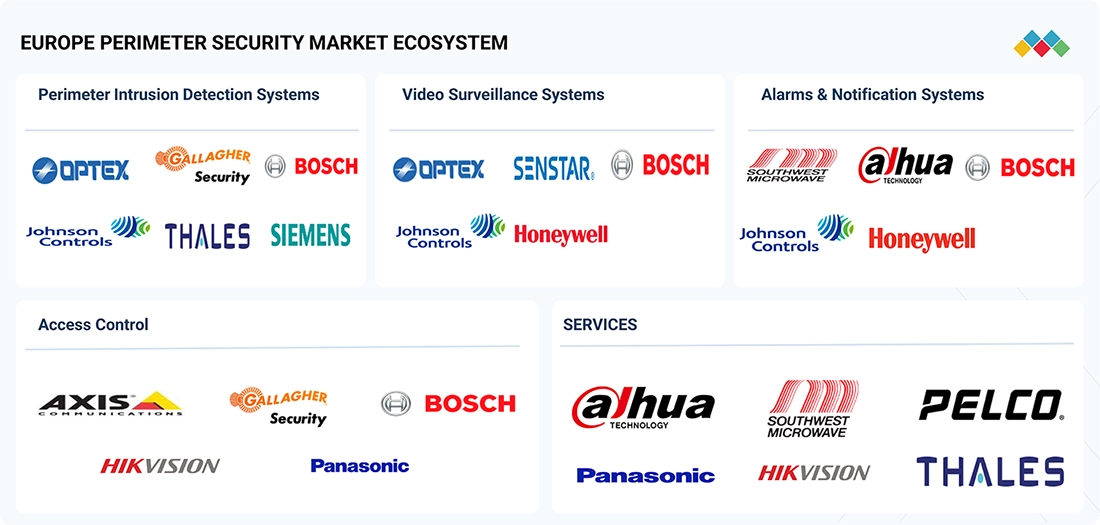
EUROPE PERIMETER SECURITY MARKET: COMMERCIAL USE CASES ACROSS INDUSTRIES
| COMPANY | USE CASE DESCRIPTION | BENEFITS |
|---|---|---|
 |
Bosch Security Systems deployed intelligent video surveillance, thermal cameras, and AI-enabled video analytics to strengthen perimeter protection across railway stations, maintenance depots, and critical rail infrastructure. | Improved intrusion detection accuracy, reduced false alarms, enhanced passenger safety, and faster security response across critical transportation infrastructure. |
 |
OPTEX deployed its FiberSensys Fiber FD322 fiber-optic perimeter intrusion detection system at Kent Science Park, integrating fence monitoring with existing CCTV and security management infrastructure. | Delivered accurate intrusion detection, minimized weather- and wildlife-related false alarms, enhanced operational efficiency, and strengthened protection of high-value research facilities. |
 |
Honeywell upgraded Heathrow Airport's integrated perimeter security by deploying enterprise access control, intelligent video surveillance, intrusion detection, and centralized security management to strengthen protection across critical airport infrastructure. | Enhanced airport-wide situational awareness, accelerated incident response, improved operational efficiency, and strengthened protection of passengers, assets, and restricted operational areas. |
|
|
Axis Communications deployed an AI-powered integrated surveillance platform combining network cameras, video analytics, ANPR, access control, and centralized video management to modernize perimeter security. | Strengthened perimeter protection, reduced theft risks, improved worker safety, accelerated vehicle access, and enhanced operational efficiency through intelligent real-time monitoring. |
Logos and trademarks shown above are the property of their respective owners. Their use here is for informational and illustrative purposes only.
Related Ecosystem
Key Takeaways
- Denmark's perimeter security market will grow from USD 893.7 million in 2026 to USD 1,228.6 million by 2031, representing a 6.6% CAGR.
- Denmark's regulatory environment and digital transformation initiatives are primary drivers of perimeter security investment.
- Denmark demonstrates high technology adoption rates, positioning it as a mature and progressive market within Europe.
- Integrated and smart security solutions are increasingly prioritized in Denmark's approach to critical infrastructure protection.
Europe Perimeter Security Market Report Scope
| Report Metric | Details |
|---|---|
| Base Year | 2026 |
| Fastest Growing Segment | LIDAR SENSORS (Subtype) |
| Forecast Period | 2026-2031 |
| Growth Rate | CAGR of 6% from 2026 to 2031 |
| Largest Segment | SYSTEMS (Component) |
| Market Size Base Year (Billions) | ~USD 22.02 (2026) |
| Revenue Forecast (Billions) | ~USD 29.47 (2031) |
| Segments Covered | Component, Type, System, Subtype, Service, Professional Service, End-Use Sector, System Subtype |
Denmark Europe Perimeter Security Market Report Segmentation
8 segment dimensions are covered across the global market.
By Component
- Services
- Systems
By Type
- Airports
- Cameras
- Hardware
- Oil And Gas
- Other Industries
- Other Infrastructures
- Sensors
- Software
By System
- Access Control Systems
- Alarm And Notification Systems
- Alarms And Notification Systems
- Barrier Systems
- Other Systems
- Perimeter Intrusion Detection Systems
- Video Surveillance Systems
By Subtype
- Airports
- Analytics
- Automatic Identification Systems (Ais)
- Biometric Readers
- Card-Based Readers
- Controllers
- Electronic Locks
- Fiber-Optic Sensors
- Infrared & Thermal Sensors
- Infrared Cameras
- Lidar Sensors
- Microwave Sensors
- Multi-Technology Readers
- Oil And Gas
- Other Hardware Devices
- Other Industries
- Other Infrastructures
- Other Sensors
- Other Software Applications
- Radar Sensors
- Standard Cameras
- Thermal Cameras
- Video Analytics
- Video Management Software (Vms)
- Visitor Management Systems
By Service
- Managed Services
- Professional Services
By Professional Service
- Maintenance And Support
- Risk Assessment And Analysis
- System Integration And Consulting
- Training And Education
By End-Use Sector
- Commercial
- Government
- Industrial
- Infrastructure
- Military & Defense
- Residential, Educational, And Religious Centers
By System Subtype
- Hardware
- Software
Target Audience
- Security Solution Providers : Perimeter security vendors and system integrators need Denmark-specific market data to develop localized go-to-market strategies, identify customer segments, and forecast revenue potential in this Nordic market.
- Government & Public Sector Agencies : Danish government bodies and public sector organizations require market intelligence to inform procurement decisions, infrastructure investment planning, and alignment with national security and digital transformation initiatives.
- Private Sector Enterprises : Large corporations and critical infrastructure operators in Denmark need market insights to evaluate security technology investments, benchmark against industry standards, and ensure regulatory compliance.
- Investment & Private Equity Firms : Investors evaluating opportunities in the Nordic security market require detailed Denmark market analysis to assess growth potential, identify acquisition targets, and make capital allocation decisions.
- Consultants & System Integrators : IT and security consultants advising Danish organizations need comprehensive market data to recommend appropriate solutions, justify investments, and align recommendations with market trends and regulatory requirements.
Reasons to Buy this Report
- Country-Specific Market Sizing : Obtain precise market valuation data for Denmark with verified figures for 2026 (USD 893.7M) and 2031 (USD 1,228.6M), enabling accurate budget allocation and investment planning specific to the Danish market.
- Regulatory & Compliance Insights : Understand Denmark's unique regulatory landscape, including GDPR compliance requirements and national cybersecurity directives that directly influence perimeter security purchasing decisions and technology adoption.
- Sector-Specific Growth Opportunities : Identify high-growth segments within Denmark's public and private sectors, including critical infrastructure, energy, transportation, and telecommunications, to target sales and partnership efforts effectively.
- Competitive Positioning Strategy : Benchmark your offerings against market trends in Denmark's 6.6% CAGR growth trajectory, enabling strategic positioning and differentiation in a market increasingly focused on integrated security solutions.
- Investment Decision Support : Make informed decisions on market entry, expansion, or acquisition strategies in Denmark with comprehensive data on market dynamics, growth drivers, and forecast trajectories through 2031.
Frequently asked questions
What is the current size of Denmark's perimeter security market?
Denmark's perimeter security market is valued at USD 893.7 million in 2026.
What is the projected market size for Denmark by 2031?
Denmark's perimeter security market is forecast to reach USD 1,228.6 million by 2031.
What is the CAGR for Denmark's perimeter security market?
Denmark's perimeter security market is expected to grow at a compound annual growth rate of 6.6% from 2026 to 2031.
What factors are driving growth in Denmark's perimeter security market?
Denmark's growth is driven by regulatory compliance requirements, digital transformation initiatives, critical infrastructure protection needs, and high technology adoption rates.
How does Denmark's market compare to the broader European perimeter security market?
Denmark demonstrates a mature market with high technology adoption and progressive security solutions, reflecting broader European trends toward integrated and smart infrastructure protection.
RESEARCH METHODOLOGY
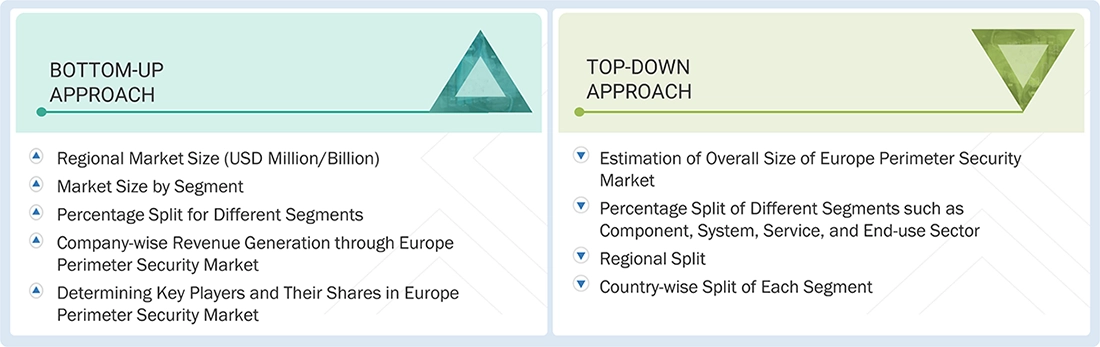
Secondary research was conducted to collect information useful for this technical, market-oriented, and commercial study of the Europe perimeter security market. The next step involved validating these findings, assumptions, and sizing estimates with industry experts across the value chain using primary research. Different approaches, including top-down and bottom-up methods, were employed to estimate the total market size. After that, the market breakup and data triangulation procedures were used to estimate the market size of the segments and subsegments of the Europe perimeter security market.
Secondary Research
During the secondary research process, various secondary sources were consulted to identify and collect information relevant to the study. The secondary sources included annual reports, press releases, investor presentations of Europe perimeter security vendors, forums, certified publications, and whitepapers. The secondary research was mainly used to obtain key information about the industry’s supply chain, the total pool of key players, market classification and segmentation according to industry trends to the bottom-most level, country-level markets, and key developments from both market- and technology-oriented perspectives, all of which were further validated by primary sources.
Primary Research
In the primary research process, various primary sources from both the supply and demand sides were interviewed to obtain qualitative and quantitative information for this report. The primary sources from the supply side included various industry experts, including chief executive officers (CEOs), vice presidents (VPs), marketing directors, technology and innovation directors, and related key executives from various key companies and organizations operating in the Europe perimeter security market.
In the market engineering process, top-down and bottom-up approaches were extensively used, along with several data triangulation methods, to estimate and forecast the overall market segments and subsegments listed in this report. Extensive qualitative and quantitative analyses were conducted on the complete market engineering process to identify key information/insights throughout the report.
After the complete market engineering process (including calculations for market statistics, market breakups, market size estimates, market forecasts, and data triangulation), extensive primary research was conducted to gather information and verify & validate the critical numbers derived. The primary research was also conducted to identify segmentation types, industry trends, the competitive landscape among market players, and key market dynamics, including drivers, restraints, opportunities, challenges, and key strategies.
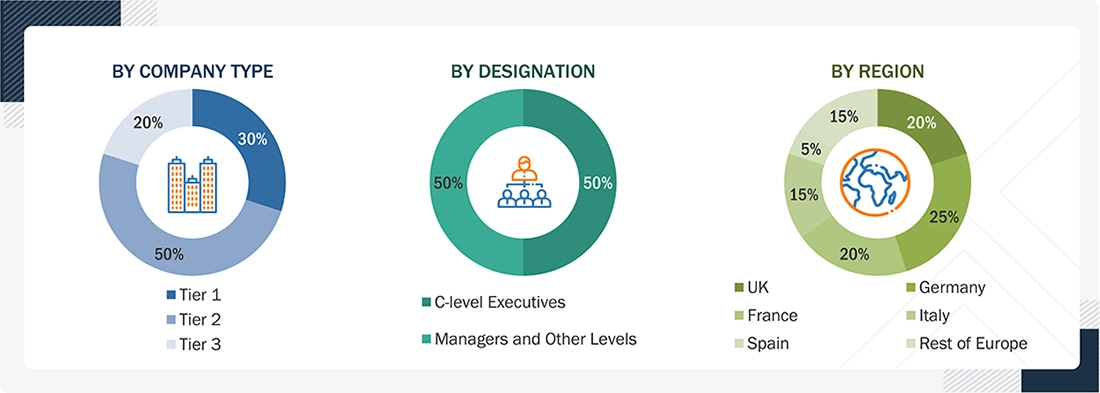
Note 1: Tier 1 companies receive revenues higher than USD 10 billion; Tier 2 companies' revenues range between USD 1 and 10 billion; and Tier 3 companies' revenues range between USD 500 million and USD 1 billion.
Note 2: Other levels include sales, marketing, and product managers.
Source: Industry Experts
To know about the assumptions considered for the study, download the pdf brochure
Market Size Estimation
Top-down and bottom-up approaches were employed to estimate and validate the size of the Europe perimeter security market, as well as the size of various dependent subsegments within the overall Europe perimeter security market. The research methodology used to estimate the market size includes the following: critical players in the market were identified through secondary research, and their market shares in each country were determined through both primary and secondary research. This entire procedure involved studying the annual and financial reports of the top market players and conducting extensive interviews with key industry leaders, including CEOs, VPs, directors, and marketing executives, to gather valuable insights.
All percentage splits and breakdowns were determined using secondary sources and verified through primary sources. All possible parameters that affect the market covered in this research study were accounted for, examined in detail, verified through primary research, and analyzed to obtain the final quantitative and qualitative data. This data was consolidated and added to detailed inputs and analysis from MarketsandMarkets.
Europe Perimeter Security Market : Top-Down and Bottom-Up Approach
Data Triangulation
The market was split into several segments and subsegments after arriving at the overall market size using the market size estimation processes explained above. The data triangulation and market breakup procedures were employed, where applicable, to complete the overall market engineering process and derive the exact statistics for each market segment and subsegment. The data was triangulated by studying various factors and trends from both the demand and supply sides.
Market Definition
The Europe perimeter security market comprises hardware, software, and services designed to detect, monitor, and respond to unauthorized access and intrusion attempts across the physical boundaries of commercial, industrial, government, critical infrastructure, transportation, residential, and public facilities. The market includes perimeter intrusion detection systems (PIDS), video surveillance, thermal imaging, access control at perimeter entry points, intelligent sensors, barriers, fencing solutions, and integrated security management platforms.
Key Stakeholders
- Government agencies & public security authorities
- Regulatory bodies and policymakers
- Defense and border security agencies
- Perimeter security equipment manufacturers (vendors/OEMs)
- Component & sensor suppliers
- Independent software vendors
- System integrators
- Consulting firms
- Value-added resellers (VARs) and distributors
- Managed security service providers (MSSPs)
- IT and cybersecurity service providers
- Research organizations and universities
- Venture capitalists and private equity firms
Report Objectives
- To define, describe, and forecast the Europe perimeter security market based on component, system, service, end-user sector, and country
- To provide detailed information about the major factors (drivers, opportunities, restraints, and challenges) influencing the growth of the market
- To analyze opportunities for stakeholders by identifying the high-growth segments of the market
- To forecast the size of the market segments with respect to European countries: UK, Germany, France, Italy, Spain, Benelux, Norway, Sweden, Denmark, Finland, Switzerland, and the Rest of Europe
- To analyze subsegments of the market with respect to individual growth trends, prospects, and contributions to the overall market
- To profile the key players and comprehensively analyze their market sizes and core competencies
- To track and analyze competitive developments such as product enhancements, new product launches, acquisitions, and partnerships & collaborations in the European market
Customization Options
With the provided market data, MarketsandMarkets offers customizations tailored to company-specific needs. The following customization options are available for the report:
Product Analysis
- Further breakdown of the Asia Pacific market by countries contributing to the regional market size.
- Further breakdown of the North American market by countries contributing to the regional market size.
- Further breakdown of the Latin American market by countries contributing to the regional market size.
- Further breakdown of the Middle East & African market by countries contributing to the regional market size.
- Further breakdown of the European market by countries contributing to the regional market size.
Company Information
- Detailed analysis and profiling of additional market players (up to 5)
Get the Full Europe Perimeter Security Market Report
Full forecast, segment splits, and company analysis for all Europe Perimeter Security Market.
- UK Europe Perimeter Security Market
- Germany Europe Perimeter Security Market
- France Europe Perimeter Security Market
- Italy Europe Perimeter Security Market
- Spain Europe Perimeter Security Market
- Norway Europe Perimeter Security Market
- Sweden Europe Perimeter Security Market
- Finland Europe Perimeter Security Market
- Switzerland Europe Perimeter Security Market
Need a Tailored Report?
Customize this report to your needs
Get 10% FREE Customization
Customize This Report
