
Europe EV Battery Testing Market (2024-2029)

The Europe EV Battery Testing Market was valued at $1010.4 Million in 2024 and projected to reach to $3177.5 Million by 2029, representing a compound annual growth rate of 21.0%. Europe's EV battery testing market is positioned for exceptional growth, expanding from $1,010.4 million in 2024 to $3,177.5 million by 2029 at a 21% CAGR.


| Market Size in | USD 26.32 MN |
| Market Forecast in | |
| CAGR | |
| Forecast Period | |
| Units Considered | Value (USD MN) |
Europe EV Battery Testing Market Trends and Insights
- This accelerated growth in Europe reflects the region's stringent regulatory frameworks, aggressive electrification targets, and substantial investments in battery manufacturing infrastructure.
- Europe's commitment to carbon neutrality and the EU's Battery Regulation are driving demand for comprehensive testing solutions across safety, performance, and durability protocols. The European market's expansion is underpinned by the proliferation of battery gigafactories, increased OEM production capacity, and heightened consumer demand for reliable EV solutions.
- Between 2024 and 2029, Europe is expected to consolidate its position as a global leader in battery testing innovation, with testing facilities becoming increasingly sophisticated to meet evolving certification requirements.
- Europe's competitive advantage stems from its established automotive supply chain, advanced testing infrastructure, and regulatory harmonization across member states, positioning the region as a critical hub for battery validation and quality assurance..
Key Market Statistics
- CAGR (2024-2029) 21.0% CAGR
- Market Size, 2024 ~USD 1010.4 Million
- Forecast, 2029 ~USD 3177.5 Million
- Geography Europe
Europe EV Battery Testing Market Overview
Regulatory Compliance Driving Growth :
Europe's stringent EU battery regulations and emissions standards are compelling automakers and battery manufacturers to invest heavily in advanced testing infrastructure, accelerating market expansion across the region.
Germany Leads European Market :
Germany dominates Europe's EV battery testing market with a valuation of $1,061.1 million, supported by its robust automotive manufacturing base and leadership in battery technology development.
Aggressive Electrification Targets :
Europe's commitment to achieving carbon neutrality by 2050 and phasing out internal combustion engines is spurring unprecedented demand for battery testing services across manufacturing and R&D facilities.
Manufacturing Infrastructure Expansion :
Substantial investments in battery gigafactories and testing centers across Germany, France, and the UK are creating significant opportunities for testing equipment and service providers throughout the region.
Europe EV Battery Testing Market Dynamics
- This acceleration is driven by the region's commitment to electrification, stringent regulatory requirements, and substantial capital investments in battery manufacturing infrastructure.
- Key markets including Germany, the UK, and France are establishing themselves as testing hubs. The outlook remains highly positive as European OEMs and battery manufacturers scale production to meet EU electrification mandates.
- Continued investment in testing facilities, coupled with technological advancements in battery chemistry and safety protocols, will sustain robust market growth.
- Strategic partnerships between automotive suppliers and testing service providers will further strengthen market dynamics through 2029..
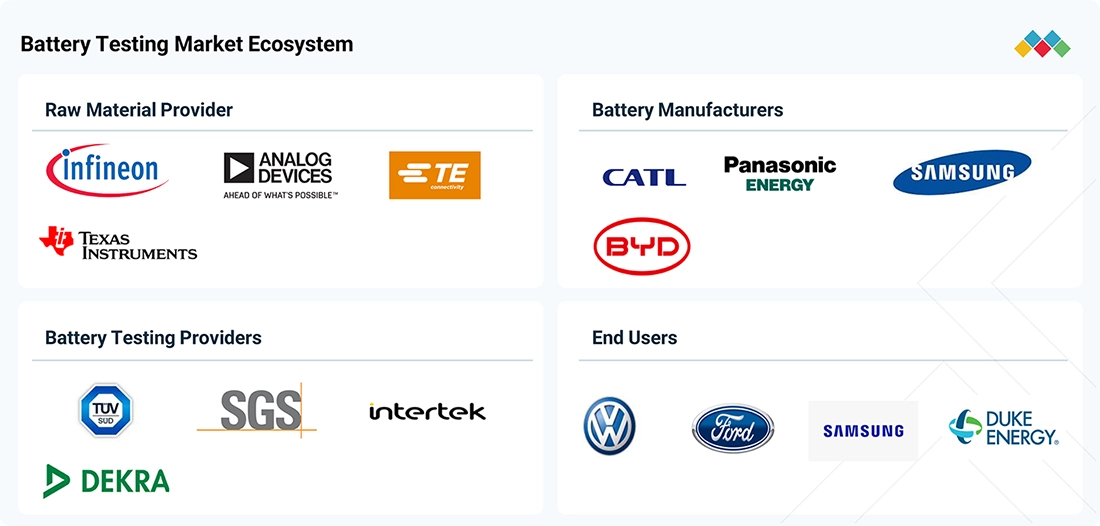
Market Ecosystem
BATTERY TESTING MARKET: COMMERCIAL USE CASES ACROSS INDUSTRIES
| COMPANY | USE CASE DESCRIPTION | BENEFITS |
|---|---|---|
 |
Tests battery cells, modules, and packs for safety, performance, durability, and lifecycle under simulated operating and abuse conditions | Identifies failure risks early, improves battery reliability, reduces warranty exposure, and supports regulatory compliance and global market access |
 |
Conducts battery safety, transportation, environmental, and performance testing to verify compliance with international standards and market requirements | Reduces product recall risks, strengthens brand protection, and facilitates market entry across multiple countries |
 |
Tests EV batteries and energy storage systems for thermal runaway, fire propagation, abuse resistance, performance, and safety compliance | Improves battery safety validation, supports certification, reduces technical risks, and builds customer confidence in EV and energy storage products |
 |
Performs battery safety, efficiency, performance benchmarking, environmental testing, and failure analysis for consumer electronics, EVs, and industrial applications | Verifies product performance claims, identifies failure causes, supports compliance with international standards, and accelerates product development and market access |
 |
Tests battery cells, modules, and complete systems for lifecycle performance, electrical safety, thermal stability, environmental durability, and transport compliance | Improves battery reliability, validates supplier quality, supports regulatory compliance, and enables market access through its international laboratory network |
Logos and trademarks shown above are the property of their respective owners. Their use here is for informational and illustrative purposes only.
Related Ecosystem
Automotive Electronics And Electrical Equipment
- Battery Electric Vehicle (BEV)
- Light Commercial Vehicles (LCVs)
- Fuel Cell Electric Vehicle (FCEV)
- Sensors
- Hybrid Electric Vehicle (HEV)
- BOSCH LIMITED
- DENSO Corporation
- Continental ag
- Panasonic Holdings Corporation
- Texas Instruments Incorporated
Electric Hybrid Vehicles
- Battery Electric Vehicle (BEV)
- Fuel Cell Electric Vehicle (FCEV)
- Light Commercial Vehicles (LCVs)
- Hybrid Electric Vehicle (HEV)
- Agricultural Tractors
- Visteon Corporation
- Byd company ltd.
- BOSCH LIMITED
- Tesla, Inc.
- FORD MOTOR COMPANY
Key Takeaways
- Europe's EV battery testing market will grow from $1,010.4M (2024) to $3,177.5M (2029) at a 21.0% CAGR, outpacing global growth.
- Stringent EU regulations and battery certification mandates are primary drivers accelerating testing demand across Europe.
- Europe's expanding battery gigafactory footprint requires advanced testing infrastructure to ensure safety and performance compliance.
- By 2029, Europe will solidify its position as a global leader in battery testing innovation and standardization.
EV Battery Testing Market Report Scope
| Report Metric | Details |
|---|---|
| Base Year | 2024 |
| Fastest Growing Segment | SOLID-STATE (Chemistry) |
| Forecast Period | 2024-2029 |
| Growth Rate | CAGR of 19% from 2024 to 2029 |
| Largest Segment | LITHIUM-ION (Chemistry) |
| Market Size Base Year (Billions) | ~USD 3.35 (2024) |
| Revenue Forecast (Billions) | ~USD 7.99 (2029) |
| Segments Covered | Ev Type, Form Factor, Propulsion, Battery Technology, Chemistry, Sourcing Type, Testing Type |
Europe EV Battery Testing Market Report Segmentation
7 segment dimensions are covered across the global market.
By Ev Type
- Hcv
- Heavy Commercial Vehicle
- Ldv
- Light-Duty Vehicle
By Form Factor
- Cylindrical
- Pouch
- Prismatic
By Propulsion
- Bev
- Fcev
- Hev
- Phev
By Battery Technology
- Cell-To-Chassis
- Cell-To-Module
- Cell-To-Pack
By Chemistry
- Lithium-Ion
- Solid-State
By Sourcing Type
- In-House
- Outsourced
By Testing Type
- Other Testing
- Performance Testing
- Safety Testing
Target Audience
- Battery Manufacturers & OEMs : European and global battery producers and automotive OEMs need market data to optimize testing investments, understand competitive positioning, and align capacity expansion with regional demand forecasts.
- Testing Equipment & Service Providers : Suppliers of battery testing equipment, software, and services require detailed market insights to identify growth opportunities, target high-potential regions, and develop region-specific solutions.
- Automotive Suppliers & Tier-1s : Component suppliers and tier-1 automotive companies need to understand testing market dynamics to ensure supply chain readiness and support OEM electrification strategies across Europe.
- Investment & Private Equity Firms : Investors evaluating opportunities in the EV battery testing sector require comprehensive market analysis, growth projections, and competitive intelligence to assess portfolio companies and acquisition targets.
- Government & Policy Bodies : European regulatory agencies and government bodies use market research to inform policy decisions, infrastructure investments, and electrification initiatives aligned with regional sustainability goals.
Countries within Europe - compare and drill down
| Country | 2025 size (native) |
|---|---|
| Germany | USD 1061.1 Million |
| France | USD 490.3 Million |
| UK | USD 805.1 Million |
| Spain | USD 208.1 Million |
| Norway | USD 229.3 Million |
| Rest Of Europe | USD 383.5 Million |
Country market size visualization
Reasons to Buy this Report
- Regional Market Sizing & Forecasts : Obtain precise market valuations for Europe and individual countries (Germany, UK, France, Spain, Norway) with detailed 5-year forecasts to support strategic planning and investment decisions.
- Regulatory & Compliance Insights : Understand Europe's stringent battery regulations, EU directives, and compliance requirements driving testing demand, enabling vendors to align products and services with regional standards.
- Competitive Landscape Analysis : Identify key testing service providers, equipment manufacturers, and technology leaders operating across European markets to benchmark performance and identify partnership opportunities.
- Growth Opportunity Mapping : Pinpoint high-growth segments and emerging opportunities within Germany, France, and the UK to prioritize market entry, expansion, and resource allocation strategies.
- Investment & Expansion Strategy : Leverage detailed market intelligence to make informed decisions on facility locations, technology investments, and go-to-market strategies tailored to Europe's evolving EV battery testing landscape.
Frequently asked questions
What is the current size of Europe's EV battery testing market?
Europe's EV battery testing market was valued at $1,010.4 million in 2024 and is projected to reach $3,177.5 million by 2029.
What is the expected growth rate for Europe's battery testing market?
Europe's EV battery testing market is expected to grow at a compound annual growth rate (CAGR) of 21.0% from 2024 to 2029.
What regulatory factors are driving Europe's battery testing market?
Europe's stringent EU Battery Regulation, carbon neutrality commitments, and mandatory safety and performance certifications are key regulatory drivers accelerating testing demand.
Which European countries are leading battery testing infrastructure development?
Germany, France, Poland, and Sweden are among Europe's leading markets for battery testing infrastructure, supported by major gigafactory investments and automotive manufacturing hubs.
How does Europe's battery testing market compare to global trends?
Europe's 21.0% CAGR exceeds the global average of 19%, reflecting the region's accelerated electrification pace and regulatory intensity.
RESEARCH METHODOLOGY
The research study involves extensive use of secondary sources such as company annual reports/presentations, industry association publications, magazine articles, directories, technical handbooks, World Economic Outlook, trade websites, technical articles, and databases to identify and collect information on the battery testing market. In-depth interviews have been conducted with various primary sources, experts from related industries, auto component providers, and service providers, to obtain and verify critical information, as well as assess the growth prospects and market estimations.
Secondary Research
Secondary sources for this research study include corporate filings, such as annual reports, investor presentations, and financial statements; trade, business, and professional associations; whitepapers and battery testing-related journals; certified publications; articles by recognized authors; directories; and databases. Secondary data has been collected and analyzed to determine the overall market size, further validated by primary research.
Primary Research
Extensive primary research has been conducted after understanding the battery testing market scenario through secondary research. Several primary interviews have been conducted with market experts from demand (Battery manufacturers, OEMs, Electronics and consumer device manufacturers) and supply (Testing, Inspection, and Certification (TIC) providers, Specialized battery testing laboratories) sides. The regions considered for the research include North America, Europe, Asia Pacific, and the Rest of the World. Approximately 60% and 40% of primary interviews have been conducted from the demand and supply sides, respectively. Primary data has been collected through questionnaires, emails, and telephonic interviews. In the canvassing of primary data, various departments within organizations, such as sales, operations, and marketing, have been covered to provide a holistic viewpoint in this report.
After interacting with industry experts, brief sessions have been conducted with experienced independent consultants to reinforce the findings from the primaries. This, along with the in-house subject matter experts’ opinions, has led to the findings described in this report.
Breakdown of Primaries
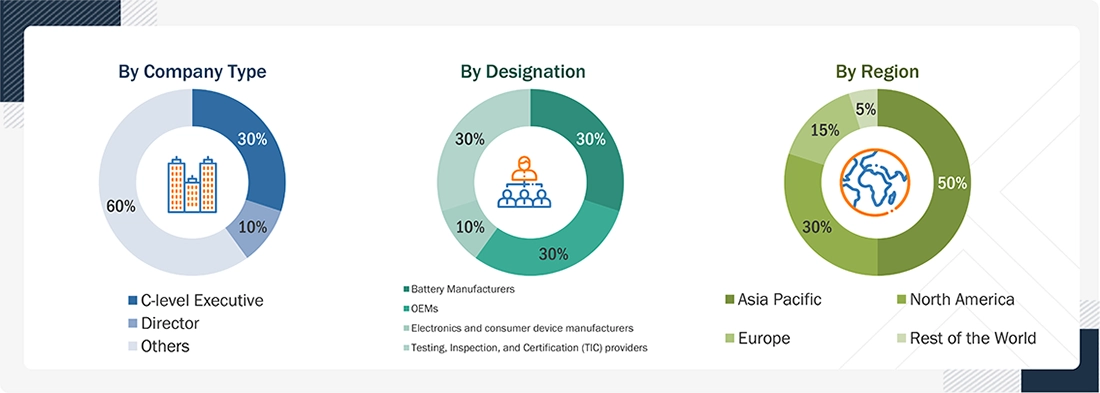
Note: Others include sales, managers, and product managers.
Company tiers are based on the value chain; the company's revenue is not considered.
To know about the assumptions considered for the study, download the pdf brochure
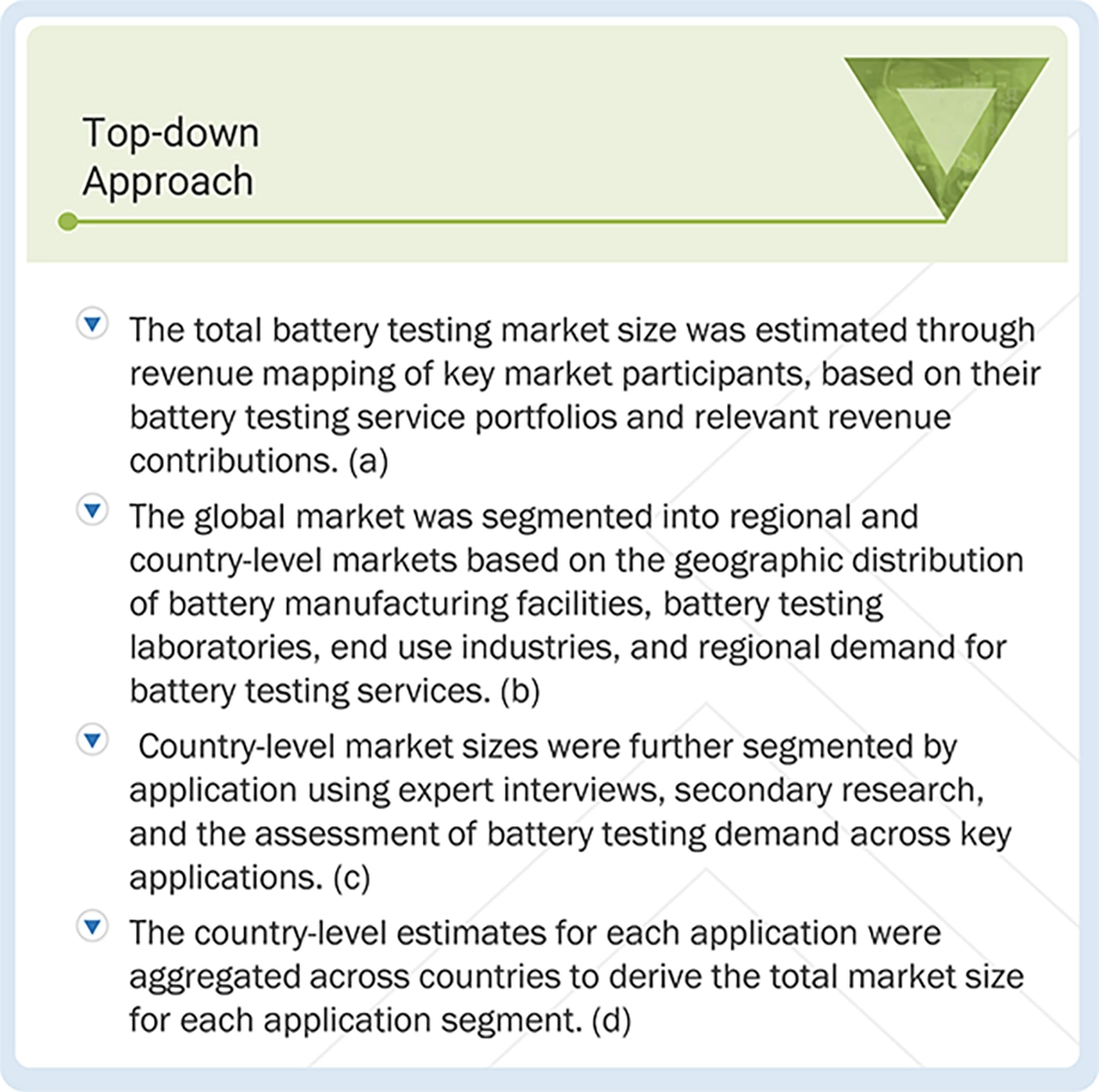
Market Size Estimation
As mentioned below, a detailed market estimation approach has been followed to estimate and validate the volume and value of the battery testing market and other submarkets.
- Segment split has been identified through primary and secondary research.
- Key players in the global battery testing market have been identified through secondary research, and their global market ranking has been determined through primary and secondary research.
- The research methodology includes the study of the annual and quarterly financial reports & regulatory filings of major market players, as well as interviews with industry experts for detailed market insights.
- All major penetration rates, percentage shares, splits, and breakdowns for the global battery testing market have been determined by using secondary sources and verified through primary sources.
- All key macro indicators affecting the revenue growth of the market segments and subsegments have been accounted for, viewed in extensive detail, verified through primary research, and analyzed to get the validated and verified quantitative & qualitative data.
- The gathered market data has been consolidated and added with detailed inputs, analyzed, and presented in this report.
Battery Testing Market: Bottom-Up Approach
Data Triangulation
After arriving at the overall market size through the aforementioned methodology, the battery testing market has been split into several segments and subsegments. The data triangulation procedure has been employed, wherever applicable, to complete the overall market engineering process and arrive at the exact market value for key segments and subsegments. The extrapolated market data has been triangulated by studying various macro indicators and regional trends from both the demand and supply-side participants.
Market Definition
Battery testing is the structured process of applying controlled electrical, thermal, or mechanical conditions to a battery cell, module, or system to measure its response and evaluate its performance, safety, and reliability against rated specifications.
Key Stakeholders
- Associations, Forums, and Alliances Related to Batteries and Energy Storage
- Automotive OEMs and EV Manufacturers
- Battery Manufacturers
- Battery Material and Component Manufacturers
- Battery Testing, Inspection, and Certification Providers
- Battery Testing Equipment and Technology Providers
- Battery Energy Storage System Manufacturers and Integrators
- Consumer Electronics Manufacturers
- Industrial Battery and Equipment Manufacturers
- Battery Distributors and Suppliers
- Battery Recycling and Second Life Battery Companies
- Research Institutions and Battery Technology Developers
- Regulatory Authorities and Government Agencies
- Standards Development and Certification Organizations
Report Objectives
- To analyze and forecast the battery testing market in terms of value (USD million) from 2026 to 2033
- To define, describe, and forecast the market by Service Type, Battery Testing Level, Battery Chemistry, Sourcing Type, Testing Type, and Application
- Service Type (Testing, Inspection and Certification)
- Battery Testing Level (Cell, Module, Battery Pack and Complete System)
- Battery Chemistry (Lithium Ion, Lead Acid, Sodium Ion and Solid State)
- Sourcing Type (Inhouse and Outsourced)
- Testing Type (Safety and Abuse Testing, Performance and Lifecycle Testing, Electrical Testing, Thermal Testing, Mechanical & Vibration Testing, Environmental Testing, EMC Testing, Failure Testing)
- Application (Electric Vehicles, ICE Vehicles, Aerospace, Marine & Defense, Battery Energy Storage Solution, Consumer Electronics, Industrial Equipment, Medical Devices, Other Applications)
- Region (Asia Pacific, Europe, North America, and Rest of the World)
- To identify and analyze key drivers, challenges, restraints, and opportunities influencing market growth
- To strategically analyze the market, considering individual growth trends, prospects, and contributions to the total market
- To study the following with respect to the market
- Supply Chain Analysis
- Ecosystem Analysis
- Technology Analysis
- Trade Analysis
- Case Study Analysis
- Patent Analysis
- Regulatory Landscape
- Average Selling Price Analysis
- Trends/Disruptions Impacting Customers’ Business
- Impact of AI/Gen AI
- Key Stakeholders and Buying Criteria
- Key Conferences and Events
- Cost per test by level
- Battery testing cost per application
- Equipment cost structure by battery type
- Inhouse versus outsourced testing economics
- Battery lifecycle testing
- OEM Strategies for Battery Testing
- To strategically profile the key players and comprehensively analyze their market share and core competencies
- To track and analyze competitive developments such as deals (joint ventures, mergers & acquisitions, partnerships, collaborations), product developments and launches, and other activities undertaken by the key industry participants
Available customizations:
- With the given market data, MarketsandMarkets offers customizations in accordance with the company's specific needs.
- Battery testing market, By Lithium-ion battery chemistry can be broken down to its subsegments at the regional level (for regions covered in the report)
- Battery testing market, By Sourcing model can be further segmented into applications, for additional countries (for countries not covered in the report)
- Additional Company Profiles (Up to 5)
Get the Full EV Battery Testing Market Report
Full forecast, segment splits, and company analysis for all EV Battery Testing Market.
- China EV Battery Testing Market
- India EV Battery Testing Market
- Japan EV Battery Testing Market
- South Korea EV Battery Testing Market
- Germany EV Battery Testing Market
- France EV Battery Testing Market
- UK EV Battery Testing Market
- Spain EV Battery Testing Market
- Norway EV Battery Testing Market
- Canada EV Battery Testing Market
- US EV Battery Testing Market
- Rest Of Europe EV Battery Testing Market
Need a Tailored Report?
Customize this report to your needs
Get 10% FREE Customization
Customize This Report