
Germany Exposure Management Market (2024-2029)

The Germany Exposure Management Market was valued at $174.1 Million in 2024 and projected to reach to $621.5 Million by 2029, representing a compound annual growth rate of 29.0%. Germany's Exposure Management Market is poised for exceptional growth through 2029, driven by escalating cyber threats and regulatory mandates.


| Market Size in | USD 26.32 MN |
| Market Forecast in | |
| CAGR | |
| Forecast Period | |
| Units Considered | Value (USD MN) |
Germany Exposure Management Market Trends and Insights
- This represents a compound annual growth rate of 29.0%, reflecting Germany's strong commitment to cybersecurity and risk management infrastructure.
- Germany's position as a leading European technology hub and its stringent regulatory environment are driving widespread adoption of exposure management solutions across enterprises. The German market benefits from increasing digitalization across manufacturing, finance, and public sectors, where exposure management has become critical for compliance and operational resilience.
- Germany's emphasis on data protection and Industry 4.0 initiatives is accelerating investment in comprehensive exposure visibility platforms.
- By 2029, Germany is expected to solidify its role as a key exposure management market in Europe, with organizations prioritizing continuous asset discovery and vulnerability assessment capabilities..
Key Market Statistics
- CAGR (2024-2029) 29.0% CAGR
- Market Size, 2024 ~USD 174.1 Million
- Forecast, 2029 ~USD 621.5 Million
- Country Germany
Germany Exposure Management Market Overview
Market Valuation & Growth :
Germany's Exposure Management Market is valued at $174.1 million in 2024, with a robust 29% CAGR projected through 2029, reaching $621.5 million. This growth rate exceeds the global average of 28.3%, positioning Germany as a high-growth market within Europe.
Regulatory Drivers :
Germany's stringent regulatory environment, including NIS2 Directive compliance and GDPR enforcement, mandates comprehensive exposure management solutions. These regulations drive enterprise adoption across financial services, manufacturing, and critical infrastructure sectors.
Technology Hub Leadership :
As a leading European technology and industrial hub, Germany hosts major enterprises requiring sophisticated cybersecurity frameworks. The country's strong manufacturing and automotive sectors demand advanced exposure management to protect intellectual property and operational continuity.
Digital Transformation Investment :
German enterprises are significantly investing in digital transformation initiatives, creating heightened demand for exposure management platforms. Industry 4.0 adoption and cloud migration strategies necessitate comprehensive vulnerability and risk visibility solutions.
Germany Exposure Management Market Dynamics
- The country's commitment to cybersecurity excellence, combined with mandatory compliance frameworks like NIS2 and GDPR, creates sustained demand for sophisticated exposure management solutions across enterprise segments. Key growth catalysts include increasing digitalization of manufacturing processes, expansion of cloud infrastructure, and heightened awareness among C-suite executives regarding cyber risk quantification.
- German enterprises are prioritizing integrated exposure management platforms that provide real-time visibility into vulnerabilities and threat landscapes, supporting both compliance and strategic risk management objectives..
Market Ecosystem
Related Ecosystem
Application Security
- Cloud Security
- Security Analytics
- Network Testing
- Security Testing
- Web Application Security
- REDINGTON
- International Business Machines Corporation
- MICROSOFT CORPORATION
- Cisco Systems, Inc.
- PALO ALTO NETWORKS, INC
Cyber Security
- Cloud Security
- Biometric Systems
- Data Loss Prevention (DLP)
- Multi-Factor Authentication
- Security Analytics
- REDINGTON
- International Business Machines Corporation
- Cisco Systems, Inc.
- MITSUI BUSSAN SECURE DIRECTIONS INC
- MICROSOFT CORPORATION
Endpoint Security
- Cloud Security
- Security Analytics
- Multi-Factor Authentication
- Biometric Security and Authentication System
- Critical Communication Network
- REDINGTON
- International Business Machines Corporation
- MICROSOFT CORPORATION
- Cisco Systems, Inc.
- PALO ALTO NETWORKS, INC
Key Takeaways
- Germany's Exposure Management Market is projected to grow from $174.1M (2024) to $621.5M (2029) at a 29.0% CAGR.
- Germany's regulatory framework and Industry 4.0 initiatives are primary drivers of exposure management adoption.
- Manufacturing and financial sectors in Germany are leading investment in exposure management solutions.
- Germany's market growth outpaces the global average, positioning it as a critical European exposure management hub.
Exposure Management Market Report Scope
| Report Metric | Details |
|---|---|
| Base Year | 2024 |
| Fastest Growing Segment | SERVICES (Component) |
| Forecast Period | 2024-2029 |
| Growth Rate | CAGR of 28.3% from 2024 to 2029 |
| Largest Segment | LARGE ENTERPRISES (Organization Size) |
| Market Size Base Year (Billions) | ~USD 2.19 (2024) |
| Revenue Forecast (Billions) | ~USD 7.6 (2029) |
| Segments Covered | Component, Deployment Mode, Application, End-User Industry, Target, Organization Size, Vertical |
Germany Exposure Management Market Report Segmentation
7 segment dimensions are covered across the global market.
By Component
- Services
- Software
- Solution
- Solutions
By Deployment Mode
- Cloud
- On-Premises
By Application
- Assets Management
- Attack Surface Management
- Log Management And Reporting
- Other Applications
- Others*
- Penetration Testing
- Security Analytics
- Threat Intelligence
- Vulnerability Management
By End-User Industry
- Bfsi
- Energy & Utilities
- Government
- Healthcare
- It & Ites
- Other Verticals
- Retail & Ecommerce
By Target
- Api Vulnerabilities
- Content Management System Vulnerabilities
- IoT Vulnerabilities
- Other Target Vulnerabilities*
By Organization Size
- Large Enterprises
- Smes
By Vertical
- Bfsi
- Energy And Utility
- Finance And Insurance
- Healthcare
- Healthcare And Social Assistance
- Information
- It And Ites
- Manufacturing
- Other Verticals*
- Others*
- Retail
- Retail Trade
- Utilities
GERMANY: EXPOSURE MANAGEMENT MARKET, BY APPLICATION, 2021–2029
| Segment | 2021 | 2022 | 2023 | 2024 | 2025 | 2026 | 2027 | 2028 | 2029 | CAGR (%) |
|---|---|---|---|---|---|---|---|---|---|---|
| ASSETS MANAGEMENT | 10.3 | 12.1 | 14.5 | 17.5 | 21.6 | 27.1 | 34.8 | 45.8 | 62 | 28.8 |
| ATTACK SURFACE MANAGEMENT | 24.2 | 28.8 | 34.8 | 42.5 | 52.9 | 67.1 | 87 | 115.8 | 158.1 | 30 |
| OTHER APPLICATIONS | 11 | 13 | 15.6 | 18.8 | 23.2 | 29.1 | 37.3 | 49.1 | 66.2 | 28.6 |
| PENETRATION TESTING | 12.9 | 15.3 | 18.5 | 22.5 | 27.9 | 35.3 | 45.7 | 60.6 | 82.5 | 29.7 |
| THREAT INTELLIGENCE | 15.2 | 18 | 21.5 | 26.1 | 32.2 | 40.5 | 52 | 68.6 | 92.9 | 28.9 |
| VULNERABILITY MANAGEMENT | 27.9 | 32.7 | 38.9 | 46.7 | 57.1 | 71.4 | 91 | 119.1 | 159.9 | 27.9 |
| TOTAL | 101.5 | 120 | 143.7 | 174.1 | 214.9 | 270.6 | 347.9 | 458.9 | 621.5 | 29 |
Target Audience
- Enterprise Security Leaders : CISOs and security directors in German enterprises need market intelligence to justify exposure management investments, benchmark against peers, and align cybersecurity strategies with regulatory requirements and industry best practices.
- Software & Solution Vendors : Cybersecurity and exposure management vendors require Germany-specific market data to develop localized solutions, identify customer segments, plan product roadmaps, and establish competitive positioning in this high-growth European market.
- Management Consulting Firms : Consultants advising German enterprises on digital transformation and risk management need authoritative market data to support client recommendations, validate business cases, and identify emerging exposure management trends.
- Investment & Private Equity Firms : Investors evaluating cybersecurity companies and market opportunities in Germany require detailed market sizing, growth projections, and sector analysis to assess investment potential and portfolio company performance.
- Regulatory & Compliance Officers : Compliance professionals in German organizations need market insights to understand exposure management solutions landscape, evaluate vendor capabilities, and ensure alignment with NIS2 and GDPR compliance obligations.
Reasons to Buy this Report
- Market Size & Growth Validation : Obtain precise market valuation data for Germany ($174.1M in 2024) and verified 5-year forecasts ($621.5M by 2029). Validate investment decisions and revenue projections with authoritative market sizing specific to the German exposure management sector.
- Regulatory Compliance Intelligence : Understand how NIS2 Directive, GDPR, and German-specific regulations drive market demand. Identify compliance-driven opportunities and customer pain points to tailor solutions and go-to-market strategies for German enterprises.
- Competitive Landscape Analysis : Benchmark against competitors in the German market with segment-specific insights. Identify market gaps, emerging players, and consolidation opportunities within Germany's exposure management ecosystem.
- Sector-Specific Opportunities : Access detailed insights into high-growth German sectors including manufacturing, automotive, financial services, and critical infrastructure. Prioritize sales efforts and product development based on sector-specific exposure management requirements.
- Strategic Market Entry & Expansion : Develop informed market entry strategies or expansion plans for Germany with data-driven insights on customer segments, adoption rates, and regional preferences. Reduce market entry risk with comprehensive Germany-focused intelligence.
Frequently asked questions
What is the current size of Germany's Exposure Management Market?
Germany's Exposure Management Market was valued at $174.1 million in 2024 and is expected to reach $621.5 million by 2029.
What is the growth rate of Germany's Exposure Management Market?
Germany's Exposure Management Market is growing at a compound annual growth rate (CAGR) of 29.0% from 2024 to 2029.
Which sectors are driving exposure management adoption in Germany?
Manufacturing, financial services, and public sector organizations in Germany are leading adoption of exposure management solutions due to regulatory requirements and digital transformation initiatives.
How does Germany's market growth compare to global trends?
Germany's 29.0% CAGR slightly exceeds the global average of 28.3%, reflecting strong regional demand and regulatory compliance pressures.
What factors are accelerating exposure management investment in Germany?
Germany's stringent data protection regulations, Industry 4.0 initiatives, and increasing cyber threats are driving organizations to invest in comprehensive exposure management platforms.
RESEARCH METHODOLOGY
The study involved significant activities in estimating the current market size for Exposure Management. Intensive secondary research was conducted to collect information about exposure management and related ecosystems. The industry executives validated these findings, assumptions, and sizing across the value chain using a primary research process as a next step. Top-down and bottom-up market estimation approaches were used to estimate the market size globally, followed by the market breakup and data triangulation procedures to assess the market segment and sub-segments in exposure management.
Secondary Research Process:
In the secondary research process, various sources were referred to to identify and collect exposure management information. These sources include annual reports, press releases, exposure management software and service vendor investor presentations, forums, vendor-certified publications, and industry/association white papers. These secondary sources were utilized to obtain critical information about exposure management’s solutions and services supply & value chain, a list of 100+ key players and SMEs, market classification, and segmentation per the industry trends and regional markets. The secondary research also gives us insights into the key developments from market and technology perspectives, which primary respondents further validated.
The factors considered for estimating the regional market size include technological initiatives undertaken by governments of different countries, GDP growth, ICT spending, recent market developments, and market ranking analysis of primary exposure management solutions and service vendors.
Primary Research Process:
We have conducted primary research with industry executives from both the supply and demand sides. The primary sources from the supply side include chief executive officers (CEOs), vice presidents (VPs), marketing directors, and technology and innovation executives of key companies operating in the exposure management market. We have conducted primary interviews with the executives to obtain qualitative and quantitative information for exposure management.
The market engineering process implemented the top-down and bottom-up approaches and various data triangulation methods to estimate and forecast the market segments and subsegments. During the post-market engineering process, we conducted primary research to verify and validate the critical numbers we arrived at. The primary analysis was also undertaken to identify the segmentation types, industry trends, the competitive landscape of the exposure management market players, and fundamental market dynamics, such as drivers, restraints, opportunities, challenges, industry trends, and key strategies.
Following is the breakup of the primary research:
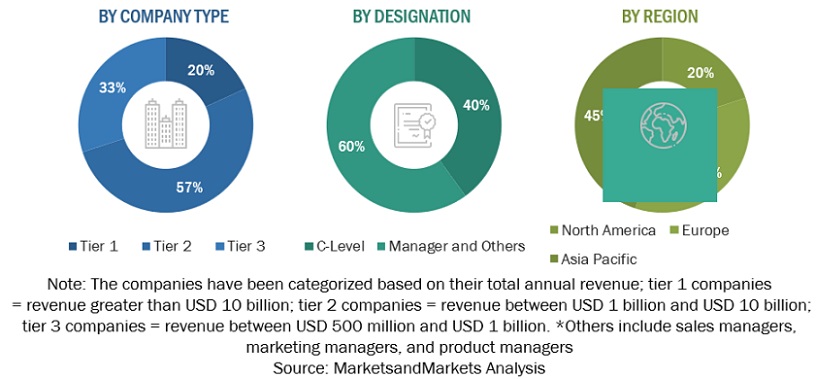
To know about the assumptions considered for the study, download the pdf brochure
Market Size Estimation Process:
Both top-down and bottom-up approaches were implemented for market size estimation to estimate, project, and forecast the size of the global and other dependent sub-segments in the overall exposure management market.
The research methodology used to estimate the market size includes these steps:
- The key players, SMEs, and startups were identified through secondary sources. Their revenue contributions in the market were determined through primary and secondary sources.
- Annual and financial reports of the publicly listed market players were considered for the company’s revenue details, and,
- Primary interviews were also conducted with industry leaders to collect information about their companies, competitors, and key players in the market.
- All percentage splits and breakups were determined using secondary sources and verified through primary sources.
Top-down and Bottom-up Approach-
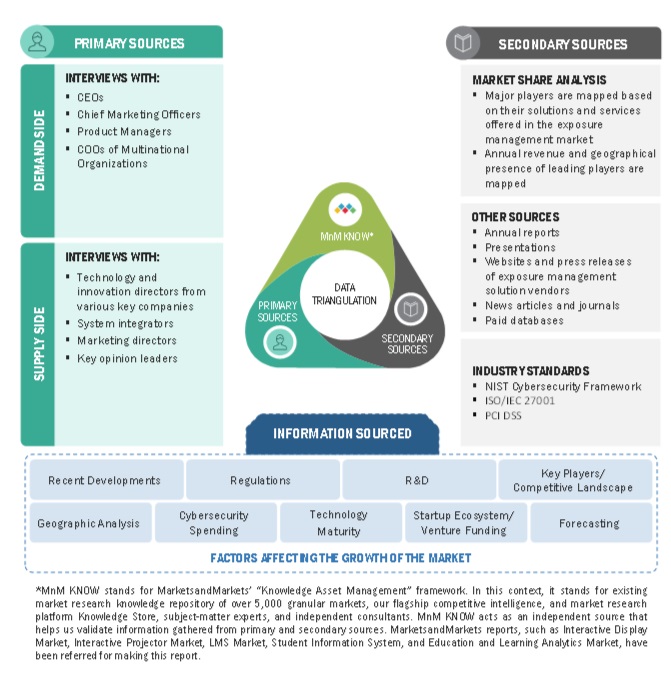
To know about the assumptions considered for the study, Request for Free Sample Report
Data Triangulation
Data triangulation is a crucial step in the market engineering process for exposure management. It involves utilizing multiple data sources and methodologies to validate and cross-reference findings, thereby enhancing the reliability and accuracy of the market segment and subsegment statistics. To conduct data triangulation, various factors and trends related to the exposure management market are studied from both the demand and supply sides. It includes analyzing data from diverse sources such as market research reports, industry publications, regulatory bodies, financial institutions, and technology providers. By examining data from different perspectives and sources, data triangulation helps mitigate potential biases and discrepancies. It provides a more comprehensive understanding of the market dynamics, including the size, growth rate, market trends, and customer preferences.
Furthermore, data triangulation aids in identifying any inconsistencies or outliers in the data, enabling researchers to refine their analysis and make informed decisions. It strengthens the credibility of the market engineering process by ensuring the conclusions drawn are based on robust and corroborated data. Data triangulation is a rigorous and systematic approach enhancing the reliability and validity of market segment and subsegment statistics in exposure management. It provides a solid foundation for informed decision-making and strategic planning within the industry.
Market Definition
Exposure management is a security practice used to map a company's digital attack surface and create and execute plans to mitigate these security threats. Exposure management includes identifying, assessing, and managing possible risks and vulnerabilities before attackers take advantage of them. the exposure management process involves scoping, discovery, prioritization, validation, and mobilization.
Key Stakeholders
- Chief Technology and Data Officers
- Certified Information Systems Auditor
- Business Analysts
- Information Technology (IT) Professionals
- Government Agencies
- Small and Medium-Sized Enterprises (SMEs) And Large Enterprises
- Consultants/ Consultancies/ Advisory Firms
- Managed and Professional Service Providers
Report Objectives
- To define, describe, and forecast the exposure management market based on component, deployment mode, application, end-user industry, and region:
- To predict and estimate the market size of five main regions: North America, Europe, Asia Pacific, Middle East & Africa, and Latin America
- To analyze the subsegments of the market concerning individual growth trends, prospects, and contributions to the overall market
- To provide detailed information related to the primary factors (drivers, restraints, opportunities, and challenges) influencing the growth of the market
- To analyze opportunities in the market for stakeholders by identifying high-growth segments of the market
- To profile the key players of the market and comprehensively analyze their market size and core competencies.
- Track and analyze competitive developments, such as new product launches, mergers and acquisitions, partnerships, agreements, and collaborations in the global exposure management market.
Customization Options
With the given market data, MarketsandMarkets offers customizations based on company-specific needs. The following customization options are available for the report:
Geographic Analysis
- Further breakup of the Asia Pacific market into countries contributing 75% to the regional market size
- Further breakup of the North American market into countries contributing 75% to the regional market size
- Further breakup of the Latin American market into countries contributing 75% to the regional market size
- Further breakup of the Middle Eastern and African market into countries contributing 75% to the regional market size
- Further breakup of the European market into countries contributing 75% to the regional market size
Company Information
- Detailed analysis and profiling of additional market players (up to 5)
Get the Full Exposure Management Market Report
Full forecast, segment splits, and company analysis for all Exposure Management Market.
- US Exposure Management Market
- Canada Exposure Management Market
- UK Exposure Management Market
- Italy Exposure Management Market
- China Exposure Management Market
- Japan Exposure Management Market
- India Exposure Management Market
- UAE Exposure Management Market
- South Africa Exposure Management Market
- Brazil Exposure Management Market
- Mexico Exposure Management Market
- Rest Of Europe Exposure Management Market
- Rest Of Asia Pacific Exposure Management Market
- Rest Of Latin America Exposure Management Market
- GCC Exposure Management Market
- Ksa Exposure Management Market
- Rest Of GCC Countries Exposure Management Market
Need a Tailored Report?
Customize this report to your needs
Get 10% FREE Customization
Customize This Report
