
Africa Fishery By-products Market (2025-2030)

The Africa Fishery By-products Market was valued at $376.2 Million in 2025 and projected to reach to $462.2 Million by 2030, representing a compound annual growth rate of 4.2%. Africa's fishery by-products market is positioned for steady expansion as the continent capitalizes on its rich aquatic resources and growing recognition of sustainable utilization practices.


| Market Size in | USD 26.32 MN |
| Market Forecast in | |
| CAGR | |
| Forecast Period | |
| Units Considered | Value (USD MN) |
Africa Fishery By-products Market Trends and Insights
- This steady growth reflects Africa's increasing focus on sustainable utilization of fish waste streams, including fish meal, fish oil, and collagen-based products.
- Africa's abundant aquatic resources and growing aquaculture sector are driving demand for value-added fishery by-products across food, pharmaceutical, and cosmetic applications. The fishery by-products market in Africa is supported by rising awareness of circular economy principles and the need to minimize waste in the fishing industry.
- Africa's coastal nations and inland fisheries are increasingly investing in processing infrastructure to convert by-products into high-margin commodities.
- Between 2025 and 2030, Africa is expected to see accelerated adoption of by-product processing technologies, driven by both domestic consumption and export opportunities to global markets seeking sustainable protein and nutritional supplements..
Key Market Statistics
- CAGR (2025-2030) 4.2% CAGR
- Market Size, 2025 ~USD 376.2 Million
- Forecast, 2030 ~USD 462.2 Million
- Country Africa
Africa Fishery By-products Market Overview
Market Valuation :
Africa's fishery by-products market is valued at USD 376.2 million in 2025, with projections reaching USD 462.2 million by 2030, representing a steady CAGR of 4.2%.
Sustainable Resource Utilization :
Africa is increasingly leveraging fish waste streams including fish meal, fish oil, and collagen-based products, driven by growing emphasis on circular economy practices and waste reduction.
Aquatic Resource Advantage :
Africa's abundant aquatic resources across coastal regions, inland fisheries, and aquaculture operations provide significant raw material availability for by-product processing and value addition.
Growth Differential :
While Africa's market grows at 4.2% CAGR, the global fishery by-products market expands at 7.3%, indicating emerging opportunities for African producers to capture increased market share through innovation and capacity building.
Africa Fishery By-products Market Dynamics
- The market benefits from increasing demand for fish meal and fish oil in animal feed applications, particularly driven by expanding aquaculture and livestock sectors across the region.
- Government initiatives promoting circular economy principles and value-added processing are encouraging local entrepreneurs to invest in by-product transformation facilities. The forecast period through 2030 presents significant opportunities for African nations to develop integrated fishery value chains that minimize waste and maximize profitability.
- Rising awareness among consumers and industries regarding the nutritional and functional benefits of fish-derived products, combined with improving processing infrastructure, is expected to accelerate market growth.
- Strategic partnerships with international buyers and investments in quality standards compliance will be critical for African producers to compete effectively in global markets..
Market Ecosystem
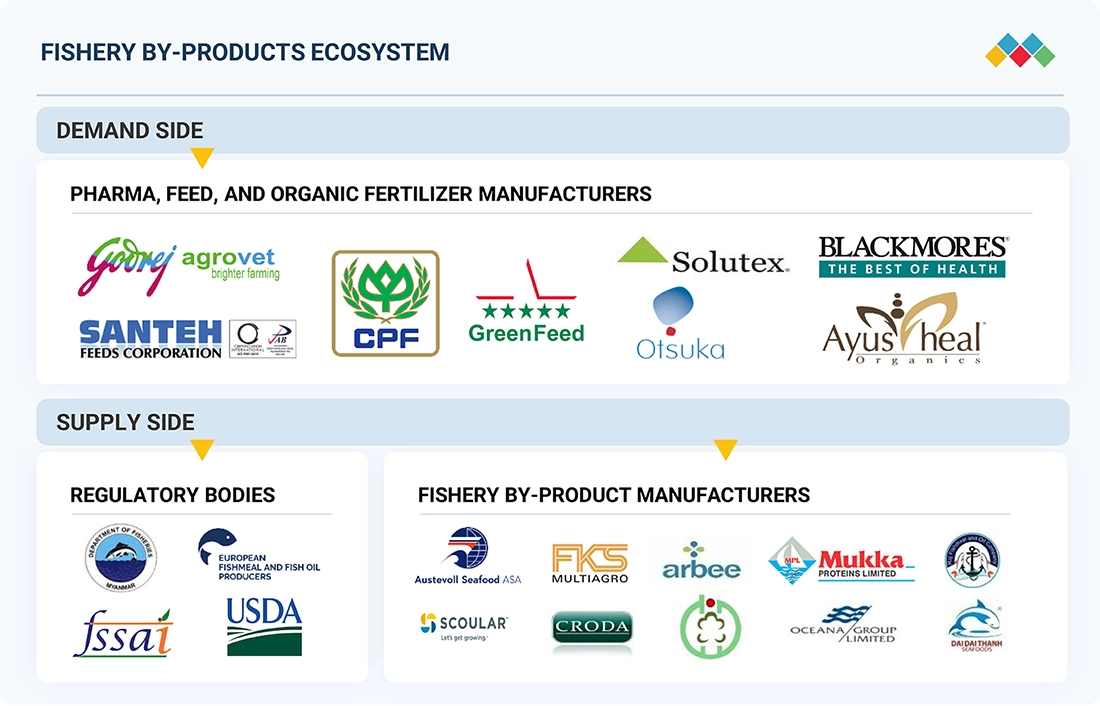
Fishery By-products Market: COMMERCIAL USE CASES ACROSS INDUSTRIES
| COMPANY | USE CASE DESCRIPTION | BENEFITS |
|---|---|---|
 |
Development of sustainable fishmeal and fish oil alternatives for aquaculture feed using advanced processing of by-products | Supports global aquaculture growth, reduces reliance on wild catch, enhances feed efficiency, and positions Scoular in circular economy solutions |
 |
Production of marine collagen peptides and functional ingredients from fish scales and skins for nutraceuticals and cosmetics | Creates premium revenue streams in health and beauty, leverages Japan’s regulatory credibility, and strengthens sustainable innovation branding |
 |
Extraction of tuna oil rich in omega-3s and bioactive compounds for infant formula, dietary supplements, and functional foods | Delivers clinically validated health benefits, taps into high-growth Omega-3 market, ensures traceability, and diversifies revenue beyond canned tuna |
 |
Development of pharmaceutical-grade EPA products and specialty marine-derived bioactives from by-products | Positions Nissui in premium pharma and nutraceutical markets, builds IP-protected product pipeline, and enhances competitiveness with clinically backed ingredients |
Logos and trademarks shown above are the property of their respective owners. Their use here is for informational and illustrative purposes only.
Related Ecosystem
Key Takeaways
- Africa's fishery by-products market is valued at USD 376.2 million in 2025 and will reach USD 462.2 million by 2030.
- Africa is experiencing a 4.2% CAGR, driven by sustainable fishing practices and circular economy adoption.
- Africa's coastal and aquaculture sectors are investing in processing infrastructure to capture value from fish waste streams.
- Africa's fishery by-products are increasingly exported globally for use in animal feed, nutraceuticals, and cosmetics.
Fishery By-products Market Report Scope
| Report Metric | Details |
|---|---|
| Base Year | 2025 |
| Fastest Growing Segment | PHARMACEUTICALS & NUTRACEUTICALS (End-Use Industry) |
| Forecast Period | 2025-2030 |
| Growth Rate | CAGR of 7.3% from 2025 to 2030 |
| Largest Segment | CAPTURE FISHERIES (Source) |
| Market Size Base Year (Billions) | ~USD 26.34 (2025) |
| Revenue Forecast (Billions) | ~USD 37.46 (2030) |
| Segments Covered | Type, Subtype, Source, End-Use Industry, Industrial Application |
Africa Fishery By-products Market Report Segmentation
5 segment dimensions are covered across the global market.
By Type
- Bioactives & Specialty Compounds
- Fish Oil
- Minerals
- Other Types
- Protein & Derivatives
- Protein & Protein Derivatives
- Type-I
- Type-Iii
By Subtype
- Aquaculture Feed
- Bone Powder
- Carotenoids
- Cartilage
- Chitin
- Chitosan
- Collagen
- Collagen Peptide
- Enzymes
- Fish Hydrolysate
- Fish Meal
- Fish Silage
- Flavor Enhancers
- Flavour Enhancers
- Fortified Food & Beverages
- Gelatin
- Inland
- Livestock Feed
- Marine
- Nutritional Supplements
- Pet Food Additives
- Squalene
By Source
- Aquaculture
- Capture Fisheries
By End-Use Industry
- Agriculture
- Animal Feed
- Cosmetics & Personal Care
- Food & Beverage
- Industrial Applications
- Pharmaceuticals & Nutraceuticals
By Industrial Application
- Aquaculture
- Fertilizers
- Pharma
AFRICA: FISHERY BY-PRODUCTS MARKET, BY END-USE INDUSTRY, 2025–2030
| Segment | 2025 | 2026 | 2027 | 2028 | 2029 | 2030 | CAGR (%) |
|---|---|---|---|---|---|---|---|
| AGRICULTURE | 50.8 | 52.3 | 53.9 | 55.7 | 57.6 | 59.8 | 3.3 |
| ANIMAL FEED | 199.6 | 208.2 | 217.6 | 227.9 | 239.1 | 251.3 | 4.7 |
| COSMETICS & PERSONAL CARE | 27.8 | 28.4 | 29 | 29.8 | 30.6 | 31.4 | 2.5 |
| FOOD & BEVERAGE | 37.9 | 39.4 | 40.9 | 42.6 | 44.5 | 46.6 | 4.2 |
| INDUSTRIAL APPLICATIONS | 15 | 15.5 | 16.1 | 16.6 | 17.3 | 18 | 3.6 |
| PHARMACEUTICALS & NUTRACEUTICALS | 45.1 | 46.8 | 48.6 | 50.6 | 52.8 | 55.1 | 4.1 |
| TOTAL | 376.24 | 390.54 | 406.16 | 423.22 | 441.84 | 462.17 | 4.2 |
Target Audience
- Fishery & Aquaculture Companies : African and international fishery operators need this data to understand regional by-product market potential, identify processing opportunities, and develop sustainable waste valorization strategies.
- Animal Feed Manufacturers : Feed producers across Africa require insights into fish meal and fish oil availability, pricing trends, and supply chain dynamics to optimize sourcing and product formulation decisions.
- Investment & Private Equity Firms : Investors seeking growth opportunities in African agriculture and food processing need comprehensive market sizing, growth forecasts, and competitive landscape analysis for due diligence and portfolio decisions.
- Government & Policy Makers : African government agencies and development organizations need market intelligence to design effective policies, incentives, and infrastructure investments supporting sustainable fishery by-product utilization.
- Pharmaceutical & Nutraceutical Companies : Manufacturers of health and wellness products require data on African collagen and fish-derived ingredient availability, quality standards, and market demand to develop sourcing and product strategies.
Reasons to Buy this Report
- Regional Market Intelligence : Gain comprehensive insights into Africa's USD 376.2 million fishery by-products market with detailed forecasts through 2030, enabling informed investment and expansion decisions across the continent.
- Growth Opportunity Identification : Identify high-potential segments within fish meal, fish oil, and collagen products specific to African markets, with analysis of emerging demand drivers and regional consumption patterns.
- Competitive Positioning : Understand Africa's market dynamics relative to global trends (7.3% vs. 4.2% CAGR), revealing gaps and opportunities for market share capture and competitive differentiation strategies.
- Supply Chain Development : Access actionable insights on sustainable utilization of Africa's abundant aquatic resources, supporting strategic decisions on processing infrastructure, partnerships, and value chain optimization.
- Regulatory & Sustainability Insights : Navigate Africa's evolving regulatory landscape and circular economy initiatives with market-specific guidance on compliance, certifications, and sustainable practices driving market growth.
Frequently asked questions
What is the current size of Africa's fishery by-products market?
Africa's fishery by-products market is valued at USD 376.2 million in 2025.
What is the projected market size for Africa's fishery by-products by 2030?
Africa's fishery by-products market is projected to reach USD 462.2 million by 2030.
What is the growth rate of Africa's fishery by-products market?
Africa's fishery by-products market is growing at a CAGR of 4.2% from 2025 to 2030.
What are the main drivers of growth in Africa's fishery by-products market?
Growth in Africa's fishery by-products market is driven by sustainable fishing practices, circular economy principles, aquaculture expansion, and rising demand for fish meal, fish oil, and collagen in global markets.
Which applications dominate Africa's fishery by-products market?
Africa's fishery by-products are primarily used in animal feed, aquaculture nutrition, pharmaceuticals, nutraceuticals, and cosmetics.
RESEARCH METHODOLOGY
The study involved two major approaches in estimating the current size of the fishery by-products market. Exhaustive secondary research was done to collect information on the market, peer, and parent markets. The next step was to validate these findings, assumptions, and sizing with industry experts across the value chain through primary research. Both top-down and bottom-up approaches were employed to estimate the complete market size. After that, market breakdown and data triangulation were used to estimate the market size of segments and subsegments.
Secondary Research
This research study involved the extensive use of secondary sources—directories and databases such as Bloomberg Businessweek and Factiva—to identify and collect information useful for a technical, market-oriented, and commercial study of the market.
In the secondary research process, various sources such as annual reports, press releases & investor presentations of companies, white papers, food journals, certified publications, articles from recognized authors, directories, and databases were referred to to identify and collect information.
Secondary research was mainly used to obtain key information about the industry’s supply chain, the total pool of key players, and market classification and segmentation as per the industry trends to the bottom-most level, regional markets, and key developments from both market- and technology-oriented perspectives.
Primary Research
Extensive primary research was conducted after obtaining information regarding the fishery by-products market scenario through secondary research. Several primary interviews were conducted with market experts from both the demand and supply sides across major countries of North America, Europe, Asia Pacific, South America, and the Rest of the World. Primary data was collected through questionnaires, emails, and telephonic interviews. The primary sources from the supply side included various industry experts, such as Chief X Officers (CXOs), Vice Presidents (VPs), Directors from business development, marketing, research, and development teams, and related key executives from distributors and key opinion leaders. Primary interviews were conducted to gather insights such as market statistics, data on revenue collected from the products and services, market breakdowns, market size estimations, market forecasting, and data triangulation. Primary research also helped in understanding the various trends related to fishery by-products type, end-user industry, and region. Stakeholders from the demand side, such as livestock rearing flocks, dairy farms, and the poultry industry, were interviewed to understand the buyer’s perspective on the suppliers, products, and their current usage of fishery by-products and the outlook of their business, which will affect the overall market.
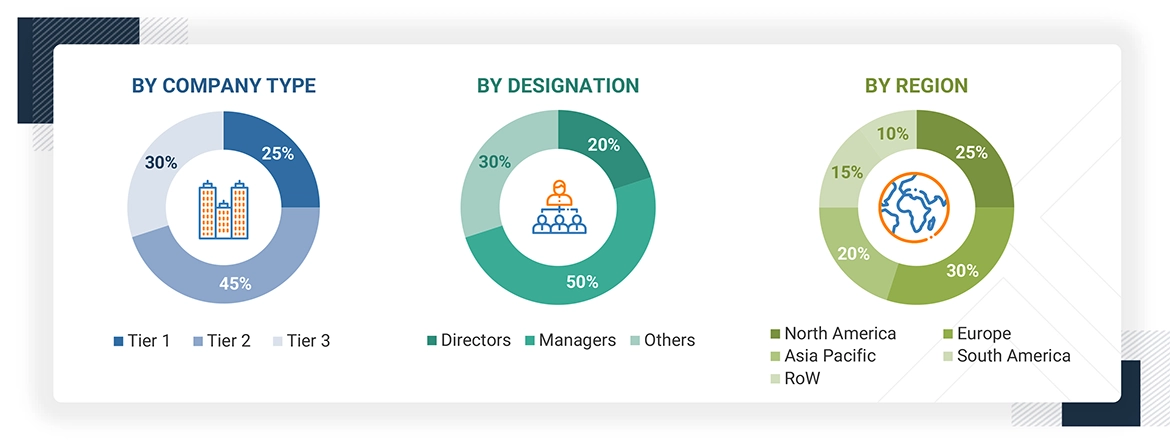
Note: The three tiers of the companies are defined based on their total revenues in 2023 or 2024,
as per the availability of financial data: Tier 1: Revenue >USD 1 billion; Tier 2: USD 100 million = Revenue = USD 1 billion;
Tier 3: Revenue
To know about the assumptions considered for the study, download the pdf brochure
|
COMPANY |
DESIGNATION |
|
Thai Union Ingredients (Thailand) |
General Manager |
|
Sopropêche (France) |
Sales Manager |
|
Pesquera Diamante Peru (Peru) |
Manager |
|
Oceana Group Limited (South Africa) |
Head of processing department |
|
Austevoll Seafood A (Norway) |
Marketing Manager |
|
Maruha Nichiro Corporation (Japan) |
Sales Executive |
Market Size Estimation
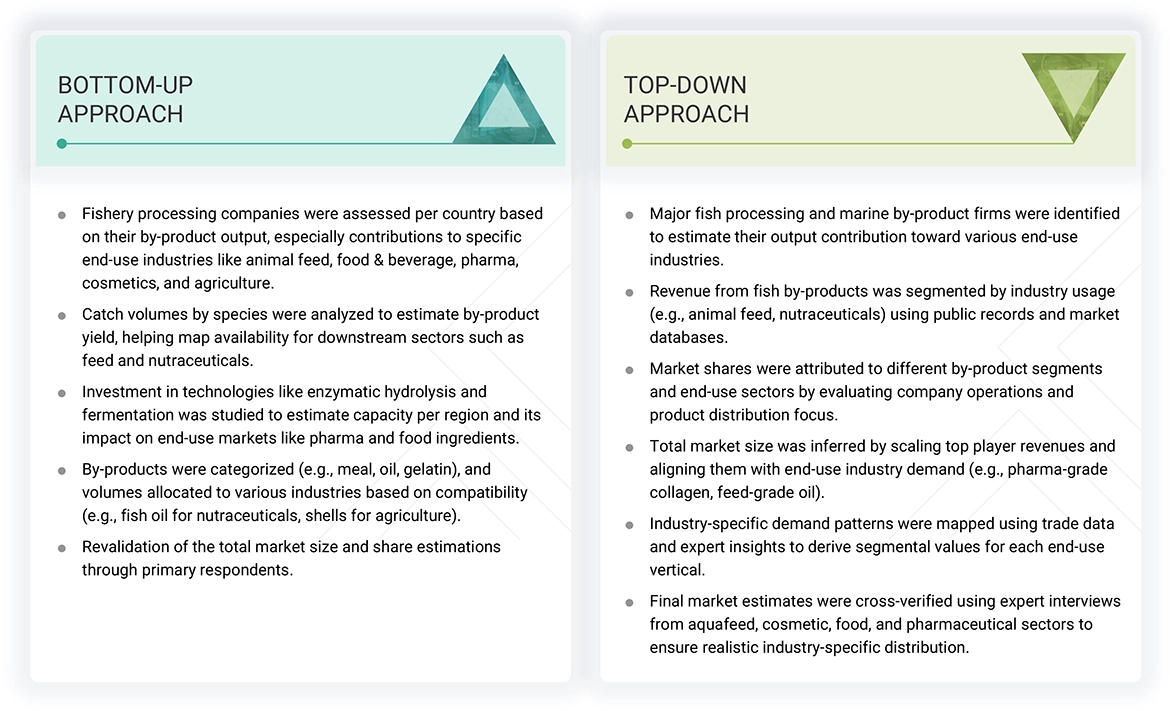
Both the top-down and bottom-up approaches were used to estimate and validate the total size of the fishery by-products market. These approaches were also used extensively to determine the size of various subsegments in the market. The research methodology used to estimate the market size includes the following details:
- The key players in the industry and the overall markets were identified through extensive secondary research.
- All shares, splits, and breakdowns were determined using secondary sources and verified through primary sources.
- All possible parameters that affect the market covered in this research study were accounted for, viewed in extensive detail, verified through primary research, and analyzed to obtain final quantitative and qualitative data.
- The research included the study of reports, reviews, and newsletters of top market players, along with extensive interviews for opinions from leaders, such as CEOs, directors, and marketing executives.
Fishery By-products Market : Top-Down and Bottom-Up Approach
Data Triangulation
After arriving at the overall market size from the estimation process explained above, the total market was split into several segments and subsegments. The data triangulation and market breakdown procedures were employed, wherever applicable, to estimate the overall fishery by-products market and arrive at the exact statistics for all segments and subsegments. The data was triangulated by studying various factors and trends from the demand and supply sides. The market size was also validated using both the top-down and bottom-up approaches.
Market Definition
According to FAO, fishery by-products refer to the non-edible or secondary components of fish and aquatic animals generated during processing or harvesting. These include heads, bones, skins, viscera, blood, scales, shells, and frames, which are commonly repurposed for animal feed, fertilizers, pharmaceuticals, collagen, gelatin, and bioactive compounds.
Stakeholders
- Fishmeal & fish oil manufacturers
- Fishmeal & fish oil traders, distributors, and suppliers
- Fish farmers
- Government and research organizations
- Associations and industry bodies
- Agricultural universities
- Intermediate suppliers such as retailers, wholesalers, and distributors
- Raw material suppliers
- Technology providers
- Industry associations
-
Regulatory bodies and institutions:
- Food and Agriculture Organization (FAO)
- United States Department of Agriculture (USDA)
- Compound Livestock Feed Manufacturers Association of India (CLFMA)
- International Feed Industry Federation (IFIF)
- American Feed Industry Association (AFIA)
- Animal Feed Manufacturers Association (AFMA)
- Organization for Economic Cooperation and Development (OECD)
- Marine Ingredients Organisation (IFFO)
- European Market Observatory for Fisheries and Aquaculture Products
- Logistics providers & transporters
-
Research institutes and organizations
- Consulting companies/consultants in the agricultural technology sector
Report Objectives
- To determine and project the size of the fishery by-products market based on type, end-user industry, and region in terms of value over five years, ranging from 2025 to 2030
- To identify the attractive opportunities in the market by determining the largest and fastest-growing segments across regions
- To provide detailed information about the key factors influencing market growth (drivers, restraints, opportunities, and challenges)
- To analyze the opportunities in the market for stakeholders and provide details of the competitive landscape for market leaders
- To analyze the micro-markets with respect to individual growth trends, prospects, and their contribution to the total market
- To identify and profile the key players in the fishery by-products market
- To understand the competitive landscape and identify the major growth strategies adopted by players across the key regions
Available Customizations
With the given market data, MarketsandMarkets offers customizations according to company-specific scientific needs. The following customization options are available for the report:
Product Analysis
- Product Matrix, which gives a detailed comparison of the product portfolio of each company.
Geographic Analysis as per Feasibility
With the given market data, MarketsandMarkets offers customizations according to company-specific scientific needs.
- Further breakdown of the Rest of Europe fishery by-products market into key countries.
- Further breakdown of the Rest of Asia Pacific fishery by-products market into key countries.
- Further breakdown of the Rest of South America fishery by-products market into key countries.
Company Information
- Detailed analyses and profiling of additional market players (up to five)
Get the Full Fishery By-products Market Report
Full forecast, segment splits, and company analysis for all Fishery By-products Market.
- Canada Fishery By-products Market
- Mexico Fishery By-products Market
- US Fishery By-products Market
- Germany Fishery By-products Market
- UK Fishery By-products Market
- France Fishery By-products Market
- Italy Fishery By-products Market
- Spain Fishery By-products Market
- Norway Fishery By-products Market
- Denmark Fishery By-products Market
- China Fishery By-products Market
- India Fishery By-products Market
- Japan Fishery By-products Market
- Vietnam Fishery By-products Market
- Thailand Fishery By-products Market
- South Korea Fishery By-products Market
- Brazil Fishery By-products Market
- Chile Fishery By-products Market
- Peru Fishery By-products Market
- Rest Of Europe Fishery By-products Market
- Rest Of Asia Pacific Fishery By-products Market
- Middle East Fishery By-products Market
- Rest Of South America Fishery By-products Market
Need a Tailored Report?
Customize this report to your needs
Get 10% FREE Customization
Customize This Report
