
Rest Of South America Flue Gas Desulfurization System Market (2021-2026)

The Rest Of South America Flue Gas Desulfurization System Market was valued at $32.3 Million in 2021 and projected to reach to $37.8 Million by 2026, representing a compound annual growth rate of 3.2%. Rest Of South America's Flue Gas Desulfurization System market is poised for moderate but consistent growth through 2026, driven by tightening environmental regulations and industrial modernization efforts across the region.


| Market Size in | USD 26.32 MN |
| Market Forecast in | |
| CAGR | |
| Forecast Period | |
| Units Considered | Value (USD MN) |
Rest Of South America Flue Gas Desulfurization System Market Trends and Insights
- Rest Of South America represents a developing segment within the broader South American FGD landscape, driven by increasing environmental regulations and industrial emission control requirements across the region.
- The market in Rest Of South America reflects moderate but steady growth as industrial facilities, particularly in power generation and chemical manufacturing, adopt desulfurization technologies to comply with stricter air quality standards. Rest Of South America's FGD market growth is supported by rising investments in pollution control infrastructure and the region's commitment to reducing sulfur dioxide emissions.
- Rest Of South America's industrial base continues to modernize, creating demand for advanced emission control systems.
- The forecast period through 2026 indicates that Rest Of South America will maintain consistent market expansion, though at a more conservative pace compared to global benchmarks, reflecting the region's economic conditions and regulatory environment..
Key Market Statistics
- CAGR (2021-2026) 3.2% CAGR
- Market Size, 2021 ~USD 32.3 Million
- Forecast, 2026 ~USD 37.8 Million
- Country Rest Of South America
Rest Of South America Flue Gas Desulfurization System Market Overview
Market Valuation :
Rest Of South America's FGD System market reached USD 32.3 million in 2021, with steady growth trajectory positioning it as an emerging segment within the regional industrial emissions control landscape.
Growth Trajectory :
The market is projected to expand from USD 32.3 million (2021) to USD 37.8 million (2026), representing a CAGR of 3.2%, outpacing broader regional development but trailing global growth rates.
Regulatory Drivers :
Increasing environmental regulations and stricter industrial emission control requirements across Rest Of South America are catalyzing FGD system adoption among manufacturing and power generation facilities.
Regional Positioning :
Rest Of South America represents a developing but strategically important segment, with untapped potential as countries strengthen environmental compliance frameworks and industrial modernization initiatives.
Rest Of South America Flue Gas Desulfurization System Market Dynamics
- The 3.2% CAGR reflects growing awareness of air quality standards and corporate sustainability commitments among manufacturing and power generation operators.
- Emerging economies within this segment are gradually adopting FGD technologies to meet international environmental benchmarks and reduce operational penalties. The market outlook remains positive as industrial facilities increasingly recognize the long-term cost benefits of emission control systems.
- Investment in infrastructure upgrades, coupled with government incentives for clean technology adoption, will support market expansion.
- However, growth remains constrained by capital limitations and competing priorities in developing economies, suggesting a measured but sustainable trajectory through the forecast period..
Market Ecosystem
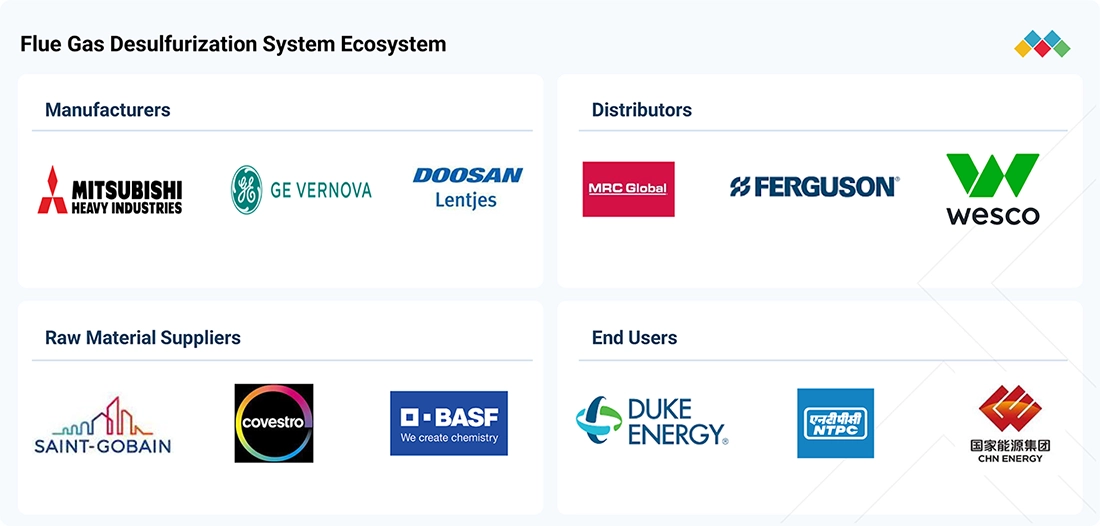
FLUE GAS DESULFURIZATION SYSTEM MARKET: COMMERCIAL USE CASES ACROSS INDUSTRIES
| COMPANY | USE CASE DESCRIPTION | BENEFITS |
|---|---|---|
 |
Mitsubishi Heavy Industries provides wet flue gas desulfurization systems for coal-fired power plants and industrial facilities to remove sulfur dioxide (SO2) from flue gases before discharge. Its FGD solutions are used in new installations and retrofit projects requiring high-efficiency emission control. | High SO2 removal efficiency | Reliable operation | Flexible plant integration | Reduced air pollution | Compliance with stringent emission standards | Long-term system durability |
 |
GE Vernova provides flue gas desulfurization solutions for coal-fired power plants, including wet FGD systems designed to control SO2 emissions. Its technologies are applied in power-generation facilities undergoing new installations, environmental upgrades, and modernization projects. | High pollutant removal efficiency | Improved plant performance | Regulatory compliance | Retrofit capability | Operational reliability | Reduced environmental impact |
 |
Doosan Lentjes develops and supplies wet and dry flue gas cleaning systems for power plants and industrial applications. Its FGD technologies are used to reduce SO2 emissions from coal-fired and other combustion-based facilities while supporting compliance with increasingly stringent environmental regulations. | High SO2 removal efficiency | Fuel flexibility | Efficient reagent utilization | Reliable operation | Lower emissions | Compliance with environmental regulations |
 |
Babcock & Wilcox provides flue gas desulfurization and other emissions-control technologies for utility and industrial facilities. Its FGD systems are used for controlling SO2 emissions from coal-fired power plants and other combustion processes, including retrofit applications. | Effective SO2 control | High system reliability | Retrofit flexibility | Reduced emissions | Improved environmental performance | Compliance with emission regulations |
Logos and trademarks shown above are the property of their respective owners. Their use here is for informational and illustrative purposes only.
Related Ecosystem
Equipment Machine And Tooling
- Wastewater Treatment
- Air Cooled Heat Exchangers
- Diaphragm Pumps
- Fiberglass
- HVAC System
- Alfa Laval Corporate AB
- Johnson Controls International plc
- Daikin Industries,Ltd.
- Veolia
- Carrier Global Corporation
Industrial Gases
- Dry Cooling Tower
- HVAC System
- Heat Exchanger
- Hybrid Cooling Tower
- Industrial Refrigeration
- Linde plc
- MESSER GROUP GMBH
- AIR LIQUIDE
- Air Products and Chemicals, Inc.
- Iwatani Corporation
Key Takeaways
- Rest Of South America's FGD market reached USD 32.3 million in 2021 with projected growth to USD 37.8 million by 2026.
- Rest Of South America is experiencing a 3.2% CAGR, reflecting steady but moderate market expansion driven by environmental compliance.
- Rest Of South America's industrial sector is increasingly adopting FGD systems to meet regional air quality and emission standards.
- Rest Of South America's market growth is supported by infrastructure investments and modernization of power generation facilities.
Flue Gas Desulfurization System Market Report Scope
| Report Metric | Details |
|---|---|
| Base Year | 2021 |
| Fastest Growing Segment | POWER GENERATION (End-Use Industry) |
| Forecast Period | 2021-2026 |
| Growth Rate | CAGR of 5.2% from 2021 to 2026 |
| Largest Segment | WET (Type) |
| Market Size Base Year (Billions) | ~USD 19.32 (2021) |
| Revenue Forecast (Billions) | ~USD 24.9 (2026) |
| Segments Covered | Type, Installation, End-Use Industry |
Rest Of South America Flue Gas Desulfurization System Market Report Segmentation
3 segment dimensions are covered across the global market.
By Type
- Dry & Semi-Dry
- Wet
By Installation
- Brownfield
- Greenfield
By End-Use Industry
- Cement Manufacturing
- Chemical
- Iron & Steel
- Power Generation
Target Audience
- FGD Equipment Manufacturers : Evaluate market expansion opportunities in Rest Of South America, assess regional demand drivers, and develop localized product strategies for an emerging but growing industrial emissions control market.
- Environmental Compliance Consultants : Provide clients with region-specific regulatory insights and FGD adoption trends in Rest Of South America to support facility upgrades and environmental compliance planning initiatives.
- Industrial Facility Operators : Understand market availability of FGD solutions, benchmark regional pricing and technology options, and assess investment requirements for emission control system implementation in Rest Of South America.
- Investment & Private Equity Firms : Identify growth investment opportunities in Rest Of South America's FGD sector with clear market sizing, growth projections, and regulatory tailwinds supporting long-term portfolio returns.
- Government & Policy Makers : Leverage market data to design effective environmental policies, assess industrial compliance capacity, and prioritize infrastructure investments in Rest Of South America's emissions control sector.
Reasons to Buy this Report
- Market-Specific Sizing Data : Access precise valuation metrics for Rest Of South America's FGD market (USD 32.3M in 2021, USD 37.8M by 2026) with region-specific CAGR analysis unavailable in generic global reports.
- Regulatory Landscape Intelligence : Understand how environmental regulations and emission control requirements specific to Rest Of South America are shaping FGD system demand and creating investment opportunities for stakeholders.
- Competitive Positioning Strategy : Identify market entry points and growth opportunities within an emerging segment where competition is less saturated than mature markets, enabling strategic positioning for vendors and investors.
- Investment Decision Support : Make informed capital allocation decisions with region-specific growth projections and market dynamics, reducing investment risk in Rest Of South America's industrial emissions control sector.
- Localized Business Development : Develop targeted go-to-market strategies for Rest Of South America by understanding regional industrial structure, regulatory drivers, and adoption barriers unique to this developing market segment.
Frequently asked questions
What is the market size of Flue Gas Desulfurization Systems in Rest Of South America?
Rest Of South America's FGD market was valued at USD 32.3 million in 2021 and is forecast to reach USD 37.8 million by 2026.
What is the growth rate for FGD systems in Rest Of South America?
Rest Of South America's FGD market is growing at a CAGR of 3.2% from 2021 to 2026.
What drives demand for FGD systems in Rest Of South America?
Rest Of South America's FGD demand is driven by stricter environmental regulations, industrial modernization, and the need for sulfur dioxide emission control in power generation and manufacturing sectors.
How does Rest Of South America's FGD market compare to global trends?
Rest Of South America's 3.2% CAGR is more conservative than the global 5.2% CAGR, reflecting the region's economic conditions and regulatory maturity.
Which industries in Rest Of South America are adopting FGD systems?
Rest Of South America's primary FGD adopters include power generation facilities, chemical manufacturing plants, and industrial facilities subject to air quality regulations.
RESEARCH METHODOLOGY
The study involved four major activities to estimate the current size of the global flue gas desulfurization system market. Exhaustive secondary research was carried out to collect information on the market, the peer product market, and the parent product group market. The next step was to validate these findings, assumptions, and sizes with the industry experts across the flue gas desulfurization system value chain through primary research. The top-down and bottom-up approaches were employed to estimate the overall size of the market. After that, market breakdown and data triangulation procedures were used to determine the size of different segments and sub-segments of the market.
Secondary Research
The market for companies offering flue gas desulfurization systems was derived from secondary data available through paid and unpaid sources, by analyzing the product portfolios of major companies in the ecosystem, and by rating the companies based on their performance and quality. Various secondary sources, such as Business Standard, Bloomberg, World Bank, and Factiva, were referred to for identifying and collecting information for this study on the flue gas desulfurization system market. In the secondary research process, various secondary sources were referred to for identifying and collecting information related to the study. Secondary sources included annual reports, press releases, and investor presentations of door vendors, forums, certified publications, and whitepapers. The secondary research was used to obtain critical information on the industry’s value chain, the total pool of key players, market classification, and segmentation from the market and technology-oriented perspectives.
Primary Research
In the primary research process, various primary sources from the supply and demand sides were interviewed to obtain qualitative and quantitative information for this report. The primary sources from the supply side included industry experts, such as Chief Executive Officers (CEOs), Vice Presidents (VPs), marketing directors, technology and innovation directors, and related key executives from several key companies and organizations operating in the flue gas desulfurization system market. After the complete market engineering (calculations for market statistics, market breakdown, market size estimations, market forecasting, and data triangulation), extensive primary research was conducted to gather information and verify and validate the critical numbers arrived at.
Primary research was also conducted to identify the segmentation, industry trends, competitive landscape of flue gas desulfurization systems offered by various market players, and key market dynamics, such as drivers, restraints, opportunities, challenges, trends, and key player strategies. In the complete market engineering process, the top-down and bottom-up approaches and several data triangulation methods were extensively used to perform the market estimation and market forecasting for the overall market segments and subsegments listed in this report. Extensive qualitative and quantitative analysis was performed on the complete market engineering process to list the key information/insights throughout the report.
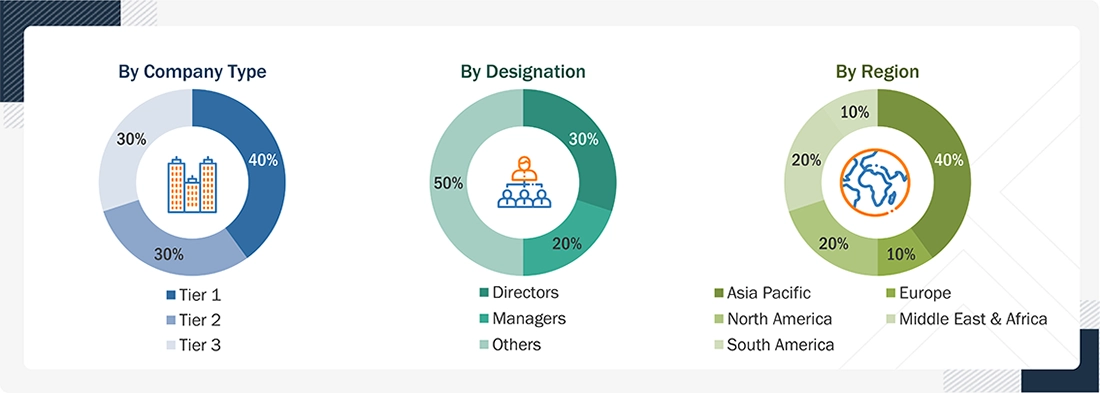
Notes: Other designations include sales, marketing, and product managers.
Tier 1: >USD 1 Billion; Tier 2: USD 500 million–1 Billion; and Tier 3: <USD 500 million.
To know about the assumptions considered for the study, download the pdf brochure
Market Size Estimation
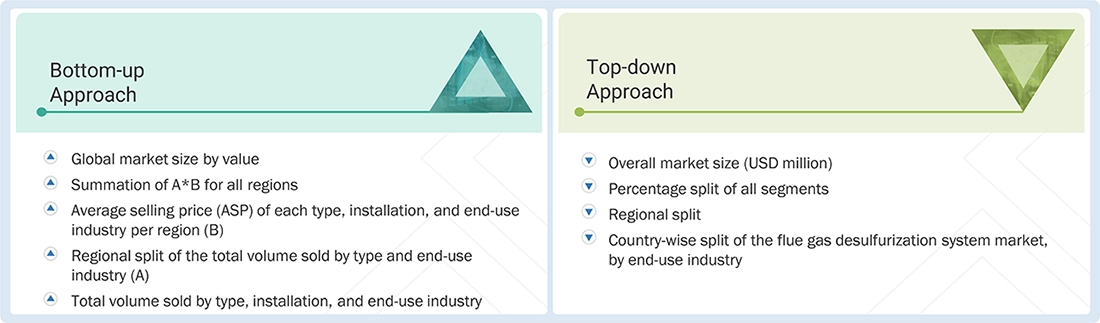
The top-down and bottom-up approaches were used to estimate and validate the size of the global flue gas desulfurization system market. These approaches were also used extensively to estimate the size of various dependent market segments. The research methodology used to estimate the market size included the following:
Data Triangulation
After arriving at the overall market size using the market size estimation processes, the market was split into several segments and subsegments. The data triangulation and market breakup procedures were employed, wherever applicable, to complete the overall market engineering process and arrive at the exact statistics of each market segment and subsegment. The data was triangulated by studying various factors and trends from the demand and supply sides.
Market Definition
Flue gas desulfurization (FGD) systems are emission-control systems designed to remove sulfur dioxide (SO2) and other sulfur compounds from flue gases generated during the combustion of sulfur-containing fuels, particularly in coal-fired power plants and industrial facilities. These systems are widely used in power generation, cement, iron & steel, chemicals & petrochemicals, and other industries to reduce SO2 emissions and comply with increasingly stringent environmental regulations. FGD technologies are generally classified into wet FGD systems and dry & semi-dry FGD systems, with the appropriate technology selected based on factors such as emission-reduction requirements, fuel characteristics, operating conditions, water availability, and plant configuration. FGD systems incorporate processes and equipment such as absorbers, scrubbers, reagent preparation and handling units, pumps, filters, and gas treatment systems to achieve the required level of sulfur dioxide removal.
Key Stakeholders
- Flue gas desulfurization system manufacturers
- Power generation companies and utilities
- FGD component and equipment suppliers
- Engineering, procurement, and construction (EPC) companies
- Industrial end users (cement, iron & steel, chemicals & petrochemicals, etc.)
- Environmental technology and emission-control companies
- Regulatory bodies and environmental agencies
- Research institutes and industry associations
Report Objectives
- To describe and forecast the size of the global flue gas desulfurization system market, by type, installation, and end-use industry, in terms of value and volume
- To forecast the market size of segments and subsegments for five regions: North America, Europe, Asia Pacific, South America, and the Middle East & Africa, in terms of value
- To provide detailed information on the significant drivers, restraints, opportunities, and challenges influencing the market
- To strategically analyze micromarkets concerning individual growth trends, prospects, and their contribution to the market
- To assess the growth opportunities in the market for stakeholders and provide details on the competitive landscape for market leaders
- To strategically profile key players and comprehensively analyze their market shares and core competencies
- To analyze competitive developments, such as product launches, acquisitions, expansions, partnerships, and agreements, in the market
- To analyze the impact of AI/Gen AI on the market
Available customizations:
With the given market data, MarketsandMarkets offers customizations according to client-specific needs.
The following customization options are available for the flue gas desulfurization system market report:
Product Analysis
- A product matrix that gives a detailed comparison of the product portfolio of each company
Regional Analysis
- A further breakdown of the flue gas desulfurization system market for additional countries
Company Information
- Detailed analysis and profiling of additional market players (up to five)
Get the Full Flue Gas Desulfurization System Market Report
Full forecast, segment splits, and company analysis for all Flue Gas Desulfurization System Market.
- China Flue Gas Desulfurization System Market
- Japan Flue Gas Desulfurization System Market
- India Flue Gas Desulfurization System Market
- South Korea Flue Gas Desulfurization System Market
- US Flue Gas Desulfurization System Market
- Canada Flue Gas Desulfurization System Market
- Mexico Flue Gas Desulfurization System Market
- Germany Flue Gas Desulfurization System Market
- UK Flue Gas Desulfurization System Market
- France Flue Gas Desulfurization System Market
- Italy Flue Gas Desulfurization System Market
- Brazil Flue Gas Desulfurization System Market
- Argentina Flue Gas Desulfurization System Market
- Chile Flue Gas Desulfurization System Market
- Saudi Arabia Flue Gas Desulfurization System Market
- UAE Flue Gas Desulfurization System Market
- Qatar Flue Gas Desulfurization System Market
- Kuwait Flue Gas Desulfurization System Market
- Oman Flue Gas Desulfurization System Market
- Rest Of Europe Flue Gas Desulfurization System Market
- Rest Of Asia Pacific Flue Gas Desulfurization System Market
Need a Tailored Report?
Customize this report to your needs
Get 10% FREE Customization
Customize This Report
