
Canada Food Lyophilization Equipment Market (2025-2030)

The Canada Food Lyophilization Equipment Market was valued at $60.9 Million in 2025 and projected to reach to $84.1 Million by 2030, representing a compound annual growth rate of 6.7%. Canada's food lyophilization equipment market is positioned for steady expansion, driven by increasing consumer preference for convenient, nutrient-preserved food products and growing adoption among Canadian food manufacturers.


| Market Size in | USD 26.32 MN |
| Market Forecast in | |
| CAGR | |
| Forecast Period | |
| Units Considered | Value (USD MN) |
Canada Food Lyophilization Equipment Market Trends and Insights
- This growth trajectory reflects Canada's increasing demand for freeze-drying technology across the food and beverage sector, driven by rising consumer preference for shelf-stable, nutrient-dense products.
- Canada's investment in advanced food preservation infrastructure and the country's strong pharmaceutical and nutraceutical industries are key contributors to market expansion. The Canadian market benefits from robust regulatory frameworks and technological innovation in food processing.
- Canada's position as a major exporter of specialty foods and ingredients has accelerated adoption of lyophilization equipment among domestic manufacturers seeking to enhance product quality and extend shelf life.
- Between 2025 and 2030, Canada is expected to see increased capital investment in freeze-drying facilities, particularly among mid-sized food processors and contract manufacturers serving North American markets..
Key Market Statistics
- CAGR (2025-2030) 6.7% CAGR
- Market Size, 2025 ~USD 60.9 Million
- Forecast, 2030 ~USD 84.1 Million
- Country Canada
Canada Food Lyophilization Equipment Market Overview
Market Valuation Growth :
Canada's food lyophilization equipment market is valued at $60.9 million in 2025 and is projected to reach $84.1 million by 2030, demonstrating robust expansion in freeze-drying technology adoption across the domestic food and beverage sector.
Strong CAGR Performance :
The Canadian market is growing at a compound annual growth rate of 6.7%, outpacing the global average of 6%, indicating accelerated demand for lyophilization solutions within Canada's food processing industry.
Consumer Preference Drivers :
Rising Canadian consumer demand for shelf-stable, nutrient-dense, and premium food products is fueling investment in freeze-drying technology, particularly among specialty food manufacturers and health-focused brands.
Regional Market Maturity :
Canada's established food processing infrastructure and regulatory framework create favorable conditions for lyophilization equipment adoption, supporting sustained market growth through 2030.
Canada Food Lyophilization Equipment Market Dynamics
- The 6.7% CAGR reflects strong domestic demand for freeze-drying technology across specialty foods, organic products, and functional beverages.
- Key growth catalysts include rising health consciousness, e-commerce expansion of premium food products, and investment in advanced food processing capabilities. Looking ahead to 2030, Canada's market will benefit from technological advancements in lyophilization efficiency, cost reduction in equipment, and expanding applications in plant-based foods and nutraceuticals.
- Domestic manufacturers and importers are increasingly recognizing freeze-drying as a competitive advantage, supporting market penetration across mid-sized and large-scale food processors throughout Canada..
Market Ecosystem
Related Ecosystem
Fandb Processing And Technology
- Dairy Products
- Bakery Products
- Filtration Equipment
- Heat Exchanger
- Acetic Acid
- Gea group
- John Bean Technologies Corporation
- Alfa Laval Corporate AB
- AZELIS HOLDINGS SA
- SPX FLOW INC
Key Takeaways
- Canada's food lyophilization equipment market is valued at $60.9 million in 2025 and will reach $84.1 million by 2030, growing at 6.7% CAGR.
- Canada's strong specialty food export sector and nutraceutical industry are primary drivers of lyophilization equipment adoption.
- Regulatory support and technological advancement in Canada are accelerating investment in freeze-drying infrastructure.
- Mid-sized food processors and contract manufacturers in Canada represent the fastest-growing customer segment for lyophilization equipment.
Food Lyophilization Equipment Market Report Scope
| Report Metric | Details |
|---|---|
| Base Year | 2025 |
| Fastest Growing Segment | SMART FREEZE DRYERS (Technology) |
| Forecast Period | 2025–2030 |
| Growth Rate | CAGR of 6% from 2025 to 2030 |
| Largest Segment | TRAY-STYLE FREEZE DRYERS (Type) |
| Market Size Base Year (Billions) | ~USD 1.2 (2025) |
| Revenue Forecast (Billions) | ~USD 1.6 (2030) |
| Segments Covered | Type, Operation Scale, Technology, Application, Operation Scale 2025–2030, Fruits & Vegetables, Crop Type, Technology Type |
Canada Food Lyophilization Equipment Market Report Segmentation
8 segment dimensions are covered across the global market.
By Type
- Fluidized Bed Dryers
- Freeze Dryers
- Fruits & Berries
- Manifold Freeze Dryers
- Mobile Freeze Dryers
- Other Dryers
- Rotary Freeze Dryers
- Shell (Rotary) Freeze Dryers
- South America
- Spray Dryers
- Tray-Style Freeze Dryers
- Vacuum Dryers
- Vegetables
By Operation Scale
- Industrial-Scale Lyophilization
- Laboratory-Scale Lyophilization
- Pilot-Scale Lyophilization
By Technology
- Conventional Freeze Dryers
- Hybrid Lyophilizers
- Smart Freeze Dryers
By Application
- Beverages
- Dairy Products
- Fruits & Vegetables
- Meat & Seafood
- Other Applications
- Pet Food
- Prepared Meals
- Probiotics
By Operation Scale 2025–2030
- Industrial-Scale Lyophilization
- Laboratory-Scale Lyophilization
- Pilot-Scale Lyophilization
By Fruits & Vegetables
- Fruits & Berries
- Vegetables
By Crop Type
- Manifold Freeze Dryers
- Rotary Freeze Dryers
- Tray-Style Freeze Dryers
By Technology Type
- Conventional Freeze Dryers
- Hybrid Lyophilizers
- Smart Freeze Dryers
Target Audience
- Food & Beverage Manufacturers : Canadian food processors need market intelligence to evaluate freeze-drying technology investments, understand competitive positioning, and identify growth opportunities in shelf-stable and premium product segments.
- Equipment Suppliers & Distributors : Lyophilization equipment vendors require Canada-specific market data to assess demand potential, develop sales strategies, and optimize distribution networks for the domestic food processing sector.
- Private Equity & Investors : Investment firms evaluating opportunities in Canada's food processing sector need detailed market sizing and growth forecasts to assess portfolio companies and identify acquisition targets in freeze-drying technology.
- Consultants & Business Strategists : Management consultants advising Canadian food industry clients require market-specific insights to develop growth strategies, competitive analyses, and technology adoption recommendations.
- Government & Trade Organizations : Canadian trade bodies and policy makers need market research to support industry development initiatives, export promotion programs, and regulatory framework development for food processing equipment.
Key Companies in the Canada Food Lyophilization Equipment Market
| Company | HQ | Ownership | Strongest segments |
|---|---|---|---|
| GEA GROUP AKTIENGESELLSCHAFT | United States | Public Company | Separation & Flow Technologies (separators, decanters, valves, pumps),Liquid & Power Technologies (brewing, liquid processing, evaporation, drying),Food & Health Technologies (meat, poultry, seafood, vegan, pharma solids), |
| TOFFLON SCIENCE AND TECHNOLOGY GROUP CO., LTD. | China | Public Company | Freeze-drying systems and loading/unloading,Aseptic filling, isolator, and inspection systems,Bioprocess and single-use (bioreactors, media, perfusion, filtration), |
| ZIRBUS TECHNOLOGY GMBH | Germany | Private Company | Pharma and biotech freeze dryers (pilot and production),Laboratory and research freeze dryers,Vacuum systems, autoclaves, and thermal process equipment, |
| MOON ENVIRONMENT TECHNOLOGY CO., LTD. | China | Public Company | Industrial refrigeration systems (compressors, freezers, chillers, IQF lines),Heat exchangers and condensers,HVAC and central A/C products, |
GEA GROUP AKTIENGESELLSCHAFT
GEA GROUP AKTIENGESELLSCHAFT is a publicly traded company founded in 1881 and headquartered in the United States. With 19,670 employees, it operates as a major industrial enterprise serving global markets.
TOFFLON SCIENCE AND TECHNOLOGY GROUP CO., LTD.
TOFFLON SCIENCE AND TECHNOLOGY GROUP CO., LTD. is a publicly traded Chinese company founded in 1993 with 5,479 employees. The company operates as a significant industrial enterprise in China.
ZIRBUS TECHNOLOGY GMBH
ZIRBUS TECHNOLOGY GMBH is a privately held company based in Germany, founded in 1984. The company operates as a German industrial enterprise.
MOON ENVIRONMENT TECHNOLOGY CO., LTD.
MOON ENVIRONMENT TECHNOLOGY CO., LTD. is a publicly traded Chinese company founded in 1956 with 5,189 employees. The company operates as a major industrial enterprise in China.
Reasons to Buy this Report
- Market-Specific Sizing & Forecasts : Access precise valuation data for Canada's lyophilization equipment market with detailed 2025-2030 projections, enabling accurate budgeting and investment planning tailored to the Canadian market landscape.
- Competitive Positioning Intelligence : Understand Canada's market dynamics, growth drivers, and regional demand patterns to identify competitive opportunities and benchmark performance against domestic and international players operating in Canada.
- Strategic Expansion Planning : Leverage Canada-specific insights to develop market entry strategies, distribution partnerships, and product positioning for freeze-drying equipment targeting Canadian food manufacturers and processors.
- Investment Decision Support : Make informed capital allocation decisions with comprehensive Canadian market analysis, including growth trajectory, consumer trends, and regulatory environment affecting lyophilization technology adoption.
- Regulatory & Compliance Guidance : Gain insights into Canada's food processing standards, equipment certifications, and market requirements essential for successfully launching or expanding lyophilization solutions in the Canadian market.
Frequently asked questions
What is the current market size of food lyophilization equipment in Canada?
Canada's food lyophilization equipment market is valued at $60.9 million in 2025 and is expected to grow to $84.1 million by 2030.
What is the growth rate of Canada's lyophilization equipment market?
Canada's food lyophilization equipment market is growing at a compound annual growth rate (CAGR) of 6.7% from 2025 to 2030.
Which industries in Canada are driving demand for lyophilization equipment?
Canada's pharmaceutical, nutraceutical, and specialty food export sectors are the primary drivers of lyophilization equipment demand.
What types of companies in Canada are investing in lyophilization equipment?
Mid-sized food processors, contract manufacturers, and specialty ingredient producers in Canada are the primary investors in lyophilization technology.
What factors are supporting growth in Canada's lyophilization equipment market?
Regulatory support, technological innovation, consumer demand for shelf-stable products, and Canada's position as a specialty food exporter are key growth factors.
RESEARCH METHODOLOGY
The research study involved four major steps in estimating the size of the food lyophilization equipment market. Exhaustive secondary research was done to collect important information about the market and peer markets. The next step was to validate these findings and assumptions and size them with the help of primary research with industry experts across the value chain. The top-down and bottom-up approaches were used to estimate the market size. After this, the market breakdown and data triangulation approaches were adopted to estimate the market sizes of segments and subsegments.
Secondary Research
Various secondary sources were referred to in the secondary research process to identify and collect the information required for this study. These sources include annual reports, press releases, investor presentations of companies, white papers, and articles from recognized authors. Secondary research was performed to obtain key information about the market’s value chain, the pool of key market players, market segmentation according to industry trends, regional outlook, and developments from market and technology perspectives.
The global market size was estimated using the top-down and bottom-up approaches, along with several other dependent submarkets. The major players in the market were identified using extensive secondary research, and their presence in the market was determined using secondary and primary research. All the percentage splits and breakdowns were determined using secondary sources and verified through primary sources.
Primary Research
Extensive primary research was conducted after understanding the food lyophilization equipment market scenario through secondary research. Several primary interviews were conducted with key opinion leaders from demand- and supply-side vendors across four major regions: North America, Europe, Asia Pacific, and RoW. Approximately 25% of the primary interviews were conducted with demand-side vendors, while 75% were with supply-side vendors. The primary data collection relied on telephone interviews, accounting for 80% of the total interviews. The remaining data was gathered through the use of questionnaires and emails.
After successful interaction with industry experts, brief sessions were conducted with highly experienced independent consultants to reinforce our primary research findings. This, along with the in-house subject matter experts’ opinions, has led us to the findings as described in the report. The breakdown of primary respondents is as follows:
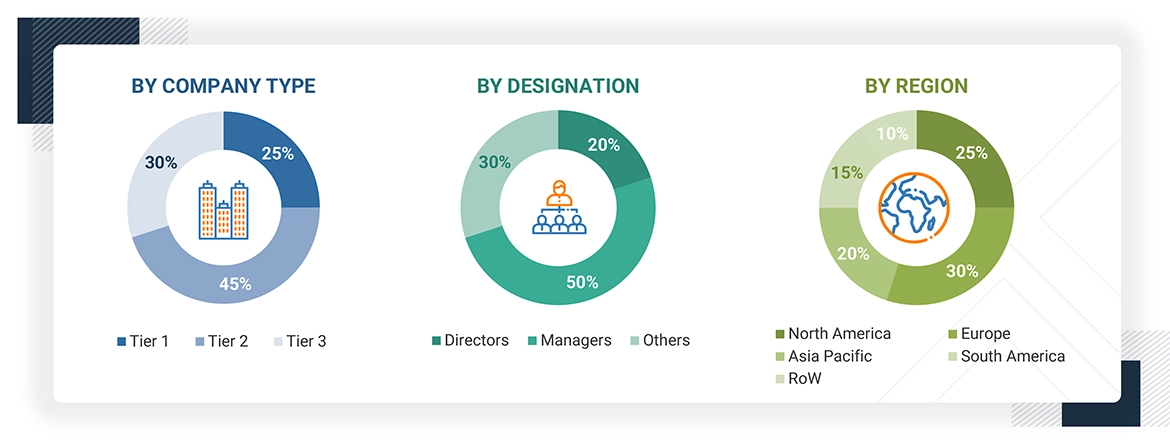
Note 1: Others include sales managers, marketing managers, and product managers.
Note 2: Tier 1 companies’ revenues are more than USD 10 billion; tier 2 companies’ revenues range between USD 1 and 10 billion; and tier 3 companies’ revenues range between USD 500 million and USD 1 billion.
Source: Industry Experts
To know about the assumptions considered for the study, download the pdf brochure
Market Size Estimation
In the complete market engineering process, top-down and bottom-up approaches and several data triangulation methods were used to estimate and forecast the market size for the overall market segments and subsegments listed in this report. Extensive qualitative and quantitative analyses were performed on the complete market engineering process to list the key information/insights throughout the report.
The key players in the food lyophilization equipment market were identified through secondary research, and their rankings in the respective regions were determined through primary and secondary research. This entire procedure involved the study of the annual and financial reports of top players and interviews with industry experts, such as chief executive officers, vice presidents, directors, and marketing executives, for quantitative and qualitative key insights. All percentage shares, splits, and breakdowns were determined using secondary sources and verified through primary sources. All parameters that affect the markets covered in this research study were accounted for, viewed in extensive detail, verified through primary research, and analyzed to obtain the final quantitative and qualitative data. This data was consolidated, supplemented with detailed inputs and analysis from MarketsandMarkets, and presented in this report.
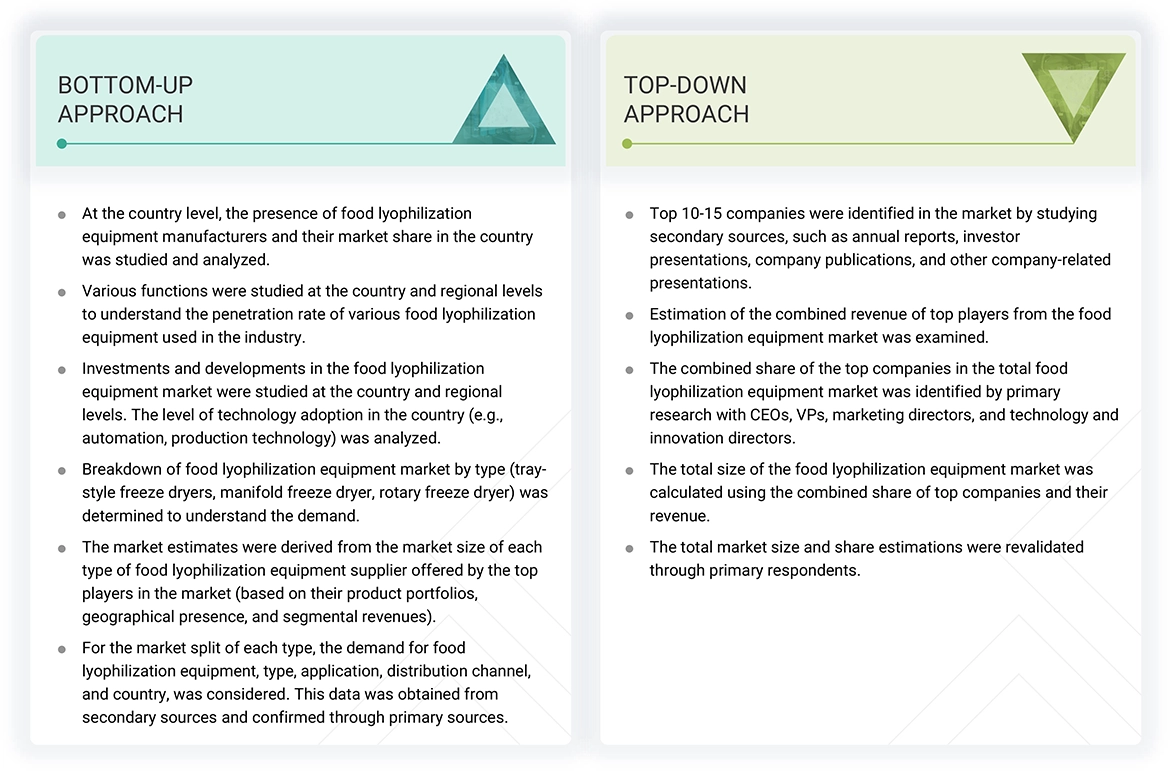
Market Size Estimation Methodology- Bottom-up approach
- At the country level, the presence of food lyophilization equipment manufacturers and their market share were studied and analyzed.
- Various functions were studied at the country & regional levels to understand the penetration rate of various food lyophilization equipment used for various functions in the industry.
- Investments and developments in the food lyophilization equipment market were studied at the country & regional levels. The country’s technological adoption level (e.g., automation, production technology) was analyzed.
- A breakdown of the food lyophilization equipment market by type (tray-style freeze dryers, manifold freeze dryers, and rotary freeze dryers, was determined to understand the demand.
- The market estimates were derived through the market size of each type of food lyophilization equipment suppliers, offered by top players in the food lyophilization equipment market (based on their product portfolios, geographical presence, and segmental revenues).
- For the market split of each type, the demand for food lyophilization equipment, type, application, distribution channel, and country was considered. This data was obtained from secondary sources and confirmed through primary inputs.
Market Size Estimation Methodology- Top-down approach
- Leading companies and system integrators operating across various industries were tracked.
- The size of the food lyophilization equipment market was derived through the data sanity method, analyzing revenues of more than 15 key providers through their annual reports and press releases, secondary databases, and summing them up to estimate the overall market size.
- Multiple discussions were conducted with key opinion leaders to understand the demand for food lyophilization equipment manufacturers and analyze the breakup of the scope of work carried out by each major company.
- Market trends were analyzed to obtain the CAGR of the food lyophilization equipment market by understanding the product penetration rate in each application and examining the demand and supply of food lyophilization equipment in different applications.
- A percentage of the overall revenue, or in some cases, a portion of the segmental revenues from each company, was used to calculate their earnings from the sales of food lyophilization equipment. This percentage has been assigned to each company based on the composition of their product portfolios.
- Estimates at every level were verified through discussions with key opinion leaders, including CXOs, directors, and operation managers, and with domain experts at MarketsandMarkets.
- Various paid and unpaid information sources, such as annual reports, press releases, white papers, and databases, were studied.
Food Lyophilization Equipment Market : Top-Down and Bottom-Up Approach
Data Triangulation
After determining the overall size of the food lyophilization equipment market from the market size estimation processes explained above, the total market was split into several segments and subsegments. Where applicable, the market breakdown and data triangulation procedures were employed to complete the overall market engineering process and arrive at the exact statistics for all segments and subsegments. The data was triangulated by studying various factors and trends. Additionally, the market size was validated using top-down and bottom-up approaches.
Market Definition
Food lyophilization equipment, also known as freeze-drying equipment, is specialized machinery used to remove moisture from food products by freezing them and then reducing the surrounding pressure to allow the frozen water in the food to sublimate (transition directly from solid to vapor without passing through the liquid phase).
Stakeholders
- Raw material suppliers
-
Regulatory bodies, which include the following:
- Food safety agencies such as the FDA, EFSA, USDA, and FSANZ
- Government agencies and NGOs
- Food safety agencies
-
End users, which include the following:
- Food & beverage manufacturers/suppliers
- Research centers, laboratories, and scientific institutes
- Retailers
- Commercial research & development (R&D) institutions and financial institutions
- Importers and exporters of lyophilization equipment
- Government and research organizations
- Trade associations and industry bodies
Report Objectives
- To define, describe, and segment the food lyophilization equipment market based on type, scale of operation, technology type, application, and region in terms of value and volume from 2025 to 2030
- To identify the attractive opportunities in the market by determining the largest and fastest-growing segments across regions
-
To analyze demand-side factors based on the following:
- Impact of macroeconomic and microeconomic factors on market growth
- Shifts in demand patterns across subsegments and regions
- To provide detailed information about the key factors influencing market growth (drivers, restraints, opportunities, and industry-specific challenges)
- To analyze the micromarkets concerning individual growth trends, prospects, and their contribution to the total market
- To assess the competitive developments, such as partnerships, mergers & acquisitions, product developments, and expansions & investments in the food lyophilization equipment market
Available Customizations
With the given market data, MarketsandMarkets offers customizations according to the specific requirements of companies. The following customization options are available for the report:
- Detailed analysis and profiling of additional market players based on various blocks of the supply chain
Get the Full Food Lyophilization Equipment Market Report
Full forecast, segment splits, and company analysis for all Food Lyophilization Equipment Market.
- US Food Lyophilization Equipment Market
- Mexico Food Lyophilization Equipment Market
- Germany Food Lyophilization Equipment Market
- France Food Lyophilization Equipment Market
- UK Food Lyophilization Equipment Market
- Italy Food Lyophilization Equipment Market
- Spain Food Lyophilization Equipment Market
- Turkey Food Lyophilization Equipment Market
- China Food Lyophilization Equipment Market
- Japan Food Lyophilization Equipment Market
- India Food Lyophilization Equipment Market
- South Korea Food Lyophilization Equipment Market
- Thailand Food Lyophilization Equipment Market
- Vietnam Food Lyophilization Equipment Market
- Brazil Food Lyophilization Equipment Market
- Argentina Food Lyophilization Equipment Market
- Egypt Food Lyophilization Equipment Market
- Rest Of Europe Food Lyophilization Equipment Market
- Rest Of Asia Pacific Food Lyophilization Equipment Market
- GCC Food Lyophilization Equipment Market
- Maghreb Countries Food Lyophilization Equipment Market
- Rest Of South America Food Lyophilization Equipment Market
Need a Tailored Report?
Customize this report to your needs
Get 10% FREE Customization
Customize This Report
