
South Korea Generative AI Server Market (2025-2030)

The South Korea Generative AI Server Market was valued at $3875.1 Million in 2025 and projected to reach to $15124.3 Million by 2030, representing a compound annual growth rate of 31.3%. South Korea's generative AI server market is positioned for exceptional growth through 2030, driven by the nation's unparalleled semiconductor manufacturing capabilities and robust digital infrastructure.


| Market Size in | USD 26.32 MN |
| Market Forecast in | |
| CAGR | |
| Forecast Period | |
| Units Considered | Value (USD MN) |
South Korea Generative AI Server Market Trends and Insights
- This represents a compound annual growth rate of 31.3%, driven by South Korea's advanced semiconductor manufacturing capabilities and strong digital infrastructure.
- South Korea's position as a global technology leader positions the nation to capitalize on surging demand for AI computing infrastructure across enterprise and cloud service sectors. The forecast period through 2030 reflects South Korea's strategic investments in AI chip development and data center modernization.
- South Korea's major technology conglomerates and emerging AI startups are accelerating adoption of generative AI servers to support large language models and enterprise applications.
- South Korea's robust R&D ecosystem and government support for AI initiatives underscore the market's growth trajectory and competitive advantage in the Asia Pacific region..
Key Market Statistics
- CAGR (2025-2030) 31.3% CAGR
- Market Size, 2025 ~USD 3875.1 Million
- Forecast, 2030 ~USD 15124.3 Million
- Country South Korea
South Korea Generative AI Server Market Overview
Market Valuation Growth :
South Korea's generative AI server market is valued at $3,875.1 million in 2025, with projections reaching $15,124.3 million by 2030, representing a robust 31.3% CAGR over the forecast period.
Semiconductor Manufacturing Leadership :
South Korea's dominance in semiconductor fabrication, led by companies like Samsung and SK Hynix, creates a competitive advantage in developing and deploying advanced AI server infrastructure domestically.
Digital Infrastructure Excellence :
With world-class broadband penetration and 5G deployment, South Korea provides an ideal ecosystem for generative AI server deployment and edge computing applications across enterprise and consumer sectors.
Technology Innovation Hub :
South Korea's thriving tech ecosystem, including major players in cloud services, telecommunications, and consumer electronics, drives accelerated adoption of generative AI server solutions across multiple industries.
South Korea Generative AI Server Market Dynamics
- The country's tech-forward enterprises and government initiatives supporting AI development create strong demand for advanced server solutions.
- South Korea's position as a global technology leader, combined with investments from major conglomerates in AI infrastructure, will sustain the 31.3% CAGR.
- The market will benefit from increasing adoption across financial services, manufacturing, and telecommunications sectors seeking to leverage generative AI for competitive advantage..
Market Ecosystem
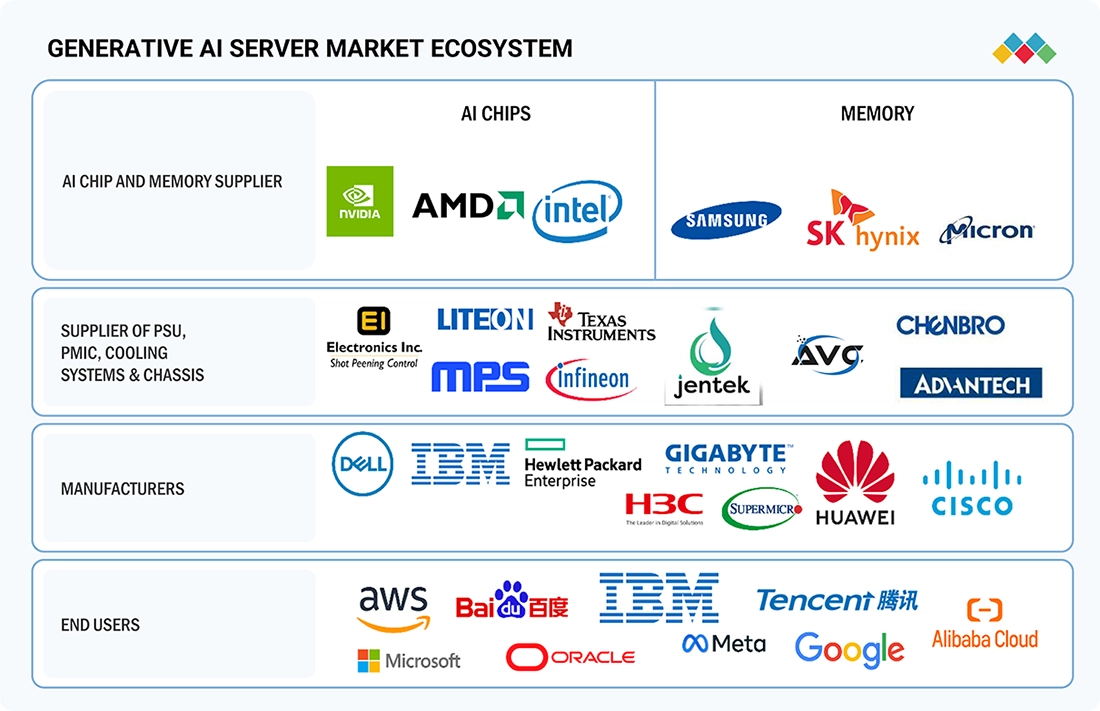
GENERATIVE AI SERVER MARKET : COMMERCIAL USE CASES ACROSS INDUSTRIES
| COMPANY | USE CASE DESCRIPTION | BENEFITS |
|---|---|---|
 |
Builds generative AI-ready infrastructure using PowerEdge XE servers integrated with GPUs (e.g., NVIDIA H100) and software stacks for LLM training and inference. | Enables enterprises to deploy scalable Gen AI workloads with optimized performance, faster model training, and integrated AI lifecycle management. |
 |
Offers Gen AI servers via HPE Cray and ProLiant platforms with HPE GreenLake for AI, supporting LLM training, fine-tuning, and inference in hybrid environments. | Provides flexible, as-a-service AI infrastructure with high-performance computing, reducing upfront costs and accelerating time-to-deployment. |
 |
Provides high-density GPU servers optimized for generative AI workloads, including liquid-cooled systems for LLM training and inference at scale. | Enhances compute density and energy efficiency while reducing total cost of ownership (TCO) for hyperscale and enterprise AI deployments. |
 |
Offers ThinkSystem AI servers with Neptune liquid cooling, designed for generative AI model training and enterprise AI applications. | Improves energy efficiency and performance per watt, enabling sustainable scaling of large AI models with reduced operational costs. |
Logos and trademarks shown above are the property of their respective owners. Their use here is for informational and illustrative purposes only.
Related Ecosystem
Electronics System And Components
- Sensors
- Temperature Sensors
- Pressure Sensors
- Actuators
- Image Sensors
- Lenovo
- Samsung
- Texas Instruments Incorporated
- HONEYWELL INTERNATIONAL INC.
- Teledyne Technologies Incorporated
Key Takeaways
- South Korea's generative AI server market will grow from $3,875.1M (2025) to $15,124.3M (2030) at a 31.3% CAGR.
- South Korea's semiconductor leadership and advanced manufacturing enable competitive advantages in AI server production and deployment.
- South Korea's enterprise and cloud sectors are driving demand for generative AI servers to support AI-powered applications and services.
- South Korea's government-backed AI initiatives and R&D investments position the nation as a key regional hub for AI infrastructure development.
Generative AI Server Market Report Scope
| Report Metric | Details |
|---|---|
| Base Year | 2025 |
| Fastest Growing Segment | HEALTHCARE (Enterprise Type) |
| Forecast Period | 2025–2030 |
| Growth Rate | CAGR of 34% from 2025 to 2030 |
| Largest Segment | GPU-BASED SERVERS (Processor Type) |
| Market Size Base Year (Billions) | ~USD 103.83 (2025) |
| Revenue Forecast (Billions) | ~USD 448.6 (2030) |
| Segments Covered | Processor Type, Function, Cooling Technology, Form Factor, Deployment, End User, Enterprise Type |
South Korea Generative AI Server Market Report Segmentation
7 segment dimensions are covered across the global market.
By Processor Type
- Asic-Based Servers
- Fpga-Based Servers
- Gpu-Based Servers
By Function
- Inference
- Training
By Cooling Technology
- Air Cooling
- Hybrid Cooling
- Liquid Cooling
By Form Factor
- Blade Servers
- Rack-Mounted Servers
- Tower Servers
By Deployment
- Cloud
- On-Premises
By End User
- Automotive
- Bfsi
- Cloud Service Providers (Csp)
- Enterprises
- Government Organizations
- Healthcare
- Media & Entertainment
- Retail & E-Commerce
By Enterprise Type
- Automotive
- Bfsi
- Healthcare
- Media & Entertainment
- Retail & E-Commerce
Target Audience
- Semiconductor & Hardware Manufacturers : South Korean and international chipmakers need detailed market data to optimize production capacity, plan R&D investments, and identify partnership opportunities with local server manufacturers and cloud providers.
- Cloud Service Providers & Data Center Operators : Domestic and international cloud providers require South Korea-specific insights to plan infrastructure expansion, understand customer demand patterns, and compete effectively in this high-growth market.
- Enterprise Technology Decision-Makers : CIOs and IT leaders at South Korean enterprises need market intelligence to evaluate generative AI server solutions, benchmark against competitors, and justify infrastructure investments to stakeholders.
- Government & Policy Advisors : South Korean government agencies and policy makers require market data to inform AI strategy, allocate R&D funding, and develop regulations supporting the nation's generative AI server ecosystem.
- Investment & Strategy Consultants : Venture capitalists, private equity firms, and management consultants need South Korea-specific market forecasts to identify investment opportunities, assess portfolio companies, and advise clients on market entry strategies.
Key Companies in the South Korea Generative AI Server Market
| Company | HQ | Ownership | Strongest segments |
|---|---|---|---|
| DELL INC. | United States | Public Company | Client Solutions Group (notebooks, desktops, workstations, peripherals, services),Infrastructure Solutions Group (servers, storage, networking, related services),Financing, payment and consumption solutions (utility, subscription, as-a-service, leases, loans), |
| LENOVO | China | Public Company | Small form factor PCs and embedded signage controllers,Thin clients and dedicated media players,Tablets and smart devices as interactive kiosks/PoS displays, |
| IBM | United States | Public Company | Software (Hybrid Cloud & AI Platforms),Consulting (Strategy, Technology, Intelligent Operations),Infrastructure (Servers, Storage, Lifecycle Services), |
| H3C TECHNOLOGIES CO., LTD. | China | Private Company | Switches and Routers,Wireless (WLAN and related),SDN and NFV Products, |
| CISCO SYSTEMS, INC. | United States | Public Company | Enterprise networking (campus, data center, branch, wireless),Security (network security, SASE, identity, threat detection/response),Collaboration (Webex suite, devices, contact center, CPaaS), |
| SUPER MICRO COMPUTER, INC. | United States | Public Company | AI-optimized servers (GPU-dense, liquid/air-cooled),Blade, multi-node, and rackmount systems,Storage systems and MicroCloud, |
| FUJITSU | Japan | Public Company | Service Solutions (consulting, cloud, integration, managed and BPO services),Hardware Solutions (computer platforms and related infrastructure),Ubiquitous Solutions and software/support, |
| INSPUR CO., LTD. | China | Public Company | Computing equipment (servers, storage, intelligent network, cloud OS),Enterprise software (ERP, PaaS, databases),Cloud and data center services (government and enterprise cloud, outsourcing, DC services), |
| NVIDIA CORPORATION | United States | Public Company | Data Center AI Compute & Networking,Gaming GPUs (GeForce),Professional Visualization & Workstation GPUs (RTX/Quadro), |
| ADLINK TECHNOLOGY INC. | Taiwan | Public Company | Computer-on-Modules and Embedded Boards (COM Express, SMARC, Qseven, OSM, ETX, SBCs, motherboards),Industrial PCs, Edge Computing Platforms, and IoT Gateways,Rugged and Transportation Systems (compactPCI, VPX, AVA railway, passenger information), |
| ADVANCED MICRO DEVICES, INC. | United States | Public Company | Data Center (EPYC, Instinct, data center GPUs and DPUs),Client (Ryzen, Ryzen AI, desktop and mobile CPUs),Gaming (Radeon, semi-custom SoCs for consoles), |
| QUANTA COMPUTERS | Taiwan | Public Company | Notebook PCs and Mobile Workstations (ODM),Server, Storage, and Data Center Hardware ODM,Networking, Edge, and IoT Systems, |
| WISTRON CORPORATION | Taiwan | Public Company | Desktop and portable computers (including notebooks, tablets, pocket computers, PDAs),Servers, system platforms, multiprocessor and network computers,Consumer AV and home appliances (LCD TVs, set-top boxes, digital video decoders, multimedia home devices), |
DELL INC.
Dell Inc. is a United States-based technology company founded in 1984 that operates as a public company with 97,000 employees. The company designs, manufactures, and sells computing hardware and related technology solutions.
LENOVO
Lenovo is a Chinese technology company founded in 1984 that operates as a public company. The company designs and manufactures computing devices and related technology products.
IBM
IBM is a United States-based technology company founded in 1911 that operates as a public company with 264,300 employees. The company provides computing hardware, software, and IT services globally.
H3C TECHNOLOGIES CO., LTD.
H3C Technologies Co., Ltd. is a Chinese private company founded in 2003 with 4,800 employees. The company specializes in networking and information technology solutions.
CISCO SYSTEMS, INC.
Cisco Systems, Inc. is a United States-based technology company founded in 1984 that operates as a public company with 86,200 employees. The company designs and manufactures networking equipment and cybersecurity solutions.
SUPER MICRO COMPUTER, INC.
Super Micro Computer, Inc. is a United States-based technology company founded in 1993 that operates as a public company with 6,238 employees. The company designs and manufactures high-performance computing systems and components.
FUJITSU
Fujitsu is a Japanese technology company founded in 1935 that operates as a public company with 99,203 employees. The company provides computing hardware, software, and IT services worldwide.
INSPUR CO., LTD.
Inspur Co., Ltd. is a Chinese public company founded in 1998 with 6,896 employees. The company manufactures and sells computing servers and related information technology products.
NVIDIA CORPORATION
NVIDIA Corporation is a United States-based technology company founded in 1993 that operates as a public company with 42,000 employees. The company designs and manufactures graphics processing units and artificial intelligence computing platforms.
ADLINK TECHNOLOGY INC.
ADLINK Technology Inc. is a Taiwan-based technology company founded in 1995 that operates as a public company with 342 employees. The company develops embedded computing and industrial automation solutions.
ADVANCED MICRO DEVICES, INC.
Advanced Micro Devices, Inc. is a United States-based semiconductor company founded in 1969 that operates as a public company with 31,000 employees. The company designs and manufactures processors and graphics chips for computing and data center applications.
QUANTA COMPUTERS
Quanta Computers is a Taiwan-based public company founded in 1988. The company manufactures computing hardware and related technology products.
WISTRON CORPORATION
Wistron Corporation is a Taiwan-based technology company founded in 2001 that operates as a public company with 8,212 employees. The company manufactures computing devices and provides electronics manufacturing services.
Reasons to Buy this Report
- Localized Market Intelligence : Gain deep insights specific to South Korea's unique market dynamics, including domestic semiconductor advantages, regulatory environment, and competitive landscape that differ significantly from global trends.
- Strategic Investment Decisions : Make informed decisions about market entry, expansion, or partnership opportunities in South Korea with detailed forecasts, growth drivers, and market sizing data through 2030.
- Competitive Benchmarking : Understand South Korea's 31.3% CAGR performance relative to global 34% growth, identifying market gaps and opportunities where South Korean players can differentiate or where international competitors can penetrate.
- Sector-Specific Opportunities : Identify high-growth segments within South Korea's generative AI server market across financial services, manufacturing, telecommunications, and consumer electronics with tailored go-to-market strategies.
- Technology Roadmap Planning : Align product development and infrastructure investments with South Korea's rapid AI server adoption trajectory, ensuring solutions meet the specific needs of Korean enterprises and government initiatives.
Frequently asked questions
What is the projected market size of South Korea's generative AI server market by 2030?
South Korea's generative AI server market is projected to reach $15,124.3 million by 2030, growing from $3,875.1 million in 2025.
What is the CAGR for South Korea's generative AI server market?
South Korea's generative AI server market is expected to grow at a compound annual growth rate of 31.3% between 2025 and 2030.
What factors are driving growth in South Korea's generative AI server market?
South Korea's growth is driven by advanced semiconductor manufacturing capabilities, strong digital infrastructure, enterprise AI adoption, and government support for AI development initiatives.
Which sectors in South Korea are adopting generative AI servers?
South Korea's enterprise, cloud service, financial services, and technology sectors are leading adoption of generative AI servers for large language models and AI-powered applications.
How does South Korea's market compare to the Asia Pacific region?
South Korea's 31.3% CAGR reflects strong regional competitiveness, supported by its semiconductor expertise, R&D capabilities, and strategic positioning within the Asia Pacific generative AI server market.
RESEARCH METHODOLOGY
The research process for this technical, market-oriented, and commercial study of the generative AI server market included the systematic gathering, recording, and analysis of data about companies operating in the market. It involved the extensive use of secondary sources, directories, and databases (Factiva, OANDA) to identify and collect relevant information. In-depth interviews were conducted with various primary respondents, including experts from core and related industries and preferred manufacturers, to obtain and verify critical qualitative and quantitative information as well as to assess the growth prospects of the market. Key players in the generative AI server market were identified through secondary research, and their market rankings were determined through primary and secondary research. This included studying annual reports of top players and interviewing key industry experts, such as CEOs, directors, and marketing executives.
Secondary Research
In the secondary research process, various secondary sources have been referred to for identifying and collecting information relevant to this study. Secondary sources include annual reports, press releases, and investor presentations of companies; white papers, certified publications, and articles from recognized authors; directories; and databases. Secondary research has been mainly conducted to obtain key information about the supply chain and value chain of the industry; a total pool of key players; segmentation of the market according to the industry trends, geographic markets, and key developments from market- and technology-oriented perspectives.
Primary Research
In the primary research process, primary sources from the supply and demand sides have been interviewed to obtain qualitative and quantitative information for this report. Primary sources from the supply side include experts, such as CEOs, vice presidents, marketing directors, technology and innovation directors, subject-matter experts, consultants, and related key executives from major companies and organizations operating in the generative AI server market.
After the complete market engineering process (market statistics calculations, market breakdown, market size estimations, market forecasting, and data triangulation), extensive primary research has been conducted to gather information and verify and validate the critical market numbers.
Several primary interviews have been conducted with experts from the demand and supply sides across four major regions—North America, Europe, Asia Pacific, and RoW. Approximately 25% of the primary interviews have been conducted with the demand side and 75% with the supply side. This primary data has been collected through questionnaires, emails, and telephone interviews.
BREAKDOWN OF PRIMARY INTERVIEW PARTICIPANTS
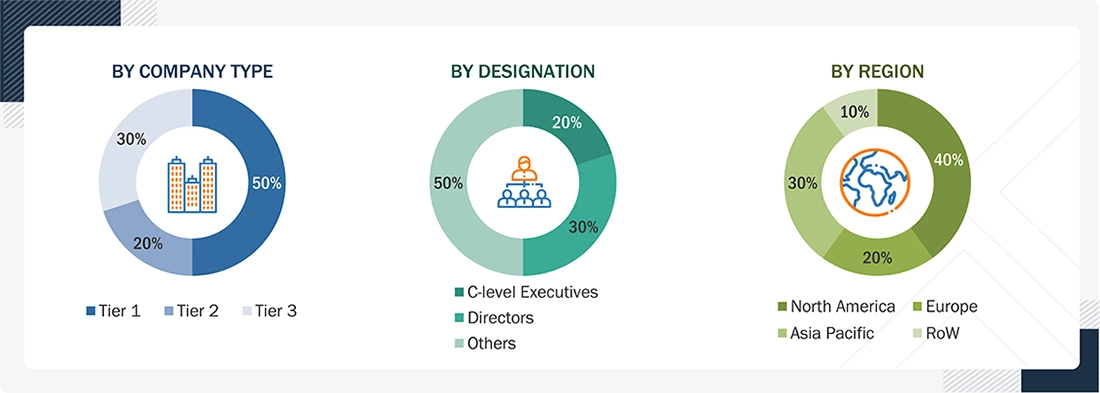
Notes: Other designations include technology heads, media analysts, sales managers, marketing managers, and product managers.
The three tiers of companies are based on their total revenues as of 2025: Tier 1: >USD 1 billion; Tier 2: USD 500 million–1 billion; and Tier 3: <USD 500 million.
To know about the assumptions considered for the study, download the pdf brochure
Market Size Estimation
In the complete market engineering process, top-down and bottom-up approaches and several data triangulation methods were used to estimate and forecast the overall market segments and subsegments listed in this report. Key players in the market were identified through secondary research, and their market shares in the respective regions were determined through primary and secondary research. This entire procedure includes the study of annual and financial reports of the top market players and extensive interviews for key insights (quantitative and qualitative) with industry experts (CEOs, VPs, directors, and marketing executives).
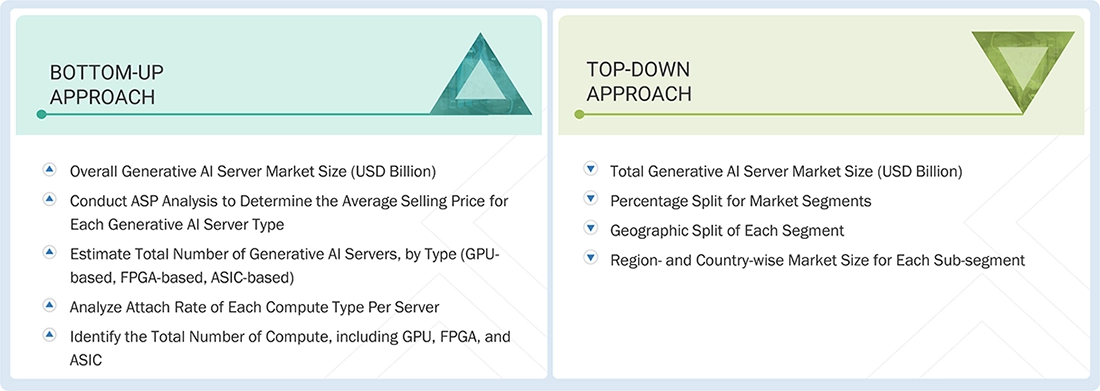
All shares, splits, and breakdowns were determined using secondary sources and verified through primary sources. All the parameters affecting the markets covered in this research study were accounted for, viewed in detail, verified through primary research, and analyzed to obtain the final quantitative and qualitative data. This data was consolidated and supplemented with detailed inputs and analysis from MarketsandMarkets and presented in this report. The following figure represents this study’s overall market size estimation process.
BOTTOM-UP APPROACH
- Initially, the companies offering compute/processors were identified. Their products were mapped based on processor type, including GPU, FPGA, and ASIC.
- After identifying compute/processors, the market is segmented based on the processor type used in generative AI servers, i.e., GPU-based, FPGA-based, and ASIC-based AI servers.
- Derive the global shipments of compute/processors by tracking the sales of leading players and their utilization in generative AI server deployments
- Assigned an attach rate for each processor type based on server configurations
- Estimating the total number of generative AI servers by type (GPU-based, FPGA-based, ASIC-based)
- Determining the Average Selling Price (ASP) for each generative AI server type by analyzing the pricing based on configurations, including the number of compute/processors and additional components like memory, storage, and cooling systems
- ASP data is collected from secondary sources such as vendor price lists and market reports and validated through primary interviews.
- Estimating the generative AI server market revenue by type (GPU-based, FPGA-based, ASIC-based)
- Carrying out multiple discussions with key opinion leaders to understand the type of generative AI server products designed and developed vertically, helping analyze the breakdown of the scope of work carried out by each major company in the generative AI server market
- Arriving at the market estimates by analyzing generative AI server companies as per their countries and subsequently combining this information to arrive at the market estimates by region
- Verifying and cross-checking the estimates at every level through discussions with key opinion leaders, including CXOs, directors, and operations managers, and finally with domain experts at MarketsandMarkets
- Studying various paid and unpaid sources of information, such as annual reports, press releases, white papers, and databases.
TOP-DOWN APPROACH
- Focusing on top-line investments and expenditures being made in the ecosystems of various end-use industries
- Building and developing the information related to the market revenue generated by key generative AI server manufacturers
- Conducting multiple on-field discussions with the key opinion leaders involved in the development of generative AI server products in various end-use industries.
- Estimating geographic splits using secondary sources based on various factors, such as the number of players in a specific country and region, the processor type, and the level of solutions offered in end-use industries.
Data Triangulation
After arriving at the overall market size, the market was split into several segments and subsegments using the market size estimation processes as explained above. Data triangulation and market breakdown procedures were employed to complete the entire market engineering process and determine each market segment's and subsegment's exact statistics. The data was triangulated by studying various factors and trends from the demand and supply sides in the generative AI server market.
Market Definition
A generative AI server is a high-performance computing system designed to train and run generative AI models like large language models (LLMs), image generators, and audio synthesizers. It features powerful graphics processing units (GPUs), field-programmable gate arrays (FPGAs), application-specific integrated circuits (ASICs), high-bandwidth memory, fast storage, and advanced networking to support massive data processing. These servers are essential for developing AI applications in cloud services, enterprise environments, and government organizations.
Key Stakeholders
- Government, financial institutions and investment communities
- Analysts and strategic business planners
- Semiconductor product designers and fabricators
- Application providers
- AI solution providers
- AI platform providers
- Business providers
- Professional service/Solution providers
- Research organizations
- Technology standard organizations, forums, alliances, and associations
- Technology investors.
Report Objectives
- To define, describe, segment, and forecast the size of the generative AI server market, in terms of value, based on processor type, function, cooling technology, form factor, deployment, end user, and region
- To forecast the size of the market segments for four major regions—North America, Europe, Asia Pacific, and the Rest of the World (RoW)
- To define, describe, segment, and forecast the size of the generative AI server market, in terms of volume, based on processor type and function
- To provide detailed information regarding drivers, restraints, opportunities, and challenges influencing the growth of the market
- To provide an ecosystem analysis, case study analysis, patent analysis, technology analysis, pricing analysis, Porter's five forces analysis, investment and funding scenario, and regulations pertaining to the market
- To provide a detailed overview of the value chain analysis of the generative AI server ecosystem
- To strategically analyze micromarkets with regard to individual growth trends, prospects, and contributions to the total market
- To analyze opportunities for stakeholders by identifying high-growth segments of the market
- To strategically profile the key players, comprehensively analyze their market positions in terms of ranking and core competencies, and provide a competitive market landscape
- To analyze strategic approaches such as product launches, acquisitions, agreements, and partnerships in the generative AI server market.
Available customizations:
With the given market data, MarketsandMarkets offers customizations according to the company’s specific needs. The following customization options are available for the report:
COMPANY INFORMATION
- Detailed analysis and profiling of additional market players (up to 7)
Get the Full Generative AI Server Market Report
Full forecast, segment splits, and company analysis for all Generative AI Server Market.
- US Generative AI Server Market
- Canada Generative AI Server Market
- Mexico Generative AI Server Market
- UK Generative AI Server Market
- Germany Generative AI Server Market
- France Generative AI Server Market
- Italy Generative AI Server Market
- Spain Generative AI Server Market
- China Generative AI Server Market
- Japan Generative AI Server Market
- India Generative AI Server Market
- Rest Of Europe Generative AI Server Market
- Rest Of Asia Pacific Generative AI Server Market
- Africa Generative AI Server Market
- Middle East Generative AI Server Market
- South America Generative AI Server Market
Need a Tailored Report?
Customize this report to your needs
Get 10% FREE Customization
Customize This Report
