
US Wi-Fi Market (2024-2029)

The US Wi-Fi Market was valued at $6407.4 Million in 2024 and projected to reach to $11309.7 Million by 2029, representing a compound annual growth rate of 12.0%. The US Wi-Fi market is positioned for substantial expansion through 2029, driven by enterprise digital transformation initiatives, widespread remote work infrastructure investments, and consumer demand for faster, more reliable connectivity.


| Market Size in | USD 26.32 MN |
| Market Forecast in | |
| CAGR | |
| Forecast Period | |
| Units Considered | Value (USD MN) |
US Wi-Fi Market Trends and Insights
- This growth trajectory reflects the US market's increasing demand for high-speed connectivity across residential, commercial, and enterprise segments.
- The US Wi-Fi market is driven by accelerating digital transformation, rising adoption of IoT devices, and the proliferation of smart home technologies throughout the country. In 2024, the US Wi-Fi market benefits from substantial infrastructure investments and the rollout of next-generation Wi-Fi 6 and Wi-Fi 6E technologies.
- The US market is witnessing heightened competition among equipment manufacturers and service providers seeking to capture growing demand for seamless connectivity.
- By 2029, the US Wi-Fi market is expected to consolidate gains from enterprise modernization, increased remote work adoption, and consumer preference for reliable wireless solutions across multiple devices and applications..
Key Market Statistics
- CAGR (2024-2029) 12.0% CAGR
- Market Size, 2024 ~USD 6407.4 Million
- Forecast, 2029 ~USD 11309.7 Million
- Country US
US Wi-Fi Market Overview
Market Valuation :
The US Wi-Fi market is valued at $6,407.4 million in 2024, with strong growth momentum driven by widespread adoption across residential, commercial, and enterprise sectors throughout the country.
Projected Growth :
Expected to reach $11,309.7 million by 2029, the US market will nearly double in value over five years, demonstrating sustained demand for advanced connectivity solutions across all major metropolitan and rural regions.
CAGR Performance :
The US Wi-Fi market is growing at a 12% CAGR, outpacing many other ICT segments while remaining below the global average of 15.4%, indicating significant untapped growth potential in the American market.
Connectivity Drivers :
Growth is fueled by accelerating digital transformation, remote work adoption, IoT proliferation, and increasing consumer demand for seamless high-speed connectivity in homes, offices, and public spaces across the United States.
US Wi-Fi Market Dynamics
- Major metropolitan areas and enterprise segments are leading adoption, while rural broadband initiatives present emerging opportunities.
- The market will benefit from 5G integration, Wi-Fi 6E standardization, and increased smart home penetration across American households and businesses. Key growth catalysts include government broadband expansion programs, enterprise network modernization, and the proliferation of bandwidth-intensive applications.
- Competitive pricing pressures and technological standardization will drive market consolidation among US providers.
- Investment in mesh networking, cloud-managed solutions, and security-enhanced platforms will define competitive differentiation throughout the forecast period..
Market Ecosystem
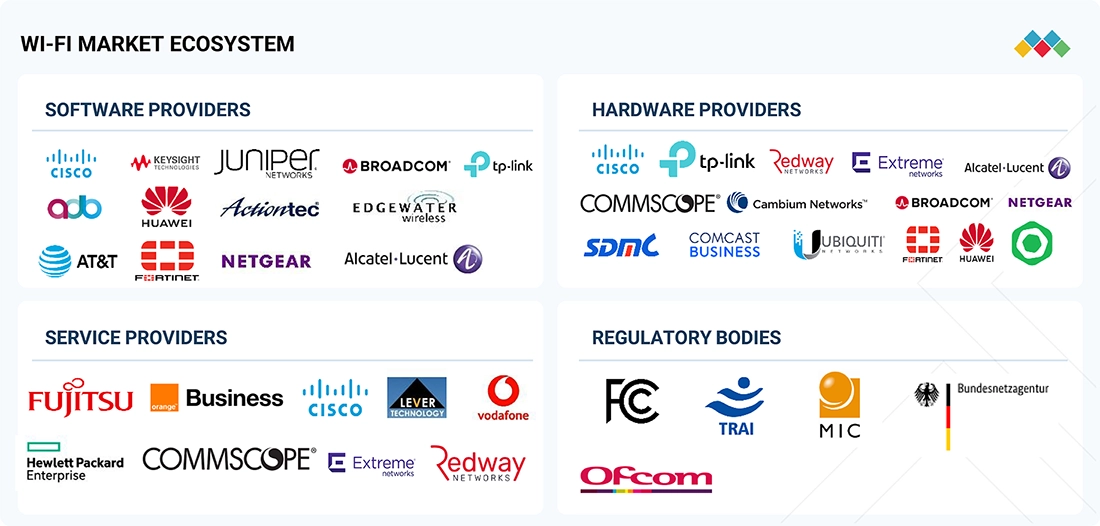
Wi-Fi Market: COMMERCIAL USE CASES ACROSS INDUSTRIES
| COMPANY | USE CASE DESCRIPTION | BENEFITS |
|---|---|---|
 |
UniEuro faced issues with unprofessional network planning, such as signal interference between APs on the same and neighboring floors, leading to coverage gaps and degraded user experiences. Additionally, the existing Wi-Fi solutions could not deliver ROI beyond basic internet access and advertisements, failing to support advanced customer data analytics and marketing strategy assessments. | The deployment transformed free Wi-Fi into a value-added service, improving customer experiences and enabling targeted marketing strategies. The solution enhanced advertisement delivery efficiency and provided actionable insights for UniEuro’s marketing strategies, turning the Wi-Fi network into a high-ROI tool for online-offline integration and customer engagement. |
 |
The district faced a rise in cyberattacks, posing significant risks to the protection of sensitive student information. Additionally, many students actively attempted to bypass network security protocols, creating potential vulnerabilities within the system. | The deployment of Extreme Networks solutions enhanced data protection by providing improved visibility into network activity and safeguarding sensitive student and administrative information. Advanced analytics tools allowed the district to proactively identify and mitigate risks, significantly improving network security. |
 |
Oxford implemented Juniper’s AI-driven Wireless Access solution across key buildings and colleges. Juniper’s cloud services, including Mist Wi-Fi Assurance and Marvis Virtual Network Assistant, provided reliable performance and simplified issue resolution. The Wi-Fi 6 access points integrated smoothly into existing infrastructure, minimizing installation disruptions, even in historic locations, and allowed colleges to manage their Wi-Fi independently with a microservices architecture. | The AI-driven Juniper solution delivered improved network visibility, control, and faster issue resolution. Students gained secure, user-friendly personal wireless LANs in their dorm rooms for their devices. The system supported Oxford’s vision of a home-like campus experience while optimizing Wi-Fi for academic and recreational use. |
Logos and trademarks shown above are the property of their respective owners. Their use here is for informational and illustrative purposes only.
Related Ecosystem
Data Centre And Networking
- Software-Defined Networking (SDN)
- Mid-Sized Data Centers
- Small Data Centers
- Remote Monitoring
- Smart Healthcare
- Cisco Systems, Inc.
- HUAWEI TECHNOLOGIES CO LTD
- Hewlett Packard Enterprise Company
- MITSUBISHI ELECTRIC INFORMATION SYSTEMS CORPORATION
- MITSUBISHI ELECTRIC INFORMATION NETWORK CORPORATION
Mobility And Telecom
- Smart Utilities
- Smart Healthcare
- Sensors
- Parking Management System
- Passenger Information System (PIS)
- AT&T Inc.
- Cisco Systems, Inc.
- HUAWEI TECHNOLOGIES CO LTD
- Telefonaktiebolaget LM Ericsson (publ)
- International Business Machines Corporation
Key Takeaways
- The US Wi-Fi market is valued at $6,407.4 million in 2024 and is forecast to grow to $11,309.7 million by 2029 at a 12.0% CAGR.
- The US market is driven by enterprise digital transformation, IoT proliferation, and widespread adoption of Wi-Fi 6 and Wi-Fi 6E standards.
- The US Wi-Fi market benefits from sustained investment in smart home infrastructure and remote work connectivity solutions.
- The US market is characterized by intense competition among vendors and increasing demand for mesh networking and enterprise-grade solutions.
Wi-Fi Market Report Scope
| Report Metric | Details |
|---|---|
| Base Year | 2024 |
| Fastest Growing Segment | WI-FI 7 (Technology) |
| Forecast Period | 2024–2029 |
| Growth Rate | CAGR of 15.4% from 2024 to 2029 |
| Largest Segment | INDOOR (Deployment) |
| Market Size Base Year (Billions) | ~USD 22.05 (2024) |
| Revenue Forecast (Billions) | ~USD 45.12 (2029) |
| Segments Covered | Offering, Hardware, Software, Service, Professional Service, Density, Deployment, Technology, Application |
US Wi-Fi Market Report Segmentation
9 segment dimensions are covered across the global market.
By Offering
- Hardware
- Services
- Software
By Hardware
- Access Points
- Controllers
- Other Hardware
- Routers
By Software
- Analytics & Monitoring Software
- Network Management Software
- Other Software
- Security Software
By Service
- Managed Services
- Professional Services
By Professional Service
- Network Planning, Designing, & Implementation
- Support & Maintenance
- Training & Consulting
By Density
- High-Density Wi-Fi
- Low-Density Wi-Fi
- Medium-Density Wi-Fi
By Deployment
- Indoor
- Outdoor
By Technology
- Other Technologies
- Wi-Fi 5
- Wi-Fi 6/6E
- Wi-Fi 7
By Application
- Corporate Enterprises
- Industry 4.0
- Other Applications
- Public Wi-Fi & Dense Environment
- Residential
- Smart Education
- Smart Healthcare
- Smart Hospitality
- Smart Retail
- Smart Transportation
US: WI-FI MARKET, BY APPLICATION, 2024–2029
| Segment | 2024 | 2025 | 2026 | 2027 | 2028 | 2029 | CAGR (%) |
|---|---|---|---|---|---|---|---|
| CORPORATE ENTERPRISES | 1121.3 | 1227.3 | 1335.2 | 1444.3 | 1553.7 | 1662.5 | 8.2 |
| INDUSTRY 4.0 | 865 | 1020.5 | 1196.7 | 1395.3 | 1617.9 | 1866.1 | 16.6 |
| OTHER APPLICATIONS | 311.1 | 365.9 | 416 | 457.5 | 486.4 | 497.6 | 9.8 |
| PUBLIC WI-FI & DENSE ENVIRONMENT | 476.7 | 560 | 653.9 | 759.1 | 876.4 | 1006.6 | 16.1 |
| RESIDENTIAL | 1698 | 1836.9 | 1975.3 | 2111.9 | 2245.6 | 2375 | 6.9 |
| SMART EDUCATION | 288.3 | 333.7 | 384 | 439.3 | 499.7 | 565.5 | 14.4 |
| SMART HEALTHCARE | 576.7 | 686.4 | 812.1 | 955.4 | 1117.7 | 1300.6 | 17.7 |
| SMART HOSPITALITY | 358.8 | 412.3 | 471 | 534.8 | 604 | 678.6 | 13.6 |
| SMART RETAIL | 480.6 | 548.9 | 623.3 | 703.6 | 789.9 | 882.2 | 12.9 |
| SMART TRANSPORTATION | 230.9 | 269.9 | 313.5 | 362 | 415.8 | 475 | 15.5 |
| TOTAL | 6407.4 | 7261.9 | 8181 | 9163.3 | 10207 | 11309.7 | 12 |
Target Audience
- Wi-Fi Equipment Manufacturers : US-based and international manufacturers need market sizing data to assess production capacity requirements, distribution channel strategies, and competitive positioning within the American Wi-Fi hardware market.
- Network Service Providers : ISPs and telecom operators require detailed US market insights to identify service expansion opportunities, pricing strategies, and technology investments aligned with American consumer and enterprise demands.
- Enterprise IT Decision Makers : CIOs and IT directors across US corporations need market intelligence to benchmark network infrastructure investments, evaluate vendor solutions, and plan enterprise Wi-Fi modernization initiatives.
- Investment & Private Equity Firms : US-focused investors require comprehensive market data to evaluate acquisition targets, assess portfolio company growth potential, and identify emerging opportunities in the American Wi-Fi and connectivity sectors.
- Government & Policy Organizations : Federal and state agencies need US market analysis to inform broadband expansion programs, rural connectivity initiatives, and technology infrastructure policies supporting American digital equity goals.
Key Companies in the US Wi-Fi Market
| Company | HQ | Ownership | Strongest segments |
|---|---|---|---|
| BELDEN INC | United States | Public Company | Industrial Ethernet switches and networking systems,Industrial and specialty copper/fiber cabling,Enterprise and smart building structured cabling, |
| RIGNET | United States | Private Company | Managed Communications Services,Applications and Internet-of-Things (Apps & IoT),Systems Integration, |
| KPN | Netherlands | Public Company | Consumer fixed (broadband, TV, fixed voice),Consumer mobile and digital brands,Business connectivity and ICT (incl. security, cloud, IoT), |
| OOREDOO | Qatar | Public Company | Mobile connectivity (voice and data),Fixed voice and broadband (consumer),Enterprise connectivity and ICT (cloud, security, hosting, SD-WAN), |
| ASUSTEK COMPUTER INC | Taiwan | Public Company | Laptops and PCs (notebooks, AIOs, tower PCs, mini-PCs, NUCs),Components (motherboards, graphics cards, cases, cooling, PSUs, storage),Networking/IoT/Servers (WiFi routers, mesh, business networking, servers, AloT), |
| HPE | United States | Public Company | Server,Hybrid Cloud (incl. Storage & GreenLake),Networking, |
| LIBERTY GLOBAL PLC | Bermuda | Public Company | Broadband Internet & Intelligent WiFi (ONE Connect, Connect Box),Video & Entertainment (Horizon 5, Replay TV, VOD, channels),Mobile (postpaid, prepaid, FMC), |
| SHAW COMMUNICATIONS INC | Canada | Private Company | Residential & SMB Wireline (broadband, video, WiFi, phone),Wireless (Freedom Mobile, Shaw Mobile),Enterprise & Public Sector Data Networking, |
| RELIANCE INDUSTRIES LTD | India | Public Company | Oil to Chemicals (refining, fuels, petrochemicals, aromatics, elastomers),Retail (supermarkets, hypermarkets, specialty, online),Digital Services (connectivity, fiber, devices, apps, enterprise solutions), |
| MOBILE TELEPHONE NETWORKS | South Africa | Private Company | Mobile voice and messaging,Mobile data and broadband,Enterprise, public sector, and ICT services, |
| TELENET GROUP | Belgium | Private Company | Consumer fixed (broadband, TV, fixed voice),Consumer mobile (BASE, FMC mobile),B2B connectivity and ICT (Telenet Business), |
| PCTEL, INC. | United States | Private Company | Precision antennas (public safety, transportation, utilities, industrial OEM),Industrial IoT devices (access points, radio modules, sensor communication modules, wireless sensors),RF test and measurement solutions and engineering services, |
| CISCO SYSTEMS | United States | Public Company | Campus and data center switching,Routing and service provider/webscale products,Security (network security, SASE, threat detection and response), |
| EXTREME NETWORKS, INC. | United States | Public Company | Switching (edge, campus, data center),Wireless LAN (access points and controllers),Cloud software, subscriptions, and SD-WAN, |
| JUNIPER NETWORKS | United States | Private Company | Service provider and cloud routing,Data center and campus switching,Network security, |
| FORTINET | United States | Public Company | Secure Networking & FortiGate Firewalls,Security Services (FortiGuard & FortiCare),Cloud, SASE & SaaS Platforms, |
| NETGEAR, INC. | United States | Public Company | Consumer Wi-Fi routers and mesh systems,Broadband modems, gateways, extenders, and adapters,Pro AV and SMB Ethernet switches and access points, |
| COMMSCOPE | United States | Public Company | RUCKUS Wi-Fi, indoor cellular, and access switching,RUCKUS IoT, control, and SaaS software,Aurora cable modem termination systems (CMTS) and broadband access, |
| BROADCOM | United States | Public Company | Networking connectivity (switching, routing, NICs, PHY, optics),Wireless device connectivity (RF, connectivity ICs, touch, charging ASICs),Servers and storage solutions (PCIe switches, SAS/RAID, Fibre Channel, HDD/SSD), |
| VODAFONE | United Kingdom | Public Company | Consumer mobile services,Fixed broadband and converged services,Enterprise connectivity and unified communications, |
| TELSTRA | Australia | Public Company | Consumer & Small Business (mobile and fixed),Enterprise & Government (Australia and International),Wholesale & Carrier Services, |
| FUJITSU | Japan | Public Company | Service Solutions (consulting, cloud, integration, BPO, managed services),Hardware Solutions (computer platforms, network services),Ubiquitous Solutions (devices, edge, collaboration), |
| AT&T | United States | Public Company | Wireless services (postpaid, prepaid, wholesale, Mexico),Wireline & broadband (fiber, copper, VPN, enterprise connectivity),Equipment & CPE (handsets, devices, customer premises equipment), |
BELDEN INC
Belden Inc is a publicly traded American company founded in 1902 that employs 8,000 people. The company operates in the communications and networking infrastructure sector.
RIGNET
RigNet is a private American company founded in 2000 with 658 employees. The company provides connectivity and communications solutions.
KPN
KPN is a publicly traded Dutch telecommunications company founded in 1881 with 9,293 employees. The company operates as a major telecom provider in the Netherlands.
OOREDOO
Ooredoo is a publicly traded Qatari telecommunications company founded in 1987 with 16,717 employees. The company provides mobile, fixed-line, and broadband services.
ASUSTEK COMPUTER INC
Asustek Computer Inc is a publicly traded Taiwanese technology company founded in 1989. The company manufactures computers, networking equipment, and consumer electronics.
HPE
HPE is a publicly traded American technology company founded in 1939 with 67,000 employees. The company provides enterprise hardware, software, and services.
LIBERTY GLOBAL PLC
Liberty Global PLC is a publicly traded media and telecommunications company incorporated in Bermuda and founded in 2004 with 6,636 employees. The company operates cable and broadband services across multiple continents.
SHAW COMMUNICATIONS INC
Shaw Communications Inc is a private Canadian telecommunications company founded in 1966 with 9,300 employees. The company provides cable television, internet, and phone services.
RELIANCE INDUSTRIES LTD
Reliance Industries Ltd is a publicly traded Indian conglomerate founded in 1957 with 404,501 employees. The company operates across energy, petrochemicals, telecommunications, and retail sectors.
MOBILE TELEPHONE NETWORKS
Mobile Telephone Networks is a private South African telecommunications company with 10 employees. The company provides mobile and telecommunications services.
TELENET GROUP
Telenet Group is a private Belgian media and telecommunications company founded in 1994 with 3,467 employees. The company provides cable television, internet, and phone services.
PCTEL, INC.
PCTEL, Inc is a private American company founded in 1994 with 213 employees. The company provides wireless network testing and optimization solutions.
CISCO SYSTEMS
Cisco Systems is a publicly traded American technology company founded in 1984 with 86,200 employees. The company designs and sells networking equipment and software solutions.
EXTREME NETWORKS, INC.
Extreme Networks, Inc is a publicly traded American networking company founded in 1996 with 2,811 employees. The company provides cloud networking solutions and infrastructure.
JUNIPER NETWORKS
Juniper Networks is a private American networking company founded in 1996 with 11,271 employees. The company develops routing, switching, and security products.
FORTINET
Fortinet is a publicly traded American cybersecurity company founded in 2000 with 15,311 employees. The company provides network security solutions and services.
NETGEAR, INC.
Netgear, Inc is a publicly traded American networking company founded in 1996 with 784 employees. The company manufactures networking equipment for consumers and businesses.
COMMSCOPE
CommScope is a publicly traded American networking infrastructure company founded in 1976 with 4,500 employees. The company provides connectivity solutions for communications networks.
BROADCOM
Broadcom is a publicly traded American semiconductor company founded in 1961 with 33,000 employees. The company designs and manufactures broadband and infrastructure software solutions.
VODAFONE
Vodafone is a publicly traded British telecommunications company founded in 1984 with 91,128 employees. The company provides mobile, fixed-line, and broadband services globally.
TELSTRA
Telstra is a publicly traded Australian telecommunications company founded in 1901 with 29,520 employees. The company provides mobile, fixed-line, and broadband services.
FUJITSU
Fujitsu is a publicly traded Japanese technology company founded in 1935 with 99,203 employees. The company provides IT services, hardware, and solutions globally.
AT&T
AT&T is a publicly traded American telecommunications company founded in 1983 with 133,030 employees. The company provides mobile, broadband, and entertainment services to millions of customers.
Reasons to Buy this Report
- Market Size & Growth Validation : Obtain precise US market valuation data ($6.4B in 2024) and verified forecasts through 2029, enabling accurate budget allocation and investment decisions for American market expansion strategies.
- Competitive Landscape Intelligence : Understand the US Wi-Fi competitive dynamics, market share distribution, and positioning strategies of major American and international players operating in residential, commercial, and enterprise segments.
- Segment-Specific Insights : Access detailed analysis of US market segments including residential Wi-Fi adoption, enterprise network upgrades, and commercial deployment trends specific to American business environments and consumer preferences.
- Regional Growth Opportunities : Identify high-growth metropolitan areas, emerging rural broadband markets, and regional demand patterns across the United States to prioritize market entry and expansion initiatives.
- Strategic Planning & Forecasting : Leverage 5-year US market forecasts and CAGR analysis to develop informed go-to-market strategies, product roadmaps, and investment timelines aligned with American market dynamics and growth trajectories.
Frequently asked questions
What is the current size of the US Wi-Fi market in 2024?
The US Wi-Fi market is valued at $6,407.4 million in 2024, reflecting strong demand for wireless connectivity solutions across consumer and enterprise segments.
What is the projected size of the US Wi-Fi market by 2029?
The US Wi-Fi market is projected to reach $11,309.7 million by 2029, growing at a compound annual growth rate of 12.0% from 2024 to 2029.
What are the primary growth drivers for the US Wi-Fi market?
The US Wi-Fi market is driven by digital transformation initiatives, IoT device adoption, smart home proliferation, enterprise modernization, and the deployment of advanced Wi-Fi 6 and Wi-Fi 6E technologies.
Which segments are contributing most to US Wi-Fi market growth?
The US Wi-Fi market growth is fueled by enterprise networking solutions, residential smart home connectivity, and commercial venue deployments requiring high-capacity wireless infrastructure.
How does the US Wi-Fi market compare to global trends?
The US Wi-Fi market grows at 12.0% CAGR, slightly below the global average of 15.4%, reflecting the US market's maturity and the higher penetration of wireless technologies compared to emerging regions.
RESEARCH METHODOLOGY
This research study involved extensive secondary sources, directories, and databases, such as Dun & Bradstreet (D&B) Hoovers and Bloomberg BusinessWeek, to identify and collect valuable information for a technical, market-oriented, and commercial study of the Wi-Fi market. The primary sources have been mainly industry experts from the core and related industries and preferred suppliers, manufacturers, distributors, service providers, technology developers, alliances, and organizations related to all segments of the value chain of this market. In-depth interviews have been conducted with primary respondents, including key industry participants, subject matter experts, C-level executives of key market players, and industry consultants, to obtain and verify critical qualitative and quantitative information.
Secondary Research
The market for companies offering Wi-Fi solutions and services to different end users has been estimated and projected based on the secondary data made available through paid and unpaid sources and by analyzing their product portfolios in the ecosystem of the Wi-Fi market. In the secondary research process, various sources such as SDM Magazine and CIO Insider were referred to to identify and collect information on the Wi-Fi market for this study. The secondary sources included annual reports, press releases, investor presentations of companies, white papers, journals, certified publications, and articles by recognized authors, directories, and databases. Secondary research has been mainly used to obtain essential information about the supply chain of the market, the total pool of key players, market classification, segmentation according to industry trends to the bottommost level, regional markets, and key developments from both market- and technology-oriented perspectives that primary sources have further validated.
Primary Research
In the primary research process, various primary sources from both the supply and demand sides were interviewed to obtain qualitative and quantitative information on the market. The primary sources from the supply side included various industry experts, including Chief Experience Officers (CXOs); Vice Presidents (VPs); directors from business development, marketing, and product development/innovation teams; related critical executives from Wi-Fi solutions vendors, System Integrators, professional service providers, and industry associations; and key opinion leaders. Primary interviews were conducted to gather insights, such as market statistics, revenue data collected from services, market breakups, market size estimations, market forecasts, and data triangulation. Primary research also helped me understand various trends related to technologies, applications, deployments, and regions. Stakeholders from the demand side, such as Chief Information Officers (CIOs), Chief Technology Officers (CTOs), Chief Strategy Officers (CSOs), and end users using Wi-Fi services, were interviewed to understand the buyer’s perspective on suppliers, products, service providers, and their current usage of Wi-Fi services which would impact the overall Wi-Fi market.
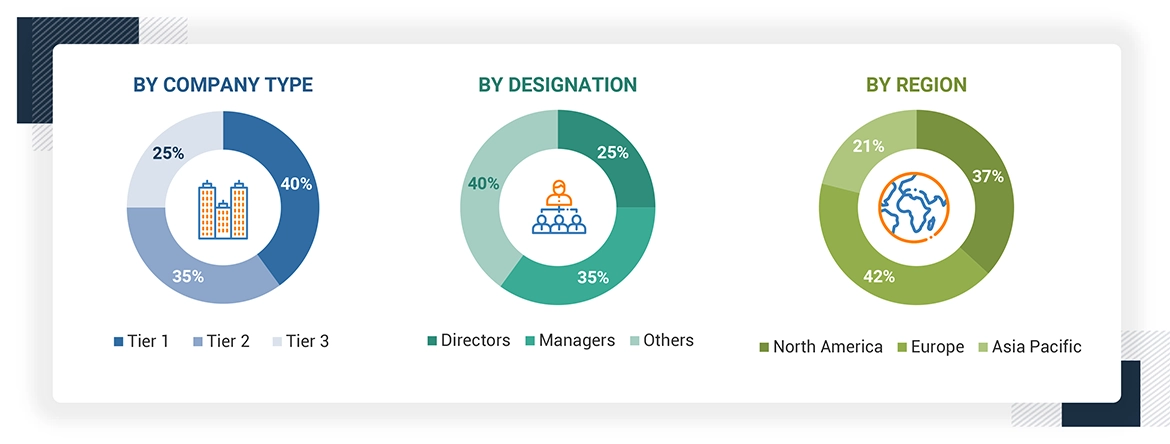
Note: Others include sales managers, marketing managers, and product managers.
To know about the assumptions considered for the study, download the pdf brochure
Market Size Estimation
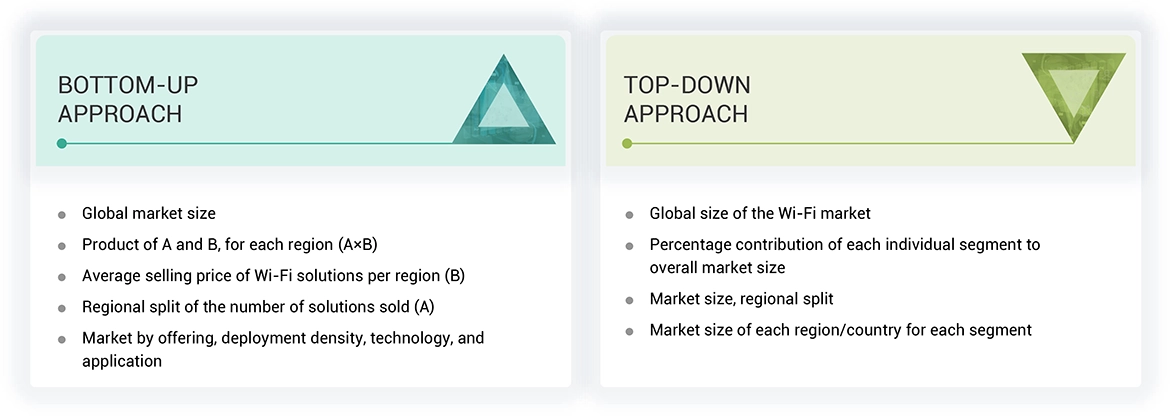
Multiple approaches were adopted to estimate and forecast the size of the Wi-Fi market. The first approach involves estimating market size by summing up the revenue generated by companies through the sale of Wi-Fi solutions and services.
Both top-down and bottom-up approaches were used to estimate and validate the total size of the Wi-Fi market. These methods were extensively used to estimate the size of various segments in the market. The research methodology used to estimate the market size includes the following:
- Key players in the market have been identified through extensive secondary research.
- In terms of value, the industry’s supply chain and market size have been determined through primary and secondary research processes.
- All percentage shares, splits, and breakups have been determined using secondary sources and verified through primary sources.
- After arriving at the overall market size, the Wi-Fi market was divided into several segments and subsegments.
Wi-Fi Market : Top-Down and Bottom-Up Approach
Data Triangulation
After arriving at the overall market size, the Wi-Fi market was divided into several segments and subsegments. The data was triangulated by studying various factors and trends from the demand and supply sides. Along with data triangulation and market breakdown, the market size was validated by the top-down and bottom-up approaches.
Market Definition
Wi-Fi is a wireless networking technology based on IEEE 802.11 standards, enabling devices to connect to the internet and each other without cables. It is widely used across homes, businesses, and industries for seamless data transfer and communication. Wi-Fi advancements like Wi-Fi 6 and 7 drive faster speeds, higher capacity, and improved connectivity.
Stakeholders
- Device Manufacturers
- Network Service Providers
- Internet Service Providers (ISPs)
- Cloud Service Providers
- Wi-Fi Standards Organizations (e.g., IEEE, Wi-Fi Alliance)
- Infrastructure Vendors
Report Objectives
- To determine, segment, and forecast the Wi-Fi market based on offering, deployment, technology, density, application, and region in terms of value.
- To forecast the segment’s size with respect to five regions: North America, Europe, Asia Pacific (Asia Pacific), Latin America, and the Middle East & Africa (Middle East & Africa)
- To provide detailed information about the major factors (drivers, restraints, opportunities, and challenges) influencing the market
- To study the complete value chain and related industry segments and perform a value chain analysis
- To strategically analyze macro and micro-markets concerning individual growth trends, prospects, and contributions to the market
- To analyze industry trends, regulatory landscape, and patents & innovations
- To analyze opportunities for stakeholders by identifying the high growth segments
- To track and analyze competitive developments, such as agreements, partnerships, collaborations, and R&D activities
Available Customizations
With the given market data, MarketsandMarkets offers customizations per the company’s specific needs. The following customization options are available for the report:
Country-wise information
- Analysis for additional countries (up to five)
Company Information
- Detailed analysis and profiling of additional market players (up to 5)
Get the Full Wi-Fi Market Report
Full forecast, segment splits, and company analysis for all Wi-Fi Market.
Need a Tailored Report?
Customize this report to your needs
Get 10% FREE Customization
Customize This Report
