
Brazil Glyceryl Glucoside Market (2026-2031)

The Brazil Glyceryl Glucoside Market was valued at $1.15 Million in 2026 and projected to reach to $1.5 Million by 2031, representing a compound annual growth rate of 5.5%. Brazil's glyceryl glucoside market is positioned for steady expansion through 2031, driven by rising consumer preference for natural and sustainable ingredients in cosmetics and food applications.


| Market Size in | USD 26.32 MN |
| Market Forecast in | |
| CAGR | |
| Forecast Period | |
| Units Considered | Value (USD MN) |
Brazil Glyceryl Glucoside Market Trends and Insights
- In 2026, Brazil's market was estimated at USD 1.15 million, reflecting steady demand for natural humectants and skin-conditioning agents in cosmetic and food applications.
- Brazil is expected to expand this market to USD 1.50 million by 2031, driven by increasing consumer preference for clean-label ingredients and sustainable sourcing practices across the region. The Brazilian market benefits from the country's robust cosmetics and personal care industry, which actively incorporates glyceryl glucoside in moisturizing formulations.
- Brazil's food and beverage manufacturers are also adopting glyceryl glucoside as a functional ingredient, supporting the projected 5.5% compound annual growth rate through 2031.
- This growth trajectory reflects Brazil's alignment with global trends toward plant-derived and multifunctional ingredients that meet both regulatory standards and consumer wellness expectations..
Key Market Statistics
- CAGR (2026-2031) 5.5% CAGR
- Market Size, 2026 ~USD 1.15 Million
- Forecast, 2031 ~USD 1.5 Million
- Country Brazil
Brazil Glyceryl Glucoside Market Overview
Market Valuation Growth :
Brazil's glyceryl glucoside market is projected to grow from USD 1.15 million in 2026 to USD 1.50 million by 2031, representing a compound annual growth rate of 5.5%, outpacing the global average of 5.2%.
Natural Ingredient Demand :
Brazilian consumers and manufacturers are increasingly adopting natural humectants and skin-conditioning agents, positioning glyceryl glucoside as a preferred ingredient in premium cosmetic and personal care formulations.
Dual Application Market :
The market benefits from dual demand streams in both food and beverage sectors and cosmetic applications, with growing interest in clean-label and naturally-derived ingredients across both industries in Brazil.
Latin American Hub Status :
Brazil serves as a key growth driver within Latin America's glyceryl glucoside market, leveraging its robust cosmetics industry and expanding food processing sector to capture regional market share.
Brazil Glyceryl Glucoside Market Dynamics
- The country's thriving beauty and personal care industry, combined with increasing regulatory support for natural formulations, creates favorable conditions for market growth.
- Local manufacturers are investing in R&D to develop innovative glyceryl glucoside-based products tailored to Brazilian consumer preferences. The forecast period will see accelerated adoption across premium cosmetic brands and functional food manufacturers seeking differentiation through natural ingredients.
- Growing middle-class consumption, coupled with heightened awareness of ingredient safety and sustainability, will further propel market expansion.
- Strategic partnerships between ingredient suppliers and local formulators are expected to enhance market penetration and drive the market toward the projected USD 1.50 million valuation by 2031..
Market Ecosystem
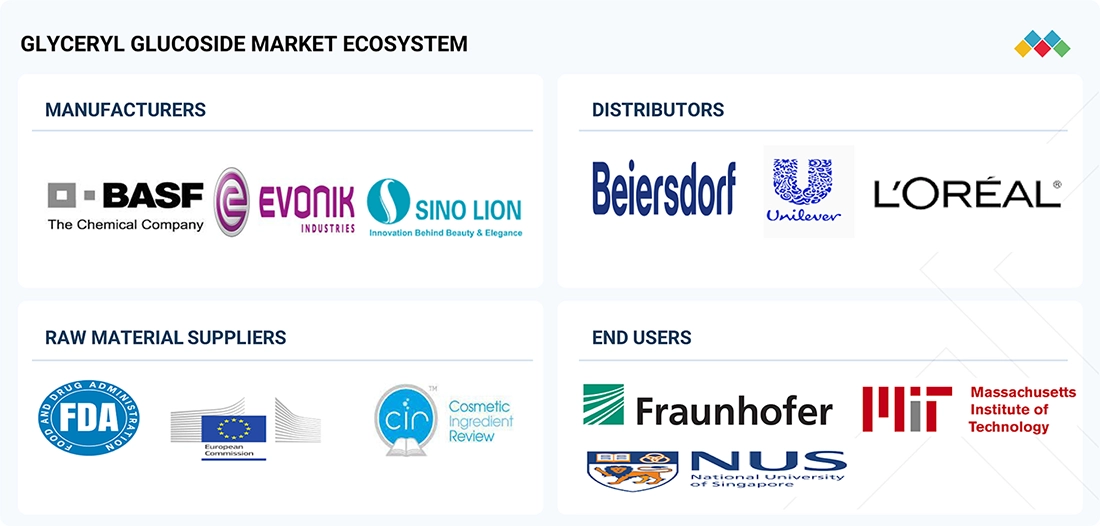
GLYCERYL GLUCOSIDE MARKET: COMMERCIAL USE CASES ACROSS INDUSTRIES
| COMPANY | USE CASE DESCRIPTION | BENEFITS |
|---|---|---|
 |
Utilizes glyceryl glucoside as a high-performance cosmetic active ingredient within its personal care portfolio, supplying to global skincare and haircare manufacturers for hydration-focused formulations | Strong global supply chain, ability to offer bio-based variants, extensive technical support & formulation expertise, and scalable production capacity for large clients |
 |
Develops glyceryl glucoside as part of advanced active systems (e.g., aquaporin-boosting ingredients) used in premium skincare and dermaceutical formulations | Enables premium positioning, supports clinically backed claims, delivers high-margin specialty ingredients, and provides innovation-driven differentiation for brands |
 |
Incorporates glyceryl glucoside in finished skincare products (e.g., moisturizers, serums) to enhance deep hydration and skin barrier performance | Achieves enhanced product efficacy, strengthens brand credibility, improves consumer satisfaction & loyalty, and supports dermatologically tested claims |
 |
Supplies glyceryl glucoside as a cost-effective functional ingredient to small and mid-sized cosmetic brands and contract manufacturers | Offers competitive pricing, flexible MOQ, easy formulation compatibility, and improves accessibility for emerging and indie brands |
Logos and trademarks shown above are the property of their respective owners. Their use here is for informational and illustrative purposes only.
Related Ecosystem
Fandb Ingredients
- Dairy Products
- Bakery Products
- Microorganism
- Polydextrose
- Carbohydrates
- AZELIS HOLDINGS SA
- Archer-Daniels-Midland Company
- Kerry Group plc
- Amway
- DSM FIRMMENICH
Key Takeaways
- Brazil's glyceryl glucoside market is valued at USD 1.15 million in 2026 and is forecast to grow to USD 1.50 million by 2031.
- Brazil demonstrates a 5.5% CAGR, outpacing the global average of 5.2%, indicating stronger regional demand momentum.
- Brazil's cosmetics and personal care sector is the primary driver, leveraging glyceryl glucoside's humectant and skin-conditioning properties.
- Brazil's clean-label and sustainability trends are accelerating adoption of plant-derived glyceryl glucoside across food, beverage, and cosmetic applications.
Glyceryl Glucoside Market Report Scope
| Report Metric | Details |
|---|---|
| Base Year | 2026 |
| Fastest Growing Segment | FORMULATED BLENDS & OTHERS (Form) |
| Forecast Period | 2026–2031 |
| Growth Rate | CAGR of 5.2% from 2026 to 2031 |
| Largest Segment | MONO-GLYCERYL GLUCOSIDES (Type) |
| Market Size Base Year (Billions) | ~USD 30.27 (2026) |
| Revenue Forecast (Billions) | ~USD 39 (2031) |
| Segments Covered | Type, Functionality, Source, Form, Concentration, End-Use Industry |
Brazil Glyceryl Glucoside Market Report Segmentation
6 segment dimensions are covered across the global market.
By Type
- Di-Glyceryl Glucosides
- Mixed Glycosides
- Mono-Glyceryl Glucosides
- Tri-Glyceryl/Higher Glycosides
By Functionality
- Emollients & Conditioning Agents
- Humectants & Moisturizing Agents
- Solubility & Compatibility Enhancers
- Texture, Stability, & Processing Aids
By Source
- Natural
- Synthetic
By Form
- Formulated Blends & Others
- Liquid Solutions
- Powder
By Concentration
- High (65–85%+)
- High-Concentration Grades (65–85%+)
- Low (<45%)
- Low-Concentration Grades (=45%)
- Mid-High (55–65%)
- Mid-High Concentration Grades (55–65%)
- Mid-Low (45–55%)
- Mid-Low Concentration Grades (45–55%)
By End-Use Industry
- Food & Beverages
- Industrial & Others
- Personal Care & Cosmetics
- Pharmaceuticals
BRAZIL: GLYCERYL GLUCOSIDE MARKET, BY END-USE INDUSTRY, 2026–2031
| Segment | 2026 | 2027 | 2028 | 2029 | 2030 | 2031 | CAGR (%) |
|---|---|---|---|---|---|---|---|
| FOOD & BEVERAGES | 0.2 | 0.21 | 0.22 | 0.23 | 0.25 | 0.26 | 5.7 |
| INDUSTRIAL & OTHERS | 0.06 | 0.06 | 0.06 | 0.07 | 0.07 | 0.07 | 4.3 |
| PERSONAL CARE & COSMETICS | 0.66 | 0.69 | 0.73 | 0.77 | 0.81 | 0.86 | 5.4 |
| PHARMACEUTICALS | 0.24 | 0.25 | 0.26 | 0.28 | 0.29 | 0.31 | 5.8 |
| TOTAL | 1.15 | 1.21 | 1.27 | 1.34 | 1.42 | 1.5 | 5.5 |
Target Audience
- Ingredient Suppliers & Manufacturers : Suppliers need Brazil-specific demand forecasts and application trends to optimize production capacity, plan distribution networks, and develop targeted marketing strategies for the growing Brazilian market.
- Cosmetics & Personal Care Brands : Local and international beauty brands require insights into Brazilian consumer preferences for natural ingredients and competitive positioning to develop compliant, market-winning formulations.
- Food & Beverage Processors : Food manufacturers need data on glyceryl glucoside adoption rates and regulatory acceptance in Brazil to evaluate ingredient viability for functional food and beverage product innovation.
- Market Entry & Investment Strategists : Business development teams and investors need Brazil market analysis to assess market attractiveness, growth potential, and risk factors for capital allocation and expansion decisions.
- Regulatory & Compliance Professionals : Compliance officers and regulatory affairs teams require Brazil-specific guidelines and market standards for glyceryl glucoside to ensure product approvals and market authorization.
Key Companies in the Brazil Glyceryl Glucoside Market
| Company | HQ | Ownership | Strongest segments |
|---|---|---|---|
| BASF SE | Germany | Public Company | Chemicals,Materials,Industrial Solutions, |
| EVONIK INDUSTRIES AG | Germany | Public Company | Advanced Technologies (silicas, silanes, methionine, hydrogen peroxide, polymers),Custom Solutions (additives for coatings, adhesives, sealants, PU foams, lubricants),Infrastructure (butadiene, MTBE, butene-1, isononanol, DINP), |
| SEEBIO BIOTECH (SHANGHAI) CO., LTD | China | Private Company | Diagnostic reagents and vaccine-related raw materials,Analytical and detection reagents,Research-use biochemicals and life science tools, |
| DKSH | Switzerland | Public Company | Healthcare,Consumer Goods,Performance Materials, |
BASF SE
BASF SE is a German public company founded in 1865 with 106,428 employees. As one of the world's largest chemical manufacturers, BASF operates globally across multiple chemical and materials sectors.
EVONIK INDUSTRIES AG
EVONIK INDUSTRIES AG is a German public company established in 1847 with 30,643 employees. The company is a leading specialty chemicals manufacturer serving diverse industrial markets worldwide.
SEEBIO BIOTECH (SHANGHAI) CO., LTD
SEEBIO BIOTECH (SHANGHAI) CO., LTD is a Chinese private biotechnology company founded in 2003.
DKSH
DKSH is a Swiss public company founded in 1865 with 24,942 employees. The company operates as a leading global provider of specialized services and solutions across multiple industries.
Reasons to Buy this Report
- Brazil-Specific Market Sizing : Access precise market valuations and forecasts exclusive to Brazil, enabling accurate budgeting and investment decisions for market entry or expansion strategies in this key Latin American economy.
- Competitive Positioning Intelligence : Understand Brazil's market dynamics relative to global trends, with insights into local consumer preferences and competitive landscape to identify differentiation opportunities in the glyceryl glucoside segment.
- Regulatory & Compliance Guidance : Gain clarity on Brazil-specific regulatory requirements for glyceryl glucoside in food and cosmetic applications, ensuring compliant product development and market-ready formulations.
- Growth Opportunity Identification : Identify high-potential application areas and customer segments within Brazil's cosmetics and food industries, with actionable insights to prioritize market development initiatives.
- Strategic Partnership Insights : Discover key local manufacturers, distributors, and formulators in Brazil's glyceryl glucoside ecosystem to inform partnership strategies and accelerate market penetration.
Frequently asked questions
What is the current market size of glyceryl glucoside in Brazil?
Brazil's glyceryl glucoside market was estimated at USD 1.15 million in 2026, based on verified market data.
What is the projected market size for glyceryl glucoside in Brazil by 2031?
Brazil's glyceryl glucoside market is forecast to reach USD 1.50 million by 2031, representing growth from the 2026 baseline.
What is the CAGR for glyceryl glucoside in Brazil?
Brazil's glyceryl glucoside market is projected to grow at a compound annual growth rate of 5.5% from 2026 to 2031.
Which industries drive glyceryl glucoside demand in Brazil?
Brazil's cosmetics and personal care industry is the primary driver, with growing adoption in food and beverage applications for clean-label formulations.
Why is Brazil's CAGR higher than the global average?
Brazil's 5.5% CAGR exceeds the global 5.2% rate due to strong regional demand from the cosmetics sector and increasing consumer preference for natural, sustainable ingredients.
RESEARCH METHODOLOGY
The study involved four major activities in estimating the current size of the glyceryl glucoside market. Exhaustive secondary research was done to collect information on the market, peer market, and parent market. The next step was to validate these findings, assumptions, and sizing with industry experts across the value chain through primary research. Both top-down and bottom-up approaches were employed to estimate the complete market size. After that, market breakdown and data triangulation were used to estimate the market size of segments and subsegments.
Secondary Research
This research study involved the extensive use of secondary sources, directories, and databases such as Bloomberg Businessweek and Factiva to identify and collect information useful for a technical, market-oriented, and commercial study of the glyceryl glucoside market.
In the secondary research process, various sources such as annual reports, press releases & investor presentations of companies, white papers, certified publications, articles from recognized authors, gold & silver standard websites, directories, and databases were referred to identify and collect information. This research study involved the extensive use of secondary sources, directories, and databases such as Bloomberg Businessweek and Factiva to identify and collect information useful for a technical, market-oriented, and commercial study of the glyceryl glucoside market.
Secondary research was mainly used to obtain key information about the industry’s supply chain, the total pool of key players, and market classification and segmentation as per the industry trends to the bottom-most level, regional markets, and key developments from both market- and technology-oriented perspectives.
Primary Research
Extensive primary research was conducted after obtaining information regarding the glyceryl glucoside market scenario through secondary research. Several primary interviews were conducted with market experts from both the demand and supply sides across major countries of North America, Europe, the Asia Pacific, South America, and the RoW. Primary data was collected through questionnaires, emails, and telephonic interviews. The primary sources from the supply side included various industry experts, such as Chief X Officers (CXOs), Vice Presidents (VPs), Directors from business development, marketing, research, and development teams, and key opinion leaders. Primary interviews were conducted to gather insights, including market statistics, revenue data from products and services, market breakdowns, market size estimates, market forecasts, and data triangulation. Primary research also helped in understanding the various trends related to glyceryl glucosides, core material, shell material, method, technology, and application. Stakeholders from the demand side, such as research institutions and universities, and third-party vendors, were interviewed to understand the buyer’s perspective on the service, and their current usage of encapsulation and the outlook of their business, which will affect the overall market.
To know about the assumptions considered for the study, download the pdf brochure
|
COMPANY NAME |
DESIGNATION |
|
BASF SE (Germany) |
R&D Expert |
|
Evonik Industries AG (Germany) |
Sales Manager |
|
YR Chemspec (China) |
Manager |
|
Beiersdorf AG (Germany) |
Sales Manager |
|
Puri Pharma (China) |
Marketing Manager |
Market Size Estimation
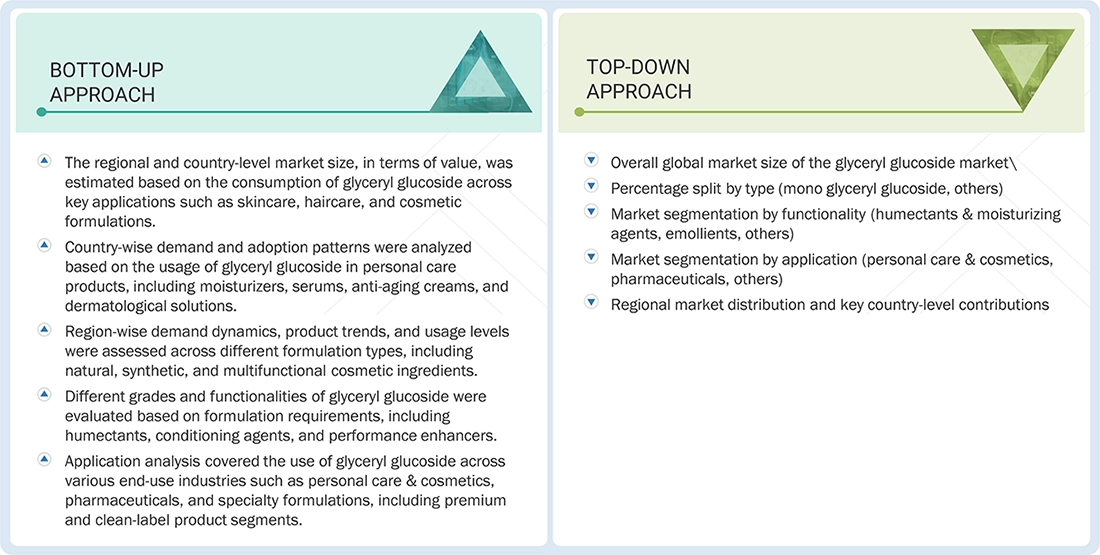
Both the top-down and bottom-up approaches were used to estimate and validate the total size of the glyceryl glucoside market. These approaches were also used extensively to determine the size of various subsegments in the market. The research methodology used to estimate the market size includes the following details:
- The key players in the industry and the overall markets were identified through extensive secondary research.
- All shares, splits, and breakdowns were determined using secondary sources and verified through primary sources.
- All possible parameters that affect the market covered in this research study were accounted for, viewed in extensive detail, verified through primary research, and analyzed to obtain final quantitative and qualitative data.
- The research included the study of reports, reviews, and newsletters of top market players, along with extensive interviews for opinions from leaders, such as CEOs, directors, and marketing executives.
Glyceryl Glucoside Market : Top-Down and Bottom-Up Approach
Data Triangulation
After arriving at the overall market size from the estimation process explained above, the total market was split into several segments and subsegments. Data triangulation and market breakdown procedures were employed, wherever applicable, to estimate the overall glyceryl glucoside market and arrive at the exact statistics for all segments and subsegments. The data was triangulated by studying various factors and trends from the demand and supply sides. Along with this, the market size was validated using both the top-down and bottom-up approaches.
Market Definition
Glyceryl glucoside is a bio-based compound known for its excellent humectant and skin-conditioning properties, enabling effective moisture retention, improved skin hydration, and enhanced barrier function. It plays a critical role in modern skincare and haircare products by supporting long-lasting hydration and improving overall product performance. The ingredient is widely utilized in formulations such as creams, lotions, serums, and cleansers, contributing to better efficacy and consumer appeal. Its compatibility with a wide range of cosmetic ingredients and alignment with clean-label and sustainable trends further enhance its importance in the market. Glyceryl glucoside supports the development of premium, dermatologically tested, and multifunctional products, which are increasingly in demand across global markets.
Key Stakeholders
- Raw material suppliers and manufacturers
- Key manufacturers of glyceryl glucoside
- Distributors, traders, and suppliers of cosmetic ingredients across global and regional markets
- Importers and exporters
- Regulatory bodies:
- The United States Department of Agriculture (USDA)
- Food and Agriculture Organization (FAO)
- European Commission (EC)
- Commercial research & development (R&D) institutions and financial institutions
- Contract manufacturers and formulation laboratories supporting product development and testing
- Financial institutions and investors supporting expansion, innovation, and production capacity in the personal care ingredients sector
- Associations:
- U.S. Food and Drug Administration (FDA)
- Society of Cosmetic Chemists
- The Organization for Economic Co-operation and Development (OECD)
Report Objectives
- Determining and projecting the size of the glyceryl glucoside market with respect to type, functionality, end-use industry, form, source, concentration/active content
- Identifying the attractive opportunities in the market by determining the largest and fastest-growing segments
- Providing detailed information about the key factors influencing market growth (drivers, restraints, opportunities, and industry-specific challenges)
- Providing the regulatory framework and market entry process related to the glyceryl glucoside market
- Analyzing the micro markets with respect to individual growth trends, prospects, and their contribution to the total market
Available customizations:
With the given market data, MarketsandMarkets offers customizations according to company-specific scientific needs.
The following customization options are available for the report:
Product Analysis
- Products Matrix, which gives a detailed comparison of the service portfolio of each company.
Regional Analysis
With the given market data, MarketsandMarkets offers customizations according to company-specific scientific needs.
- Further breakdown of the Rest of Europe Glyceryl Glucoside Market into key countries.
- Further breakdown of the Rest of South America Glyceryl Glucoside Market into key countries.
- Further breakdown of the Rest of Asia Pacific Glyceryl Glucoside Market into key countries.
Company Information
- Detailed analyses and profiling of additional market players (up to five)
Get the Full Glyceryl Glucoside Market Report
Full forecast, segment splits, and company analysis for all Glyceryl Glucoside Market.
- US Glyceryl Glucoside Market
- Canada Glyceryl Glucoside Market
- Mexico Glyceryl Glucoside Market
- Germany Glyceryl Glucoside Market
- France Glyceryl Glucoside Market
- UK Glyceryl Glucoside Market
- Italy Glyceryl Glucoside Market
- Spain Glyceryl Glucoside Market
- China Glyceryl Glucoside Market
- India Glyceryl Glucoside Market
- Japan Glyceryl Glucoside Market
- South Korea Glyceryl Glucoside Market
- Indonesia Glyceryl Glucoside Market
- Thailand Glyceryl Glucoside Market
- Malaysia Glyceryl Glucoside Market
- Vietnam Glyceryl Glucoside Market
- Philippines Glyceryl Glucoside Market
- Singapore Glyceryl Glucoside Market
- Argentina Glyceryl Glucoside Market
- Rest Of Europe Glyceryl Glucoside Market
- Rest Of Asia Pacific Glyceryl Glucoside Market
Need a Tailored Report?
Customize this report to your needs
Get 10% FREE Customization
Customize This Report
