
Spain Hardware in the Loop Market (2025-2030)

The Spain Hardware in the Loop Market was valued at $21.4 Million in 2025 and projected to reach to $32 Million by 2030, representing a compound annual growth rate of 8.4%. Spain's Hardware in the Loop market is poised for sustained growth driven by the country's robust automotive manufacturing base and increasing digitalization across industrial sectors.


| Market Size in | USD 26.32 MN |
| Market Forecast in | |
| CAGR | |
| Forecast Period | |
| Units Considered | Value (USD MN) |
Spain Hardware in the Loop Market Trends and Insights
- This growth trajectory reflects Spain's increasing adoption of simulation and testing technologies across automotive, aerospace, and industrial sectors.
- Spain is positioning itself as a key player in European hardware-in-the-loop solutions, driven by investments in R&D and digital transformation initiatives. The expansion of Spain's Hardware in the Loop market is supported by rising demand for advanced testing methodologies and the country's strong manufacturing base.
- Spain's automotive and industrial sectors are leveraging hardware-in-the-loop technology to enhance product development cycles and reduce time-to-market.
- Between 2025 and 2030, Spain is expected to see accelerated adoption as companies prioritize validation and verification processes in embedded systems development. Spain's market growth is underpinned by regional regulatory compliance requirements and the need for cost-effective testing solutions.
- The country's participation in European supply chains and technology partnerships further strengthens the Hardware in the Loop market outlook through 2030..
Key Market Statistics
- CAGR (2025-2030) 8.4% CAGR
- Market Size, 2025 ~USD 21.4 Million
- Forecast, 2030 ~USD 32 Million
- Country Spain
Spain Hardware in the Loop Market Overview
Market Size & Growth :
Spain's Hardware in the Loop market is valued at USD 21.4 million in 2025, with projected growth to USD 32.0 million by 2030, demonstrating an 8.4% CAGR that reflects strong regional demand for advanced testing solutions.
Automotive Sector Leadership :
Spain's automotive industry, a cornerstone of its economy, is driving significant HIL adoption for vehicle testing, validation, and compliance with European safety standards, positioning the country as a critical hub for automotive simulation technologies.
European Integration :
Spain's strategic location within the European market enables it to leverage cross-border partnerships and access to EU funding initiatives, accelerating the adoption of Hardware in the Loop technologies across multiple industrial verticals.
Aerospace & Industrial Expansion :
Beyond automotive, Spain's aerospace and industrial manufacturing sectors are increasingly investing in HIL systems for product development and quality assurance, diversifying the market beyond traditional automotive applications.
Spain Hardware in the Loop Market Dynamics
- The 8.4% CAGR through 2030 reflects Spain's commitment to advanced simulation technologies and compliance with stringent European regulatory standards.
- Investment in R&D infrastructure and government support for Industry 4.0 initiatives are accelerating HIL adoption among Spanish manufacturers. The market outlook remains positive as Spanish companies increasingly recognize the cost-efficiency and risk-reduction benefits of Hardware in the Loop testing.
- Collaboration with European technology leaders and integration with IoT and AI-driven solutions are expected to unlock new growth opportunities.
- Spain's position as a manufacturing hub within the EU positions it favorably to capture expanding demand for sophisticated testing and validation solutions across automotive, aerospace, and industrial automation sectors..
Market Ecosystem
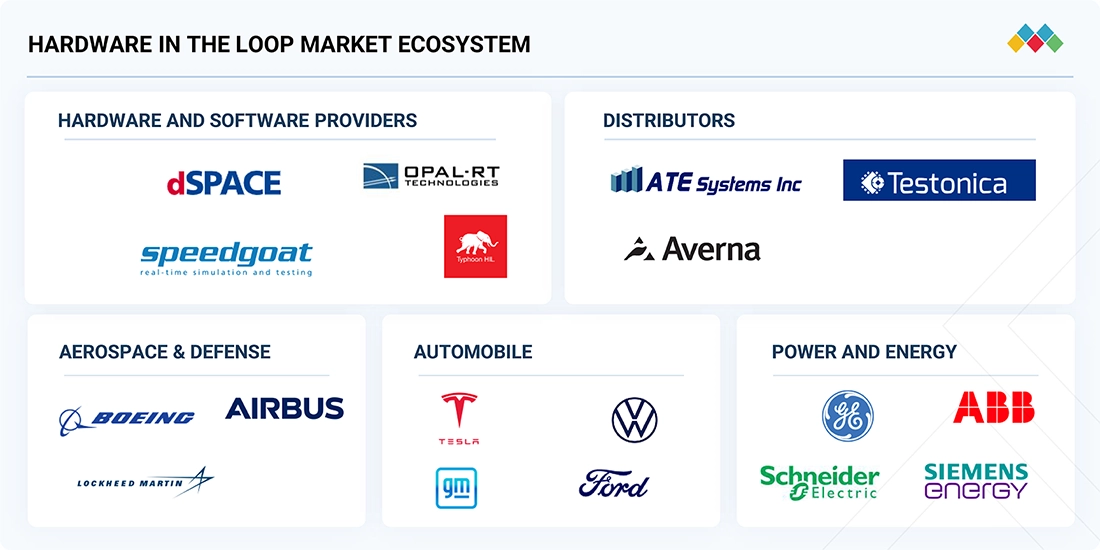
Hardware in the Loop Market Trends: COMMERCIAL USE CASES ACROSS INDUSTRIES
| COMPANY | USE CASE DESCRIPTION | BENEFITS |
|---|---|---|
 |
Simulation and validation platforms for automotive, aerospace, and industrial automation | Accelerates controller software testing, enables early fault detection, reduces development time |
 |
Modular HIL systems for embedded controller development in automotive (including EVs), aerospace, and energy | Shortens prototype cycles, increases test coverage, lowers costs, improves innovation speed |
 |
Power electronics and grid HIL solutions for energy and utilities | Real-time fault injection, safer equipment validation, robust compliance and risk reduction |
 |
HIL for automotive ECU, ADAS, and sensor simulation | Enhanced reliability of advanced driver-assistance systems, efficient failure mode exploration |
Logos and trademarks shown above are the property of their respective owners. Their use here is for informational and illustrative purposes only.
Related Ecosystem
Testing Inspection And Certification
- Eddy Current Testing (ECT)
- Safety Testing
- Signal Generators
- Acoustic Emission Testing (AET)
- Automated Test Equipment
- Sgs s.a.
- Intertek Group plc
- Bureau veritas s.a.
- TUV RHEINLAND AG
- EUROFINS SCIENTIFIC SE
Key Takeaways
- Spain's Hardware in the Loop market is valued at USD 21.4 million in 2025 and will reach USD 32.0 million by 2030, growing at 8.4% CAGR.
- Spain's automotive and industrial sectors are primary drivers of Hardware in the Loop adoption for advanced product validation.
- Spain benefits from strong European supply chain integration and regulatory frameworks supporting simulation-based testing.
- Investment in R&D and digital transformation initiatives positions Spain as a competitive hub for Hardware in the Loop solutions in Europe.
Hardware in the Loop Market Report Scope
| Report Metric | Details |
|---|---|
| Base Year | 2025 |
| Fastest Growing Segment | POWER ELECTRONICS (Vertical) |
| Forecast Period | 2025–2030 |
| Growth Rate | CAGR of 10.1% from 2025 to 2030 |
| Largest Segment | OPEN LOOP (Type) |
| Market Size Base Year (Billions) | ~USD 1.1 (2025) |
| Revenue Forecast (Billions) | ~USD 1.78 (2030) |
| Segments Covered | Offering, Type, Vertical |
Spain Hardware in the Loop Market Report Segmentation
3 segment dimensions are covered across the global market.
By Offering
- Hardware
- Services
- Software
By Type
- Closed Loop
- Consulting And System Design
- Maintenance And Support
- Open Loop
- System Integration
By Vertical
- Aerospace
- Automobile
- Defense
- Other Verticals
- Power Electronics
- Renewable Energy
- Research & Education
SPAIN: HARDWARE IN THE LOOP MARKET, BY VERTICAL, 2025–2030
| Segment | 2025 | 2026 | 2027 | 2028 | 2029 | 2030 | CAGR (%) |
|---|---|---|---|---|---|---|---|
| AEROSPACE | 4.45 | 4.76 | 5.08 | 5.43 | 5.81 | 6.2 | 6.9 |
| AUTOMOBILE | 10.64 | 11.71 | 12.89 | 14.21 | 15.67 | 17.29 | 10.2 |
| DEFENSE | 1.37 | 1.43 | 1.5 | 1.56 | 1.63 | 1.71 | 4.5 |
| OTHER VERTICALS | 0.7 | 0.72 | 0.74 | 0.75 | 0.75 | 0.74 | 1 |
| POWER ELECTRONICS | 2.17 | 2.36 | 2.57 | 2.8 | 3.05 | 3.33 | 9 |
| RENEWABLE ENERGY | 0.82 | 0.89 | 0.96 | 1.04 | 1.13 | 1.22 | 8.2 |
| RESEARCH & EDUCATION | 1.2 | 1.25 | 1.31 | 1.37 | 1.44 | 1.5 | 4.7 |
| TOTAL | 21.35 | 23.12 | 25.05 | 27.16 | 29.47 | 31.99 | 8.4 |
Target Audience
- Automotive Manufacturers : Spanish and international automotive OEMs and suppliers need detailed market data to optimize their HIL testing investments, accelerate product development cycles, and ensure compliance with European safety standards.
- Aerospace & Defense Companies : Aerospace firms operating in Spain require market insights to understand HIL adoption trends, identify partnership opportunities, and plan technology investments for advanced simulation and validation capabilities.
- Technology & Software Providers : HIL software and hardware solution vendors need Spain-specific market intelligence to identify customer segments, assess competitive positioning, and develop localized go-to-market strategies.
- Industrial Equipment Manufacturers : Spanish industrial automation and equipment manufacturers need market data to understand HIL adoption drivers and identify opportunities to integrate advanced testing solutions into their product portfolios.
- Investment & Consulting Firms : Private equity, venture capital, and management consulting firms require accurate market forecasts and growth analysis to evaluate investment opportunities and advise clients on market expansion in Spain.
Key Companies in the Spain Hardware in the Loop Market
| Company | HQ | Ownership | Strongest segments |
|---|---|---|---|
| ADVANTEST CORPORATION | Japan | Public Company | SoC automated test equipment,Memory and SSD test systems,Handlers, device interface, and interconnect solutions, |
| LENOVO | China | ||
| EMERSON ELECTRIC CO. | United States |
ADVANTEST CORPORATION
Advantest Corporation is a Japanese public company founded in 1946 that employs 7,241 people. The company operates as a major provider of semiconductor testing and measurement solutions.
LENOVO
Lenovo is a Chinese technology company that designs, manufactures, and sells personal computers, smartphones, and enterprise solutions globally.
EMERSON ELECTRIC CO.
Emerson Electric Co. is a United States-based company that provides engineering solutions and technology services across industrial, climate, and energy sectors.
Reasons to Buy this Report
- Localized Market Intelligence : Gain deep insights into Spain-specific market dynamics, regulatory drivers, and competitive landscape that directly impact your business strategy and market entry decisions in this key European market.
- Growth Opportunity Identification : Identify high-potential segments within Spain's automotive, aerospace, and industrial sectors where Hardware in the Loop adoption is accelerating, enabling targeted investment and partnership opportunities.
- Competitive Positioning : Understand Spain's market structure, key players, and technology trends to benchmark your offerings and develop competitive strategies tailored to Spanish customer requirements and preferences.
- Regulatory & Compliance Insights : Access critical information on European and Spanish regulatory requirements driving HIL adoption, ensuring your products and solutions meet local compliance standards and market expectations.
- Investment & Expansion Planning : Leverage accurate market forecasts and growth projections through 2030 to make informed decisions on resource allocation, facility expansion, and go-to-market strategies in Spain.
Frequently asked questions
What is the current size of Spain's Hardware in the Loop market?
Spain's Hardware in the Loop market is estimated at USD 21.4 million in 2025.
What is the projected market size for Spain's Hardware in the Loop market by 2030?
Spain's Hardware in the Loop market is projected to reach USD 32.0 million by 2030.
What is the growth rate of Spain's Hardware in the Loop market?
Spain's Hardware in the Loop market is expected to grow at a compound annual growth rate of 8.4% from 2025 to 2030.
Which industries are driving Hardware in the Loop adoption in Spain?
Spain's automotive, aerospace, and industrial sectors are the primary drivers of Hardware in the Loop technology adoption.
What factors support Hardware in the Loop market growth in Spain?
Spain's market growth is supported by regulatory compliance requirements, strong manufacturing capabilities, European supply chain integration, and increased R&D investments in digital transformation.
RESEARCH METHODOLOGY
This research study involved the extensive use of secondary sources, directories, and databases such as Hoovers, Bloomberg, Businessweek, Factiva, and OneSource, to identify and collect information useful for a technical, market-oriented, and commercial study of the hardware in the loop market. Primary sources were several experts from core and related industries and preferred suppliers, manufacturers, distributors, service providers, technology developers, and organizations related to all the segments of the value chain of the hardware in the loop ecosystem.
In-depth interviews with various primary respondents, such as key industry participants, subject matter experts (SMEs), C-level executives of key market players, and industry consultants, among other experts, were conducted to obtain and verify critical qualitative and quantitative information and assess future market prospects.
Secondary Research
Secondary sources referred to for this research study included corporate filings (such as annual reports, investor presentations, and financial statements); trade, business, and professional associations; white papers; certified publications; articles by recognized authors; directories; and databases. Secondary data was collected and analyzed to arrive at the overall market size, which was further validated through primary research.
Primary Research
Extensive primary research was conducted after gaining knowledge about the current scenario of the hardware in the loop market through secondary research. Several primary interviews were conducted with experts from both the demand and supply sides across four major regions: North America, Europe, Asia Pacific, and RoW. This primary data was collected through questionnaires, emails, and telephone interviews.
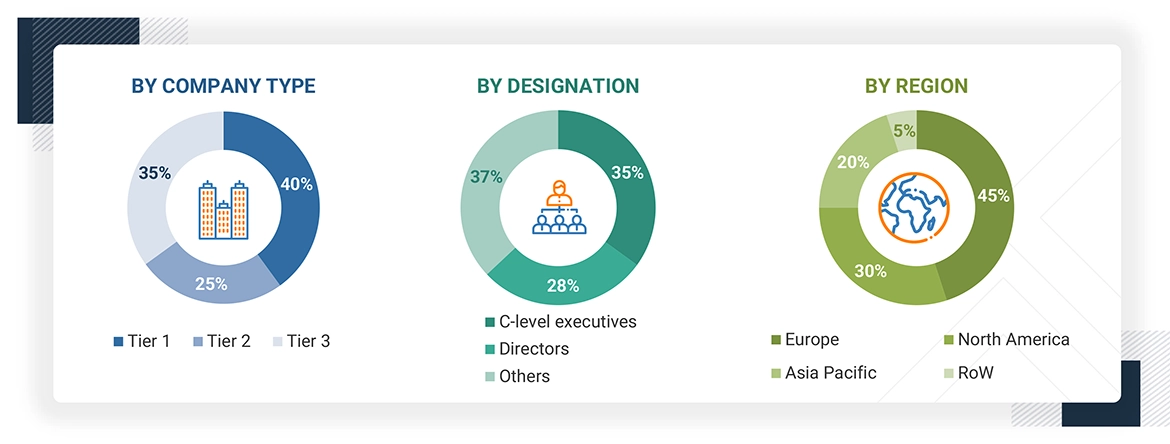
Note: Other designations include sales managers, marketing managers, and product managers.
The three tiers of the companies have been defined based on their total revenue as of 2024; tier 1: revenue greater than USD 1 billion; tier 2: revenue between USD 500 million and USD 1 billion; and tier 3: revenue less than USD 500 million.
To know about the assumptions considered for the study, download the pdf brochure
Market Size Estimation
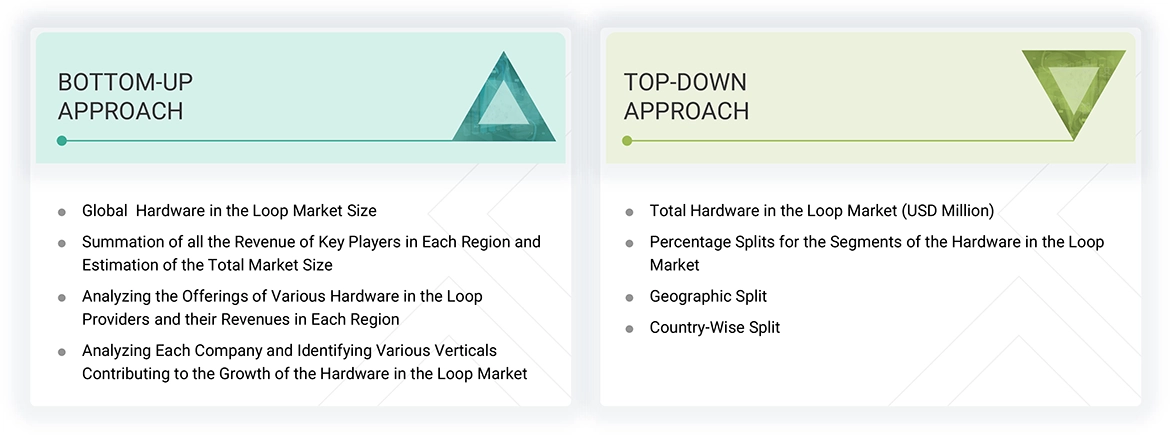
Both the top-down and bottom-up approaches were used to estimate and validate the size of the hardware in the loop market and its various dependent submarkets.
Hardware in the Loop Market : Top-Down and Bottom-Up Approach
Data Triangulation
After arriving at the overall market size using the market size estimation processes explained above, the market was split into several segments and subsegments. The data triangulation and market breakup procedures were employed, wherever applicable, to complete the overall market engineering process and arrive at the exact statistics of each market segment and subsegment. The data was triangulated by studying various factors and trends from both the demand and supply sides.
Market Definition
Hardware in the loop (HIL) is a hardware simulation/emulation technology used to virtually emulate a plant under control. This virtual environment is later connected to an electronic control unit (ECU) to observe the real-time performance of the ECU without even connecting to the physical plant. This report covers various verticals of hardware in the loop systems, such as aerospace, defense, automotive, power electronics, renewable energy, and research & education.
Key Stakeholders
- End users of hardware in the loop
- Hardware in the loop solution providers
- Technology providers
- Research organizations and consulting companies
- Venture capitalists, private equity firms, and start-ups
- Research organizations and consulting companies
- Technology standard organizations, forums, alliances, and associations
Report Objectives
- To define and forecast the hardware in the loop market size by type and vertical in terms of value
- To describe and forecast the market for four key regions: North America, Europe, Asia Pacific, and Rest of the World (RoW), along with their respective countries
- To provide detailed information regarding the significant drivers, restraints, opportunities, and challenges influencing the market growth
- To strategically analyze micromarkets1 with respect to individual growth trends, prospects, and contributions to the overall market
- To study the complete value chain of the hardware in the loop market
- To analyze opportunities in the market for stakeholders by identifying high-growth segments of the hardware in the loop ecosystem
- To strategically profile key players and comprehensively analyze their market position in terms of ranking and core competencies2 and provide details of the competitive landscape
- To analyze strategic approaches such as product launches, collaborations, contracts, acquisitions, agreements, expansions, and partnerships in the hardware in the loop market
Available Customizations
With the given market data, MarketsandMarkets offers customizations according to the specific requirements of companies. The following customization options are available for the report:
Company Information
- Detailed analysis and profiling of additional market players
Get the Full Hardware in the Loop Market Report
Full forecast, segment splits, and company analysis for all Hardware in the Loop Market.
- US Hardware in the Loop Market
- Canada Hardware in the Loop Market
- Mexico Hardware in the Loop Market
- UK Hardware in the Loop Market
- Germany Hardware in the Loop Market
- France Hardware in the Loop Market
- Italy Hardware in the Loop Market
- Poland Hardware in the Loop Market
- China Hardware in the Loop Market
- India Hardware in the Loop Market
- Japan Hardware in the Loop Market
- South Korea Hardware in the Loop Market
- Indonesia Hardware in the Loop Market
- Australia Hardware in the Loop Market
- Malaysia Hardware in the Loop Market
- Thailand Hardware in the Loop Market
- Vietnam Hardware in the Loop Market
- Nordics Hardware in the Loop Market
- Rest Of Europe Hardware in the Loop Market
- Rest Of Asia Pacific Hardware in the Loop Market
Need a Tailored Report?
Customize this report to your needs
Get 10% FREE Customization
Customize This Report
