
Canada Healthcare Indoor Location Market (2026-2031)

The Canada Healthcare Indoor Location Market was valued at $381.33 Million in 2026 and projected to reach to $1617.57 Million by 2031, representing a compound annual growth rate of 27.2%. Canada's healthcare indoor location market is poised for exceptional growth through 2031, driven by increasing digitalization of healthcare facilities and rising demand for operational efficiency.


| Market Size in | USD 26.32 MN |
| Market Forecast in | |
| CAGR | |
| Forecast Period | |
| Units Considered | Value (USD MN) |
Canada Healthcare Indoor Location Market Trends and Insights
- This represents a compound annual growth rate of 27.2%, reflecting strong adoption of location-based technologies across Canadian healthcare facilities.
- Canada's market growth is driven by increasing demand for real-time asset tracking, patient flow optimization, and operational efficiency in hospitals and clinics. The Canadian healthcare sector is leveraging indoor positioning systems to enhance patient safety, streamline staff workflows, and improve emergency response capabilities.
- Between 2026 and 2031, Canada is expected to see accelerated deployment of these technologies as healthcare providers invest in digital infrastructure and patient-centric solutions.
- Canada's regulatory environment and emphasis on healthcare innovation position the country as a key growth market within North America's broader healthcare indoor location ecosystem..
Key Market Statistics
- CAGR (2026-2031) 27.2% CAGR
- Market Size, 2026 ~USD 381.33 Million
- Forecast, 2031 ~USD 1617.57 Million
- Country Canada
Canada Healthcare Indoor Location Market Overview
Market Valuation Growth :
Canada's healthcare indoor location market is valued at $381.33 million in 2026 and is projected to reach $1,617.57 million by 2031, representing a 324% increase over the five-year forecast period.
Strong CAGR Performance :
Canada's market is expanding at a 27.2% CAGR from 2026 to 2031, slightly outpacing the global average of 27.8%, indicating robust regional adoption and investment in location-based healthcare technologies.
Real-Time Asset Tracking Adoption :
Canadian healthcare facilities are increasingly implementing real-time asset tracking solutions to optimize equipment management, reduce operational costs, and improve patient care delivery across hospitals and clinics.
Regulatory Support & Infrastructure :
Canada's advanced healthcare infrastructure, coupled with supportive regulatory frameworks and digital health initiatives, creates a favorable environment for indoor location technology deployment across the nation's healthcare sector.
Canada Healthcare Indoor Location Market Dynamics
- Canadian hospitals and medical centers are prioritizing real-time asset tracking, patient flow optimization, and staff management solutions to enhance care quality and reduce costs.
- The market's 27.2% CAGR reflects strong institutional investment in location-based technologies and growing awareness of their clinical and operational benefits. Looking ahead, Canada's market will be shaped by advancing wireless infrastructure, integration with electronic health records systems, and regulatory emphasis on patient safety and data security.
- Provincial healthcare systems are increasingly adopting indoor positioning technologies to streamline workflows and improve resource allocation.
- Strategic partnerships between technology providers and Canadian healthcare institutions will accelerate market penetration, positioning Canada as a key growth market within North America's healthcare technology landscape..
Market Ecosystem

HEALTHCARE INDOOR LOCATION MARKET: COMMERCIAL USE CASES ACROSS INDUSTRIES
| COMPANY | USE CASE DESCRIPTION | BENEFITS |
|---|---|---|
 |
Zebra deployed its MotionWorks RTLS solution at Hull University Teaching Hospitals NHS Trust to track and trace medical equipment across its two clinical campuses. The deployment uses RFID to provide visibility of equipment and support inventory and operational workflows. The Trust has labelled more than 72,000 assets and continues to track sterile trays across its facilities. | Real-time asset visibility | Reduced equipment search time | Improved asset utilization | Better operational efficiency |
 |
RWJBarnabas Health deployed Securitas Healthcare's RTLS across seven hospitals to improve visibility of medical assets and support operational workflows. The solution enables healthcare teams to locate and manage tagged assets through the RTLS platform, supporting clinicians, biomedical teams, and other hospital stakeholders. | Improved asset utilization | Reduced unnecessary purchases | Enhanced operational efficiency | Improved patient and staff safety |
 |
Kontakt.io deployed location-aware BLE smart badges across Northeast Georgia Health System to protect healthcare staff. The badges enable employees to send silent duress alerts, with their location transmitted in real time to security and designated responders. NGHS deployed the solution for approximately 10,000 staff members, with the platform also supporting expansion into other clinical and operational workflows. | Faster emergency response | Improved staff safety | Real-time staff visibility | Automated security workflows |
Logos and trademarks shown above are the property of their respective owners. Their use here is for informational and illustrative purposes only.
Related Ecosystem
Key Takeaways
- Canada's healthcare indoor location market will grow from $381.33M (2026) to $1,617.57M (2031) at a 27.2% CAGR.
- Canadian healthcare facilities are increasingly adopting real-time asset tracking and patient flow optimization technologies.
- Canada's regulatory framework and healthcare investment priorities support accelerated market expansion through 2031.
- Indoor positioning systems in Canada enhance patient safety, operational efficiency, and emergency response capabilities.
Healthcare Indoor Location Market Report Scope
| Report Metric | Details |
|---|---|
| Base Year | 2026 |
| Fastest Growing Segment | ACCESS CONTROL & SECURITY (Application) |
| Forecast Period | 2026-2031 |
| Growth Rate | CAGR of 27.8% from 2026 to 2031 |
| Largest Segment | HOSPITALS & HEALTHCARE FACILITIES (Facility Type) |
| Market Size Base Year (Billions) | ~USD 3.17 (2026) |
| Revenue Forecast (Billions) | ~USD 10.82 (2031) |
| Segments Covered | Offering, Hardware, Type, Technology, Application, Facility Type, Service |
Canada Healthcare Indoor Location Market Report Segmentation
7 segment dimensions are covered across the global market.
By Offering
- Hardware
- Services
- Software
By Hardware
- Other Hardware
- Readers/Trackers /Access Point
- Readers/Trackers/Access Point
- Tags/Badges
By Type
- Consulting
- Deployment & Integration
- Support & Maintenance
By Technology
- Ble
- Infrared
- Other Technologies
- Rfid
- Ultrasound
- Uwb
- Wi-Fi
By Application
- Access Control & Security
- Environmental Monitoring
- Inventory/Asset Tracking & Management
- Other Applications
- Personnel Locating & Monitoring
- Supply Chain Management & Automation
By Facility Type
- Hospitals & Healthcare Facilities
- Senior Living Facilities
By Service
- Consulting
- Deployment & Integration
- Support & Maintenance
Target Audience
- Healthcare IT Directors : Canadian hospital and clinic IT leaders need market data to justify technology investments, evaluate vendor solutions, and plan digital transformation initiatives aligned with provincial healthcare priorities and budgets.
- Medical Device Manufacturers : Device makers targeting Canada require market sizing, growth forecasts, and adoption trends to develop go-to-market strategies, establish distribution partnerships, and position products for Canadian healthcare procurement processes.
- Healthcare Consultants : Consulting firms advising Canadian healthcare organizations need comprehensive market intelligence to recommend location-based solutions, benchmark against industry standards, and support operational efficiency initiatives.
- Technology Solution Providers : Software and IoT companies entering Canada's healthcare market need localized market data, competitive insights, and adoption forecasts to identify opportunities, refine positioning, and accelerate market penetration.
- Healthcare Investors & Venture Capital : Investment firms evaluating Canadian healthcare technology opportunities require detailed market analysis, growth projections, and sector dynamics to assess portfolio companies and identify high-potential investment targets.
Reasons to Buy this Report
- Market Size & Growth Validation : Comprehensive data validating Canada's market expansion from $381.33M to $1,617.57M, enabling accurate financial forecasting and investment decision-making for healthcare technology initiatives across Canadian provinces.
- Competitive Landscape Intelligence : Detailed insights into Canadian market dynamics, key players, and competitive positioning specific to Canada's healthcare sector, helping organizations identify partnership and expansion opportunities within the region.
- Technology Adoption Trends : In-depth analysis of real-time asset tracking, patient monitoring, and staff management technology adoption patterns specific to Canadian healthcare facilities, informing product development and market entry strategies.
- Regulatory & Infrastructure Context : Canada-specific regulatory environment, healthcare system structure, and digital health policy insights that directly impact indoor location technology implementation and market growth trajectories.
- Strategic Planning & ROI Projections : Actionable market forecasts and growth drivers specific to Canada enabling stakeholders to develop targeted strategies, allocate resources effectively, and project return on investment for healthcare location solutions.
Frequently asked questions
What is the current size of Canada's healthcare indoor location market?
Canada's healthcare indoor location market is valued at $381.33 million in 2026 and is projected to grow to $1,617.57 million by 2031.
What is the expected growth rate for Canada's healthcare indoor location market?
Canada's healthcare indoor location market is expected to grow at a compound annual growth rate (CAGR) of 27.2% from 2026 to 2031.
What are the primary drivers of growth in Canada's healthcare indoor location market?
Key drivers include increasing demand for real-time asset tracking, patient flow optimization, operational efficiency improvements, and enhanced patient safety across Canadian healthcare facilities.
How are Canadian healthcare providers using indoor location technology?
Canadian healthcare providers are deploying indoor positioning systems for real-time asset tracking, staff workflow optimization, patient safety monitoring, and emergency response coordination.
What factors support Canada's healthcare indoor location market expansion through 2031?
Canada's supportive regulatory environment, healthcare sector investment priorities, emphasis on digital innovation, and focus on patient-centric solutions drive market growth through 2031.
RESEARCH METHODOLOGY
This research study involved four major activities in estimating the healthcare indoor location market size. Exhaustive secondary research was conducted to collect important information about the market and peer markets. The next step involved validating these findings and assumptions and sizing them with the help of primary research with industry experts across the value chain. Both top-down and bottom-up approaches were used to estimate the market size. After which, the market breakdown and data triangulation were adopted to estimate the market sizes of segments and sub-segments.
Secondary Research
The market size of companies offering healthcare indoor location hardware, software, and services for various subscribers was estimated based on the secondary data available through paid and unpaid sources and by analyzing the different components (hardware, solutions, and services) of major companies in the ecosystem and rating them based on their performance and quality. In the secondary research process, various sources were referred to for identifying and collecting information for this study. The secondary sources included annual reports, press releases and investor presentations of companies, white papers, journals, and certified publications and articles from recognized authors, directories, and databases.
Secondary research was mainly used to obtain key information about the industry’s supply chain, the total pool of key players, market classification, and segmentation according to industry trends to the bottommost level, regional markets, and key developments from both market- and technology-oriented perspectives, all of which were further validated by primary sources.
Primary Research
In the primary research process, various primary sources from both the supply and demand sides were interviewed to obtain qualitative and quantitative information for the report. The primary sources from the supply side included industry experts, such as Chief Executive Officers (CEOs), Vice Presidents (VPs), marketing directors, technology and innovation directors, and related key executives from various key companies and organizations providing healthcare indoor location solutions. The primary sources from the demand side included end users, such as Chief Information Officers (CIOs), consultants, service professionals, technicians and technologists, and managers at public and investor-owned utilities.
In the market engineering process, top-down and bottom-up approaches were extensively used, along with several data triangulation methods, to perform market estimation and market forecasting for the overall market segments and subsegments listed in the report. Extensive qualitative and quantitative analyses were performed on the complete market engineering process to list key information/insights throughout the report.
After the complete market engineering (including calculations for market statistics, market breakup, market size estimations, market forecasting, and data triangulation), extensive primary research was conducted to gather information. Primary research was conducted to identify the segmentation, industry trends, key players, competitive landscape, and key market dynamics, such as drivers, restraints, opportunities, challenges, industry trends, and key strategies.
BREAKDOWN OF PRIMARIES
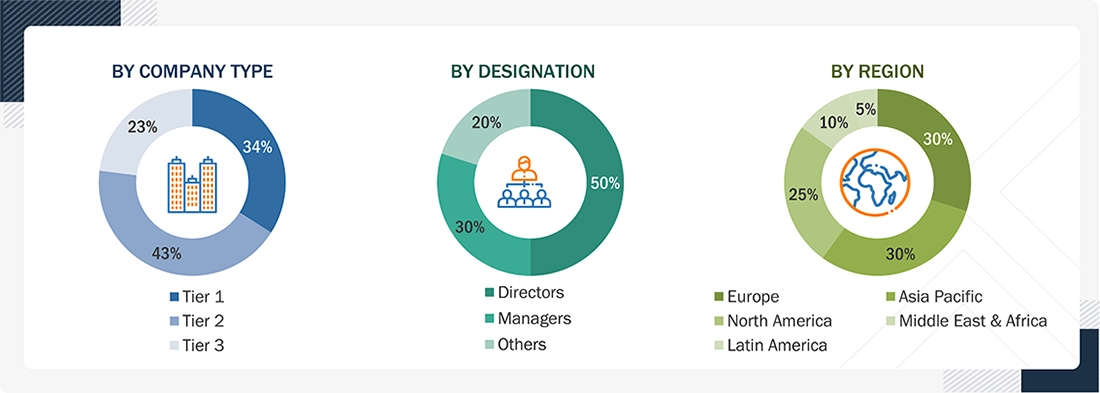
Note: Tier 1 companies have revenues of more than USD 10 billion; tier 2 companies’ revenue ranges from USD 1 billion to USD 10 billion; and tier 3 companies’ revenue ranges from USD 500 million to USD 1 billion.
To know about the assumptions considered for the study, download the pdf brochure
Market Size Estimation
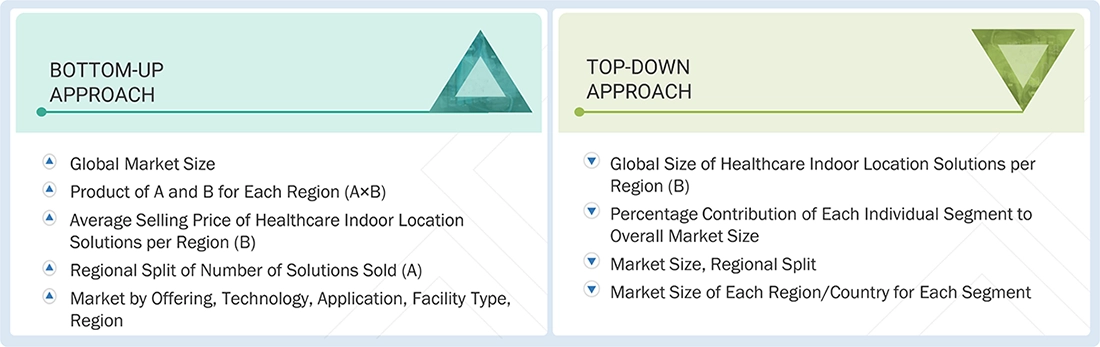
In the market engineering process, the top-down and bottom-up approaches were used along with multiple data triangulation methods to estimate and validate the size of the healthcare indoor location market, as well as other dependent submarkets. The research methodology used to estimate the market sizes includes the following:
- Initially, MarketsandMarkets focuses on top-line investments and spending in the ecosystem. Further, significant developments in the critical market area were considered.
- Tracking recent and upcoming developments in the healthcare indoor location market that include investments, R&D activities, product launches, collaborations, mergers and acquisitions, and partnerships, as well as forecasting the market size based on these developments and other critical parameters.
- Conducting multiple discussions with key opinion leaders to learn about the diverse types of authentications and brand protection offerings used and the applications for which they are used to analyze the breakdown of the scope of work carried out by major companies.
- Segmenting the market based on technology types concerning applications wherein the types are to be used and deriving the size of the global healthcare indoor location market.
- Segmenting the overall market into various market segments
- Validating the estimates at every level through discussions with key opinion leaders, such as chief executives (CXOs), directors, and operations managers, and finally with the domain experts at MarketsandMarkets
Healthcare Indoor Location : Top-Down and Bottom-Up Approach
Data Triangulation
After arriving at the overall market size from the above estimation process, the healthcare indoor location market was split into several segments and sub-segments. To complete the overall market engineering process and arrive at the exact statistics for all segments and sub-segments, data triangulation and market breakdown procedures were used, wherever applicable. The data was triangulated by studying various factors and trends from both the demand and supply sides.
The healthcare indoor location market size was validated using top-down and bottom-up approaches.
Market Definition
Healthcare indoor location refers to the use of indoor positioning and location-tracking technologies to identify, monitor, and determine the real-time or near-real-time location of patients, healthcare staff, medical assets, equipment, and other resources within healthcare facilities.
The technologies used include Bluetooth Low Energy (BLE), RFID, Ultra-Wideband (UWB), Wi-Fi, and infrared (IR) to provide location visibility within hospitals and other healthcare environments. The resulting location information is used for applications such as medical asset tracking, patient and staff tracking, patient flow management, staff safety, infant protection, equipment utilization, indoor navigation, and workflow optimization.
Key Stakeholders
- Healthcare Indoor Location Solution Providers
- Independent Software Vendors (ISVs)
- Investors and Venture Capitalists (VCs)
- Managed Service Providers
- Support and Maintenance Service Providers
- System Integrators (SIs)/Migration Service Providers
- Value-added Resellers (VARs) and Distributors
Report Objectives
- To determine, segment, and forecast the healthcare indoor location market based on offering (hardware, software, and services), technology, application, facility type, and region in terms of value
- To forecast the size of the market segments with respect to five main regions: North America, Europe, Asia Pacific, Middle East & Africa, and Latin America
- To provide detailed information about the major factors (drivers, restraints, opportunities, and challenges) influencing the growth of the market
- To study the complete value chain and related industry segments and perform a value chain analysis of the market landscape
- To strategically analyze the macro and micromarkets with respect to individual growth trends, prospects, and contributions to the total market
- To analyze the industry trends, pricing data, patents, and innovations related to the market
- To analyze the opportunities for stakeholders by identifying the high-growth segments of the market
- To profile the key players in the market and comprehensively analyze their market share/ranking and core competencies
- To track and analyze competitive developments, such as mergers & acquisitions, product launches & developments, partnerships, agreements, collaborations, business expansions, and R&D activities
Available customizations:
With the given market data, MarketsandMarkets offers customizations per the company’s specific needs. The following customization options are available for the report:
Geographic Analysis
- Further break-up of the Asia Pacific market into countries contributing 75% to the regional market size
- Further break-up of the North America market into countries contributing 75% to the regional market size
- Further break-up of the Latin America market into countries contributing 75% to the regional market size
- Further break-up of the Middle East & Africa market into countries contributing 75% to the regional market size
- Further break-up of the Europe market into countries contributing 75% to the regional market size.
Company Information
- Detailed analysis and profiling of additional market players (up to 5)
Get the Full Healthcare Indoor Location Market Report
Full forecast, segment splits, and company analysis for all Healthcare Indoor Location Market.
- UAE Healthcare Indoor Location Market
- South Africa Healthcare Indoor Location Market
- Brazil Healthcare Indoor Location Market
- Mexico Healthcare Indoor Location Market
- Rest Of Europe Healthcare Indoor Location Market
- Rest Of Asia Pacific Healthcare Indoor Location Market
- Rest Of Latin America Healthcare Indoor Location Market
- Ksa Healthcare Indoor Location Market
- US Healthcare Indoor Location Market
- UK Healthcare Indoor Location Market
- Germany Healthcare Indoor Location Market
- France Healthcare Indoor Location Market
- China Healthcare Indoor Location Market
- India Healthcare Indoor Location Market
- Japan Healthcare Indoor Location Market
Need a Tailored Report?
Customize this report to your needs
Get 10% FREE Customization
Customize This Report
