
Poland High-Purity Sulfuric Acid Market (2025-2030)

The Poland High-Purity Sulfuric Acid Market was valued at $7.1 Million in 2025 and projected to reach to $8.9 Million by 2030, representing a compound annual growth rate of 4.6%. Poland's high-purity sulfuric acid market is poised for moderate growth through 2030, supported by expanding electronics and pharmaceutical manufacturing sectors that require consistent supply of high-quality chemical inputs.


| Market Size in | USD 26.32 MN |
| Market Forecast in | |
| CAGR | |
| Forecast Period | |
| Units Considered | Value (USD MN) |
Poland High-Purity Sulfuric Acid Market Trends and Insights
- Poland's chemical manufacturing sector, particularly in electronics, pharmaceuticals, and metal processing, drives steady demand for high-purity sulfuric acid as a critical feedstock and processing agent.
- The market in Poland benefits from the country's strategic position within the European Union and its expanding industrial base. Growth in Poland's high-purity sulfuric acid market is supported by increasing investments in semiconductor and electronics manufacturing, where ultra-pure grades are essential for etching and cleaning applications.
- Poland's pharmaceutical and fine chemical industries also contribute to market expansion, as high-purity sulfuric acid is integral to synthesis and purification processes.
- Regulatory compliance with EU chemical standards and sustainability initiatives are shaping production and distribution practices across Poland's supply chain..
Key Market Statistics
- CAGR (2025-2030) 4.6% CAGR
- Market Size, 2025 ~USD 7.1 Million
- Forecast, 2030 ~USD 8.9 Million
- Country Poland
Poland High-Purity Sulfuric Acid Market Overview
Market Size & Growth :
Poland's high-purity sulfuric acid market is valued at USD 7.1 million in 2025, with projected growth to USD 8.9 million by 2030, reflecting a steady CAGR of 4.6% driven by industrial expansion.
Key End-Use Industries :
Electronics manufacturing, pharmaceutical production, and metal processing sectors in Poland are primary consumers of high-purity sulfuric acid, utilizing it as a critical feedstock and processing agent in their operations.
Chemical Manufacturing Hub :
Poland's robust chemical manufacturing sector positions it as a significant market for high-purity sulfuric acid, with growing demand from domestic producers and regional supply chains across Central Europe.
Growth Trajectory vs. Global :
Poland's CAGR of 4.6% is moderately below the global average of 6.1%, indicating steady but conservative growth compared to faster-expanding regions, reflecting mature market dynamics.
Poland High-Purity Sulfuric Acid Market Dynamics
- The country's strategic position within Central European supply chains and ongoing industrial modernization initiatives will sustain demand for specialized chemical feedstocks.
- Investment in advanced manufacturing facilities and stricter quality standards across industries will further drive adoption of high-purity variants.
- However, growth will be tempered by market maturity and competition from regional suppliers, resulting in the projected 4.6% CAGR..
Market Ecosystem
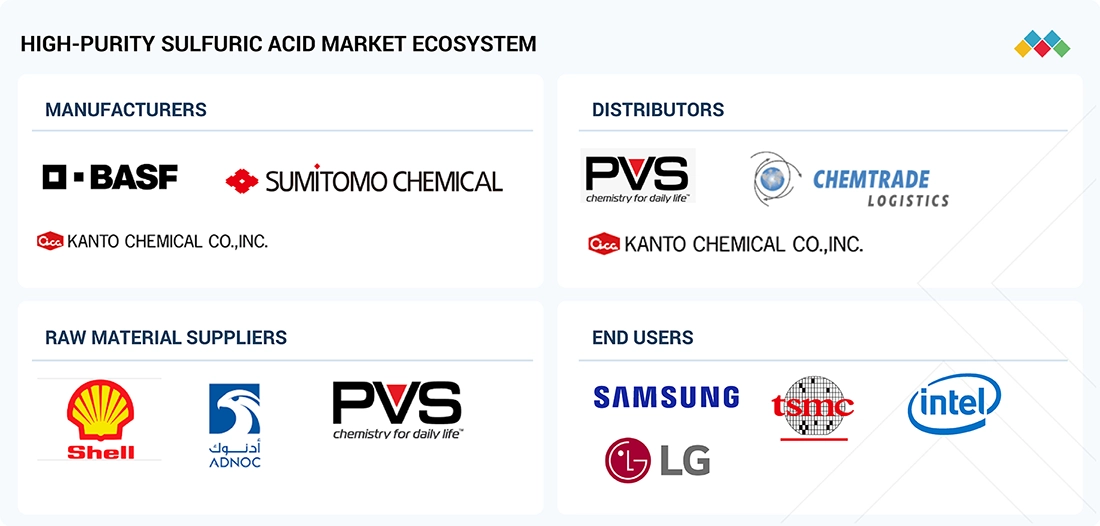
High-Purity Sulfuric Acid Market: COMMERCIAL USE CASES ACROSS INDUSTRIES
| COMPANY | USE CASE DESCRIPTION | BENEFITS |
|---|---|---|
 |
Utilized in wafer cleaning and surface preparation during semiconductor fabrication to remove metal ions, organic residues, and contaminants from silicon wafers. | Ensures ultra-clean wafer surfaces, improves chip yield, and maintains process purity required for advanced nodes (≤3nm). |
|
|
Applied in the etching and cleaning stages of integrated circuit (IC) and memory chip production, especially for DRAM and NAND manufacturing. | Enhances precision in patterning, prevents particle contamination, and supports high device reliability and performance. |
 |
Used in the production and purification of battery electrolytes and cathode materials for lithium-ion batteries. | Improves purity of active materials, enhances battery performance, and extends cycle life through minimized impurity levels. |
 |
In semiconductor fabrication, it’s employed for wafer cleaning, photomask treatment, and etching of metal layers in analog and RF chip production. | Provides consistent surface quality, supports high-frequency device stability, and ensures process uniformity. |
 |
Used for high-precision wafer cleaning and oxidation processes in microprocessor and logic chip manufacturing. | Enables sub-nanometer defect control, enhances transistor performance, and supports next-generation process integration. |
Logos and trademarks shown above are the property of their respective owners. Their use here is for informational and illustrative purposes only.
Related Ecosystem
Speciality Chemicals
- Corrosion Inhibitors
- Polyetheretherketone (PEEK)
- Acrylonitrile Butadiene Styrene (ABS)
- Epoxy Resin
- Polycarbonate
- Basf se
- DOW CHEMICAL COMPANY
- Evonik industries ag
- Clariant ag.
- Solvay sa
Key Takeaways
- Poland's high-purity sulfuric acid market is valued at USD 7.1 million in 2025 and is forecast to reach USD 8.9 million by 2030.
- Poland's market is growing at a CAGR of 4.6%, driven by electronics, pharmaceuticals, and metal processing industries.
- EU regulatory frameworks and sustainability requirements are key factors shaping Poland's market dynamics and competitive positioning.
- Poland's strategic location within Europe and expanding industrial base support long-term growth in high-purity sulfuric acid demand.
High-Purity Sulfuric Acid Market Report Scope
| Report Metric | Details |
|---|---|
| Base Year | 2025 |
| Fastest Growing Segment | CLEANING (Application) |
| Forecast Period | 2025–2030 |
| Growth Rate | CAGR of 6.1% from 2025 to 2030 |
| Largest Segment | SEMICONDUCTOR & ELECTRONICS (End-Use Industry) |
| Market Size Base Year (Billions) | ~USD 0.5 (2025) |
| Revenue Forecast (Billions) | ~USD 0.67 (2030) |
| Segments Covered | Grade, Application, End-Use Industry |
Poland High-Purity Sulfuric Acid Market Report Segmentation
3 segment dimensions are covered across the global market.
By Grade
- Ppb
- Ppt
By Application
- Cleaning
- Etching
- Other Applications
By End-Use Industry
- Other End-Use Industries
- Pharmaceutical
- Pharmaceuticals
- Semiconductor & Electronics
POLAND: HIGH-PURITY SULFURIC ACID MARKET, BY END-USE INDUSTRY, 2025–2030
| Segment | 2025 | 2026 | 2027 | 2028 | 2029 | 2030 | CAGR (%) |
|---|---|---|---|---|---|---|---|
| OTHER END-USE INDUSTRIES | 0.1 | 0.1 | 0.1 | 0.1 | 0.1 | 0.1 | 2.1 |
| PHARMACEUTICAL | 1.8 | 1.9 | 1.9 | 2 | 2.1 | 2.2 | 4.1 |
| SEMICONDUCTOR & ELECTRONICS | 5.3 | 5.5 | 5.7 | 6 | 6.3 | 6.6 | 4.8 |
| TOTAL | 7.1 | 7.4 | 7.7 | 8.1 | 8.5 | 8.9 | 4.6 |
Target Audience
- Chemical Manufacturers & Suppliers : Polish and regional chemical producers need market data to assess demand trends, identify growth opportunities in electronics and pharma sectors, and optimize production capacity and pricing strategies.
- Electronics & Semiconductor Companies : Polish electronics manufacturers require insights into high-purity sulfuric acid supply availability, pricing trends, and market dynamics to secure reliable feedstock and manage production costs.
- Pharmaceutical Producers : Polish pharmaceutical manufacturers depend on this data to understand high-purity sulfuric acid market conditions, supplier landscape, and cost forecasts critical for drug synthesis and quality assurance.
- Metal Processing & Refining Firms : Metal processing companies in Poland need market intelligence to evaluate sulfuric acid availability, pricing projections, and supply chain reliability for their industrial operations and cost management.
- Investment & Business Development Teams : Investors, consultants, and business development professionals evaluating Poland's chemical sector require comprehensive market data to assess investment viability, growth potential, and competitive dynamics.
Key Companies in the Poland High-Purity Sulfuric Acid Market
| Company | HQ | Ownership | Strongest segments |
|---|---|---|---|
| SUMITOMO CHEMICAL CO., LTD. | Japan | Public Company | Agro & Life Solutions (crop protection, fertilizers, household insecticides),ICT & Mobility Solutions (optical, semiconductor, battery materials, engineering plastics),Advanced Medical Solutions (CDMO, oligonucleotides, regenerative medicine), |
| BASF | Germany | Public Company | Chemicals (petrochemicals and intermediates),Materials (isocyanates, polyamides, plastics specialties),Industrial Solutions (dispersions, resins, additives, catalysts), |
| LS MNM INC. | South Korea | Private Company | Electrolytic copper cathodes,Precious metals (gold, silver, PGMs),Chemicals (sulfuric acid and others), |
| CHEMTRADE LOGISTICS | Canada | Public Company | Sulphuric acid and sulphur derivatives (merchant, regen, ultrapure, sulphur products, ammonium sulphate),Water treatment coagulants and related products,Electrochemicals (chlor-alkali and sodium chlorate), |
| KOREAZINC | South Korea | Public Company | Zinc slab and alloy ingots,Lead and lead alloys,Copper cathodes and electrolytic copper foil, |
| LANXESS | Germany | Public Company | Specialty Additives,Consumer Protection,Advanced Intermediates, |
| AVANTOR, INC. | United States | Public Company | Materials and Consumables,Equipment and Instrumentation,Services and Specialty Procurement, |
| MERCK KGAA | Germany | Public Company | Life Science (reagents, consumables, bioprocessing, CDMO),Healthcare (oncology, neurology, fertility, rare diseases),Electronics (semiconductor and display materials), |
SUMITOMO CHEMICAL CO., LTD.
Sumitomo Chemical Co., Ltd. is a Japanese public company founded in 1913 with 27,491 employees. The company operates as a major chemical manufacturer serving global markets.
BASF
BASF is a German public company founded in 1865 with 106,428 employees. It is one of the world's largest chemical producers.
LS MNM INC.
LS MNM Inc. is a South Korean private company founded in 1936 with 758 employees. The company operates in the chemical industry.
CHEMTRADE LOGISTICS
ChemTrade Logistics is a Canadian public company founded in 2001 with 1,474 employees. The company provides chemical logistics and distribution services.
KOREAZINC
Korea Zinc is a South Korean public company founded in 1974 with 1,891 employees. The company is a major zinc and non-ferrous metal producer.
LANXESS
LANXESS is a German public company founded in 1863 with 11,630 employees. The company is a leading specialty chemicals manufacturer.
AVANTOR, INC.
Avantor, Inc. is a United States public company founded in 1904 with 13,500 employees. The company is a global provider of mission-critical products and services for customers in the life sciences and advanced technologies sectors.
MERCK KGAA
Merck KGaA is a German public company founded in 1668 with 59,077 employees. The company is a leading science and technology company operating in pharmaceuticals, life sciences, and performance materials.
Reasons to Buy this Report
- Poland-Specific Market Sizing : Obtain precise market valuation data for Poland (USD 7.1M in 2025), enabling accurate budgeting, investment decisions, and competitive positioning within this Central European market segment.
- Industry-Focused Demand Insights : Understand which Polish industries—electronics, pharmaceuticals, and metal processing—drive high-purity sulfuric acid consumption, allowing targeted sales and marketing strategies for sector-specific opportunities.
- 5-Year Forecast Planning : Access detailed projections through 2030 (USD 8.9M) with 4.6% CAGR to inform long-term supply chain planning, capacity expansion, and market entry strategies specific to Poland's growth trajectory.
- Competitive Benchmarking : Compare Poland's 4.6% CAGR against the global 6.1% benchmark to identify market maturity levels, competitive intensity, and relative growth opportunities versus other regions.
- Regulatory & Supply Chain Context : Gain Poland-specific insights into chemical manufacturing standards, regional supply chain dynamics, and market drivers essential for compliance, sourcing, and distribution strategy development.
Frequently asked questions
What is the current market size of high-purity sulfuric acid in Poland?
Poland's high-purity sulfuric acid market is estimated at USD 7.1 million in 2025.
What is the projected market size for high-purity sulfuric acid in Poland by 2030?
Poland's high-purity sulfuric acid market is forecast to reach USD 8.9 million by 2030.
What is the CAGR for Poland's high-purity sulfuric acid market?
Poland's high-purity sulfuric acid market is expected to grow at a CAGR of 4.6% from 2025 to 2030.
Which industries drive demand for high-purity sulfuric acid in Poland?
Poland's demand is primarily driven by electronics manufacturing, pharmaceuticals, fine chemicals, and metal processing industries.
How do EU regulations impact Poland's high-purity sulfuric acid market?
EU chemical safety and environmental regulations shape production standards, distribution practices, and sustainability initiatives across Poland's high-purity sulfuric acid supply chain.
RESEARCH METHODOLOGY
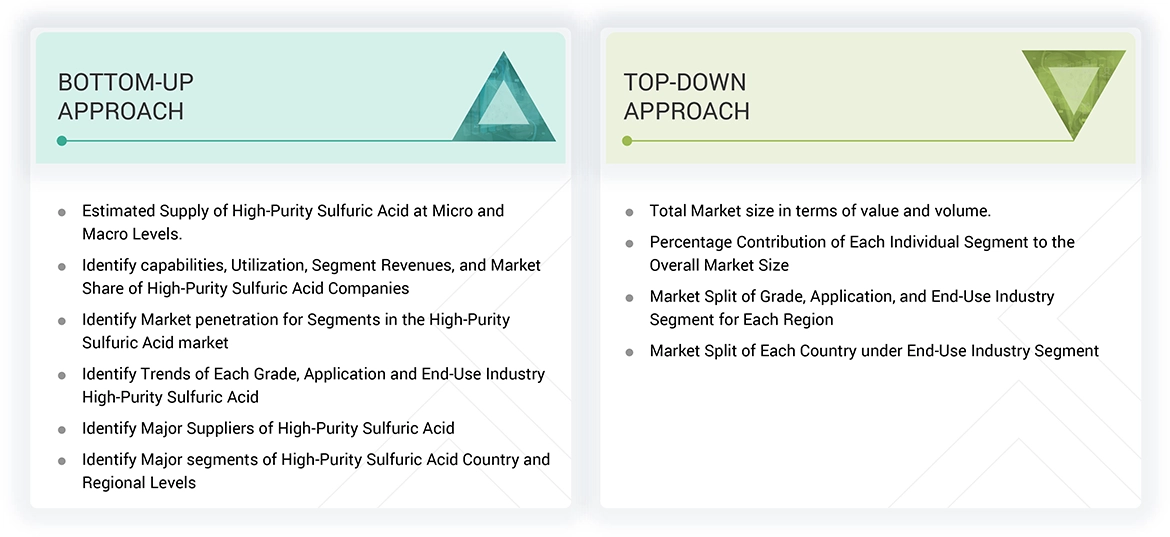
The study involved four major activities in estimating the market size of the High-Purity Sulfuric Acid market. Exhaustive secondary research was done to collect information on the market, the peer market, and the parent market. The next step was to validate these findings, assumptions, and sizing with industry experts across the value chain through primary research. Both top-down and bottom-up approaches were employed to estimate the complete market size. Thereafter, the market breakdown and data triangulation procedures were used to estimate the market size of the segments and subsegments.
Secondary Research
In the secondary research process, various secondary sources have been referred to for identifying and collecting information for this study. These secondary sources include annual reports, press releases, investor presentations of companies, white papers, certified publications, trade directories, certified publications, articles from recognized authors, gold standard and silver standard websites, and databases.
Secondary research has been used to obtain key information about the value chain of the industry, monetary chain of the market, the total pool of key High-Purity Sulfuric Acid, market classification and segmentation according to industry trends to the bottom-most level, and regional markets. It was also used to obtain information about the key developments from a market-oriented perspective.
Primary Research
The High-Purity Sulfuric Acid market comprises several stakeholders in the value chain, which include raw material suppliers, manufacturers, and end users. Various primary sources from the supply and demand sides of the High-Purity Sulfuric Acid market have been interviewed to obtain qualitative and quantitative information. The primary interviewees from the demand side include key opinion leaders in end-use sectors. The primary sources from the supply side include manufacturers, associations, and institutions involved in the High-Purity Sulfuric Acid industry.
Primary interviews were conducted to gather insights such as market statistics, data of revenue collected from the products and services, market breakdowns, market size estimations, market forecasting, and data triangulation. Primary research also helped in understanding the various trends related to chemistry, application, and region. Stakeholders from the demand side, such as CIOs, CTOs, and CSOs were interviewed to understand the buyer’s perspective on the suppliers, products, component providers, and their current usage of High-Purity Sulfuric Acid and future outlook of their business which will affect the overall market.
The breakdown of profiles of the primary interviewees is illustrated in the figure below:
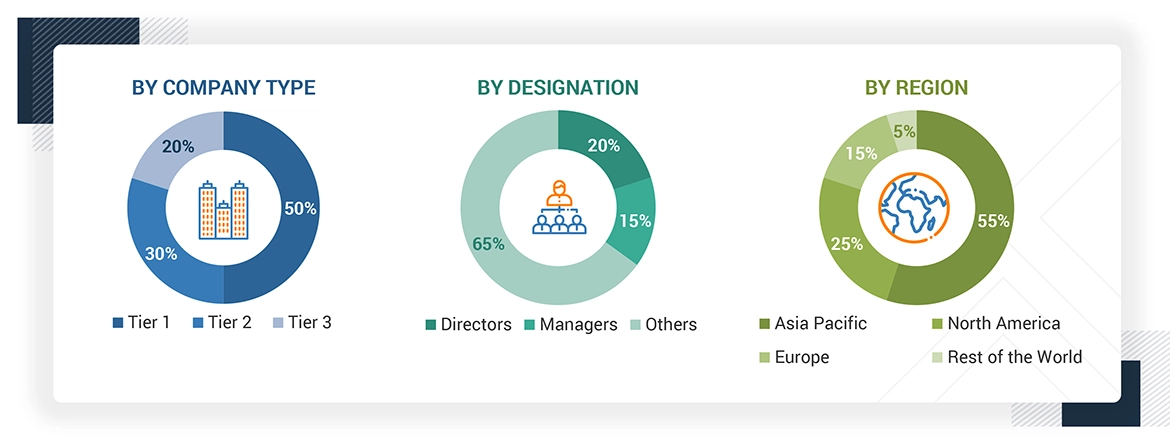
Note: Tier 1, Tier 2, and Tier 3 companies are classified based on their market revenue in 2024 available in the public domain, product portfolios, and geographical presence.
Other designations include sales representatives, production heads, and technicians.
To know about the assumptions considered for the study, download the pdf brochure
Market Size Estimation
The top-down approach was used to estimate and validate the size of various submarkets for High-Purity Sulfuric Acid for each region. The research methodology used to estimate the market size included the following steps:
- The key players in the industry have been identified through extensive secondary research.
- The supply chain of the industry has been determined through primary and secondary research.
- The global market was then segmented into five major regions and validated by industry experts.
- All percentage shares, splits, and breakdowns based on grade, application, end-use industry, and regions were determined using secondary sources and verified through primary sources.
- All possible parameters that affect the markets covered in this research study were accounted for, viewed in extensive detail, verified through primary research, and analyzed to get the final quantitative and qualitative data. This data was consolidated and added with detailed inputs and analysis and presented in this report.
High-Purity Sulfuric Acid Market: Bottum-Up and Top-Down Approach
Data Triangulation
After arriving at the total market size from the estimation process High-Purity Sulfuric Acid above, the overall market has been split into several segments and sub-segments. To complete the overall market engineering process and arrive at the exact statistics for all the segments and sub-segments, the data triangulation and market breakdown procedures have been employed, wherever applicable. The data has been triangulated by studying various factors and trends from both the demand and supply sides. Along with this, the market size has been validated by using both the top-down and bottom-up approaches and primary interviews. Hence, for every data segment, there have been three sources—top-down approach, bottom-up approach, and expert interviews. The data was assumed correct when the values arrived from the three sources matched.
Market Definition
High-purity sulfuric acid is a highly pure form of sulfuric acid (H2SO4) that has few metal and non-metal impurities and is of absolutely vital necessity in industries which require ultra-clean environments. Sulfuric acid, by itself, is a strongly corrosive, dense, colorless liquid distinguished by its exceedingly acidic properties and is an extremely essential ingredient of the majority of chemical reactions. It is basically produced in the Contact Process, whereby the elemental sulfur is burned to produce sulfur dioxide (SO2), and it is then oxidized to form sulfur trioxide (SO3) by the use of a vanadium pentoxide (V2O5) catalyst. The SO3 is later dissolved in water to produce sulfuric acid. But for high purity, advanced purification methods like distillation, filtration, and chemical treatment are employed to remove minute amounts of metal ions, organic substances, and residues of sulfurous acid. High-purity sulfuric acid finds its most significant application in the semiconductor industry, where it is applied for wafer cleaning and etching to yield defect-free production of microchips. Apart from semiconductors, it is also a critical ingredient in pharmaceuticals, catalyst regeneration, and chemical synthesis for laboratory-grade use, where contamination must be eliminated at all costs. Its advantages to end-use industries include superior cleaning efficiency, elimination of microscopic contaminants, and enhanced process reliability through stable chemical properties. The demand for high-purity sulfuric acid is driven primarily by the growing requirement for miniaturized electronic devices, enhanced pharma synthesis, and increasing application of precision chemical processing. As industries move towards tighter quality and environmental regulations, the development of eco-friendly production processes such as acid recycling and ultra-pure extraction techniques is increasing its importance. This transformation makes sure that high-purity sulfuric acid remains to be a main ingredient in high-tech processes as well as addressing environmental sustainability concerns.
Stakeholders
- High-Purity Sulfuric Acid Manufacturers
- High-Purity Sulfuric Acid Traders, Distributors, and Suppliers
- Raw Type Suppliers
- Government and Private Research Organizations
- Associations and Industrial Bodies
- R&D Institutions
- Environmental Support Agencies
Report Objectives
- To define, describe, and forecast the size of the High-Purity Sulfuric Acid market, in terms of value and volume.
- To provide detailed information regarding the major factors (drivers, opportunities, restraints, and challenges) influencing the growth of the market.
- To estimate and forecast the market size based on product grade, application, end-use industry, and region.
- To forecast the size of the market with respect to major regions, namely, Europe, North America, Asia Pacific, Rest of the World, along with their key countries.
- To strategically analyze micromarkets with respect to individual growth trends, prospects, and their contribution to the overall market.
- To analyze opportunities in the market for stakeholders and provide a competitive landscape of market leaders.
- To track and analyze recent development such as product launch, partnership, acquisition, and expansion in the market.
- To strategically profile key market players and comprehensively analyze their core competencies.
Get the Full High-Purity Sulfuric Acid Market Report
Full forecast, segment splits, and company analysis for all High-Purity Sulfuric Acid Market.
- China High-Purity Sulfuric Acid Market
- Japan High-Purity Sulfuric Acid Market
- Taiwan High-Purity Sulfuric Acid Market
- South Korea High-Purity Sulfuric Acid Market
- India High-Purity Sulfuric Acid Market
- Canada High-Purity Sulfuric Acid Market
- Mexico High-Purity Sulfuric Acid Market
- US High-Purity Sulfuric Acid Market
- Germany High-Purity Sulfuric Acid Market
- France High-Purity Sulfuric Acid Market
- Netherlands High-Purity Sulfuric Acid Market
- Turkey High-Purity Sulfuric Acid Market
- Israel High-Purity Sulfuric Acid Market
- South Africa High-Purity Sulfuric Acid Market
- Rest Of Europe High-Purity Sulfuric Acid Market
- Rest Of Asia Pacific High-Purity Sulfuric Acid Market
- Rest Of Row High-Purity Sulfuric Acid Market
Need a Tailored Report?
Customize this report to your needs
Get 10% FREE Customization
Customize This Report
