
Brazil High Purity Gas Market (2025-2030)

The Brazil High Purity Gas Market was valued at $815.8 Million in 2025 and projected to reach to $1076.4 Million by 2030, representing a compound annual growth rate of 5.7%. Brazil's high purity gas market is positioned for steady growth through 2030, supported by ongoing industrialization and major infrastructure initiatives across the nation.


| Market Size in | USD 26.32 MN |
| Market Forecast in | |
| CAGR | |
| Forecast Period | |
| Units Considered | Value (USD MN) |
Brazil High Purity Gas Market Trends and Insights
- This growth trajectory reflects Brazil's increasing demand across packaging, construction, mining, and industrial gas applications.
- Brazil's market expansion is driven by rising industrialization, infrastructure development, and the country's significant mining sector, which relies heavily on high purity gases for operational efficiency and safety compliance. The Brazilian high purity gas market benefits from growing adoption in semiconductor manufacturing, healthcare, and food processing industries.
- Brazil's strategic position as a major Latin American economy positions it as a key market for specialized gas suppliers and industrial operators.
- Between 2025 and 2030, Brazil is expected to see sustained investment in gas infrastructure and supply chain optimization, supporting market maturation and competitive consolidation..
Key Market Statistics
- CAGR (2025-2030) 5.7% CAGR
- Market Size, 2025 ~USD 815.8 Million
- Forecast, 2030 ~USD 1076.4 Million
- Country Brazil
Brazil High Purity Gas Market Overview
Market Valuation :
Brazil's high purity gas market is valued at USD 815.8 million in 2025, with strong growth potential driven by industrial expansion and infrastructure development across the country.
Growth Trajectory :
The market is projected to reach USD 1,076.4 million by 2030, representing a CAGR of 5.7%, outpacing many regional markets and reflecting Brazil's industrial momentum.
Key Application Sectors :
Demand is concentrated in packaging, construction, mining, and industrial gas applications, with mining and construction sectors driving significant consumption growth in Brazil.
Growth Drivers :
Rising industrialization, infrastructure development projects, increased mining activities, and expanding manufacturing sectors are primary catalysts for market expansion in Brazil.
Brazil High Purity Gas Market Dynamics
- The country's robust mining sector, coupled with expanding construction and manufacturing activities, creates sustained demand for high purity gases in specialized applications.
- Investment in industrial facilities and growing adoption of advanced technologies in packaging and production processes further strengthen market fundamentals. The 5.7% CAGR reflects Brazil's competitive positioning within Latin America's industrial landscape.
- Regional economic recovery, coupled with increased foreign direct investment in manufacturing and resource extraction, is expected to accelerate market penetration.
- Strategic focus on quality standards and supply chain optimization will be critical for market participants seeking to capitalize on Brazil's expanding industrial base through 2030..
Market Ecosystem
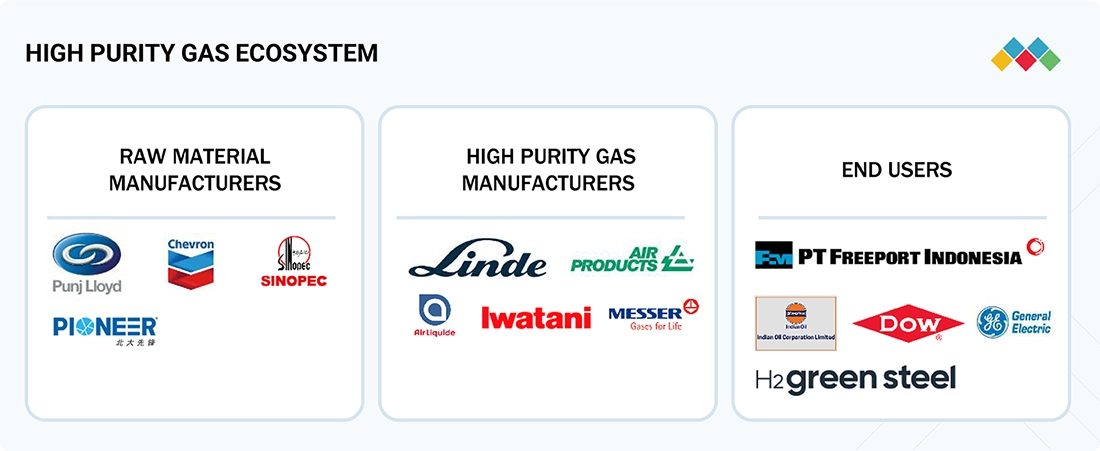
High Purity Gas Market: COMMERCIAL USE CASES ACROSS INDUSTRIES
| COMPANY | USE CASE DESCRIPTION | BENEFITS |
|---|---|---|
 |
Intel uses ultra-high purity gases (99.9999% purity) in semiconductor fabrication at facilities like Fab 34 in Ireland. It utilizes nitrogen for inerting and purging silicon wafers, hydrogen for reduction processes, and argon for sputtering applications. Its USD 18.5 billion facility consumes up to 50,000 cubic meters of nitrogen per hour during production. | Facilitates the production of advanced semiconductor nodes at 5nm and smaller; Supports precise chemical vapor deposition and etching processes |
 |
Mayo Clinic uses medical-grade oxygen (>99.5% purity) for hyperbaric oxygen therapy and critical care applications. Patients breathe 100% pure oxygen in pressurized chambers to treat conditions like carbon monoxide poisoning, diabetic wounds, and radiation tissue damage. The clinic maintains strict FDA compliance for pharmaceutical-grade oxygen. | Speeds up wound healing by 300% through improved oxygen delivery; Addresses hypoxemia and increases blood oxygen saturation to over 95% |
 |
Boeing employs ultra-high purity nitrogen in composite wing manufacturing for the 777X aircraft. Air Products installed a specialized nitrogen system with three 15,000-gallon liquid tanks to create inert atmospheres in the world's largest autoclave. | Produces defect-free composite wings that are 30% lighter than metallic structures and prevents oxidation during wing curing processes, which cost over USD 50 million |
Logos and trademarks shown above are the property of their respective owners. Their use here is for informational and illustrative purposes only.
Related Ecosystem
Automotive Advance Technologies
- Battery Electric Vehicle (BEV)
- Light Commercial Vehicles (LCVs)
- Fuel Cell Electric Vehicle (FCEV)
- Hybrid Electric Vehicle (HEV)
- Internal Combustion Engine (ICE)
- BOSCH LIMITED
- Continental ag
- Visteon Corporation
- DENSO Corporation
- ZF FRIEDRICHSHAFEN AG
Green Bio Chemicals
- Animal-Based Sealants
- Bacterial Fermentation
- Corrosion Inhibitors
- Hydrogen Peroxide
- Nitrile Butadiene Rubber (NBR)
- Basf se
- Evonik industries ag
- Solvay sa
- AZELIS HOLDINGS SA
- CARGILL, INCORPORATED
Speciality Chemicals
- Corrosion Inhibitors
- Polyetheretherketone (PEEK)
- Acrylonitrile Butadiene Styrene (ABS)
- Epoxy Resin
- Polycarbonate
- Basf se
- DOW CHEMICAL COMPANY
- Evonik industries ag
- Clariant ag.
- Solvay sa
Key Takeaways
- Brazil's high purity gas market is valued at USD 815.8 million in 2025 and will reach USD 1,076.4 million by 2030.
- Brazil's market is expanding at a 5.7% CAGR, driven by mining, construction, and industrial manufacturing demand.
- Brazil's growing semiconductor and healthcare sectors are emerging as key growth drivers for high purity gas consumption.
- Brazil's strategic infrastructure investments and supply chain development will support market consolidation through 2030.
High Purity Gas Market Report Scope
| Report Metric | Details |
|---|---|
| Base Year | 2025 |
| Fastest Growing Segment | ELECTRONICS (End-Use Industry) |
| Forecast Period | 2025–2030 |
| Growth Rate | CAGR of 7.1% from 2025 to 2030 |
| Largest Segment | AIR SEPARATION (Manufacturing Process) |
| Market Size Base Year (Billions) | ~USD 37.46 (2025) |
| Revenue Forecast (Billions) | ~USD 52.78 (2030) |
| Segments Covered | Type, Function, Manufacturing Process, Storage & Distribution And Transportation, End-Use Industry |
Brazil High Purity Gas Market Report Segmentation
5 segment dimensions are covered across the global market.
By Type
- Carbon Gas
- High Atmospheric Gas
- Noble Gas
- Other Types Of Gas
By Function
- Coolant
- Illumination
- Insulation
By Manufacturing Process
- Air Separation
- Hydrogen Production
By Storage & Distribution And Transportation
- Cylinders/Packaged Gas
- Merchant Liquid
- Tonnage
By End-Use Industry
- Chemicals
- Electronics
- Food & Beverage
- Medical & Healthcare
- Metal Production
- Oil & Gas
- Other End-Use Industries
BRAZIL: HIGH PURITY GAS MARKET, BY END-USE INDUSTRY, 2025–2030
| Segment | 2025 | 2026 | 2027 | 2028 | 2029 | 2030 | CAGR (%) |
|---|---|---|---|---|---|---|---|
| CHEMICALS | 113.8 | 120.1 | 126.7 | 133.6 | 141 | 148.7 | 5.5 |
| ELECTRONICS | 273.3 | 291.1 | 310.1 | 330.3 | 351.9 | 374.8 | 6.5 |
| FOOD & BEVERAGE | 80.7 | 84.8 | 89.1 | 93.7 | 98.4 | 103.5 | 5.1 |
| MEDICAL & HEALTHCARE | 77.5 | 81.9 | 86.6 | 91.5 | 96.7 | 102.3 | 5.7 |
| METAL PRODUCTION | 77.8 | 82.4 | 87.2 | 92.4 | 97.8 | 103.6 | 5.9 |
| OIL & GAS | 47.6 | 49.6 | 51.7 | 53.9 | 56.1 | 58.5 | 4.2 |
| OTHER END-USE INDUSTRIES | 145.1 | 152.4 | 160.1 | 168 | 176.4 | 185.1 | 5 |
| TOTAL | 815.8 | 862.3 | 911.5 | 963.4 | 1018.3 | 1076.4 | 5.7 |
Target Audience
- Industrial Gas Suppliers : Manufacturers and distributors of high purity gases need Brazil-specific market data to assess market entry strategies, capacity planning, and competitive positioning in this growing South American market.
- Mining & Extraction Companies : Mining operators in Brazil require detailed market insights to forecast gas procurement needs, optimize supply chain decisions, and evaluate supplier partnerships for operational efficiency.
- Construction & Infrastructure Firms : Construction companies and infrastructure developers need market intelligence to understand gas requirements for major projects and plan long-term supply agreements in Brazil.
- Investment & Private Equity : Investors evaluating opportunities in Brazil's industrial sector need comprehensive market data to assess growth potential, valuation benchmarks, and risk factors in the high purity gas segment.
- Manufacturing & Packaging Operators : Manufacturers in packaging and production sectors require Brazil market forecasts to optimize gas sourcing strategies, budget planning, and supplier negotiations for operational continuity.
Key Companies in the Brazil High Purity Gas Market
| Company | HQ | Ownership | Strongest segments |
|---|---|---|---|
| AHLSTROM-MUNKSJO | Finland | Private Company | Filtration and Life Sciences,Food and Consumer Packaging,Protective Materials and Industrial Specialties, |
| LINDE PLC | United Kingdom | Public Company | Atmospheric gases (oxygen, nitrogen, argon, rare gases),Process gases (hydrogen, CO, CO2, helium, acetylene, specialty and electronic gases),Engineering and turnkey process plants, |
| AIR LIQUIDE | France | Public Company | Large Industries (onsite, pipeline, cogeneration),Industrial Merchant (packaged and bulk gases, hardgoods, services),Healthcare (medical gases, homecare, specialty ingredients), |
| AIR PRODUCTS AND CHEMICALS, INC. | United States | Public Company | Atmospheric gases (oxygen, nitrogen, argon),Process gases (hydrogen, syngas, carbon monoxide, CO2, helium),Specialty gases and electronics, |
| MESSER SE & CO. KGAA | Germany | Private Company | Bulk & on-site industrial gases (O2, N2, Ar),Cylinder and packaged gases (incl. acetylene, shielding, mixed gases),Medical and healthcare gases, |
| NIPPON SANSO HOLDINGS CORPORATION | Japan | Public Company | Industrial gases,Medical gases,Electronic material gases, |
| IWATANI CORPORATION | Japan | Public Company | Integrated Energy (LPG, LNG, petroleum, home energy solutions),Industrial Gases & Machinery (air gases, hydrogen, helium, welding, equipment),Materials (PET resins, biomass fuels, battery and semiconductor materials), |
| DAIGAS GROUP | Japan | Public Company | Domestic Energy (city gas, LNG, LPG, power, engineering),Overseas Energy (gas development and investments),Life & Business Solutions (real estate, IT, materials, services), |
| SOL SPA | United States | Public Company | Medsurg,Dental Solutions,Health Information Systems, |
| RESONAC HOLDINGS CORPORATION | Japan | Public Company | Semiconductor and Electronic Materials,Mobility (automotive materials and components),Innovation Enabling Materials (ceramics, resins, specialty chemicals), |
AHLSTROM-MUNKSJO
Ahlstrom-Munksjo is a Finnish private company founded in 1851 with 6,883 employees. The company operates in the manufacturing sector with a long-established history spanning over 170 years.
LINDE PLC
Linde PLC is a United Kingdom-based public company founded in 1879 with 65,034 employees. The company is a major industrial operator with significant global presence and scale.
AIR LIQUIDE
Air Liquide is a French public company founded in 1902 with 65,000 employees. The company operates as a large-scale industrial enterprise with extensive international operations.
AIR PRODUCTS AND CHEMICALS, INC.
Air Products and Chemicals, Inc. is a United States-based public company founded in 1940 with 21,194 employees. The company is a significant player in the chemicals and industrial gases sector.
MESSER SE & CO. KGAA
Messer SE & Co. KGAA is a German private company founded in 1898 with 11,701 employees. The company has maintained its private ownership structure while building a substantial workforce over more than 125 years.
NIPPON SANSO HOLDINGS CORPORATION
Nippon Sanso Holdings Corporation is a Japanese public company founded in 1910 with 20,411 employees. The company operates as a major industrial enterprise with significant market presence in Japan.
IWATANI CORPORATION
Iwatani Corporation is a Japanese public company founded in 1930 with 12,113 employees. The company has established itself as a notable player in its industry sector.
DAIGAS GROUP
Daigas Group is a Japanese public company founded in 1897 with 21,835 employees. The company operates as a large-scale enterprise with over 125 years of operational history.
SOL SPA
SOL SPA is a United States-based public company founded in 2023 with 20,584 employees. The company is a newly established public enterprise with a substantial workforce.
RESONAC HOLDINGS CORPORATION
Resonac Holdings Corporation is a Japanese public company founded in 1939 with 21,525 employees. The company operates as a major industrial enterprise with significant scale and market presence.
Reasons to Buy this Report
- Market-Specific Sizing : Access precise valuation data for Brazil's high purity gas market with verified 2025 baseline (USD 815.8M) and 2030 forecasts, enabling accurate budget allocation and revenue projections.
- Sector-Level Insights : Understand demand patterns across Brazil's key application sectors—packaging, construction, and mining—with granular analysis of growth drivers specific to each vertical.
- Competitive Positioning : Benchmark Brazil's 5.7% CAGR against global growth rates (7.1%) to identify market maturity levels and competitive opportunities within Latin America's industrial gas landscape.
- Investment Decision Support : Leverage Brazil-focused market intelligence to evaluate expansion strategies, partnership opportunities, and capital allocation decisions in South America's largest industrial economy.
- Regulatory & Trend Analysis : Gain insights into Brazil-specific industrial trends, infrastructure development initiatives, and mining sector dynamics that directly influence high purity gas demand and market evolution.
Frequently asked questions
What is the current size of Brazil's high purity gas market?
Brazil's high purity gas market is valued at USD 815.8 million in 2025.
What is the projected market size for Brazil's high purity gas market by 2030?
Brazil's high purity gas market is projected to reach USD 1,076.4 million by 2030.
What is the CAGR for Brazil's high purity gas market?
Brazil's high purity gas market is expected to grow at a CAGR of 5.7% from 2025 to 2030.
Which industries drive demand for high purity gases in Brazil?
Brazil's demand for high purity gases is driven by mining, construction, packaging, semiconductor manufacturing, healthcare, and food processing industries.
What factors support growth in Brazil's high purity gas market?
Brazil's market growth is supported by industrialization, infrastructure development, mining sector expansion, and increasing adoption in emerging sectors like semiconductors and healthcare.
RESEARCH METHODOLOGY
The study involves two major activities in estimating the current market size for the high purity gas market. Exhaustive secondary research was done to collect information on the market, peer market, and parent market. The next step was to validate these findings, assumptions, and sizing with industry experts across the value chain through primary research. Both top-down and bottom-up approaches were employed to estimate the complete market size. After that, market breakdown and data triangulation were used to estimate the market size of segments and subsegments.
Secondary Research
Secondary sources referred to for this research study include financial statements of companies offering high purity gas and information from various trade, business, and professional associations. Secondary research has been used to obtain critical information about the industry’s value chain, the total pool of key players, market classification, and segmentation according to industry trends to the bottom-most level and regional markets. secondary data was collected and analyzed to arrive at the overall size of the high purity gas market, which was validated by primary respondents.
Primary Research
Extensive primary research was conducted after obtaining information regarding the high purity gas market scenario through secondary research. Several primary interviews were conducted with market experts from both the demand and supply sides across major countries of North America, Europe, Asia Pacific, the Middle East & Africa, and Latin America. Primary data was collected through questionnaires, emails, and telephonic interviews. The primary sources from the supply side included various industry experts, such as Chief X Officers (CXOs), Vice Presidents (VPs), Directors from business development, marketing, product development/innovation teams, and related key executives from high purity gas industry vendors; system integrators; component providers; distributors; and key opinion leaders.
Primary interviews were conducted to gather insights such as market statistics, data on revenue collected from the products and services, market breakdowns, market size estimations, market forecasting, and data triangulation. Primary research also helped in understanding the various trends related to type, storage & distribution and transportation, manufacturing process, function, end-use industry, and region.
Stakeholders from the demand side, such as CIOs, CTOs, CSOs, and installation teams of the customer/end users who are using high purity gas, were interviewed to understand the buyer’s perspective on the suppliers, products, component providers, and their current usage of high purity gases and future outlook of their business which will affect the overall market.

Source: Secondary Research, Interviews with Experts, MarketsandMarkets Analysis
Market Size Estimation
The research methodology used to estimate the size of the high purity gas market includes the following details. The sizing of the market was undertaken from the demand side. The market was upsized based on procurements and modernizations in high purity gases in different end-use industries at a regional level. Such procurements provide information on the demand aspects of the high purity gas industry for each application. For each application, all possible segments of the high purity gas market were integrated and mapped.
Top-Down and Bottom-Up Approach

Source: Secondary Research, Interviews with Experts, MarketsandMarkets Analysis
Data Triangulation
After arriving at the overall size from the market size estimation process explained above, the total market was split into several segments and subsegments. The data triangulation and market breakdown procedures explained below were implemented, wherever applicable, to complete the overall market engineering process and arrive at the exact statistics for various market segments and subsegments. The data was triangulated by studying various factors and trends from the demand and supply sides. Along with this, the market size was validated using both the top-down and bottom-up approaches.
Market Definition
High purity gases refer to the gases that are produced, handled, and used with extremely low levels of contaminants. These gases are typically used in applications where precision and purity are critical, such as in semiconductor manufacturing, pharmaceuticals, and scientific research. High purity/ultra high purity gases are those gases which are used for specialized applications such as manufacturing semiconductor devices and flat-panel displays. The purity of these gases ranges from 99.998% to 99.999%. They are used in various end-user segments to improve overall yield, reduce operational cost, and to optimize performance of various industrial or other operations. These gases include atmospheric gases, noble gases, carbon gases, and other gases (fluorine, chlorine, and bromine).
Stakeholders
- High purity gas manufacturers
- Government and research organizations
- National and local government organizations
- Institutional investors
- European High Purity Gases Association
- US Oil & Gas Association
Report Objectives
- To define, describe, and forecast the high purity gas market size in terms of volume and value
- To provide detailed information regarding the key factors, such as drivers, restraints, opportunities, and challenges influencing the market growth
- To analyze and project the global high purity gas market by type, by storage & distribution and transportation, by manufacturing process, by function, end-use industry, and region
- To forecast the market size concerning five main regions (along with country-level data), namely, North America, Europe, Asia Pacific, Latin America, and the Middle East & Africa, and analyze the significant region-specific trends
- To strategically analyze micromarkets with respect to individual growth trends, prospects, and contributions of the submarkets to the overall market
- To analyze the market opportunities and the competitive landscape for stakeholders and market leaders
- To assess recent market developments and competitive strategies, such as agreements, contracts, acquisitions, and new product developments/new product launches, to draw the competitive landscape
- To strategically profile the key market players and comprehensively analyze their core competencies
Geographic Analysis
- Further breakup of the Asia Pacific market into countries contributing to the rest of the regional market size
- Further breakup of the North American market into countries contributing to the rest of the regional market size
- Further breakup of the Latin American market into countries contributing to the rest of the regional market size
- Further breakup of the Middle East & African market into countries contributing to the rest of the regional market size
- Further breakup of the European market into countries contributing to the rest of the regional market size
Get the Full High Purity Gas Market Report
Full forecast, segment splits, and company analysis for all High Purity Gas Market.
- US High Purity Gas Market
- Canada High Purity Gas Market
- Mexico High Purity Gas Market
- Germany High Purity Gas Market
- UK High Purity Gas Market
- France High Purity Gas Market
- Italy High Purity Gas Market
- Russia High Purity Gas Market
- Ukraine High Purity Gas Market
- China High Purity Gas Market
- Japan High Purity Gas Market
- India High Purity Gas Market
- Australia High Purity Gas Market
- South Africa High Purity Gas Market
Need a Tailored Report?
Customize this report to your needs
Get 10% FREE Customization
Customize This Report
