
Rest of World High Shear Mixers Market (2026-2031)

The Rest of World High Shear Mixers Market was valued at $16.18 Million in 2026 and projected to reach to $20.2 Million by 2031, representing a compound annual growth rate of 4.5%. The Rest of World high shear mixers market is positioned for consistent expansion, driven by evolving consumer preferences toward processed and specialty food products.


| Market Size in | USD 26.32 MN |
| Market Forecast in | |
| CAGR | |
| Forecast Period | |
| Units Considered | Value (USD MN) |
Rest of World High Shear Mixers Market Trends and Insights
- Rest of World regions are increasingly adopting high shear mixing technologies across food and beverage production, driven by rising demand for processed foods, dairy products, and specialty beverages.
- Rest of World markets benefit from growing industrialization and investment in food processing infrastructure, particularly in emerging economies seeking to modernize production capabilities. Rest of World's high shear mixers market is characterized by moderate growth momentum, with a compound annual growth rate (CAGR) of 4.5% over the forecast period.
- Rest of World manufacturers are responding to demand for efficient mixing solutions that improve product consistency, reduce processing time, and enhance operational efficiency.
- Rest of World's market expansion is supported by increasing consumer preferences for quality food products and regulatory compliance requirements that necessitate advanced mixing equipment in food manufacturing facilities..
Key Market Statistics
- CAGR (2026-2031) 4.5% CAGR
- Market Size, 2026 ~USD 16.18 Million
- Forecast, 2031 ~USD 20.2 Million
- Geography Rest of World
Rest of World High Shear Mixers Market Overview
Steady Growth Trajectory :
Rest of World high shear mixers market is valued at USD 16.18 million in 2026, with a projected CAGR of 4.5% through 2031, reaching USD 20.20 million by forecast end.
Processed Food Demand Driver :
Rising consumption of processed foods and dairy products across Rest of World regions is accelerating adoption of high shear mixing technologies in food and beverage production facilities.
Specialty Beverage Expansion :
Growing demand for specialty beverages including plant-based drinks, functional beverages, and premium dairy alternatives is creating new opportunities for high shear mixer deployment in Rest of World markets.
Technology Adoption Acceleration :
Rest of World regions are increasingly recognizing the efficiency and quality benefits of high shear mixing technologies, driving market penetration across emerging food and beverage manufacturing sectors.
Rest of World High Shear Mixers Market Dynamics
- Emerging economies within this region are investing in modernized food processing infrastructure, creating substantial opportunities for high shear mixer manufacturers.
- The market's 4.5% CAGR reflects steady industrialization of food and beverage production across diverse geographic regions. Key growth catalysts include increasing urbanization, rising disposable incomes, and growing food safety regulations that necessitate advanced mixing technologies.
- Rest of World manufacturers are progressively adopting high shear mixers to improve product consistency, reduce processing time, and meet international quality standards.
- This trend is expected to sustain market growth through 2031, with particular momentum in dairy, beverage, and processed food segments..
Market Ecosystem
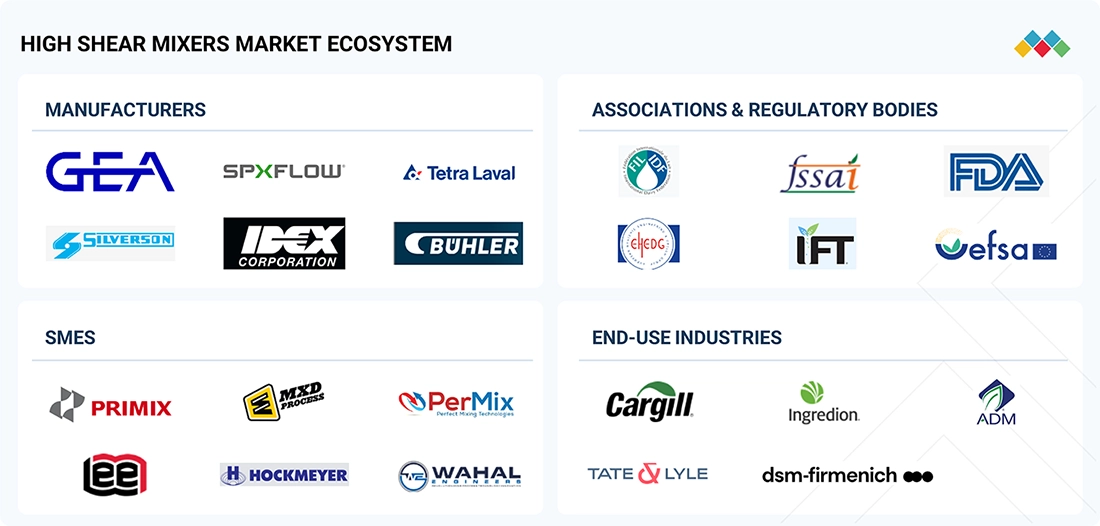
HIGH SHEAR MIXERS MARKET: COMMERCIAL USE CASES ACROSS INDUSTRIES
| COMPANY | USE CASE DESCRIPTION | BENEFITS |
|---|---|---|
 |
GEA acquired Flocmix to enhance its portfolio in mixing and process technologies by integrating sensor-based solutions that improve efficiency and performance in industrial mixing systems. | The acquisition improved blending and process technology capabilities, facilitating the integration of sensor-based solutions for enhanced efficiency and process control. It also enhances performance in complex high shear mixing applications. |
 |
Tetra Pak acquired Bioreactors.net to enhance its fermentation and alternative protein processing capabilities. This acquisition facilitates expansion into applications that require advanced shear-controlled environments and mixing-intensive dispersion technologies. | This acquisition enhanced capabilities in fermentation and alternative protein processing, supporting the growth of plant-based and new food categories. It focuses on advanced shear-controlled mixing and dispersion technologies for complex formulations. |
 |
SPX FLOW acquired UTG Mixing Group, which includes the Stelzer, Uutechnic, and Jamix brands. This acquisition has strengthened SPX FLOW's position in the high shear mixers market by expanding its operations in Europe, enhancing its technical expertise and manufacturing capacity, and broadening its portfolio of mixing solutions across the chemical, food, pharmaceutical, and industrial markets. As a result, SPX FLOW is better positioned to reach a global customer base. | The acquisition expands geographic reach and service offerings, providing integrated testing solutions and better access to advanced analytical services for clients across various industries. |
Logos and trademarks shown above are the property of their respective owners. Their use here is for informational and illustrative purposes only.
Related Ecosystem
Fandb Processing And Technology
- Dairy Products
- Bakery Products
- Filtration Equipment
- Heat Exchanger
- Acetic Acid
- Gea group
- John Bean Technologies Corporation
- Alfa Laval Corporate AB
- AZELIS HOLDINGS SA
- SPX FLOW INC
Key Takeaways
- Rest of World high shear mixers market valued at USD 16.18 million in 2026, growing to USD 20.20 million by 2031
- Rest of World market demonstrates 4.5% CAGR, reflecting steady adoption of advanced mixing technologies in food processing
- Rest of World growth driven by industrialization, modernization of food production facilities, and rising quality standards
- Rest of World demand supported by expanding dairy, beverage, and processed food sectors requiring efficient mixing solutions
High Shear Mixers Market Report Scope
| Report Metric | Details |
|---|---|
| Base Year | 2026 |
| Fastest Growing Segment | DAIRY ALTERNATIVES (Application) |
| Forecast Period | 2026–2031 |
| Growth Rate | CAGR of 4.8% from 2026 to 2031 |
| Largest Segment | PROCESSING (Type) |
| Market Size Base Year (Billions) | ~USD 0.7 (2026) |
| Revenue Forecast (Billions) | ~USD 0.89 (2031) |
| Segments Covered | System Type, Application, Beverage, Configuration, Mixing Application, Type |
Rest of World High Shear Mixers Market Report Segmentation
6 segment dimensions are covered across the global market.
By System Type
- Batch Mixers
- Inline Mixers
By Application
- Beverages
- Cheese
- Dairy
- Dairy Alternatives
- Food Products
- ICE Cream
- Other Applications
- Other Food Products
By Beverage
- Alcoholic
- Non-Alcoholic
By Configuration
- Batch Mixing Systems
- Continuous Mixing Systems
- Hybrid Systems
- Recirculation Mixing Systems
By Mixing Application
- Dispersion
- Emulsification
- Homogenization
- Particle Size Reduction
By Type
- Depositors & Pan-Greasers
- Mixers
- Other Types
- Oven & Proofers
- Pre-Processing
- Processing
- Sheeters & Molders
- Slicers & Dividers
Target Audience
- Food & Beverage Manufacturers : Rest of World food and beverage producers need market intelligence to evaluate high shear mixer investments, understand regional adoption trends, and benchmark against competitors in emerging markets.
- Equipment Suppliers & OEMs : Manufacturers and distributors of high shear mixing equipment require Rest of World market data to identify growth regions, assess demand potential, and develop region-specific product strategies.
- Investment & Private Equity Firms : Investors evaluating opportunities in Rest of World food processing and beverage manufacturing need market sizing and growth forecasts to assess portfolio companies and acquisition targets.
- Market Consultants & Analysts : Consulting firms and research professionals require Rest of World-specific data to support client advisory work, competitive analysis, and strategic recommendations in food and beverage sectors.
- Regional Distributors & Resellers : Distribution partners operating in Rest of World regions need market forecasts and demand insights to optimize inventory, plan sales strategies, and identify high-potential customer segments.
Key Companies in the Rest of World High Shear Mixers Market
| Company | HQ | Ownership | Strongest segments |
|---|---|---|---|
| GEA GROUP AKTIENGESELLSCHAFT | United States | Public Company | Separation & Flow Technologies (separators, decanters, valves, pumps),Liquid & Power Technologies (brewing, liquid processing, concentration, fermentation),Food & Health Technologies (meat, poultry, seafood, vegan, pharma equipment), |
| SPX FLOW, INC. | United States | Private Company | Nutrition & Health (dairy, food, beverage, hygienic process),Precision Solutions – Air Dryers & Filtration,Precision Solutions – Mixers & Pumps, |
| IDEX CORPORATION | United States | Public Company | Health & Science Technologies (HST),Fluid & Metering Technologies (FMT),Fire & Safety/Diversified Products (FSDP), |
| BüHLER HOLDING AG | Switzerland | Private Company | Grain & Rice Milling, Food and Feed Processing Lines,Cocoa, Chocolate, and Confectionery Systems,Die-Casting, Grinding & Dispersion, Surface Coating, |
| SILVERSON MACHINES | United Kingdom | Private Company | In-line high-shear mixers,Batch high-shear mixers,Laboratory and pilot mixers, |
| EBARA CORPORATION | Japan | Public Company | Building Service & Industrial (pumps, fans, booster units, chillers, cooling towers),Energy & Infrastructure (pumps, compressors, turbines, heating/cooling machines),Environmental Solutions (incineration, gasification, waste and sewerage systems, boilers), |
GEA GROUP AKTIENGESELLSCHAFT
GEA GROUP AKTIENGESELLSCHAFT is a publicly traded German industrial company founded in 1881 with approximately 19,670 employees operating in the United States. The company is a long-established manufacturer serving various industrial sectors.
SPX FLOW, INC.
SPX FLOW, INC. is a privately held United States company founded in 2015 with 4,900 employees. The company operates in the industrial equipment and flow technology sector.
IDEX CORPORATION
IDEX CORPORATION is a publicly traded United States company founded in 1987 with 8,700 employees. The company manufactures fluid and metering technologies, sealing solutions, and specialty products for various industrial applications.
BüHLER HOLDING AG
BÜHLER HOLDING AG is a Swiss private company founded in 1860 with approximately 12,090 employees. The company is a global leader in process engineering and manufacturing solutions for food, feed, and advanced materials industries.
SILVERSON MACHINES
SILVERSON MACHINES is a privately held United Kingdom company established in 1946. The company specializes in the design and manufacture of mixing and processing equipment.
EBARA CORPORATION
EBARA CORPORATION is a publicly traded Japanese company founded in 1912 with approximately 21,148 employees. The company manufactures pumps, compressors, and other industrial machinery for global markets.
Countries within Rest of World - compare and drill down
| Country | 2025 size (native) |
|---|
Country market size visualization
Reasons to Buy this Report
- Regional Market Sizing : Obtain precise market valuation for Rest of World high shear mixers at USD 16.18 million (2026) and USD 20.20 million (2031), enabling accurate regional investment and expansion planning.
- Growth Opportunity Identification : Identify emerging opportunities across Rest of World regions where high shear mixer adoption is accelerating in processed foods, dairy, and specialty beverages with 4.5% CAGR potential.
- Competitive Landscape Intelligence : Understand Rest of World market dynamics, regional demand drivers, and technology adoption patterns to inform product development and market entry strategies.
- Demand Driver Analysis : Gain insights into specific factors driving high shear mixer adoption in Rest of World markets, including urbanization, food safety regulations, and consumer preference shifts.
- Strategic Planning Data : Leverage Rest of World-specific forecasts and market trends to develop targeted go-to-market strategies and resource allocation plans for emerging food and beverage markets.
Frequently asked questions
What is the market size of high shear mixers in Rest of World?
Rest of World high shear mixers market is valued at USD 16.18 million in 2026 and is projected to reach USD 20.20 million by 2031.
What is the growth rate for Rest of World high shear mixers market?
Rest of World high shear mixers market is expected to grow at a CAGR of 4.5% from 2026 to 2031.
Which industries drive demand in Rest of World high shear mixers market?
Rest of World demand is primarily driven by food and beverage manufacturing, including dairy products, processed foods, sauces, and specialty beverages requiring consistent mixing quality.
What factors are contributing to Rest of World market growth?
Rest of World market growth is fueled by industrialization, modernization of food processing infrastructure, rising consumer quality expectations, and regulatory compliance requirements in emerging economies.
How does Rest of World market compare to global trends?
Rest of World high shear mixers market grows at 4.5% CAGR, slightly below the global average of 4.8%, reflecting regional variations in industrialization and food processing adoption rates.
RESEARCH METHODOLOGY
This study employed two primary approaches to estimate the current size of the high shear mixers market. Exhaustive secondary research was conducted to gather information on system types, configurations, mixing applications, and market segments. The next step involved validating these findings, assumptions, and sizing estimates with industry experts across the value chain through primary research. The top-down and bottom-up approaches were employed to estimate the complete market size. Thereafter, data triangulation was used to estimate the market size of segments and subsegments.
Secondary Research
This research study used extensive secondary sources—directories and databases such as Bloomberg Businessweek and Factiva—to identify and collect information for a technical, market-oriented, and commercial market study. In the secondary research process, sources such as annual reports, press releases & investor presentations of companies, white papers, food processing- and processing equipment-related journals, certified publications, articles from recognized authors, directories, and databases were consulted to identify and collect information. Secondary research was primarily used to obtain key information on the industry’s supply chain, the pool of key players, and market classification and segmentation based on industry trends, down to the bottom-most level of regional markets, and key developments from market- and technology-oriented perspectives.
Primary Research
Extensive primary research was conducted after secondary research provided information on the high shear mixers market. Several primary interviews were conducted with market experts from the demand and supply sides across all regions. Primary data was collected through questionnaires, emails, and telephonic interviews. The primary sources on the supply side included various industry experts, such as chief experience officers (CXOs), vice presidents (VPs), and directors from business development, marketing, research, and development teams, as well as related key executives from distributors and key opinion leaders.
Primary interviews were conducted to gather insights, including market statistics, product and service revenue data, market breakdowns, market size estimates, market forecasting, and data triangulation. Primary research also helped understand the various trends in system types, configurations, mixing applications, applications, and regions. Stakeholders from the demand side were interviewed to understand buyers’ perspectives on suppliers, products, and the outlook for their businesses, which will impact the overall market.
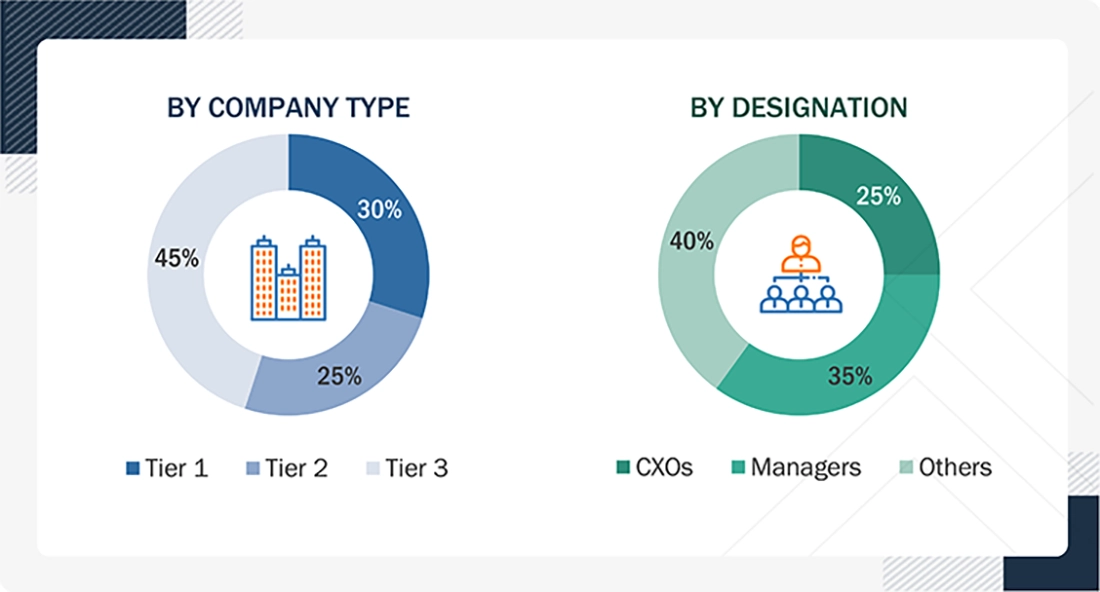
Note: The three tiers of companies are defined based on their total revenues in 2024 or 2025, depending on the availability of financial data: Tier 1: Revenue > USD 1 billion; Tier 2: USD 100 million ≤ revenue ≤ USD 1 billion; Tier 3: Revenue < USD 100 million.
|
COMPANY |
DESIGNATION |
|
GEA Group Aktiengesellschaft (Germany) |
Regional Sales Manager |
|
SPX FLOW, Inc. (US) |
Marketing Manager |
|
Tetra Laval Group (Switzerland) |
General Manager |
|
IDEX Corporation (US) |
Sales Manager |
|
Bühler Holding AG (Switzerland) |
Sales Manager |
|
EBARA Corporation (Japan) |
Sales Executive |
To know about the assumptions considered for the study, download the pdf brochure
Market Size Estimation
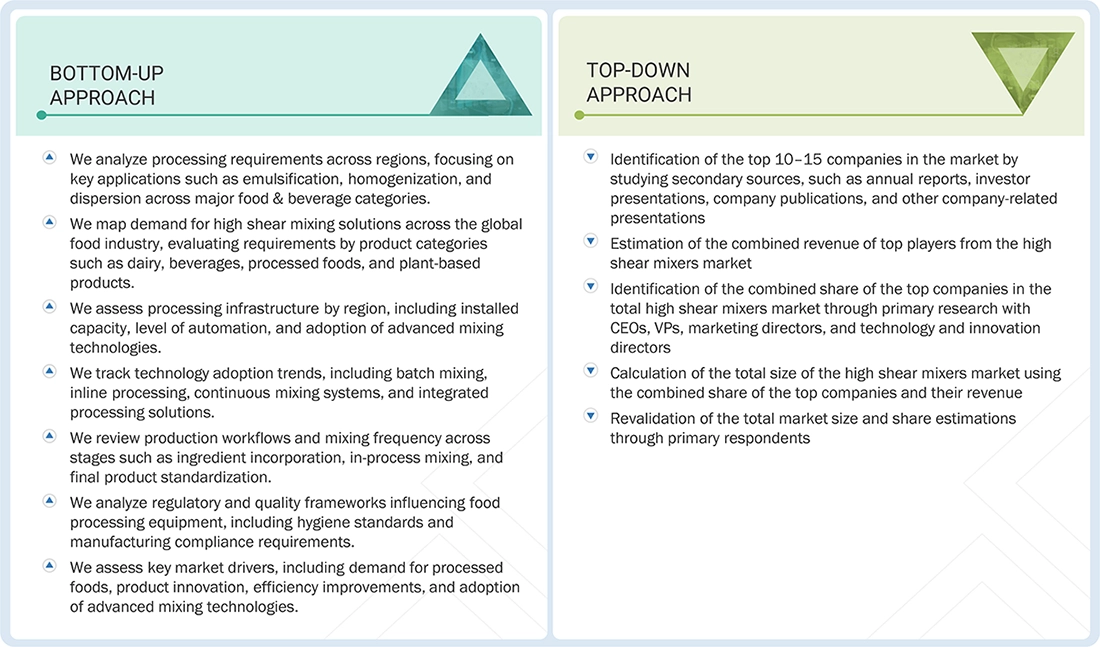
The top-down and bottom-up approaches were used to estimate and validate the total size of the high shear mixers market. These approaches were also widely used to determine the sizes of various subsegments in the market. The research methodology used to estimate the market size includes the following details:
- The key players in the industry and the overall markets were identified through extensive secondary research.
- All shares, splits, and breakdowns were determined using secondary sources and verified through primary sources.
- All possible parameters that affect the market covered in this research study were accounted for, viewed in extensive detail, verified through primary research, and analyzed to obtain final quantitative and qualitative data.
- The research included the study of reports, reviews, and newsletters of top market players, along with extensive interviews for opinions from leaders, such as CEOs, directors, and marketing executives.
High Shear Mixers Market: Bottom-up and Top-down Approaches
Data Triangulation
After determining the overall market size through the estimation process described above, the market was split into several segments and subsegments. The data triangulation procedure was employed, wherever applicable, to estimate the overall high shear mixers market and obtain precise statistics for all segments and subsegments. The data was triangulated by examining various factors and trends on both the demand and supply sides. The market size was also validated using the top-down and bottom-up approaches.
Market Definition
The high shear mixers market comprises equipment and systems used for effective mixing, homogenization, dispersion, and emulsification of liquid and semi-liquid products across various industries. High shear mixer systems typically consist of rotor-stator designs that can be installed in-tank or inline for high-intensity shear processing. These mixers are essential for preparing complex formulations.
High shear mixing solutions offer advanced processing capabilities, including emulsification, homogenization, dispersion, and particle size reduction. These processes are utilized in both batch and inline mixers for a variety of food products. High shear mixers are used across multiple food categories, including dairy, cheese, ice cream, dairy alternatives, beverages, and more. They come in various configurations, including batch, recirculation, continuous, and hybrid systems.
These mixers play a critical role in enhancing process efficiency, reducing mixing time, improving product consistency, and ensuring scalability in industrial operations. Consequently, the high shear mixers market is vital to modern food processing, supporting product innovation, operational efficiency, and compliance with stringent quality standards in global production environments.
Key Stakeholders
- Supply Side: High shear mixer manufacturers, component suppliers, system integrators, and providers of complete processing solutions, including tank-based and inline mixing systems
- Technology Providers: Developers of advanced mixing technologies, including rotor-stator designs, multi-stage shear systems, vacuum-assisted mixing, thermal processing integration (heating/cooling), and automation and digital control solution providers for process optimization and monitoring
- Demand Side: Food & beverage manufacturers, including dairy processors, beverage producers, processed food manufacturers, plant-based product companies, and contract manufacturers utilizing high shear mixing systems in production
- Regulatory Side: Food safety and quality regulatory authorities, industry standards organizations, and government bodies involved in setting processing, hygiene, and equipment compliance standards for food & beverage manufacturing
- Associations and industry bodies:
-
- Food and Agriculture Organization
- European Hygienic Engineering & Design Group (EHEDG)
- International Society for Pharmaceutical Engineering (ISPE)
- International Dairy Federation (IDF)
- International Association for Food Protection (IAFP)
Report Objectives
- To determine and project the size of the high shear mixers market based on system type, configuration, mixing application, application, and region, over five years, ranging from 2026 to 2031
- To identify the attractive opportunities in the market by determining the largest and fastest-growing segments across regions
- To provide detailed information about the key factors influencing market growth (drivers, restraints, opportunities, and challenges)
- To analyze the opportunities in the market for stakeholders and provide details of the competitive landscape for market leaders
- To analyze the micromarkets with respect to individual growth trends, prospects, and their contribution to the total market
- To identify and profile the key players in the market
- To understand the competitive landscape and identify the major growth strategies adopted by players across the key regions
Available customizations:
Based on the given market data, MarketsandMarkets offers customizations tailored to company-specific scientific needs. The following customization options are available for the report:
PRODUCT ANALYSIS
- Product matrix that provides a detailed comparison of each company's product portfolio.
Segmental ANALYSIS
- Further breakdown of other types of high shear mixers by mixer type
- Further breakdown of other equipment into key types
COMPANY INFORMATION
- Detailed analyses and profiling of additional market players (up to five)
Get the Full High Shear Mixers Market Report
Full forecast, segment splits, and company analysis for all High Shear Mixers Market.
Need a Tailored Report?
Customize this report to your needs
Get 10% FREE Customization
Customize This Report
