
India Hydrogen Sensor Market (2026-2031)

The India Hydrogen Sensor Market was valued at $1.6 Million in 2026 and projected to reach to $4.7 Million by 2031, representing a compound annual growth rate of 20.1%. India's hydrogen sensor market is poised for exceptional growth as the nation accelerates its transition toward clean energy and sustainable industrial practices.


| Market Size in | USD 26.32 MN |
| Market Forecast in | |
| CAGR | |
| Forecast Period | |
| Units Considered | Value (USD MN) |
India Hydrogen Sensor Market Trends and Insights
- Valued at USD 1.6 million in 2026, India's market is projected to grow to USD 4.7 million by 2031, reflecting a compound annual growth rate of 20.1%.
- This accelerated growth in India significantly outpaces global trends, positioning the country as a high-potential market within the Asia Pacific region. India's hydrogen sensor demand is fueled by increasing investments in hydrogen fuel cell technology, renewable energy infrastructure, and stringent workplace safety regulations across manufacturing and chemical sectors.
- The semiconductor and electronics industry in India is rapidly scaling production capabilities to support hydrogen sensing applications.
- By 2031, India's market expansion will be supported by government initiatives promoting green hydrogen and industrial automation, making the country a critical hub for hydrogen sensor innovation and deployment in emerging markets..
Key Market Statistics
- CAGR (2026-2031) 20.1% CAGR
- Market Size, 2026 ~USD 1.6 Million
- Forecast, 2031 ~USD 4.7 Million
- Country India
India Hydrogen Sensor Market Overview
Rapid Market Expansion :
India's hydrogen sensor market is projected to grow from USD 1.6 million in 2026 to USD 4.7 million by 2031, representing a robust 20.1% CAGR that significantly exceeds the global average of 12.2%.
Clean Energy Commitment :
India's National Hydrogen Mission and renewable energy targets are driving demand for hydrogen sensors across industrial applications, fuel cell development, and green hydrogen production facilities.
Industrial Safety Compliance :
Stringent safety regulations in India's manufacturing and petrochemical sectors are mandating hydrogen detection systems, creating sustained demand for advanced sensor technologies.
Emerging Technology Adoption :
Growing investments in hydrogen infrastructure, fuel cell vehicles, and energy storage solutions are positioning India as a key growth market for hydrogen sensor manufacturers and technology providers.
India Hydrogen Sensor Market Dynamics
- Government initiatives, including the National Hydrogen Mission and renewable energy expansion targets, are catalyzing investments in hydrogen production, storage, and utilization technologies.
- This regulatory environment, combined with increasing industrial safety requirements, creates substantial opportunities for sensor manufacturers. The market's 20.1% CAGR reflects India's strategic positioning in the global hydrogen economy.
- Rising demand from fuel cell vehicle development, green hydrogen projects, and industrial safety applications will drive sensor adoption across multiple sectors.
- As India strengthens its hydrogen infrastructure and attracts international investment, the market is expected to become increasingly competitive and technologically advanced..
Market Ecosystem

HYDROGEN SENSOR MARKET: COMMERCIAL USE CASES ACROSS INDUSTRIES
| COMPANY | USE CASE DESCRIPTION | BENEFITS |
|---|---|---|
 |
Provides fixed and portable hydrogen gas detection systems for industrial safety across oil & gas plants, chemical plants, and hydrogen production facilities. Solutions are integrated with plant safety and automation systems for continuous monitoring | Enhances workplace safety | Ensures regulatory compliance | Enables real-time leak detection | Reduces risk of explosions in hydrogen handling environments |
 |
Specializes in portable and fixed gas detection systems for hydrogen leak detection in confined and hazardous environments such as labs, storage units, and fueling stations | Provides high-sensitivity detection | Ensures worker safety | Enables quick response to leaks | Supports compliance with strict safety standards |
 |
Deploys hydrogen sensing technologies integrated into industrial automation and digitalization platforms, supporting hydrogen production (electrolyzers) and energy infrastructure monitoring | Enables seamless integration with Industry 4.0 systems | Improves operational visibility | Supports predictive maintenance | Enhances process safety |
 |
Develops high-performance hydrogen sensors including electrochemical and solid-state technologies for industrial, aerospace, and energy applications | Offers high accuracy and fast response times | Supports critical applications | Improves detection reliability |Enables use in advanced hydrogen systems |
 |
Manufactures compact semiconductor-based hydrogen sensors for integration into safety devices, fuel cells, and consumer/industrial applications | Enables miniaturization, cost-effective deployment, and scalable integration into hydrogen-powered systems | Supports emerging mobility applications |
Logos and trademarks shown above are the property of their respective owners. Their use here is for informational and illustrative purposes only.
Related Ecosystem
Electronics System And Components
Industrial Automation
Key Takeaways
- India's hydrogen sensor market will grow from USD 1.6 million in 2026 to USD 4.7 million by 2031 at a 20.1% CAGR.
- India's growth rate of 20.1% significantly exceeds the global CAGR of 12.2%, establishing India as a high-growth market.
- India's market expansion is driven by green hydrogen initiatives, industrial safety regulations, and renewable energy investments.
- India's semiconductor and electronics sector is scaling production to meet rising hydrogen sensor demand across multiple industries.
Hydrogen Sensor Market Report Scope
| Report Metric | Details |
|---|---|
| Base Year | 2026 |
| Fastest Growing Segment | AUTOMOTIVE (Industry) |
| Forecast Period | 2026–2031 |
| Growth Rate | CAGR of 12.2% from 2026 to 2031 |
| Largest Segment | 1,000–10,000 PPM (Detection Range) |
| Market Size Base Year (Billions) | ~USD 0.08 (2026) |
| Revenue Forecast (Billions) | ~USD 0.14 (2031) |
| Segments Covered | Technology, Industry, Detection Range |
India Hydrogen Sensor Market Report Segmentation
3 segment dimensions are covered across the global market.
By Technology
- Catalytic
- Electrochemical
- Mos
- Other Technologies
- Thermal Conductivity
By Industry
- Automotive
- Chemicals
- Manufacturing
- Oil & Gas
- Other Industries
- Power & Energy
By Detection Range
- 1,000–10,000 Ppm
- Above 10,000 Ppm
- Below 1,000 Ppm
INDIA: HYDROGEN SENSOR MARKET, BY INDUSTRY, 2026–2032
| Segment | 2026 | 2027 | 2028 | 2029 | 2030 | 2031 | 2032 | CAGR (%) |
|---|---|---|---|---|---|---|---|---|
| AUTOMOTIVE | 0.22 | 0.3 | 0.41 | 0.57 | 0.77 | 1.06 | 1.44 | 36.7 |
| CHEMICALS | 0.21 | 0.24 | 0.28 | 0.32 | 0.37 | 0.43 | 0.5 | 15.2 |
| MANUFACTURING | 0.28 | 0.32 | 0.36 | 0.42 | 0.49 | 0.57 | 0.66 | 15.6 |
| OIL & GAS | 0.42 | 0.47 | 0.52 | 0.58 | 0.65 | 0.73 | 0.83 | 12.1 |
| OTHER INDUSTRIES | 0.07 | 0.08 | 0.1 | 0.12 | 0.14 | 0.17 | 0.2 | 18.6 |
| POWER & ENERGY | 0.37 | 0.44 | 0.52 | 0.62 | 0.75 | 0.9 | 1.08 | 19.5 |
| TOTAL | 1.57 | 1.85 | 2.2 | 2.63 | 3.17 | 3.85 | 4.71 | 20.1 |
Target Audience
- Sensor Manufacturers & Technology Providers : Evaluate India's rapidly expanding market opportunity to guide product development, manufacturing capacity planning, and localization strategies for hydrogen sensor technologies.
- Industrial & Energy Companies : Understand hydrogen sensor requirements and market availability in India to support clean energy initiatives, fuel cell projects, and industrial safety compliance investments.
- Investment & Private Equity Firms : Assess India's hydrogen sensor market growth potential and investment opportunities in emerging technology companies, infrastructure projects, and clean energy ventures.
- Government & Policy Makers : Leverage market data to inform hydrogen economy policies, industrial safety regulations, and clean energy initiatives aligned with India's National Hydrogen Mission objectives.
- Automotive & Fuel Cell Developers : Identify sensor supply chain requirements and market dynamics in India to support hydrogen fuel cell vehicle development and commercialization timelines.
Key Companies in the India Hydrogen Sensor Market
| Company | HQ | Ownership | Strongest segments |
|---|---|---|---|
| AMPHENOL CORPORATION | United States | Public Company | Communications Solutions (high-speed, RF, fiber, antennas, network solutions),Harsh Environment Solutions (rugged connectors, power distribution, aerospace/defense/industrial),Interconnect and Sensor Systems (cable assemblies, PCBs, sensors, cable management), |
AMPHENOL CORPORATION
Amphenol Corporation is a global manufacturer of interconnect products and assemblies founded in 1932. With approximately 170,000 employees, the publicly traded company serves diverse industries including aerospace, automotive, and telecommunications. Amphenol designs and produces connectors, cables, and related components for demanding applications worldwide.
Reasons to Buy this Report
- India-Specific Market Sizing : Access precise valuation data for India's hydrogen sensor market with detailed 2026-2031 forecasts, enabling accurate investment planning and resource allocation for India-focused business strategies.
- Competitive Growth Insights : Understand why India's 20.1% CAGR outpaces global trends at 12.2%, identifying unique market drivers and competitive advantages specific to the Indian hydrogen sensor landscape.
- Regulatory & Policy Context : Gain comprehensive understanding of India's National Hydrogen Mission, safety compliance requirements, and government incentives shaping market demand and investment opportunities.
- Sector-Specific Applications : Identify high-growth application areas within India including fuel cell vehicles, green hydrogen production, industrial safety, and energy storage solutions with localized demand patterns.
- Strategic Market Entry : Develop informed market entry strategies with India-specific insights on customer segments, distribution channels, regulatory pathways, and partnership opportunities in this high-growth market.
Frequently asked questions
What is the current size of India's hydrogen sensor market?
India's hydrogen sensor market was valued at USD 1.6 million in 2026 and is projected to reach USD 4.7 million by 2031.
What is the CAGR for India's hydrogen sensor market?
India's hydrogen sensor market is expected to grow at a compound annual growth rate of 20.1% from 2026 to 2031.
What factors are driving growth in India's hydrogen sensor market?
India's market growth is driven by government green hydrogen initiatives, increasing industrial safety regulations, renewable energy investments, and expanding fuel cell technology adoption.
How does India's hydrogen sensor market compare to global trends?
India's CAGR of 20.1% significantly outpaces the global CAGR of 12.2%, making India one of the fastest-growing markets for hydrogen sensors.
Which industries in India are driving hydrogen sensor demand?
India's hydrogen sensor demand is primarily driven by the semiconductor and electronics, manufacturing, chemical processing, and renewable energy sectors.
RESEARCH METHODOLOGY
The study involved four major activities in estimating the current size of the hydrogen sensor market. Extensive secondary research was conducted to gather information on the market, adjacent industries, and the broader hydrogen ecosystem. This was followed by primary research with industry stakeholders across the value chain, including sensor manufacturers, system integrators, distributors, and end users, to validate assumptions and market sizing. Both top-down and bottom-up approaches were used to estimate the overall market size. Market breakdowns and data triangulation techniques were then applied to derive the size of individual segments and subsegments. Secondary and primary sources were jointly used to support a comprehensive technical and commercial analysis of the hydrogen sensor market.
Secondary Research
Various secondary sources were referred to in the secondary research process to identify and collect information relevant to the hydrogen sensor market. These sources include annual reports, press releases, and investor presentations of key companies; white papers; technical journals; certified publications; and articles from recognized authors, industry websites, directories, and databases. Secondary research was conducted to obtain key insights into the market’s supply chain, value chain, competitive landscape, and segmentation across technologies, applications, and regions. It also helped analyze industry trends and recent technological developments. The collected data was further analyzed to estimate the overall market size and validate findings, which were subsequently refined through primary research with industry experts and stakeholders.
Primary Research
Extensive primary research was conducted after gaining knowledge about the current scenario of the hydrogen sensor market through secondary research. Several primary interviews were conducted with experts from the demand and supply sides across four major regions: North America, Europe, Asia Pacific, and RoW. This primary data was collected through questionnaires, emails, and telephonic interviews.
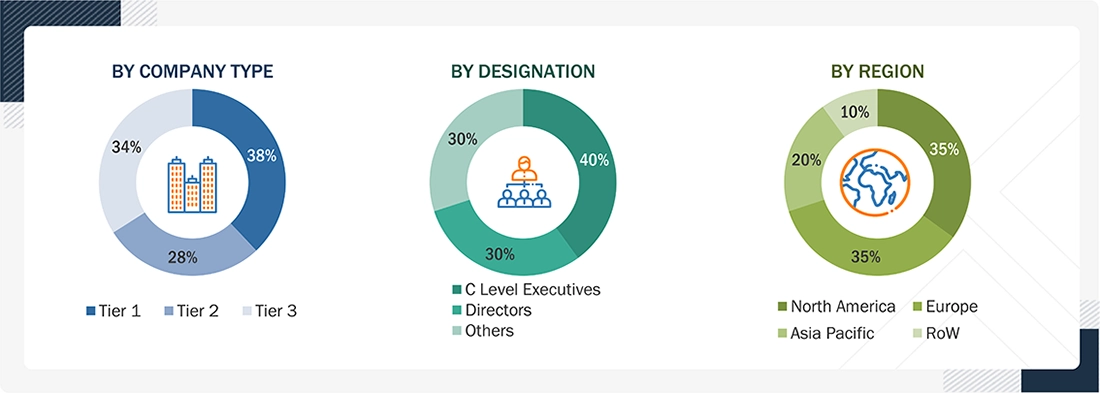
Note: The three tiers of the companies are defined based on their total revenue in 2025: Tier 1 - revenue greater than or equal to USD 1 billion; Tier 2 - revenue between USD 100 million and USD 1 billion; and Tier 3 revenue less than or equal to USD 100 million. Other designations include sales managers, marketing managers, and product managers.
To know about the assumptions considered for the study, download the pdf brochure
Market Size Estimation
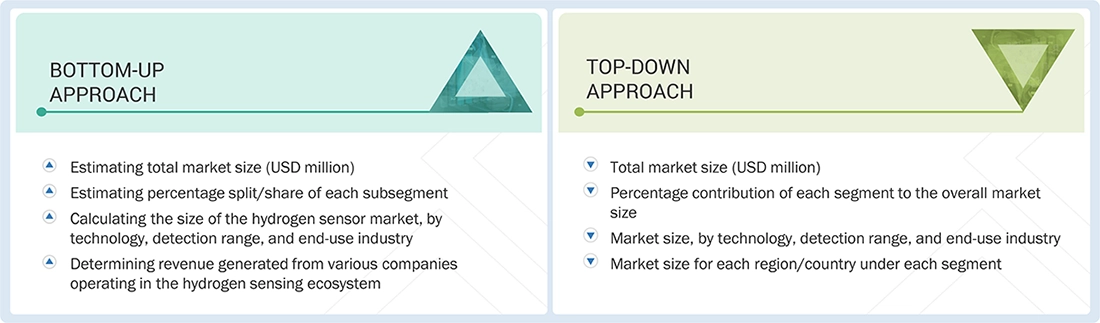
Both top-down and bottom-up approaches have been used to estimate and validate the total size of the hydrogen sensor market. These methods have also been used extensively to estimate the size of various subsegments in the market. The following research methodology has been used to estimate the market size:
- Major players in the industry and markets have been identified through extensive secondary research.
- The industry’s value chain and market size (in terms of value) have been determined through primary and secondary research processes.
- All percentage shares, splits, and breakdowns have been determined using secondary sources and verified through primary sources.
Data Triangulation
After arriving at the overall size of the hydrogen sensor market from the market size estimation process explained above, the total market has been split into several segments and subsegments. Data triangulation and market breakdown procedures have been employed, wherever applicable, to complete the overall market engineering process and arrive at the exact statistics for all segments and subsegments of the market. The data has been triangulated by studying various factors and trends from both the demand and supply sides. Along with this, the market size has been validated using both top-down and bottom-up approaches.
Market Definition
Hydrogen sensing is a method used to detect and measure the concentration of hydrogen gas, ensuring safety and enabling efficient monitoring across various environments. Detection can involve different sensing principles, such as electrochemical, catalytic, thermal conductivity, and optical methods, depending on the application and required sensitivity. Hydrogen sensors are designed to identify leaks at very low concentrations as well as monitor higher levels in industrial processes, supporting early warning systems and risk mitigation.
A hydrogen sensor is a device used to detect the presence of hydrogen gas in industries such as energy, oil & gas, chemicals, automotive, and power generation. These sensors play a critical role in preventing hazards such as fire and explosion by enabling real-time monitoring and leak detection. They are commonly integrated into safety systems, storage units, pipelines, and fuel cell applications. A typical hydrogen sensor consists of sensing elements, signal processing units, and communication interfaces and may vary in design based on detection range, response time, and environmental conditions.
Key Stakeholders
- Hydrogen sensor manufacturers and technology providers (electrochemical, MEMS, semiconductor, and infrared sensor developers)
- Hydrogen production companies and industrial gas suppliers (electrolysis, reforming, and gas processing operators)
- Oil & gas, chemical, and petrochemical companies utilize hydrogen in industrial processes
- Automotive OEMs and fuel cell system manufacturers (FCEVs and hydrogen mobility ecosystem players)
- Energy and power generation companies (hydrogen power plants, energy storage, and utilities)
- Infrastructure developers (hydrogen storage, pipelines, and refueling station operators)
- Government and regulatory authorities involved in safety standards, hydrogen policies, and clean energy initiatives
- Research institutions, laboratories, and R&D organizations working on hydrogen technologies and sensing advancements
- Investors, venture capitalists, and funding agencies supporting hydrogen and sensor innovation ecosystems
- End-use industries such as aerospace & defense, manufacturing, healthcare, and environmental monitoring sectors
Report Objectives
- To define, describe, and forecast the hydrogen sensor market in terms of value, by technology, detection range, end-use industry, and region
- To forecast the market size, in terms of value, by region—North America, Europe, Asia Pacific, and Rest of the World (RoW)
- To provide qualitative information about the applications of hydrogen sensors, recent trends in sensing technologies, and advancements in gas sensing solutions across industries
- To provide detailed information regarding the major factors influencing the growth of the market, namely, drivers (growing hydrogen adoption), restraints (cost and technical limitations), opportunities (clean energy transition), and challenges (sensor durability and accuracy requirements)
- To estimate the market size in terms of value for hydrogen sensor technologies, including electrochemical, semiconductor, catalytic, and thermal conductivity sensors
- To strategically analyze micro markets with respect to individual growth trends, prospects, and contributions to the total market
- To study the complete hydrogen sensor value chain, including raw material suppliers, sensor manufacturers, system integrators, and end users
- To analyze opportunities in the market for stakeholders by identifying high-growth segments such as fuel cell vehicles, hydrogen production, and industrial safety applications
- To strategically profile key players and comprehensively analyze their core competencies, along with detailing the competitive landscape for market leaders
- To analyze competitive developments such as product launches, mergers, acquisitions, partnerships, and expansions in the hydrogen sensor market
- To benchmark market players using company evaluation frameworks based on various parameters within business strategies, product portfolios, and technological capabilities
- To provide a macroeconomic outlook for all regions covered in this report, considering hydrogen economic developments and energy transition trends
- To provide information on ecosystem analysis, case study analysis, technology trends, emerging applications, interconnected markets, and cross-sector opportunities, along with the impact of evolving clean energy and safety regulations on the hydrogen sensor market
Available customizations:
With the given market data, MarketsandMarkets offers customizations according to the company’s specific needs. The following customization options are available for the report:
Company Information:
- Detailed analysis and profiling of additional market players (up to 5)
Get the Full Hydrogen Sensor Market Report
Full forecast, segment splits, and company analysis for all Hydrogen Sensor Market.
- Rest Of Europe Hydrogen Sensor Market
- Rest Of Asia Pacific Hydrogen Sensor Market
- Canada Hydrogen Sensor Market
- US Hydrogen Sensor Market
- Mexico Hydrogen Sensor Market
- UK Hydrogen Sensor Market
- Germany Hydrogen Sensor Market
- France Hydrogen Sensor Market
- Italy Hydrogen Sensor Market
- Spain Hydrogen Sensor Market
- China Hydrogen Sensor Market
- Japan Hydrogen Sensor Market
- South Korea Hydrogen Sensor Market
Need a Tailored Report?
Customize this report to your needs
Get 10% FREE Customization
Customize This Report
