The industrial sensors market is expected to be valued at USD 16.0 billion in 2018 and is likely to reach USD 21.6 billion by 2023, at a CAGR of 6.16% during the forecast period. The study involved 4 major activities to estimate the current market size for industrial sensors. Exhaustive secondary research was done to collect information on market, peer market, and parent market. The next step was to validate these findings, assumptions, and sizing with industry experts across value chain through primary research. Both top-down and bottom-up approaches were employed to estimate the complete market size. Thereafter, market breakdown and data triangulation were used to estimate the market size of segments and subsegments.

In the secondary research process, various secondary sources have been referred to for identifying and collecting information important for this study. These secondary sources include sensors journals and magazines, IEEE journals; annual reports, press releases, and investor presentations of companies; white papers; and certified publications and articles from recognized authors, directories, and databases such as Factiva, Hoovers, and OneSource.
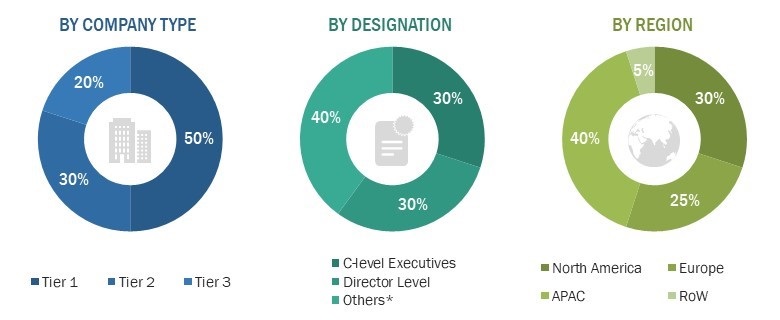
In the primary research process, various primary sources from both supply and demand sides have been interviewed to obtain qualitative and quantitative information important for this report. The primary sources from the supply side include industry experts such as CEOs, VPs, marketing directors, technology and innovation directors, and related executives from key companies and organizations operating in the industrial sensors market. After complete market engineering (including calculations regarding market statistics, market breakdown, market size estimations, market forecasting, and data triangulation), extensive primary research has been conducted to gather information as well as verify and validate the critical numbers arrived at.

To know about the assumptions considered for the study, download the pdf brochure
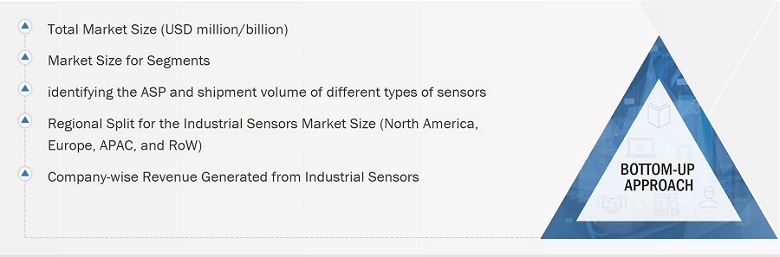
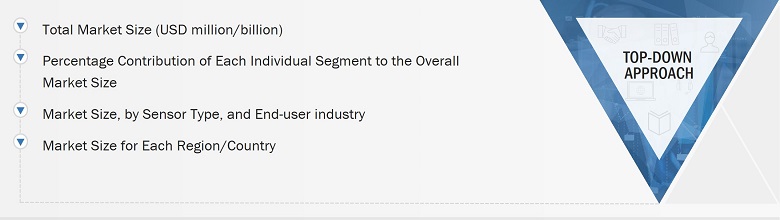
In the complete market engineering process, both top-down and bottom-up approaches have been implemented, along with several data triangulation methods, to estimate and validate the size of the industrial sensors market and other dependent submarkets listed in this report.
After arriving at the overall market size from the estimation process explained above, the overall market has been split into several segments and subsegments. To complete the overall market engineering process and arrive at the exact statistics for all segments and subsegments, the market breakdown and data triangulation procedures have been employed, wherever applicable. The data have been triangulated by studying various factors and trends identified from both demand and supply sides, in consumer electronics and automotive industries.
The following are the major objectives of the study.
Report Metric |
Details |
|
Market size available for years |
2015-2023 |
|
Base year considered |
2017 |
|
Forecast period |
2018-2023 |
|
Forecast units |
Value (USD) and Volume (Million Units) |
|
Segments covered |
Sensor, Type, Application, and Region |
|
Geographies covered |
North America, APAC, Europe and RoW |
|
Companies covered |
Rockwell Automation (US), Honeywell (US), Amphenol Corporation (US), Texas Instruments (US), Panasonic (Japan) |
This research report categorizes the industrial sensors market based on core type, device type, industry, and region.
With the given market data, MarketsandMarkets offers customizations according to the company’s specific needs. The following customization options are available for the report:
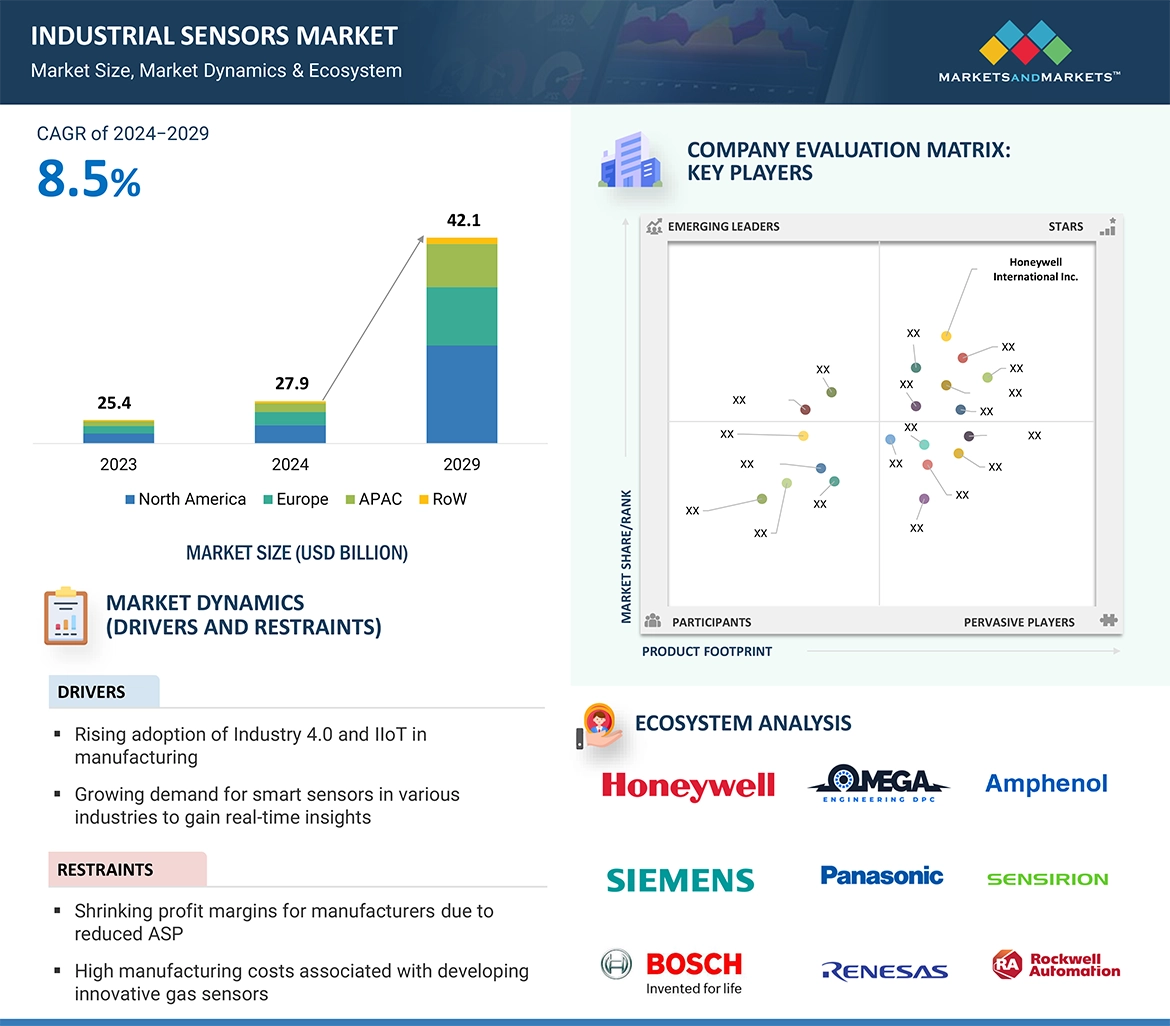
The industrial sensors market is expected to be valued at USD 16.0 billion in 2018 and is likely to reach USD 21.6 billion by 2023, at a CAGR of 6.16% during the forecast period. The growth of this market is propelled by growing Industrial 4.0 and IIoT, surging wireless sensors market, and burgeoning demand for industrial robots. However, high implementation cost is restraining the growth of this market.
In this report, the industrial sensors market has been segmented by sensor into level, image, gas, pressure, position, force, flow, temperature, and moisture & humidity. Among all sensors, level sensors are expected to hold the largest share of the market throughout the forecast period. Level sensors occupy a huge share of the industrial sensors market as they are used in major applications such as manufacturing and process industries, semiconductor manufacturing, automotive manufacturing, and aerospace and defense manufacturing.
Noncontact industrial sensors is a faster growing segment of the industrial sensors market. Increasing penetration of remote sensing and wireless sensing attributes to the growth of noncontact sensors in the market. The wireless sensors market is increasing due to factors such as increasing penetration in industrial automation applications; growing adoption of wearables in industrial facilities; emerging concepts, such as smart factory; and increasing applications in pharmaceuticals and mining industries and petroleum refineries.

To request to know about sample pages on the above findings, click Request Sample
APAC is expected to hold the largest share of the industrial sensors market in 2018. APAC is the largest market for industrial sensors because of the presence of China in this region. China’s manufacturing output is the largest in the world. Therefore, China is among the world’s largest manufacturer and industrial producers. It is one of the major manufacturers of consumer electronics, automobiles, etc.
A few major players operating in the industrial sensors market are Rockwell Automation (US), Honeywell (US), Amphenol Corporation (US), Texas Instruments (US), Panasonic (Japan), STMicroelectronics (Switzerland), First Sensor (Germany), and Siemens (Germany). Rockwell delivers a wide range of solutions and services for applications such as food & beverages, life sciences, oil & gas, mining, cement, metals, pulp & paper, and water & wastewater. The company offers start-to-end industrial services to its end users. The available solutions offer the company an advantage over its competitors for increased growth. The company adopts both organic and inorganic growth strategies. In the last 3 years, Rockwell Automation offered 2 products related to the industrial sensors segment.
To speak to our analyst for a discussion on the above findings, click Speak to Analyst
Table of Contents
1 Introduction (Page No. - 14)
1.1 Study Objectives
1.2 Definition
1.3 Market Scope
1.3.1 Markets Covered
1.3.2 Geographic Scope
1.3.3 Years Considered
1.4 Currency
1.5 Package Size
1.6 Stakeholders
2 Research Methodology (Page No. - 17)
2.1 Research Data
2.1.1 Secondary Data
2.1.1.1 Secondary Sources
2.1.2 Primary Data
2.1.2.1 Primary Sources
2.1.2.2 Key Industry Insights
2.2 Market Size Estimation
2.2.1 Bottom-Up Approach
2.2.2 Top-Down Approach
2.3 Market Breakdown & Data Triangulation
2.4 Research Assumptions
3 Executive Summary (Page No. - 26)
4 Premium Insight (Page No. - 29)
4.1 Attractive Opportunities for Industrial Sensors Market Growth
4.2 Market, By Type
4.3 Market in APAC
4.4 Market, By Geography
4.5 Market, By Application
5 Market Overview (Page No. - 32)
5.1 Introduction
5.2 Market Dynamics
5.2.1 Drivers
5.2.1.1 Growing Industrial 4.0 and IIoT
5.2.1.2 Increasing Industrial Wireless Sensor Market
5.2.1.3 Rising Demand for Industrial Robots
5.2.2 Restraints
5.2.2.1 Higher Implementation Cost of Sensor Networks
5.2.3 Opportunities
5.2.3.1 Predictive Maintenance to Offer Opportunities to Industrial Sensors Market in Coming Years
5.2.4 Challenges
5.2.4.1 Reluctance in Adopting Sensor Technology in Old Industries
6 Industrial Sensors Market, By Sensor (Page No. - 35)
6.1 Introduction
6.2 Level Sensor
6.2.1 Major Applications Such as Manufacturing and Process Industries are Driving Level Sensor Market
6.3 Temperature Sensor
6.3.1 Temperature Sensor Witnessing High Demand From Industries Such as Chemical & Petrochemical and Oil & Gas
6.4 Flow Sensor
6.4.1 Increasing Number of Applications and Development of New and Improved Technologies Have Resulted in Increased Adoption of Flow Sensors in Industries
6.5 Position Sensor
6.5.1 Linear Position Sensor
6.5.1.1 Linear Position Sensors are the Most Commonly Used Position Sensors in Industries
6.5.2 Angular Position Sensor
6.5.2.1 Industrial Robots Will Drive the Market for Angular Position Sensors
6.6 Pressure Sensor
6.6.1 Advancements in Mems Technology Into Pressure Sensors is Increasing the Adoption of Pressure Sensors in Industries
6.7 Force Sensor
6.7.1 Increasing Use of Industrial Robots is Driving the Market for Force Sensors in Industries
6.8 Humidity and Moisture Sensor
6.8.1 Trend of Miniaturization is Driving the Market for Humidity and Moisture Sensors
6.9 Image Sensor
6.9.1 Machine Vision is the Primary Driving Factor for Use of Image Sensor in Industries
6.1 Gas Sensor
6.10.1 Increasing Enforcement of Occupational Health and Safety Regulations By Government is Positively Impacting Gas Sensor Market
7 Industrial Sensors Market, By Type (Page No. - 49)
7.1 Introduction
7.2 Contact
7.2.1 Temperature Sensors Hold Largest Share of Contact Type Sensors During Forecast Period
7.3 Noncontact
7.3.1 Image Sensor are Fastest-Growing Noncontact Type Industrial Sensors
8 Industrial Sensors Market, By Application (Page No. - 53)
8.1 Introduction
8.2 Manufacturing
8.2.1 Trend of IIoT is Driving Industrial Sensors Market in Manufacturing Application
8.3 Oil & Gas
8.3.1 Increasing Use of Humidity and Moisture Sensors to Drive Use of Sensors in Oil & Gas Industry
8.4 Chemicals
8.4.1 Stringent Safety Regulations in Chemicals Industry to Drive Industrial Sensors Market
8.5 Pharmaceuticals
8.5.1 Supervision and Management of Various Processes Occurring at Production Floor are Key Applications of Industrial Sensors in Pharmaceutical Industry
8.6 Energy & Power
8.6.1 IoT is Promoting Use of Sensors in Smart Grids for Various Applications on Various Parameters Such as Power Leakages, Tampering, and Third-Party Interferences
8.7 Mining
8.7.1 Safety Concerns in Mining Industry is Increasing the Demand for Sensors
9 Geographic Analysis (Page No. - 70)
9.1 Introduction
9.2 Europe
9.2.1 UK
9.2.1.1 UK is Fastest-Growing Country for Industrial Sensors in the European Region
9.2.2 Germany
9.2.2.1 Automotive Manufacturing is Driving the Market for Industrial Sensors in Germany
9.2.3 France
9.2.3.1 Upcoming Safety Regulations to Drive Industrial Sensors Market in France in Near Future
9.2.4 Rest of Europe
9.3 APAC
9.3.1 China
9.3.1.1 Upcoming Safety Regulations to Drive Industrial Sensors Market in France in Near Future
9.3.2 Japan
9.3.2.1 Increasing Use of Robotics in Industries Will Increase the Demand of Industrial Sensors in Japan
9.3.3 Rest of APAC
9.4 North America
9.4.1 UK
9.4.1.1 Oil & Gas, Manufacturing and Pharmaceuticals are Driving Industrial Sensors Market in the Us
9.4.2 Canada
9.4.2.1 Automotive Manufacturing is Driving the Market for Industrial Sensors in Canada
9.4.3 Mexico
9.4.3.1 Mexico’s Automotive Industry is Growing Due to Availability of Cheap Labor and Lenient Restrictions on Manufacturing and Licensing Operations
9.5 RoW
10 Competitive Landscape (Page No. - 82)
10.1 Introduction
10.2 Market Ranking Analysis (Level Sensor Market)
10.3 Competitive Situations and Trends
10.3.1 Product Launches
10.3.2 Mergers and Acquisitions
10.3.3 Product Development
10.3.4 Contracts and Agreements
10.3.5 Partnership
11 Company Profile (Page No. - 90)
11.1 Introduction
(Business Overview, Products Offered, Recent Developments, SWOT Analysis, and MnM View)*
11.2 Key Players
11.2.1 Rockwell Automation
11.2.2 Honeywell
11.2.3 Texas Instruments
11.2.4 Panasonic
11.2.5 Stmicroelectronics
11.2.6 First Sensor
11.2.7 Siemens
11.2.8 Amphenol Corporation
11.2.9 Integrated Device Technology
11.2.10 Bosch Sensortec
11.3 Other Key Players
11.3.1 Te Connectivity
11.3.2 Omega Engineering
11.3.3 Sensirion
11.3.4 AMS AG
11.3.5 Microchip
11.3.6 NXP Semiconductors
11.3.7 Endress+Hauser Management AG
11.3.8 Teledyne Technologies Incorporated
11.3.9 Figaro Engineering Inc.
11.3.10 Safran Colibrys SA
*Details on Business Overview, Products Offered, Recent Developments, SWOT Analysis, and MnM View Might Not Be Captured in Case of Unlisted Companies.
12 Appendix (Page No. - 120)
12.1 Insights of Industry Experts
12.2 Discussion Guide
12.3 Knowledge Store: Marketsandmarkets’ Subscription Portal
12.4 Available Customizations
12.5 Related Reports
12.6 Author Details
List of Tables (67 Tables)
Table 1 Industrial Sensors Market, By Sensor, 2015–2023 (USD Million)
Table 2 Industrial Sensors Market, By Sensor, 2015–2023 (Million Units)
Table 3 Level Sensor Market, By Type, 2015–2023 (USD Million)
Table 4 Level Sensor Market, By Application, 2015–2023 (USD Million)
Table 5 Temperature Sensor Market, By Type, 2015–2023 (USD Million)
Table 6 Temperature Sensor Market, By Application, 2015–2023 (USD Million)
Table 7 Flow Sensor Market, By Type, 2015–2023 (USD Million)
Table 8 Flow Sensor Market, By Application, 2015–2023 (USD Million)
Table 9 Position Sensor Market, By Type I, 2015–2023 (USD Million)
Table 10 Position Sensor Market, By Type Ii, 2015–2023 (USD Million)
Table 11 Linear Position Sensor Market, By Type, 2015–2023 (USD Million)
Table 12 Angular Position Sensor Market, By Type, 2015–2023 (USD Million)
Table 13 Position Sensor Market, By Application, 2015–2023 (USD Million)
Table 14 Pressure Sensor Market, By Type, 2015–2023 (USD Million)
Table 15 Pressure Sensor Market, By Application, 2015–2023 (USD Million)
Table 16 Force Sensor Market, By Application, 2015–2023 (USD Million)
Table 17 Humidity and Moisture Sensor Market, By Application, 2015–2023 (USD Million)
Table 18 Image Sensor Market, By Application, 2015–2023 (USD Million)
Table 19 Gas Sensor Market, By Type, 2015–2023 (USD Million)
Table 20 Gas Sensor Market, By Application, 2015–2023 (USD Million)
Table 21 Industrial Sensors Market, By Type, 2015–2023 (USD Million)
Table 22 Market for Contact Type, By Sensor, 2015–2023 (USD Million)
Table 23 Market for Noncontact Type, By Sensor, 2015–2023 (USD Million)
Table 24 Market, By Application, 2015–2023 (USD Million)
Table 25 Market for Manufacturing, By Sensor, 2015–2023 (USD Million)
Table 26 Market for Manufacturing, By Region, 2015–2023 (USD Million)
Table 27 Market in North America, By Country, 2015–2023 (USD Million)
Table 28 Market in APAC, By Country, 2015–2023 (USD Million)
Table 29 Market in Europe, By Country, 2015–2023 (USD Million)
Table 30 Market for Oil & Gas, By Sensor, 2015–2023 (USD Million)
Table 31 Market for Oil & Gas, By Region, 2015–2023 (USD Million)
Table 32 Market in North America, By Country, 2015–2023 (USD Million)
Table 33 Market in APAC, By Country, 2015–2023 (USD Million)
Table 34 Market in Europe, By Country, 2015–2023 (USD Million)
Table 35 Market for Chemicals, By Sensor, 2015–2023 (USD Million)
Table 36 Market for Chemicals, By Region, 2015–2023 (USD Million)
Table 37 Market in North America, By Country, 2015–2023 (USD Million)
Table 38 Market in APAC, By Country, 2015–2023 (USD Million)
Table 39 Market in Europe, By Country, 2015–2023 (USD Million)
Table 40 Market for Pharmaceuticals, By Sensor, 2015–2023 (USD Million)
Table 41 Market for Pharmaceuticals, By Region, 2015–2023 (USD Million)
Table 42 Market in North America for Pharmaceuticals, By Country, 2015–2023 (USD Million)
Table 43 Market in APAC for Pharmaceuticals, By Country, 2015–2023 (USD Million)
Table 44 Market in Europe for Pharmaceuticals, By Country, 2015–2023 (USD Million)
Table 45 Market for Energy & Power, By Sensor, 2015–2023 (USD Million)
Table 46 Market for Energy & Power, By Region, 2015–2023 (USD Million)
Table 47 Market in North America for Energy & Power, By Country, 2015–2023 (USD Million)
Table 48 Market in APAC for Energy & Power, By Country, 2015–2023 (USD Million)
Table 49 Market in Europe for Energy & Power, By Country, 2015–2023 (USD Million)
Table 50 Market for Mining, By Sensor, 2015–2023 (USD Million)
Table 51 Market for Mining, By Region, 2015–2023 (USD Million)
Table 52 Market in North America for Mining, By Country, 2015–2023 (USD Million)
Table 53 Industrial Sensors Market in APAC for Mining, By Country, 2015–2023 (USD Million)
Table 54 Industrial Sensors Market in Europe for Mining, By Country, 2015–2023 (USD Million)
Table 55 Industrial Sensors Market, By Region, 2015–2023 (USD Million)
Table 56 Industrial Sensors Market in Europe, By Application, 2015–2023 (USD Million)
Table 57 Industrial Sensors Market in Europe, By Country, 2015–2023 (USD Million)
Table 58 Industrial Sensors Market in APAC, By Application, 2015–2023 (USD Million)
Table 59 Industrial Sensors Market in APAC, By Country, 2015–2023 (USD Million)
Table 60 Industrial Sensors Market in North America, By Application, 2015–2023 (USD Million)
Table 61 Industrial Sensors Market in North America, By Country, 2015–2023 (USD Million)
Table 62 Industrial Sensors Market in RoW, By Application, 2015–2023 (USD Million)
Table 63 Product Launches, 2015–2018
Table 64 Acquisitions, 2015–2018
Table 65 Product Developments, 2015–2018
Table 66 Contracts and Agreements, 2015–2018
Table 67 Partnership, 2015–2018
List of Figures (34 Figures)
Figure 1 Research Design
Figure 2 Breakdown of Primaries
Figure 3 Research Flow of Market Size Estimation
Figure 4 Market Size Estimation Methodology: Bottom-Up Approach
Figure 5 Market Size Estimation Methodology: Top-Down Approach
Figure 6 Data Triangulation
Figure 7 Level Sensors to Hold Largest Size of Industrial Sensors Market During Forecast Period
Figure 8 Industrial Sensors Market By Noncontact Type to Grow at Higher CAGR During Forecast Period
Figure 9 Industrial Sensors Market for Manufacturing Applications to Grow at Highest CAGR During Forecast Period
Figure 10 APAC Held Largest Share of Industrial Sensors Market in 2017
Figure 11 Increasing Use of Industrial Sensors in Manufacturing to Offer Opportunities for Market Growth
Figure 12 Level Sensor Expected to Hold Largest Share of Industrial Sensors Market During Forecast Period
Figure 13 Manufacturing Held Largest Share of Industrial Sensors Market in APAC in 2017
Figure 14 Industrial Sensors Market in US to Grow at Highest CAGR During Forecast Period
Figure 15 Pharmaceuticals to Grow at Highest CAGR During Forecast Period
Figure 16 Image Sensor to Grow at Highest CAGR During Forecast Period
Figure 17 Mining Application to Grow at Highest CAGR During Forecast Period
Figure 18 Noncontact Type Industrial Sensors to Grow at Higher CAGR During Forecast Period
Figure 19 Pharmaceuticals to Grow at Highest CAGR During Forecast Period
Figure 20 Pharmaceutical Application in North America to Grow at Highest CAGR During Forecast Period
Figure 21 Europe: Snapshot of Industrial Sensors Market
Figure 22 APAC: Snapshot of Industrial Sensors Market
Figure 23 North America: Snapshot of Industrial Sensors Market
Figure 24 Level Sensor Manufacturers
Figure 25 Product Launch: Key Strategy Adopted By Major Players During 2015–2018
Figure 26 Rockwell: Company Snapshot
Figure 27 Honeywell: Company Snapshot
Figure 28 Texas Instruments: Company Snapshot
Figure 29 Panasonic: Company Snapshot
Figure 30 Stmicroelectronics: Company Snapshot
Figure 31 First Sensor: Company Snapshot
Figure 32 Siemens: Company Snapshot
Figure 33 Amphenol: Company Snapshot
Figure 34 Integrated Device Technology: Company Snapshot
Growth opportunities and latent adjacency in Industrial Sensors Market
I would like to collect information about Singapore Industrial Market, for a potential business opportunity in the future. Have you considered IIoT-based sensors in the scope of your report?
Does industrial sensor market report cover elemental analysis? Asset protection? Alternate technologies such as lab based Big Data?
I am interested in the applications of radar systems, especially imaging radar systems for detailed object localization. Have you considered RADAR systems in the scope of your study?
My interest in specifically into Mobile Hydraulics and Industrial Automation. Does the industrial sensor market provide it? Also, what is the market scope? Could you provide me with the overview or a particular brochure for the same?
As a student I want to identify which industry has the highest demand on sensors especially in combination of IoT-Applications in the overall industrial applications. Also which are the specific sensors that are required for industrial automation.
Looking for a report for the purpose of detailing information about competitors (size, SWOT, characteristics), industry (profitability, size, and growth), and market shares in the industrial sensors market. Could you provide me the details of the same?
I´d like to read the report with the code 6767 (Industrial Sensor Market) as a sample. Please contact me if you have further questions.
I am interested in the applications of radar systems, especially imaging radar systems for detailed object localization. Have you considered RADAR systems in the scope of your study?
Looking for market data to accomplish a market study for our current products which is aligned with sensors used in industrial applications and to help assess new product market.
Trying to understand the industrial sensors market to determine if the vertical is worth pursuing more aggressively at a broader fund level / making it a key industry of focus.
I am currently preparing estimates of commercial opportunity for a wide range of sensor types. I am seeking a report that estimates market size for sensors in relatively narrow selections across various industry verticals.
Humidity sensors market size and hygrometer market size in Pharma , F&B, semiconductor, pulp and paper and in harsh environments like oil and gas, petrochemical, refineries and fuel cells.
Looking to review the industrial sensor market report. I need to understand the research methodology which you have followed.
Primary interest in the growth of hydraulic cylinder position sensors in the mobile market. Of secondary interest would be new markets for our mobile oriented level sensors which would be aligned with industrial applications