
Europe Industrial Data Management Market (2025-2030)

The Europe Industrial Data Management Market was valued at $27610.3 Million in 2025 and projected to reach to $51966.6 Million by 2030, representing a compound annual growth rate of 13.5%. Europe's Industrial Data Management Market is positioned for sustained growth through 2030, driven by the region's commitment to digital transformation and advanced manufacturing practices.


| Market Size in | USD 26.32 MN |
| Market Forecast in | |
| CAGR | |
| Forecast Period | |
| Units Considered | Value (USD MN) |
Europe Industrial Data Management Market Trends and Insights
- This 13.5% compound annual growth rate reflects Europe's strong commitment to digital transformation across the semiconductor and electronics sectors.
- Europe's manufacturing base, coupled with stringent data governance regulations and Industry 4.0 adoption, is driving demand for advanced data management solutions. The European market benefits from a mature industrial ecosystem and significant investment in smart manufacturing technologies.
- Europe's focus on sustainability and compliance-driven data practices positions the region as a leader in enterprise-grade data management implementations.
- Between 2025 and 2030, Europe is expected to capture increasing market share as organizations modernize legacy systems and integrate AI-driven analytics into production workflows. Europe's competitive advantage stems from its regulatory framework, skilled workforce, and collaborative innovation environment.
- The region's emphasis on data sovereignty and privacy standards creates unique opportunities for localized data management solutions tailored to European enterprises..
Key Market Statistics
- CAGR (2025-2030) 13.5% CAGR
- Market Size, 2025 ~USD 27610.3 Million
- Forecast, 2030 ~USD 51966.6 Million
- Geography Europe
Europe Industrial Data Management Market Overview
Market Valuation & Growth :
Europe's Industrial Data Management Market is valued at $27,610.3 million in 2025, with a projected expansion to $51,966.6 million by 2030, representing a robust 13.5% CAGR driven by digital transformation initiatives across semiconductor and electronics manufacturing.
Regulatory & Compliance Drivers :
Stringent data governance regulations including GDPR and emerging EU data sovereignty requirements are accelerating adoption of advanced data management solutions across European semiconductor and electronics manufacturers.
Manufacturing Excellence :
Europe's established semiconductor and electronics manufacturing base, supported by Industry 4.0 initiatives, is creating strong demand for integrated industrial data management platforms to optimize production efficiency and supply chain visibility.
Regional Leadership :
Germany and the UK lead European adoption with combined market sizes exceeding $20.6 billion, while emerging markets in Poland and the Nordics present significant growth opportunities for data management solution providers.
Europe Industrial Data Management Market Dynamics
- The semiconductor and electronics sectors are increasingly investing in data management infrastructure to meet regulatory compliance requirements and enhance operational efficiency.
- Germany's manufacturing prowess and the UK's technology innovation ecosystem are catalyzing market expansion across the continent. The market outlook remains positive as European manufacturers prioritize data-driven decision-making and real-time analytics capabilities.
- Investment in Industry 4.0 technologies, coupled with EU-wide digital initiatives and data sovereignty mandates, will continue to fuel demand for sophisticated industrial data management solutions.
- Regional players and global vendors are expanding their presence to capture opportunities in this high-growth market segment..
Market Ecosystem
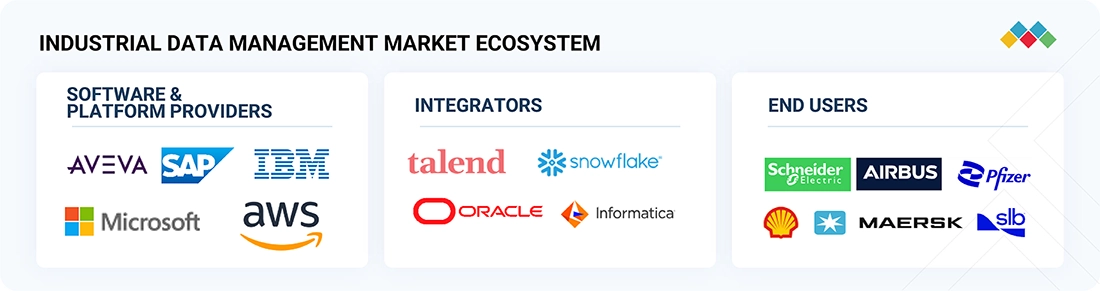
Industrial Data Management Market TRENDS: COMMERCIAL USE CASES ACROSS INDUSTRIES
| COMPANY | USE CASE DESCRIPTION | BENEFITS |
|---|---|---|
 |
Operational telemetry & historian replacement (ingest OPC-UA / IoT Edge → Azure). |Manufacturing execution systems (MES) and shop-floor transactional workloads. |Predictive maintenance pipelines combining time-series + relational dat | Fully-managed PaaS (Azure SQL) and integrated industrial playbook speeds deployments and reduces DB admin overhead; good high-availability and scale for OLTP + near-real-time analytics |
 |
Global transactional systems that need strong consistency and horizontal scale (Spanner). Large-scale analytics / data-warehouse for manufacturing telemetry, digital twins and supply-chain analytics (BigQuery). Real-time fusion of transactional + analytical workloads (Spanner → BigQuery integration | True global scale + strong consistency for OLTP (Spanner) and serverless, fast analytics (BigQuery),reduced ETL friction via native integrations so teams can run real-time analytics on operational data. |
 |
ERP + asset management backplane (S/4HANA) for utilities, oil & gas, discrete manufacturing. In-memory processing for near-real-time asset analytics and regulatory reporting. | Tight integration between high-performance HANA DB and SAP business processes (ERP/EAM) shortens time-to-insight for maintenance, compliance and billing use cases; good for industries needing regulatory reporting and integrated transactions + analytics. |
 |
Plant & supply-chain data consolidation, manufacturing analytics, and centralized operational repositories. Heavy OLTP workloads and multi-site ERP/PLM integrations in mining, oil & gas, heavy industry... | Mature enterprise DB features (performance tuning, security, monitoring) combined with Oracle industry-cloud solutions reduce integration complexity for large industrial customers and help manage regulatory/operational data at scale |
 |
Real-time ingestion and event-stream analytics for sensor/time-series data (Db2 Event Store). Enterprise asset management and APM (Maximo) with a central operational datastore. Hybrid deployments (on-prem / cloud) for utilities and energy.. | Strength in asset-centric workflows (Maximo) plus Db2’s high-availability and real-time ingestion capabilities makes IBM strong for asset-heavy industries that require integrated EAM + operational analytics and hybrid deployment options... |
Logos and trademarks shown above are the property of their respective owners. Their use here is for informational and illustrative purposes only.
Related Ecosystem
Industrial Automation
- Sensors
- Image Sensors
- Manufacturing Execution System (MES)
- Actuators
- Flow Sensors
- Siemens ag
- ABB India Limited
- Emerson Electric Co.
- HONEYWELL INTERNATIONAL INC.
- SCHNEIDER ELECTRIC SE
Information System And Analytics
- Machine Learning
- Natural Language Processing (NLP)
- Sensors
- Software as A Service (SaaS)
- Data Loss Prevention (DLP)
- International Business Machines Corporation
- MICROSOFT CORPORATION
- Amazon.com, Inc.
- Oracle Corporation
Key Takeaways
- Europe's Industrial Data Management Market will nearly double from $27.6B (2025) to $52.0B (2030), driven by 13.5% CAGR growth.
- Europe's regulatory environment and GDPR compliance requirements accelerate adoption of sophisticated data management platforms.
- Industry 4.0 initiatives across European manufacturing create sustained demand for real-time data analytics and integration solutions.
- Europe's emphasis on data sovereignty and localized infrastructure differentiates the region's market dynamics from global competitors.
Industrial Data Management Market Report Scope
| Report Metric | Details |
|---|---|
| Base Year | 2025 |
| Fastest Growing Segment | CLOUD-BASED (Deployment) |
| Forecast Period | 2025–2030 |
| Growth Rate | CAGR of 15.2% from 2025 to 2030 |
| Largest Segment | SOFTWARE (Offering) |
| Market Size Base Year (Billions) | ~USD 105.08 (2025) |
| Revenue Forecast (Billions) | ~USD 213.2 (2030) |
| Segments Covered | Type, Industry, Offering, Data Stack Management, Deployment, Organization Type, Data Type, Semi-Structured, Data Management Stack |
Europe Industrial Data Management Market Report Segmentation
9 segment dimensions are covered across the global market.
By Type
- Data Governance & Compliance
- Data Integration & Storage
- Data Orchestration & Analytics
- Data Security
- Data Sharing
- Data Visualization
By Industry
- Bfsi
- Energy & Utilities
- Healthcare
- Healthcare & Life Sciences
- Manufacturing & Processing
- Telecom & Networking
- Warehousing & Logistics
By Offering
- Services
- Software
By Data Stack Management
- Legacy
- Modern
By Deployment
- Cloud-Based
- Hybrid
- On-Premises
By Organization Type
- Large
- Small & Mid-Sized
By Data Type
- Semi-Structured
- Structured
- Unstructured
By Semi-Structured
- Bfsi
- Energy & Utilities
- Healthcare
- Manufacturing & Processing
- Telecom & Networking
- Warehousing & Logistics
By Data Management Stack
- Legacy
- Modern
EUROPE: INDUSTRIAL DATA MANAGEMENT MARKET, BY INDUSTRY, 2025–2030
| Segment | 2025 | 2026 | 2027 | 2028 | 2029 | 2030 | CAGR (%) |
|---|---|---|---|---|---|---|---|
| BFSI | 7227.8 | 8023.2 | 8990.2 | 10176.4 | 11645.9 | 13794.4 | 13.8 |
| ENERGY & UTILITIES | 1854.8 | 1949.4 | 2068 | 2215.7 | 2399.5 | 2622.3 | 7.2 |
| HEALTHCARE & LIFE SCIENCES | 5301.3 | 5941.4 | 6717.8 | 7668.9 | 8846.2 | 10138.2 | 13.8 |
| MANUFACTURING | 8661.3 | 9754 | 11090.9 | 12743.2 | 14807.4 | 17362 | 14.9 |
| TELECOM & NETWORKING | 2866.5 | 3141.3 | 3471.3 | 3870.7 | 4358.6 | 4933.5 | 11.5 |
| WAREHOUSING & LOGISTICS | 1698.6 | 1883.3 | 2106.9 | 2380 | 2717.1 | 3116.3 | 12.9 |
| TOTAL | 27610.3 | 30692.7 | 34445.1 | 39055 | 44774.7 | 51966.6 | 13.5 |
Target Audience
- Software & Data Management Vendors : Identify market opportunities and competitive positioning across European regions to optimize product development, pricing strategies, and go-to-market approaches for industrial data solutions.
- Semiconductor & Electronics Manufacturers : Benchmark data management investments against regional peers, understand compliance requirements, and evaluate technology solutions to enhance operational efficiency and regulatory adherence.
- System Integrators & Consultants : Access market intelligence to identify client opportunities, develop service offerings aligned with regional regulatory requirements, and support digital transformation initiatives across Europe.
- Investment & Private Equity Firms : Evaluate market growth potential, identify acquisition targets, and assess investment opportunities in European industrial data management companies and technology providers.
- Government & Policy Organizations : Understand industrial data management adoption trends, regulatory effectiveness, and digital transformation progress to inform policy development and industry support initiatives across Europe.
Countries within Europe - compare and drill down
| Country | 2025 size (native) |
|---|---|
| France | USD 7622.8 Million |
| Germany | USD 10453 Million |
| Italy | USD 5760.3 Million |
| Nordics | USD 3628.2 Million |
| Poland | USD 3752.5 Million |
| Spain | USD 5559.9 Million |
| UK | USD 10242.1 Million |
| Rest Of Europe | USD 4947.9 Million |
Country market size visualization
Reasons to Buy this Report
- Country-Level Market Insights : Gain detailed market sizing and growth projections for 9 European countries including Germany, UK, France, and emerging markets like Poland, enabling targeted market entry and expansion strategies.
- Regulatory Compliance Intelligence : Understand how GDPR, EU data sovereignty, and emerging compliance frameworks are shaping industrial data management adoption across Europe, critical for solution positioning and sales strategies.
- Competitive Landscape Analysis : Identify regional leaders and growth opportunities across diverse European markets, from mature Western European economies to high-growth Central and Eastern European regions.
- Sector-Specific Opportunities : Access semiconductor and electronics industry-specific insights for Europe, including manufacturing trends, digital transformation priorities, and technology investment patterns.
- Strategic Growth Planning : Leverage 5-year forecast data (2025-2030) to develop long-term market strategies, resource allocation plans, and partnership opportunities across Europe's industrial data management ecosystem.
Frequently asked questions
What is the projected size of Europe's Industrial Data Management Market by 2030?
Europe's Industrial Data Management Market is projected to reach $51,966.6 million by 2030, growing from $27,610.3 million in 2025.
What is the CAGR for Europe's Industrial Data Management Market?
Europe's Industrial Data Management Market is expected to grow at a compound annual growth rate of 13.5% between 2025 and 2030.
What factors are driving growth in Europe's Industrial Data Management Market?
Europe's growth is driven by Industry 4.0 adoption, GDPR compliance requirements, digital transformation initiatives, and increased investment in smart manufacturing technologies.
How does Europe's data management market compare to global trends?
Europe's 13.5% CAGR is slightly below the global 15.2% CAGR, but Europe's market is characterized by stronger regulatory compliance focus and data sovereignty requirements.
Which industries in Europe are driving Industrial Data Management demand?
Europe's semiconductor and electronics sectors are primary drivers, supported by automotive, manufacturing, and industrial automation industries implementing advanced data management solutions.
RESEARCH METHODOLOGY
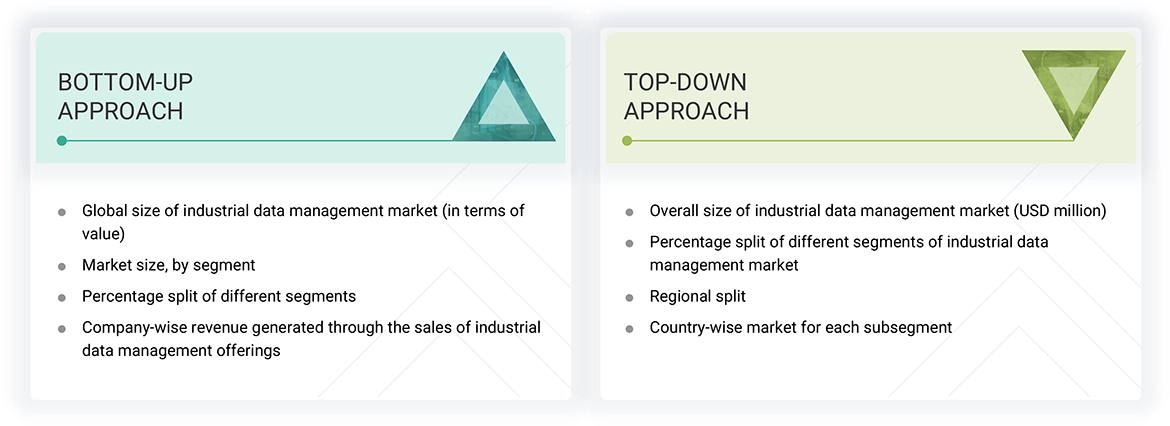
The study utilized four major activities to estimate the industrial data management market size. Exhaustive secondary research was conducted to gather information on the market and its peer and parent markets. The next step was to validate these findings, assumptions, and sizing with industry experts across the value chain through primary research. Both the top-down and bottom-up approaches were employed to estimate the total market size. Finally, market breakdown and data triangulation methods were utilized to estimate the market size for different segments and subsegments.
Secondary Research
In the secondary research process, various sources were used to identify and collect information on the industrial data management market for this study. Secondary sources for this research study include corporate filings (such as annual reports, investor presentations, and financial statements), trade, business, and professional associations, white papers, certified publications, articles by recognized authors, directories, and databases. Secondary data was collected and analyzed to determine the overall market size, which was further validated through primary research.
List of Key Secondary Sources
|
Source |
Web Link |
|
The International Organization of Motor Vehicle Manufacturers |
https://www.oica.net/ |
|
Energy Information Administration |
https://www.eia.gov/ |
|
Federal Aviation Administration |
https://www.faa.gov/ |
|
ASEAN Automotive Federation |
https://www.asean-autofed.com/ |
|
International Society of Automation |
|
|
International Federation of Robotics |
|
|
Technology & Services Industry Association (TSIA). |
Primary Research
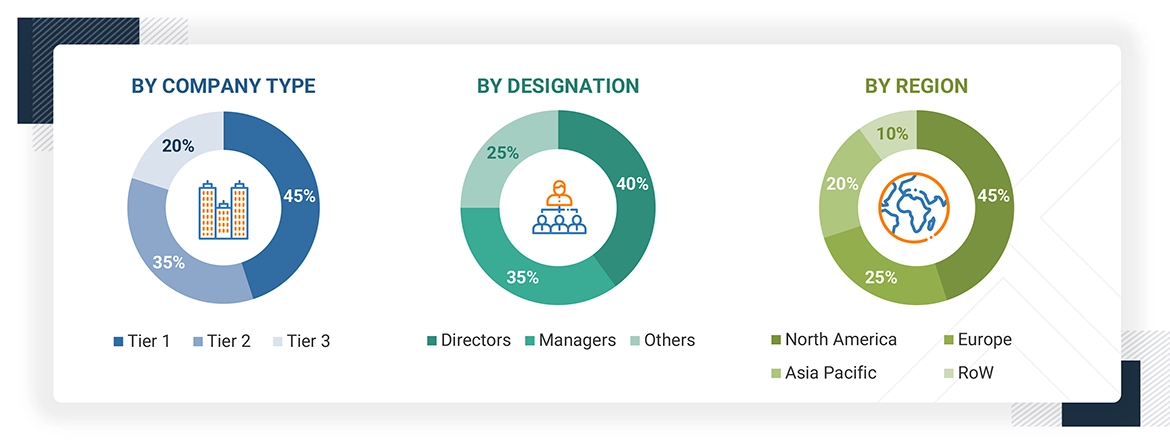
Primary interviews were conducted to gather insights into market statistics, revenue data, market breakdowns, size estimations, and forecasting. Additionally, primary research was used to comprehend the various technologies, types, end-uses, and regional trends. Interviews with stakeholders from the demand side, including CIOs, CTOs, CSOs, and customer/end-user installation teams using industrial data management offerings and processes, were also conducted to understand their perspective on suppliers, products, component providers, and their current and future use of industrial data management, which will impact the overall market. Several primary interviews were conducted across major countries in North America, Europe, Asia Pacific, and RoW.
To know about the assumptions considered for the study, download the pdf brochure
Market Size Estimation
In the complete market engineering process, the top-down and bottom-up approaches and several data triangulation methods have been used to estimate and forecast the overall market segments and subsegments listed in this report. Key players in the market have been identified through secondary research, and their market shares in the respective regions have been determined through primary and secondary research. This entire procedure includes the study of annual and financial reports of the top market players and extensive interviews for key insights (quantitative and qualitative) with industry experts (CEOs, VPs, directors, and marketing executives).
All percentage shares, splits, and breakdowns have been determined using secondary sources and verified through primary sources. All the parameters affecting the markets covered in this research study have been accounted for, viewed in detail, verified through primary research, and analyzed to obtain the final quantitative and qualitative data. This data has been consolidated and supplemented with detailed input and analysis from MarketsandMarkets and presented in this report. The following figure represents this study's overall market size estimation process.
Industrial Data Management Market : Top-Down and Bottom-Up Approach
Data Triangulation
Once the overall size of the industrial data management market was determined using the methods described above, it was divided into multiple segments and subsegments. Market engineering was performed for each segment and subsegment using market breakdown and data triangulation methods, as applicable, to obtain accurate statistics. Various factors and trends from the demand and supply sides were studied to triangulate the data. The market was validated using both the top-down and bottom-up approaches.
Market Definition
The industrial data management refers to the sector focused on the collection, storage, analysis, and utilization of data generated by industrial operations and processes. This market encompasses a range of solutions, including data storage and analysis systems, historians, cloud platforms, and analytics tools that help organizations manage the vast amounts of data produced by machinery, sensors, and control systems in industries such as manufacturing, energy, oil & gas, and utilities. The primary goal is to improve operational efficiency, enable predictive maintenance, ensure regulatory compliance, and support data-driven decision-making. As industries increasingly adopt Industrial Internet of Things (IIoT) technologies, automation, and digital transformation initiatives, the demand for robust and scalable data management solutions continues to grow.
The report study covers a comprehensive analysis of the industrial data management market based on type, offering, stack, data type, organization type, vertical, and region. A few key providers of industrial data management are Microsoft (US), Alphabet Inc. (US), SAP (Germany), Oracle (US), IBM (US), and AWS (US).
Key Stakeholders
- Technology & Solution Providers
- System Integrators & IT Service Providers
- Research & Academic Institutions
- Government & Regulatory Bodies and Financial Institutions
- ODM and OEM Technology Solution Providers
- Industrial Data Management Software and Services Providers and Distributors
- Market Research and Consulting Firms
- Associations, Organizations, Forums, and Alliances related to the Industrial Data Management Industry
- Technology Investors
- Venture Capitalists, Private Equity Firms, and Start-ups
- End Users
Report Objectives
- To describe and forecast the industrial data management market size by type, offering, stack, data type, organization type, industry, and region, in terms of value
- To describe and forecast the market for various segments across four main regions, namely, North America, Europe, Asia Pacific, and RoW, in terms of value
- To strategically analyze micromarkets about individual growth trends, prospects, and market contributions
- To provide detailed information regarding drivers, restraints, opportunities, and challenges influencing the market growth
- To analyze opportunities for stakeholders by identifying high-growth segments in the market
- To provide a detailed overview of the industrial data management value chain
- To strategically analyze key technologies, indicative selling price trend, trends impacting customer business, ecosystem, regulatory landscape, patent landscape, Porter's five forces, import and export scenarios, trade landscape, key stakeholders and buying criteria, and case studies about the market under study
- To strategically profile key players in the industrial data management market and comprehensively analyze their market share and core competencies
- To analyze competitive developments, such as partnerships, acquisitions, expansions, collaborations, and product launches, along with R&D in the industrial data management market
Available Customizations
With the given market data, MarketsandMarkets offers customizations according to the specific requirements of companies. The following customization options are available for the report:
- Detailed analysis and profiling of additional market players (up to 5)
- Additional country-level analysis of the industrial data management market
Product Analysis
- The product matrix provides a detailed comparison of the product portfolio of each company in the industrial data management market
Get the Full Industrial Data Management Market Report
Full forecast, segment splits, and company analysis for all Industrial Data Management Market.
- Canada Industrial Data Management Market
- Mexico Industrial Data Management Market
- US Industrial Data Management Market
- France Industrial Data Management Market
- Germany Industrial Data Management Market
- Italy Industrial Data Management Market
- Nordics Industrial Data Management Market
- Poland Industrial Data Management Market
- Rest Of Europe Industrial Data Management Market
- Spain Industrial Data Management Market
- UK Industrial Data Management Market
- Australia Industrial Data Management Market
- China Industrial Data Management Market
- India Industrial Data Management Market
- Indonesia Industrial Data Management Market
- Japan Industrial Data Management Market
- Malaysia Industrial Data Management Market
- Rest Of Asia Pacific Industrial Data Management Market
- South Korea Industrial Data Management Market
- Thailand Industrial Data Management Market
- Vietnam Industrial Data Management Market
Need a Tailored Report?
Customize this report to your needs
Get 10% FREE Customization
Customize This Report
