
Asia Pacific Industrial Filtration Market (2024-2029)

The Asia Pacific Industrial Filtration Market was valued at $7452 Million in 2024 and projected to reach to $9691.1 Million by 2029, representing a compound annual growth rate of 5.4%. The Asia Pacific industrial filtration market is poised for sustained expansion through 2029, driven by accelerating industrialization across China, India, and Southeast Asia.


| Market Size in | USD 26.32 MN |
| Market Forecast in | |
| CAGR | |
| Forecast Period | |
| Units Considered | Value (USD MN) |
Asia Pacific Industrial Filtration Market Trends and Insights
- Asia Pacific's 5.4% compound annual growth rate outpaces the global average, driven by rapid industrialization, stringent environmental regulations, and increasing demand from power generation and manufacturing sectors across the region.
- The market in Asia Pacific is characterized by rising investments in air and water quality management, particularly in emerging economies where industrial expansion is accelerating. Key drivers propelling Asia Pacific's filtration market include growing energy consumption, expansion of thermal and renewable power plants, and heightened focus on emission control standards.
- Asia Pacific's manufacturing base, coupled with increasing adoption of advanced filtration technologies, supports sustained market expansion through 2029.
- The region's competitive landscape features both established global players and emerging local manufacturers, creating diverse opportunities for market participants across Asia Pacific..
Key Market Statistics
- CAGR (2024-2029) 5.4% CAGR
- Market Size, 2024 ~USD 7452 Million
- Forecast, 2029 ~USD 9691.1 Million
- Geography Asia Pacific
Asia Pacific Industrial Filtration Market Overview
Market Leadership by China :
China dominates the Asia Pacific industrial filtration market with USD 4,615.9 million in 2024, driven by massive manufacturing expansion, coal-fired power plants, and strict air quality standards requiring advanced filtration solutions.
India's Rapid Industrialization :
India's market valued at USD 1,596.3 million is accelerating due to growing power generation capacity, automotive manufacturing, and environmental compliance requirements across industrial sectors.
Regional Growth Outpacing Global Average :
Asia Pacific's 5.4% CAGR significantly exceeds the global 4.9% rate, reflecting the region's faster industrialization pace and increasing adoption of pollution control technologies in emerging economies.
Australia's Mature Market Position :
Australia contributes USD 1,647.0 million to the regional market, supported by established mining operations, stringent environmental regulations, and advanced manufacturing infrastructure.
Asia Pacific Industrial Filtration Market Dynamics
- Stringent environmental regulations, particularly in air and water quality standards, are compelling manufacturers to invest in advanced filtration technologies.
- The power generation sector remains a primary growth driver, with coal and natural gas plants requiring sophisticated filtration systems to meet emissions targets. Investment in manufacturing infrastructure, coupled with rising awareness of workplace safety and environmental compliance, will continue to fuel demand.
- Emerging economies in the region are increasingly adopting international filtration standards, while technological innovations in filter materials and efficiency are creating new market opportunities.
- By 2029, the market is expected to reach USD 9,691.1 million, reflecting the region's critical role in global industrial filtration expansion..
Market Ecosystem
Related Ecosystem
Industrial Equipment
- HVAC System
- Fiberglass
- Actuators
- Cartridge Filters
- Electrostatic Precipitators
- Siemens ag
- GRUNDFOS GROUP
- ABB India Limited
- SCHNEIDER ELECTRIC SE
- Eaton Corporation plc
Key Takeaways
- Asia Pacific industrial filtration market valued at USD 7,452.0 million in 2024, expanding to USD 9,691.1 million by 2029 at 5.4% CAGR
- Asia Pacific's growth rate exceeds global average, driven by industrialization and environmental compliance requirements across the region
- Power generation and manufacturing sectors in Asia Pacific are primary demand drivers for advanced filtration solutions
- Asia Pacific market features competitive dynamics between multinational corporations and regional manufacturers, creating diverse growth opportunities
Industrial Filtration Market Report Scope
| Report Metric | Details |
|---|---|
| Base Year | 2024 |
| Fastest Growing Segment | FILTER PRESS (Product) |
| Forecast Period | 2024-2029 |
| Growth Rate | CAGR of 4.9% from 2024 to 2029 |
| Largest Segment | LIQUID (Type) |
| Market Size Base Year (Billions) | ~USD 37.08 (2024) |
| Revenue Forecast (Billions) | ~USD 47.1 (2029) |
| Segments Covered | Type, Technology, Product, Filter Media, Industry |
Asia Pacific Industrial Filtration Market Report Segmentation
5 segment dimensions are covered across the global market.
By Type
- Air
- Liquid
By Technology
- Centrifugal Filtration
- Electronic
- Gas-Phase
- Gravity Filtration
- Mechanical
- Other Technologies
- Pressure Filtration
- Vacuum Filtration
By Product
- Bag Filter
- Bag Filters
- Cartridge Filter
- Depth Filter
- Drum Filter
- Electrostatic Precipitator
- Filter Press
- Hepa Filter
- Other Products
- Ulpa Filter
By Filter Media
- Activated Carbon/ Charcoal
- Activated Carbon/Charcoal
- Fiberglass
- Filter Paper
- Metal
- Nonwoven Fabric
- Other Filter Media
By Industry
- Automotive
- Chemicals & Petrochemicals
- Food & Beverage
- Food & Beverages
- Metals & Mining
- Oil & Gas
- Other Industries
- Pharmaceuticals
- Power Generation
Target Audience
- Industrial Equipment Manufacturers : Need Asia Pacific market data to develop region-specific filtration products, understand local regulatory requirements, and identify growth opportunities in China, India, and emerging markets.
- Power Generation & Energy Companies : Require detailed insights into filtration demand across Asia Pacific's expanding power sector to optimize procurement strategies, supplier selection, and compliance with regional environmental standards.
- Investment & Private Equity Firms : Seek comprehensive market analysis to evaluate acquisition targets, assess growth potential of filtration companies in Asia Pacific, and identify emerging market opportunities for portfolio expansion.
- Environmental & Regulatory Consultants : Need country-specific filtration market data to advise clients on compliance requirements, technology adoption trends, and market dynamics across Asia Pacific industrial sectors.
- Supply Chain & Procurement Managers : Require regional market intelligence to optimize sourcing strategies, identify qualified suppliers in Asia Pacific, and forecast filtration component demand across manufacturing operations.
Countries within Asia Pacific - compare and drill down
| Country | 2025 size (native) |
|---|---|
| China | USD 4615.9 Million |
| India | USD 1596.3 Million |
| Japan | USD 738.7 Million |
| Australia | USD 1647 Million |
| South Korea | USD 823.1 Million |
| Rest Of Asia Pacific | USD 270 Million |
Country market size visualization
Reasons to Buy this Report
- Country-Level Market Insights : Access detailed market sizing and growth projections for China, India, Japan, South Korea, and Australia to identify high-potential investment and expansion opportunities within Asia Pacific.
- Competitive Positioning Strategy : Understand regional market dynamics and competitive landscapes across Asia Pacific's fastest-growing industrial sectors to develop targeted go-to-market strategies and product positioning.
- Regulatory & Compliance Landscape : Gain insights into stringent environmental regulations driving filtration adoption across Asia Pacific nations, enabling compliance-focused product development and market entry planning.
- Sector-Specific Growth Drivers : Identify which industries—power generation, manufacturing, automotive—are driving filtration demand in each Asia Pacific country to prioritize sales and marketing efforts effectively.
- Investment & Expansion Planning : Leverage comprehensive Asia Pacific market data to support capital allocation decisions, facility location planning, and partnership development across the region's high-growth markets.
Frequently asked questions
What is the current market size of industrial filtration in Asia Pacific?
The Asia Pacific industrial filtration market was valued at USD 7,452.0 million in 2024 and is projected to reach USD 9,691.1 million by 2029.
What is the expected growth rate for Asia Pacific's industrial filtration market?
Asia Pacific's industrial filtration market is expected to grow at a compound annual growth rate (CAGR) of 5.4% from 2024 to 2029.
Which industries drive demand for industrial filtration in Asia Pacific?
Power generation, manufacturing, and energy sectors are the primary drivers of industrial filtration demand across Asia Pacific, supported by rapid industrialization and environmental regulations.
How does Asia Pacific's growth compare to the global industrial filtration market?
Asia Pacific's 5.4% CAGR exceeds the global average of 4.9%, reflecting stronger regional industrialization and regulatory pressures in the region.
What factors are driving growth in Asia Pacific's industrial filtration market?
Key growth factors in Asia Pacific include rapid industrialization, stringent environmental regulations, expansion of power plants, increased manufacturing activity, and rising investments in air and water quality management.
RESEARCH METHODOLOGY
The study involved major activities in estimating the current industrial filtration market size. Exhaustive secondary research was done to collect information on the peer and parent markets. The next step was to validate these findings, assumptions, and sizing with industry experts across the value chain through primary research. Both top-down and bottom-up approaches were employed to estimate the complete industrial filtration market size. Thereafter, market breakdown and data triangulation were used to estimate the industrial filtration market size of the segments and subsegments.
Secondary Research
The secondary sources referred to for this research study comprises of annual reports of companies, investor presentations of companies, press releases, white papers, certified publications, articles by recognized authors, and databases of various companies and associations. Secondary research was mainly used to obtain key information about the supply chain and to identify the key players offering industrial filtration products, market classification, and segmentation according to the offerings of the leading players, along with the industry trends to the bottom-most level, regional markets, and key developments from both market- and technology-oriented perspectives.
Primary Research
In order to gather qualitative and quantitative data for this study, a variety of primary sources from the supply and demand sides were interviewed throughout the primary research phase. Chief executive officers (CEO), vice presidents, mechanical design engineers, senior R&D engineers, sales executives, production supervisors, and related key executives from various companies and organizations operating in the industrial filtration market were among the primary sources from the supply side.
Throughout the whole market engineering process, a number of data triangulation techniques were employed in conjunction with a combination of top-down and bottom-up methodologies to generate market size estimates and projections for each of the segments and subsegments included in this study. In order to highlight important details and insights throughout the study, a thorough market engineering approach involved conducting extensive qualitative and quantitative assessments.
Following is the breakdown of primary respondents:
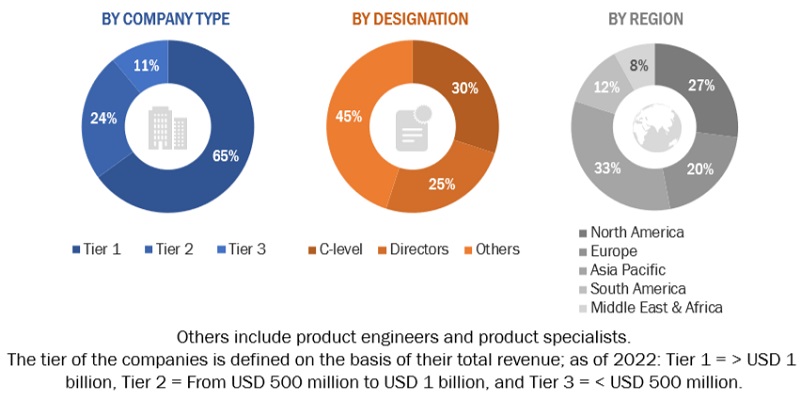
To know about the assumptions considered for the study, download the pdf brochure
Industrial Filtration Market Size Estimation
Both top-down and bottom-up approaches were used to estimate and validate the total size of the industrial filtration market. These methods were also used extensively to estimate the size of various subsegments in the market. The research methodology used to estimate the market size includes the following:
- The key players in the industry and market have been identified through extensive secondary research, and their market share in the respective regions has been determined through both secondary and primary research.
- The industry’s value chain and market size, in terms of value, have been determined through primary and secondary research processes.
- All percentage shares, splits, and breakdowns have been determined using secondary sources and verified through primaries.
Global Industrial Filtration Market Size: Top-down Approach
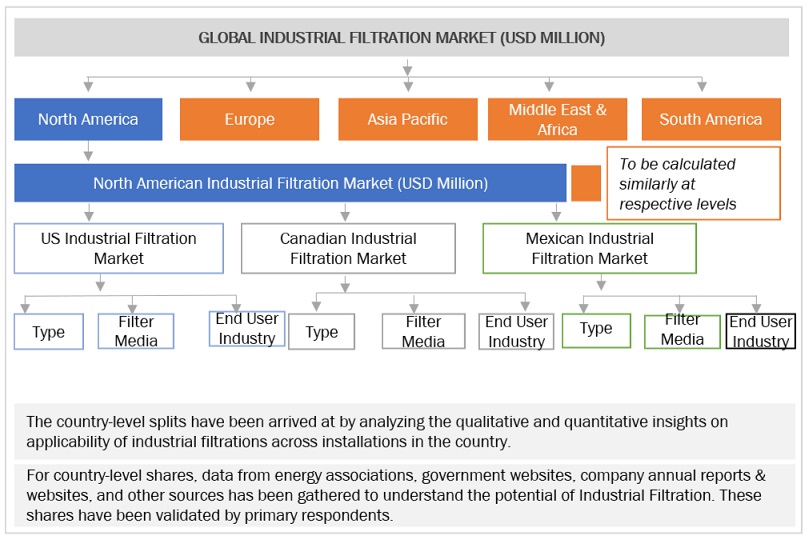
To know about the assumptions considered for the study, Request for Free Sample Report
Global Industrial Filtration Market Size: Bottom-Up Approach
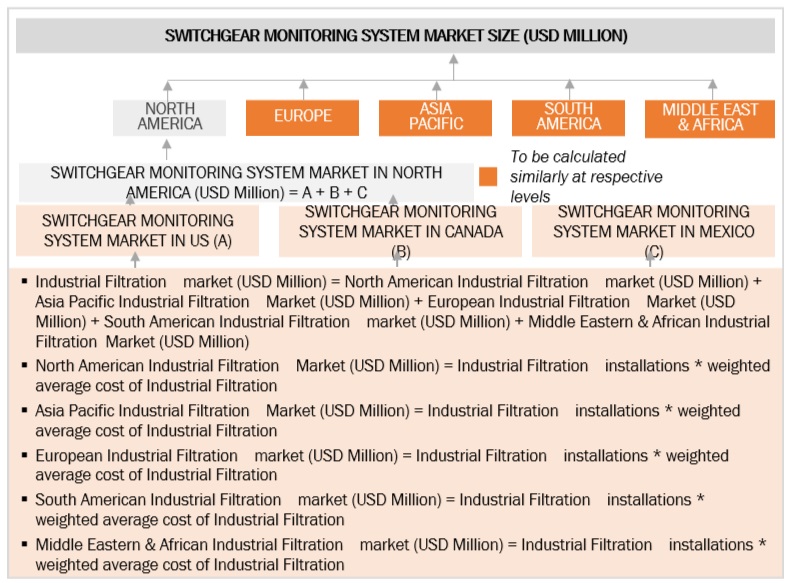
Data Triangulation
After arriving at the overall industrial filtration market size from the estimation process explained above, the total market has been split into several segments and subsegments. The complete market engineering process is done to arrive at the exact statistics for all the segments and subsegments, also data triangulation and market breakdown processes have been employed, wherever applicable. The data has been triangulated by examining various factors and trends from both the demand- and supply sides. Along with this, the market has been validated through both the top-down and bottom-up approaches.
Market Definition
Industrial filtration is the process of removing suspended solids from liquids or air with the help of filter media. It helps in reducing emissions, preventing downtime due to failures, extending the service life of the machines, and removing clogging in pipelines. Industrial filters are used across numerous end-use industries, such as manufacturing, power generation, oil & gas, pharmaceuticals, metals & mining, and process industries.
The industrial filtration market refers to the year-on-year sales of industrial filters by key manufacturers across end-user industries. Industrial filters are used for treating both air and liquids using different filtration technologies and filter media.
Key Stakeholders
- Chemical and pharmaceutical companies
- Distributors
- Filtration and environmental associations
- Filtration technology providers
- Government and research organizations
- Industrial filter manufacturers
- Industrial filter media manufacturers
- Mining companies
- Power generation companies
- Raw material suppliers
- Oil & gas operators
Objectives Of The Study
- To define, describe, segment, and forecast the industrial filtration market based on type, product, filter media, and end user industry.
- To forecast the market size for five key regions: North America, South America, Europe, Asia Pacific, and Middle East & Africa, along with their key countries
- To provide detailed information about the key drivers, restraints, opportunities, and challenges influencing the growth of the market
- To strategically analyze the subsegments with respect to individual growth trends, prospects, and contributions of each segment to the overall market size
- To analyze market opportunities for stakeholders and the competitive landscape of the market
- To strategically profile the key players and comprehensively analyze their market shares and core competencies
- To analyze competitive developments, such as sales contracts, agreements, investments, expansions, new product launches, mergers, partnerships, collaborations, and acquisitions, in the market
Available Customizations:
With the given market data, MarketsandMarkets offers customizations as per the client’s specific needs. The following customization options are available for this report:
Geographic Analysis
- Further breakdown of region or country-specific analysis
Company Information
- Detailed analyses and profiling of additional market players (up to 5)
Get the Full Industrial Filtration Market Report
Full forecast, segment splits, and company analysis for all Industrial Filtration Market.
- US Industrial Filtration Market
- Canada Industrial Filtration Market
- Mexico Industrial Filtration Market
- Germany Industrial Filtration Market
- UK Industrial Filtration Market
- France Industrial Filtration Market
- Italy Industrial Filtration Market
- Russia Industrial Filtration Market
- China Industrial Filtration Market
- India Industrial Filtration Market
- Japan Industrial Filtration Market
- Australia Industrial Filtration Market
- South Korea Industrial Filtration Market
- Saudi Arabia Industrial Filtration Market
- UAE Industrial Filtration Market
- South Africa Industrial Filtration Market
- Brazil Industrial Filtration Market
- Argentina Industrial Filtration Market
- Rest Of Europe Industrial Filtration Market
- Rest Of Asia Pacific Industrial Filtration Market
- GCC Countries Industrial Filtration Market
- Rest Of GCC Countries Industrial Filtration Market
- Rest Of South America Industrial Filtration Market
Need a Tailored Report?
Customize this report to your needs
Get 10% FREE Customization
Customize This Report
