
Asia Pacific Industrial Software Market (2024-2029)

The Asia Pacific Industrial Software Market was valued at $7897.1 Million in 2024 and projected to reach to $18959.3 Million by 2029, representing a compound annual growth rate of 19.1%. Asia Pacific is positioned as the fastest-growing region for industrial software, driven by the region's dominance in semiconductor manufacturing and aggressive digital transformation initiatives.


| Market Size in | USD 26.32 MN |
| Market Forecast in | |
| CAGR | |
| Forecast Period | |
| Units Considered | Value (USD MN) |
Asia Pacific Industrial Software Market Trends and Insights
- The region's rapid industrialization, digital transformation initiatives, and semiconductor manufacturing expansion are driving robust demand for advanced software solutions.
- Asia Pacific's 19.1% compound annual growth rate significantly outpaces global trends, reflecting the region's strategic importance in the semiconductor and electronics supply chain. The Asia Pacific industrial software market is characterized by increasing adoption of automation, IoT integration, and cloud-based manufacturing solutions across key economies including China, Japan, South Korea, and India.
- Between 2024 and 2029, Asia Pacific is expected to capture substantial market share as enterprises invest in digital infrastructure and Industry 4.0 technologies.
- The region's competitive manufacturing landscape and government support for technological advancement position Asia Pacific as the fastest-growing geography for industrial software solutions..
Key Market Statistics
- CAGR (2024-2029) 19.1% CAGR
- Market Size, 2024 ~USD 7897.1 Million
- Forecast, 2029 ~USD 18959.3 Million
- Geography Asia Pacific
Asia Pacific Industrial Software Market Overview
Fastest Growing Region Globally :
Asia Pacific leads industrial software adoption with a 19.1% CAGR, outpacing the global average of 16.7%, driven by accelerated digital transformation across semiconductor manufacturing hubs.
Semiconductor Manufacturing Expansion :
China, Japan, and South Korea collectively represent over $14.4 billion in market value, fueled by massive investments in chip fabrication facilities and advanced manufacturing automation.
Rapid Industrialization & Digital Shift :
Asia Pacific's industrial base is undergoing unprecedented digital transformation, with enterprises increasingly adopting IoT, AI-enabled software, and cloud-based solutions for operational efficiency.
Market Trajectory & Opportunity :
The region is projected to grow from $7.9 billion in 2024 to $19.0 billion by 2029, representing a $12.1 billion incremental opportunity for software vendors and solution providers.
Asia Pacific Industrial Software Market Dynamics
- China's continued investment in advanced chip production, coupled with Japan and South Korea's technological leadership, creates substantial demand for sophisticated software solutions that optimize manufacturing processes, enhance supply chain visibility, and enable predictive maintenance. The region's 19.1% CAGR reflects strong momentum from emerging economies and established industrial centers alike.
- Government policies supporting Industry 4.0 adoption, coupled with rising labor costs driving automation investments, will sustain robust growth through 2029.
- Asia Pacific's market expansion presents critical opportunities for vendors targeting semiconductor, electronics, and advanced manufacturing sectors..
Market Ecosystem
Related Ecosystem
Industrial Automation
- Sensors
- Image Sensors
- Manufacturing Execution System (MES)
- Actuators
- Flow Sensors
- Siemens ag
- ABB India Limited
- Emerson Electric Co.
- HONEYWELL INTERNATIONAL INC.
- SCHNEIDER ELECTRIC SE
Information System And Analytics
- Machine Learning
- Natural Language Processing (NLP)
- Sensors
- Software as A Service (SaaS)
- Data Loss Prevention (DLP)
- International Business Machines Corporation
- MICROSOFT CORPORATION
- Amazon.com, Inc.
- Oracle Corporation
Key Takeaways
- Asia Pacific industrial software market will grow from $7.9B (2024) to $19.0B (2029) at a 19.1% CAGR, outpacing global growth rates.
- Asia Pacific's semiconductor and electronics manufacturing dominance drives accelerated adoption of advanced industrial software solutions.
- Digital transformation and Industry 4.0 initiatives across Asia Pacific economies are creating sustained demand for automation and IoT-enabled software.
- Asia Pacific represents the fastest-growing regional market for industrial software, reflecting strategic investments in manufacturing technology infrastructure.
Industrial Software Market Report Scope
| Report Metric | Details |
|---|---|
| Base Year | 2024 |
| Fastest Growing Segment | AI IN MANUFACTURING (Technology) |
| Forecast Period | 2024-2029 |
| Growth Rate | CAGR of 16.7% from 2024 to 2029 |
| Largest Segment | DISCRETE INDUSTRY (End-User Industry) |
| Market Size Base Year (Billions) | ~USD 21.53 (2024) |
| Revenue Forecast (Billions) | ~USD 46.6 (2029) |
| Segments Covered | Technology, Deployment, End-User Industry, Process Industry, Discrete Industry, Type, Platform Type |
Asia Pacific Industrial Software Market Report Segmentation
7 segment dimensions are covered across the global market.
By Technology
- AI In Manufacturing
- Fault Detection And Classification
- Hmi
- Human Machine Interface (Hmi)
- Industrial Metrology
- Mes
- Robotic Software
- Scada
By Deployment
- Cloud
- Cloud-Based
- Hybrid
- On-Demand
- On-Premises
By End-User Industry
- Discrete Industry
- Process Industry
By Process Industry
- Chemicals
- Energy & Power
- Food & Beverages
- Oil & Gas
- Other Process Industries
- Pharmaceuticals
- Water & Wastewater Treatment
By Discrete Industry
- Aerospace
- Automotive
- Electronics & Semiconductors
- Other Discrete Industries
- Others Discrete Industries
By Type
- AI Platforms
- AI Solutions
- Communication Management
- Data Management And Analysis
- Predictive Maintenance
- Recognition
- Simulation
By Platform Type
- Api
- Machine Learning Framework
Target Audience
- Software Vendors & Solution Providers : Require detailed Asia Pacific market sizing and growth forecasts to develop localized product strategies, allocate R&D resources, and identify high-potential customer segments in semiconductor and electronics manufacturing.
- Manufacturing & Semiconductor Enterprises : Need market intelligence to benchmark software investments, evaluate vendor landscapes, and understand digital transformation trends across Asia Pacific's competitive industrial ecosystem.
- Private Equity & Investment Firms : Utilize Asia Pacific market data for investment thesis validation, portfolio company growth planning, and M&A target identification in the high-growth industrial software sector.
- System Integrators & Consultants : Require regional market insights to advise clients on technology adoption, competitive positioning, and software investment priorities aligned with Asia Pacific's digital transformation momentum.
- Government & Economic Development Agencies : Use market intelligence to inform industrial policy, technology incentive programs, and economic development strategies supporting semiconductor and advanced manufacturing growth.
Countries within Asia Pacific - compare and drill down
| Country | 2025 size (native) |
|---|---|
| China | USD 8207.8 Million |
| Japan | USD 3745.6 Million |
| South Korea | USD 2445 Million |
| Rest Of Asia Pacific | USD 4560.9 Million |
Country market size visualization
Reasons to Buy this Report
- Capture High-Growth Market Opportunity : With 19.1% CAGR, Asia Pacific offers the fastest expansion potential globally. Early market entry and localized solutions position vendors to capture significant share in a $12.1 billion incremental market opportunity through 2029.
- Semiconductor Industry Dominance : China, Japan, and South Korea account for $14.4 billion in combined market value. Understanding regional semiconductor software needs is critical for vendors targeting the world's largest chip manufacturing ecosystem.
- Emerging Market Expansion Insights : Rest of Asia Pacific represents $4.6 billion in untapped potential. Detailed market intelligence enables vendors to identify high-potential countries and develop region-specific go-to-market strategies.
- Competitive Intelligence & Benchmarking : Comprehensive Asia Pacific data enables competitive positioning against regional and global players. Understand market dynamics, growth drivers, and customer requirements across key industrial hubs.
- Strategic Investment & Partnership Planning : Detailed country-level insights support M&A decisions, partnership identification, and resource allocation across Asia Pacific's diverse industrial software landscape.
Frequently asked questions
What is the current size of the Asia Pacific industrial software market?
The Asia Pacific industrial software market was valued at $7,897.1 million in 2024 and is projected to reach $18,959.3 million by 2029.
What is the growth rate for Asia Pacific industrial software?
Asia Pacific's industrial software market is expected to grow at a compound annual growth rate (CAGR) of 19.1% from 2024 to 2029.
Which countries drive Asia Pacific industrial software demand?
Key markets in Asia Pacific include China, Japan, South Korea, and India, where semiconductor manufacturing and digital transformation initiatives are strongest.
What factors are accelerating growth in Asia Pacific?
Rapid industrialization, semiconductor supply chain expansion, Industry 4.0 adoption, IoT integration, and government support for technological advancement are primary growth drivers in Asia Pacific.
How does Asia Pacific growth compare to global trends?
Asia Pacific's 19.1% CAGR significantly exceeds the global industrial software market CAGR of 16.7%, making it the fastest-growing region.
RESEARCH METHODOLOGY
The study utilized four major activities to estimate the industrial software market size. Exhaustive secondary research was conducted to gather information on the market and its peer and parent markets. The next step was to validate these findings, assumptions, and sizing with industry experts across the value chain through primary research. Both top-down and bottom-up approaches were employed to estimate the total market size. Finally, market breakdown and data triangulation methods were utilized to estimate the market size for different segments and subsegments.
Secondary Research
In the secondary research process, various sources were used to identify and collect information on the industrial software market for this study. Secondary sources for this research study include corporate filings (such as annual reports, investor presentations, and financial statements), trade, business, and professional associations, white papers, certified publications, articles by recognized authors, directories, and databases. The secondary data was collected and analyzed to determine the overall market size, further validated through primary research.
List of key secondary sources
|
SOURCE |
WEB LINK |
|
Automation Industry Association |
www.aia-india.org |
|
Manufacturing Enterprise Solutions Association (MESA) |
http://www.mesa.org/en/index.asp |
|
International Society of Automation (ISA) |
https://www.isa.org/ |
|
Measurement, Control & Automation Association (MCAA) |
https://themcaa.org/ |
|
User Association of Automation Technology in Process Industries (NAMUR) |
https://www.namur.net/en/index.html |
|
The Industrial Interoperability Standard (The OPC Foundation) |
https://opcfoundation.org/ |
Primary Research
Primary interviews were conducted to gather insights on market statistics, revenue data, market breakdowns, size estimations, and forecasting. Additionally, primary research was used to comprehend the various technology, type, end-use, and regional trends. Interviews with stakeholders from the demand side, including CIOs, CTOs, CSOs, and customer/end-user installation teams using industrial software offerings and processes, were also conducted to understand their perspective on suppliers, products, component providers, and their current and future use of industrial software, which will impact the overall market. Several primary interviews were conducted across major countries in North America, Europe, Asia Pacific, the Middle East, Africa, and Latin America.
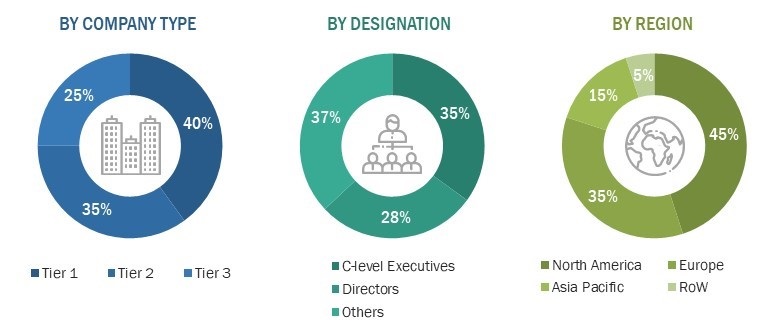
To know about the assumptions considered for the study, download the pdf brochure
Market Size Estimation
Both top-down and bottom-up approaches were utilized to estimate and validate the size of the industrial software market and its submarkets. Secondary research was conducted to identify the key players in the market, and primary and secondary research was used to determine their market share in specific regions. The process involved studying top players’ annual and financial reports and conducting extensive interviews with industry leaders such as CEOs, VPs, directors, and marketing executives. Secondary sources were used to determine all percentage shares and breakdowns, verified through primary sources. All parameters that could impact the markets covered in this research study were accounted for, analyzed in detail, verified through primary research, and consolidated to obtain the final quantitative and qualitative data.
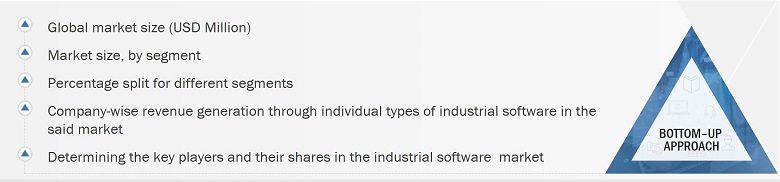
Global Industrial Software Market Size: Botton Up Approach
- Identifying end users that are either using or will use industrial software.
- Tracking leading companies and system integrators operating across various industries.
- Deriving the size of the industrial software by type market through the data sanity method; analyzing revenues of more than 25 critical providers through their annual reports and press releases and summing them up to estimate the overall market size.
- Analyzing the use cases across different regions and companies
- Tracking the ongoing and upcoming installation contracts, acquisitions, expansions, and product launches by various companies and forecasting the market size based on these developments and other critical parameters.
- Conduct multiple discussions with key opinion leaders to understand industrial software components offered by companies to various applications and analyze the breakdown of the scope of work carried out by each major company providing industrial software components.
- Carrying out the market trend analysis to obtain the CAGR of the industrial software with respect to their types in the said market by understanding the industry penetration rate and analyzing the demand and supply of software in different verticals.
- Assigning a percentage to the overall revenue or, in a few cases, to each company's segmental revenues to derive their revenues from the sale of industrial software. This percentage for each company has been assigned based on their product portfolios.
- Verifying and crosschecking the estimates at every level through discussions with key opinion leaders, including CEOs, directors, operations managers, and domain experts at MarketsandMarkets
- Studying various paid and unpaid information sources, such as annual reports, press releases, and white papers
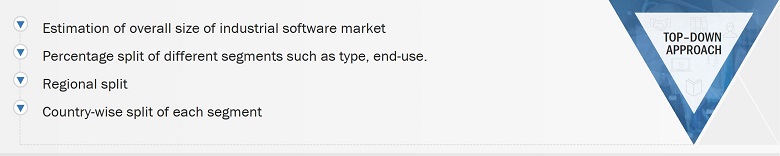
Global Industrial Software Market Size: Top-Down Approach
The top-down approach has been used to estimate and validate the total size of the industrial software market.
- Information related to the revenue of key manufacturers and providers of Industrial software components was studied and analyzed to estimate the global size of the Industrial software market.
- Multiple discussions were conducted with key opinion leaders to understand the demand for industrial software solutions and analyze the breakdown of the scope of work carried out by each significant company.
- Revenue, geographic presence, critical applications served, and diverse offerings of all identified players in the Industrial software market were studied to estimate and arrive at the percentage split of different market segments.
- All major players in the Industrial software market were identified through secondary research and verified through brief discussions with industry experts.
- Multiple discussions were conducted with key opinion leaders of all key companies developing Industrial software solutions to validate the market split based on type, industry, and region.
- Geographic splits were estimated using secondary sources based on factors such as the number of players offering industrial software solutions in a specific country or region and the industries for which these players provide the solutions.
Data Triangulation
Once the overall size of the industrial software market was determined using the methods described above, it was divided into multiple segments and subsegments. Market engineering was performed for each segment and subsegment using market breakdown and data triangulation methods, as applicable, to obtain accurate statistics. Various factors and trends from the demand and supply sides were studied to triangulate the data. The market was validated using both top-down and bottom-up approaches.
Market Definition
The industrial software market encompasses software solutions specifically designed to optimize and manage various industrial processes and operations across different sectors, such as manufacturing, energy, automotive, pharmaceuticals, and more. These software solutions include but are not limited to Manufacturing Execution Systems (MES), Supervisory Control and Data Acquisition (SCADA), Human Machine Interface (HMI), AI in Manufacturing, Robotic Software, and various analytics and optimization tools. Industrial software facilitates automation, real-time monitoring, data integration, and decision support to enhance efficiency, productivity, quality, and compliance within industrial settings. The market serves industries seeking to leverage digital technologies to achieve operational excellence, meet regulatory requirements, and adapt to evolving market demands in an increasingly competitive global landscape.
Key Stakeholders
- Providers and distributors in industrial software
- End users
- System integrators
- Mobile application developers
- Networking and communication service providers
- Governments, financial institutions, and investment communities
- Research organizations
Report Objectives
- To define, describe, and forecast the industrial software market based on type & end-use, and region
- To forecast the size of the market segments for four major regions—North America, Europe, Asia Pacific (APAC), and the Rest of the World (RoW)
- To provide detailed information regarding the major factors influencing the growth of the market (drivers, restraints, opportunities, and challenges)
- To strategically analyze micromarkets1 with respect to individual growth trends, prospects, and contributions to the total market
- To study the complete value chain and allied industry segments and perform a market value chain analysis.
- To provide ecosystem analysis, case study analysis, patent analysis, technology analysis, pricing analysis, Porter’s five forces analysis, key stakeholders and buying criteria, key conferences and events, and regulatory bodies, government agencies, and regulations pertaining to the market
- To strategically profile the key players and comprehensively analyze their market shares and core competencies2.
- Analyzing the opportunities in the market for stakeholders and describing the market's competitive landscape.
- To analyze competitive developments such as collaborations, agreements, contracts, partnerships, mergers & acquisitions, product launches, and research & development (R&D) in the market
- To analyze the impact of the recession on the industrial software market
Available customizations:
With the given market data, MarketsandMarkets offers customizations according to the specific requirements of companies. The following customization options are available for the report:
- Detailed analysis and profiling of additional market players (up to 5)
- Additional country-level analysis of the industrial software market
Product Analysis
- The product matrix provides a detailed comparison of the product portfolio of each company in the industrial software market.
Get the Full Industrial Software Market Report
Full forecast, segment splits, and company analysis for all Industrial Software Market.
- UK Industrial Software Market
- France Industrial Software Market
- Rest Of Europe Industrial Software Market
- China Industrial Software Market
- Japan Industrial Software Market
- South Korea Industrial Software Market
- Rest Of Asia Pacific Industrial Software Market
- US Industrial Software Market
- Canada Industrial Software Market
- Mexico Industrial Software Market
- Germany Industrial Software Market
Need a Tailored Report?
Customize this report to your needs
Get 10% FREE Customization
Customize This Report
