
Spain Insulated Metal Panels Market (2025-2030)

The Spain Insulated Metal Panels Market was valued at $231.1 Million in 2025 and projected to reach to $251.1 Million by 2030, representing a compound annual growth rate of 1.68%. Spain's insulated metal panels market is poised for steady, sustainable growth through 2030, driven by the country's commitment to energy efficiency standards and green building practices.


| Market Size in | USD 26.32 MN |
| Market Forecast in | |
| CAGR | |
| Forecast Period | |
| Units Considered | Value (USD MN) |
Spain Insulated Metal Panels Market Trends and Insights
- This modest but steady expansion in Spain reflects the country's increasing adoption of energy-efficient building materials across commercial and industrial sectors.
- Spain's construction industry, particularly in cold storage, food processing, and pharmaceutical facilities, continues to drive demand for high-performance insulation solutions. The Spanish market benefits from regulatory pressures around building energy efficiency and sustainability standards aligned with EU directives.
- Spain's focus on reducing carbon footprints in manufacturing and logistics has positioned insulated metal panels as a preferred choice for facility upgrades and new construction projects.
- Between 2025 and 2030, Spain is expected to see gradual market maturation as awareness of thermal performance benefits and cost savings spreads across regional construction and industrial segments..
Key Market Statistics
- CAGR (2025-2030) 1.68% CAGR
- Market Size, 2025 ~USD 231.1 Million
- Forecast, 2030 ~USD 251.1 Million
- Country Spain
Spain Insulated Metal Panels Market Overview
Market Size & Growth :
Spain's insulated metal panels market is valued at USD 231.1 million in 2025, with projected growth to USD 251.1 million by 2030, representing a steady CAGR of 1.68%.
Energy Efficiency Adoption :
Spain's construction sector is increasingly prioritizing energy-efficient building materials, driven by EU sustainability regulations and rising operational costs in commercial and industrial facilities.
Construction Sector Momentum :
Spain's construction industry recovery post-pandemic is fueling demand for insulated metal panels in both new builds and renovation projects across commercial and industrial segments.
Regional Performance vs Global :
Spain's CAGR of 1.68% is below the global average of 2.69%, indicating a more conservative market growth trajectory compared to other European regions.
Spain Insulated Metal Panels Market Dynamics
- The Spanish construction industry's recovery and modernization efforts are creating consistent demand for high-performance building materials in commercial warehouses, industrial facilities, and retail spaces.
- Government incentives for energy-efficient renovations and stricter building codes are expected to support market expansion.
- However, growth remains moderate compared to global trends, reflecting Spain's mature construction market and competitive pricing pressures.
- The market will likely benefit from increased adoption in logistics and cold storage facilities, where insulated metal panels provide significant operational cost savings..
Market Ecosystem
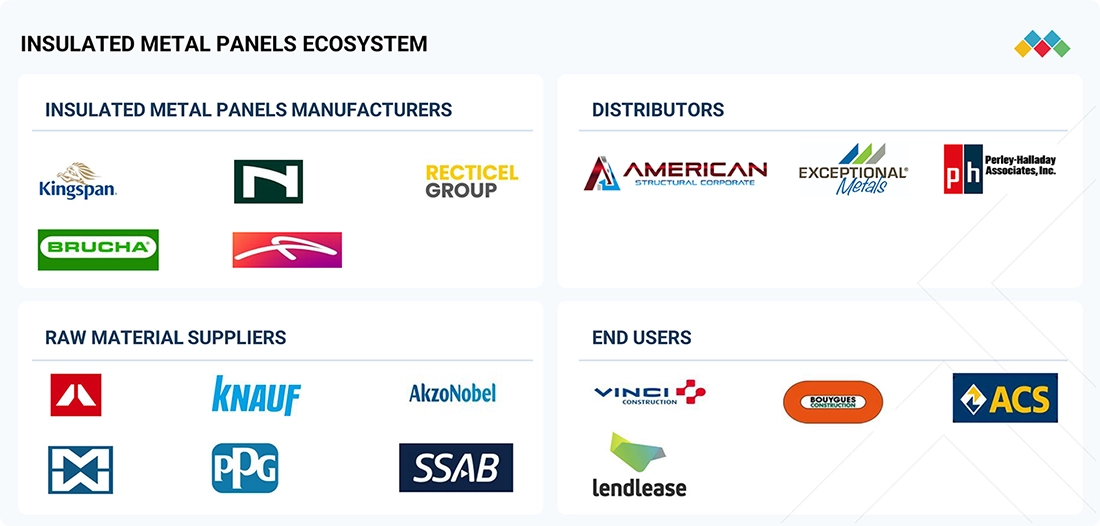
INSULATED METAL PANELS MARKET: COMMERCIAL USE CASES ACROSS INDUSTRIES
| COMPANY | USE CASE DESCRIPTION | BENEFITS |
|---|---|---|
 |
Metl-Span supplied insulated metal panels for Hello Fresh’s 210,000 sq. ft. distribution center in Newnan, Georgia, the company’s first facility in the Southeast. The project required a cold-storage-ready building envelope that could maintain consistent internal temperatures while meeting an aggressive three-month construction timeline. To support the interior box-in-box construction within an existing shell, the project team selected 4” CF Mesa insulated metal panels in Polar White, enabling rapid installation and on-time delivery. Over 150,000 sq. ft. of panels were installed within ten weeks, supporting Hello Fresh’s fast regional expansion. | Enabled quick and simple installation, meeting tight project schedules | Provided reliable thermal performance for cold storage and cold dock areas | Supported both interior and exterior cladding with design flexibility |Delivered a clean, durable, and easily washable surface with concealed fasteners |
Logos and trademarks shown above are the property of their respective owners. Their use here is for informational and illustrative purposes only.
Related Ecosystem
Ceramics And Glass
- Zirconia
- Alumina Ceramics
- Silicon Carbide
- Silicon Nitride
- Titanate Ceramics
- Saint-gobain
- 3M COMPANY
- CERAMTEC GMBH
- Kyocera Corporation
- COORSTEK INCORPORATED
Key Takeaways
- Spain's insulated metal panels market is valued at USD 231.1 million in 2025 with a projected value of USD 251.1 million by 2030.
- Spain experiences a CAGR of 1.68% through the forecast period, indicating steady but conservative market growth.
- Spain's market is driven by EU energy efficiency regulations and increasing demand from cold storage and food processing industries.
- Spain's construction sector is gradually adopting insulated metal panels for sustainability and thermal performance benefits.
Insulated Metal Panels Market Report Scope
| Report Metric | Details |
|---|---|
| Base Year | 2025 |
| Fastest Growing Segment | MINERAL WOOL (Insulation Material) |
| Forecast Period | 2025–2030 |
| Growth Rate | CAGR of 2.69% from 2025 to 2030 |
| Largest Segment | STEEL (Metal Type) |
| Market Size Base Year (Billions) | ~USD 15 (2025) |
| Revenue Forecast (Billions) | ~USD 17.13 (2030) |
| Segments Covered | Metal Type, Insulation Material, Application, End Use |
Spain Insulated Metal Panels Market Report Segmentation
4 segment dimensions are covered across the global market.
By Metal Type
- Aluminum
- Other Metal Types
- Steel
By Insulation Material
- Mineral Wool
- Other Insulation Materials
- Pir/Pur
- Polystyrene
By Application
- Ceilings
- Exterior Walls
- Interior Walls
- Other Applications
- Roofs
By End Use
- Non-Residential
- Residential
Target Audience
- Construction & Building Material Suppliers : Spanish distributors and manufacturers need localized market data to optimize inventory, pricing strategies, and sales forecasts for insulated metal panels across regional construction projects.
- Commercial Real Estate Developers : Property developers and construction firms in Spain require market insights to evaluate material costs, sustainability compliance, and competitive positioning for commercial and industrial projects.
- Industrial & Logistics Operators : Warehouse and cold storage facility operators need Spain-specific market analysis to assess insulated panel adoption rates, cost-benefit analysis, and energy savings potential for facility upgrades.
- Investment & Private Equity Firms : Investors evaluating opportunities in Spain's construction and building materials sector need detailed market sizing and growth forecasts to assess portfolio companies and acquisition targets.
- Government & Policy Makers : Spanish government agencies and sustainability organizations require market data to evaluate the effectiveness of energy efficiency incentives and develop future building regulation strategies.
Key Companies in the Spain Insulated Metal Panels Market
| Company | HQ | Ownership | Strongest segments |
|---|---|---|---|
| KINGSPAN GROUP | Ireland | Public Company | Steel-based insulated metal panels,Aluminum-based insulated metal panels,Other metal-based insulated panels, |
| NUCOR CORPORATION | United States | Public Company | Steel IMPs – PIR/PUR core,Steel IMPs – Polystyrene core,Steel IMPs – Mineral wool core, |
| ARCELORMITTAL | Luxembourg | Public Company | Steel-faced IMPs,Aluminum-faced IMPs,Other metal/Hybrid IMPs, |
| RECTICEL NV/SA | Belgium | Public Company | PIR/PUR insulated metal panels and boards,Mineral wool insulated panels,Modular units (floor, column, ceiling elements), |
| TATA STEEL | India | Public Company | Steel-faced IMPs and coil for IMPs,Aluminum-faced and other metal IMP inputs,PIR/PUR-focused panel systems and solutions, |
KINGSPAN GROUP
Kingspan Group is an Irish public company founded in 1965 that employs 27,526 people. The company operates as a multinational enterprise with significant global operations.
NUCOR CORPORATION
Nucor Corporation is a United States-based public company founded in 1905 with 33,000 employees. The company is a major player in its industry with over a century of operational history.
ARCELORMITTAL
ArcelorMittal is a Luxembourg-based public company founded in 1976 and is one of the world's largest employers in its sector with 125,554 employees.
RECTICEL NV/SA
Recticel NV/SA is a Belgian public company established in 1896 with 1,245 employees. The company has maintained operations for over a century as a publicly traded enterprise.
TATA STEEL
Tata Steel is an Indian public company founded in 1907 with 112,262 employees, making it one of the largest employers in its industry globally.
Reasons to Buy this Report
- Market-Specific Sizing & Forecasts : Access precise valuation data for Spain's insulated metal panels market with detailed 2025-2030 projections, enabling accurate budgeting and investment planning for Spanish operations.
- Competitive Landscape Intelligence : Understand Spain's unique market dynamics, local competitor positioning, and regional growth drivers that differ from broader European trends, informing strategic market entry or expansion decisions.
- Regulatory & Compliance Insights : Gain clarity on Spain-specific building codes, EU energy efficiency directives, and government incentive programs that directly impact market demand and customer purchasing decisions.
- Sector-Specific Opportunity Analysis : Identify high-growth segments within Spain's commercial, industrial, and logistics sectors where insulated metal panels deliver maximum ROI and operational efficiency benefits.
- Strategic Decision Support : Make informed decisions on pricing strategies, distribution channels, and product positioning tailored to Spain's moderate growth profile and construction industry characteristics.
Frequently asked questions
What is the current market size of insulated metal panels in Spain?
Spain's insulated metal panels market is estimated at USD 231.1 million in 2025.
What is the projected market size for insulated metal panels in Spain by 2030?
Spain's insulated metal panels market is projected to reach USD 251.1 million by 2030.
What is the CAGR for Spain's insulated metal panels market?
Spain's insulated metal panels market is expected to grow at a CAGR of 1.68% from 2025 to 2030.
Which industries drive demand for insulated metal panels in Spain?
Spain's demand is primarily driven by cold storage, food processing, pharmaceutical manufacturing, and commercial construction sectors.
What regulatory factors influence Spain's insulated metal panels market?
EU energy efficiency directives and Spain's sustainability standards encourage adoption of high-performance insulation materials in building and industrial applications.
RESEARCH METHODOLOGY
The study involved four major activities to estimate the current size of the global insulated metal panels market. Exhaustive secondary research was conducted to collect information on the insulated metal panels market, the peer product market, and the parent product group market. The next step was to validate these findings, assumptions, and size estimates with industry experts across the insulated metal panels value chain through primary research. The top-down and bottom-up approaches were employed to estimate the overall size of the insulated metal panels market. After that, market breakdown and data triangulation procedures were used to determine the size of different segments of the market.
Secondary Research
The market for companies offering insulated metal panels was analyzed using secondary data from paid and unpaid sources, by examining the product portfolios of major companies in the ecosystem, and by rating companies based on performance and quality. For this study, secondary sources such as Business Standard, Bloomberg, the World Bank, and Factiva were consulted to identify and collect information on the insulated metal panels market. Secondary sources included annual reports, press releases, and investor presentations from insulated metal panels vendors, forums, certified publications, and white papers. The secondary research provided critical information on the industry’s value chain, the total pool of key players, market classification, and segmentation from both market- and technology-oriented perspectives.
Primary Research
In the primary research process, interviews with various supply- and demand-side sources were conducted to obtain qualitative and quantitative information for this report. The supply-side sources included industry experts, such as chief executive officers (CEOs), vice presidents (VPs), marketing directors, technology and innovation directors, and related key executives from several key companies and organizations operating in the insulated metal panels market. After completing the market engineering (calculations for market statistics, market breakdown, market size estimates, market forecasting, and data triangulation), extensive primary research was conducted to gather information and verify and validate the critical numbers arrived at. Primary research was also conducted to identify segmentation types, industry trends, the competitive landscape of insulated metal panels offered by various market players, and key market dynamics, including drivers, restraints, opportunities, challenges, trends, and key player strategies. In the complete market engineering process, the top-down and bottom-up approaches, along with several data triangulation methods, were extensively used to perform market estimation and forecasting for the overall market segments and subsegments listed in this report. Extensive qualitative and quantitative analysis was performed throughout the complete market engineering process to present key information and insights throughout the report.
The following is the breakdown of primary respondents:
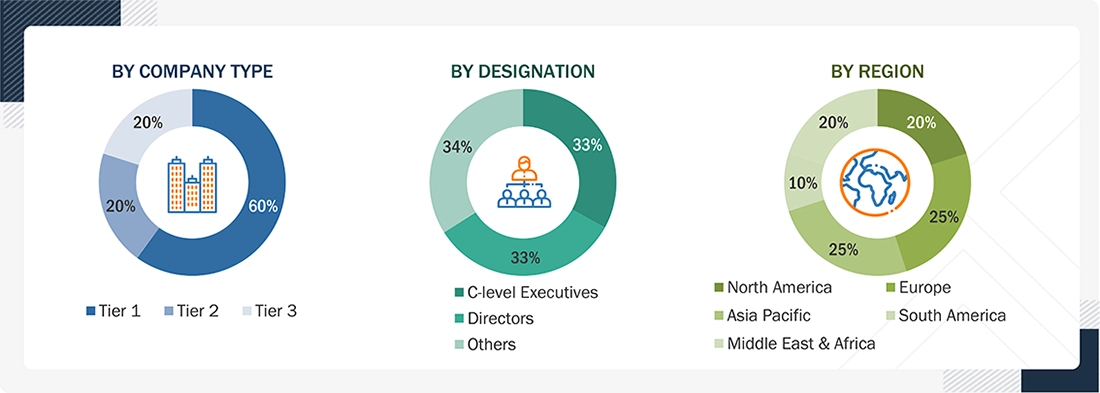
Notes: Other designations include sales, marketing, and product managers.
Tier 1: >USD 1 Billion; Tier 2: USD 500 million–1 Billion; and Tier 3: <USD 500 million
To know about the assumptions considered for the study, download the pdf brochure
Market Size Estimation
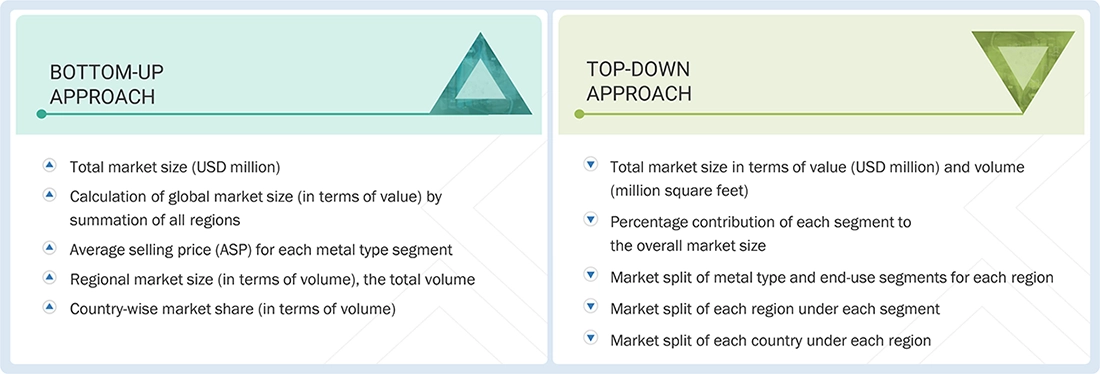
The top-down and bottom-up approaches were used to estimate and validate the size of the global insulated metal panels market. These approaches were also widely used to estimate the sizes of various dependent market segments. The research methodology used to estimate the market size included the following:
Insulated Metal Panels Market Market : Top-Down and Bottom-Up Approach
Data Triangulation
After determining the overall market size using market size estimation processes, the market was divided into several segments and subsegments. Data triangulation and market breakup procedures were employed, wherever applicable, to complete the overall market engineering process and arrive at the exact statistics for each market segment and subsegment. The data was triangulated by analyzing various factors and trends from both the demand and supply sides.
Market Definition
Insulated metal panels are building components for walls and roofs that integrate structure, insulation, and exterior protection into a single product. They consist of a three-layer sandwich construction: an outer metal sheet, an insulating core, and an inner metal sheet. These layers are permanently bonded under controlled factory conditions to create a strong, rigid, lightweight panel. The metal facings are typically steel or aluminum and are coated with protective finishes such as polyester, PVDF, galvanized, or Galvalume to provide corrosion resistance, weather durability, and aesthetic appeal. The insulating core, the most critical component of an IMP, is made from high-performance materials such as Polyurethane (PUR), Polyisocyanurate (PIR), Polystyrene (PS), or Mineral Wool. This core provides excellent thermal insulation, reducing heat transfer and improving energy efficiency in buildings. By integrating exterior cladding, insulation, and a vapor barrier into one system, insulated metal panels eliminate the need for separate on-site insulation installation. This results in faster construction, improved building performance, high R-values, and long-term durability, making insulated metal panels a versatile and cost-effective solution for industrial, commercial, and cold-storage applications.
Key Stakeholders
- Raw Material Suppliers
- Insulated Metal Panel Manufacturers
- Machinery and Equipment Suppliers
- Distributors and Dealers
- Contractors and Installers
- End Users
- Regulatory and Standards Bodies
- Project Developers and Builders
- Logistics and Supply Chain Partners
- Investors & Financial Institutions
Report Objectives
- To define, describe, and forecast the size of the global insulated metal panels market, by metal type, insulation material, application, and end-use, in terms of value and volume
- To forecast the market size for North America, Europe, Asia Pacific, South America, and the Middle East & Africa, along with their respective countries, in terms of value and volume
- To provide detailed information on the significant drivers, restraints, opportunities, and challenges influencing the market
- To strategically analyze micromarkets concerning individual growth trends, prospects, and their contribution to the market
- To assess growth opportunities in the market for stakeholders and provide details on the competitive landscape for market leaders
- To strategically profile key players and comprehensively analyze their market share and core competencies
- To analyze competitive developments, such as expansions, acquisitions, product launches, partnerships, agreements, and contracts in the insulated metal panels market
- To provide the impact of AI/Gen AI on the market
- To provide the macroeconomic outlook for each region covered under the study, and the impact of the 2025 US tariff on the market
Available customizations:
With the given market data, MarketsandMarkets offers customizations according to client-specific needs.
The following customization options are available for the insulated metal panels report:
Product Analysis
- A product matrix that gives a detailed comparison of the product portfolio of each company
Regional Analysis
- A further breakdown of the insulated metal panels market for additional countries
Company Information
- Detailed analysis and profiling of additional market players (up to five)
Get the Full Insulated Metal Panels Market Report
Full forecast, segment splits, and company analysis for all Insulated Metal Panels Market.
- China Insulated Metal Panels Market
- Japan Insulated Metal Panels Market
- India Insulated Metal Panels Market
- South Korea Insulated Metal Panels Market
- Australia Insulated Metal Panels Market
- UK Insulated Metal Panels Market
- Germany Insulated Metal Panels Market
- France Insulated Metal Panels Market
- Italy Insulated Metal Panels Market
- Canada Insulated Metal Panels Market
- Mexico Insulated Metal Panels Market
- Brazil Insulated Metal Panels Market
- Argentina Insulated Metal Panels Market
- South Africa Insulated Metal Panels Market
- US Insulated Metal Panels Market
- Rest Of Europe Insulated Metal Panels Market
- Rest Of Asia Pacific Insulated Metal Panels Market
Need a Tailored Report?
Customize this report to your needs
Get 10% FREE Customization
Customize This Report
