
Asia Pacific IoT Market (2025-2030)

The Asia Pacific IoT Market was valued at $11430 Million in 2025 and projected to reach to $16810 Million by 2030, representing a compound annual growth rate of 8.0%. Asia Pacific's IoT market is positioned for substantial growth, driven by rapid digital transformation across China, India, and Japan.


| Market Size in | USD 26.32 MN |
| Market Forecast in | |
| CAGR | |
| Forecast Period | |
| Units Considered | Value (USD MN) |
Asia Pacific IoT Market Trends and Insights
- Middle East & Africa's growth trajectory reflects increasing digital transformation initiatives across government, enterprise, and industrial sectors.
- The region's IoT adoption is driven by smart city projects, oil and gas digitalization, and healthcare modernization efforts that leverage connected devices and real-time data analytics. Middle East & Africa's 8.0% compound annual growth rate (CAGR) demonstrates resilience and opportunity within the region's technology landscape.
- Middle East & Africa is witnessing accelerated investment in IoT infrastructure, particularly in the Gulf Cooperation Council (GCC) countries and emerging African markets.
- The forecast period through 2030 indicates sustained momentum as Middle East & Africa continues to bridge digital divides and deploy IoT solutions across critical infrastructure, manufacturing, and consumer applications..
Key Market Statistics
- CAGR (2025-2030) 8.0% CAGR
- Market Size, 2025 ~USD 11430 Million
- Forecast, 2030 ~USD 16810 Million
- Geography Asia Pacific
Asia Pacific IoT Market Overview
China's IoT Dominance :
China leads Asia Pacific's IoT market with USD 174,310 million in 2025, driven by massive smart city investments, 5G infrastructure expansion, and industrial automation across manufacturing sectors.
India's Rapid Growth Trajectory :
India's IoT market valued at USD 95,800 million in 2025, experiencing accelerated adoption in smart agriculture, healthcare IoT, and enterprise digitalization initiatives across emerging sectors.
Japan's Advanced IoT Ecosystem :
Japan commands USD 59,540 million market size, leveraging robotics integration, industrial IoT solutions, and smart infrastructure development to address demographic challenges and operational efficiency.
Regional 8% CAGR Growth :
Asia Pacific IoT market projected to expand from USD 11,430 million (2025) to USD 16,810 million (2030) at 8% CAGR, outpacing global digital transformation benchmarks across diverse economies.
Asia Pacific IoT Market Dynamics
- Government initiatives supporting smart cities, coupled with increasing enterprise adoption of connected devices and edge computing solutions, create significant expansion opportunities.
- The region's manufacturing sector digitalization and growing IoT investments in healthcare and agriculture sectors fuel market momentum. Key growth catalysts include expanding 5G infrastructure, rising IoT talent pools, and competitive manufacturing costs attracting global IoT deployments.
- Asia Pacific's diverse economic landscape presents varied adoption rates, with developed markets like Japan leading in advanced IoT applications, while emerging economies accelerate foundational IoT infrastructure development.
- Strategic investments in IoT platforms and localized solutions will be critical for capturing regional market share through 2030..
Market Ecosystem
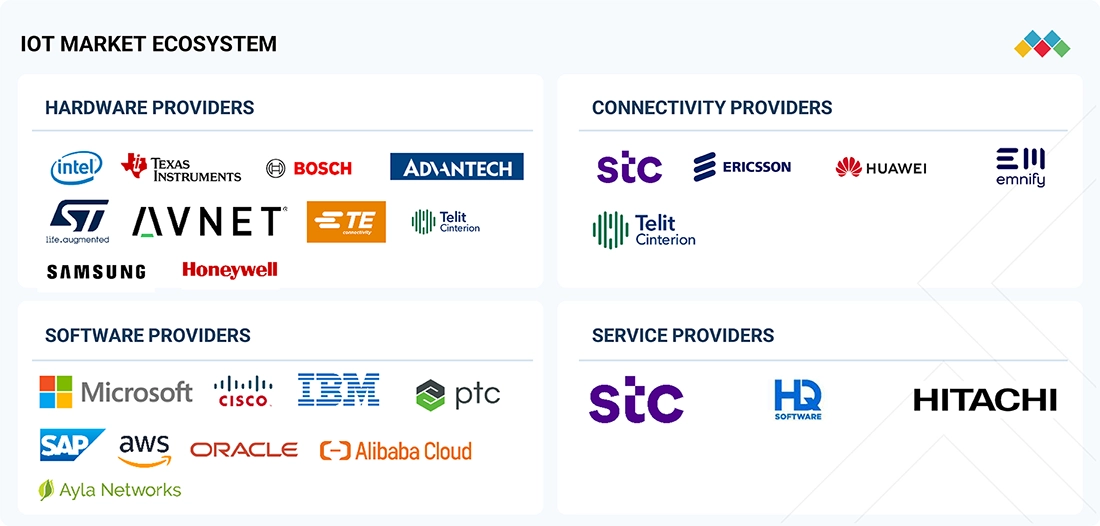
IoT Market: COMMERCIAL USE CASES ACROSS INDUSTRIES
| COMPANY | USE CASE DESCRIPTION | BENEFITS |
|---|---|---|
 |
Smart-city deployments connecting streetlights and municipal sensors to central platforms for remote management, analytics and new city services. | Lower energy costs, faster rollouts, platform for additional services. |
 |
Real-time fleet and asset tracking using telematics and connected sensors to monitor location, condition, and route adherence for large shippers and logistics providers. | Real-time visibility, reduced loss, improved routing and asset utilization. |
 |
Industrial IoT solutions that connect factory equipment and plant networks to edge and cloud platforms to enable telemetry, automation and operations integration. | Improved uptime, faster incident resolution, better OT/IT alignment |
 |
Connected-vehicle and workshop data solutions that transmit vehicle diagnostics and service-relevant telemetry to OEMs and service providers. | Faster diagnostics and servicing, better aftersales experience, secure data exchange. |
 |
Scalable IoT ingestion and platform services that connect medical devices and healthcare equipment for secure data processing and analytics at scale. | Secure device connectivity, scalable data processing, accelerated analytics and ML. |
Logos and trademarks shown above are the property of their respective owners. Their use here is for informational and illustrative purposes only.
Related Ecosystem
Automotive Advance Technologies
- Battery Electric Vehicle (BEV)
- Light Commercial Vehicles (LCVs)
- Fuel Cell Electric Vehicle (FCEV)
- Hybrid Electric Vehicle (HEV)
- Internal Combustion Engine (ICE)
- BOSCH LIMITED
- Continental ag
- Visteon Corporation
- DENSO Corporation
- ZF FRIEDRICHSHAFEN AG
High Voltage Products And Systems
- Analytics Software
- Connected Healthcare
- Connected Logistics
- Geographical Information System (GIS)
- Network Bandwidth Management
- ABB India Limited
- Siemens ag
- SCHNEIDER ELECTRIC SE
- Eaton Corporation plc
- Mitsubishi Electric Corporation
Digitalization And Iot
- Sensors
- Remote Monitoring
- Supply Chain Management
- Passenger Information System (PIS)
- Platform as A Service (PaaS)
- International Business Machines Corporation
- Cisco Systems, Inc.
- MICROSOFT CORPORATION
- Oracle Corporation
- HUAWEI TECHNOLOGIES CO LTD
Key Takeaways
- Middle East & Africa's IoT market will expand from USD 11.43 billion in 2025 to USD 16.81 billion by 2030, representing an 8.0% CAGR.
- Middle East & Africa is prioritizing smart city and critical infrastructure projects as primary drivers of IoT adoption and investment.
- Middle East & Africa's oil, gas, and energy sectors are leveraging IoT for operational efficiency and predictive maintenance capabilities.
- Middle East & Africa faces infrastructure and connectivity challenges that require targeted investment to unlock full IoT market potential.
IoT Market Report Scope
| Report Metric | Details |
|---|---|
| Base Year | 2025 |
| Fastest Growing Segment | SATELLITE (Connectivity) |
| Forecast Period | 2025–2030 |
| Growth Rate | CAGR of 9.6% from 2025 to 2030 |
| Largest Segment | HARDWARE (Module Type) |
| Market Size Base Year (Billions) | ~USD 547.1 (2025) |
| Revenue Forecast (Billions) | ~USD 865.2 (2030) |
| Segments Covered | Module Type, Hardware, Connectivity, Software, Service, Professional Service, Focus Area |
Asia Pacific IoT Market Report Segmentation
7 segment dimensions are covered across the global market.
By Module Type
- Connectivity
- Hardware
- Hardware Type
- Services
- Software
By Hardware
- Modules/Sensors
- Other Hardware
- Security Hardware
By Connectivity
- Cellular
- Lp-Wan
- Other Connectivity
- Satellite
By Software
- Analytics Software
- Application Software
- IoT Platforms
- Other Software
- Security And Safety Software
By Service
- Managed Services
- Professional Services
By Professional Service
- Implementation Services
- Strategy & System Design Services
By Focus Area
- Other Focus Areas
- Smart Agriculture
- Smart Buildings
- Smart Energy & Utilities
- Smart Healthcare
- Smart Manufacturing
- Smart Retail
- Smart Transportation/Mobility
Target Audience
- IoT Solution Providers : Identify expansion opportunities across Asia Pacific's fastest-growing markets and tailor product offerings to regional IoT adoption patterns and infrastructure maturity levels.
- Enterprise Technology Leaders : Benchmark IoT investment strategies against Asia Pacific market trends and understand regional digital transformation priorities to optimize deployment decisions.
- Investment & Private Equity Firms : Evaluate IoT market growth potential across Asia Pacific countries and identify acquisition targets, funding opportunities, and portfolio company expansion strategies.
- Government & Policy Makers : Assess IoT market development, smart city initiatives, and digital infrastructure investments needed to support regional economic growth and technological competitiveness.
- Telecommunications & Infrastructure Operators : Understand IoT connectivity demand drivers across Asia Pacific and align 5G/edge computing investments with regional market growth forecasts and customer requirements.
Countries within Asia Pacific - compare and drill down
| Country | 2025 size (native) |
|---|---|
| China | USD 174310 Million |
| Japan | USD 59540 Million |
| India | USD 95800 Million |
Country market size visualization
Reasons to Buy this Report
- Country-Level Market Granularity : Access detailed market sizing for China (USD 174,310M), India (USD 95,800M), and Japan (USD 59,540M) to identify high-potential investment and expansion opportunities within Asia Pacific.
- Competitive Landscape Intelligence : Understand regional IoT vendor positioning, market consolidation trends, and emerging player strategies specific to Asia Pacific's diverse regulatory and technological environments.
- Sector-Specific Growth Drivers : Identify IoT adoption patterns across manufacturing, smart cities, healthcare, and agriculture sectors unique to Asia Pacific economies and their development stages.
- 5G & Infrastructure Impact Analysis : Evaluate how 5G rollout, edge computing expansion, and connectivity infrastructure investments across Asia Pacific markets accelerate IoT deployment and revenue generation.
- Strategic Market Entry Roadmap : Develop localized go-to-market strategies leveraging Asia Pacific's 8% CAGR growth trajectory and country-specific IoT adoption benchmarks through 2030.
Frequently asked questions
What is the projected size of the Middle East & Africa IoT market by 2030?
The Middle East & Africa IoT market is forecast to reach USD 16,810 million by 2030, growing from USD 11,430 million in 2025.
What is the CAGR for the Middle East & Africa IoT market?
Middle East & Africa's IoT market is expected to grow at a compound annual growth rate of 8.0% between 2025 and 2030.
Which sectors are driving IoT adoption in Middle East & Africa?
Middle East & Africa's primary IoT growth drivers include smart cities, oil and gas digitalization, healthcare modernization, and critical infrastructure development.
What challenges does the Middle East & Africa IoT market face?
Middle East & Africa faces infrastructure gaps, varying connectivity levels across countries, cybersecurity concerns, and the need for standardized IoT frameworks.
How does Middle East & Africa's IoT growth compare to global trends?
Middle East & Africa's 8.0% CAGR is slightly below the global IoT market CAGR of 9.6%, reflecting regional infrastructure and adoption maturity differences.
RESEARCH METHODOLOGY
This research study extensively utilized secondary sources, directories, and databases, including Dun & Bradstreet (D&B), Hoovers, and Bloomberg Businessweek, to identify and collect information relevant to a technical, market-oriented, and commercial study of the IoT market. The primary sources have primarily consisted of industry experts from core and related industries, as well as preferred suppliers, manufacturers, distributors, service providers, technology developers, alliances, and organizations related to all segments of the value chain of this market. In-depth interviews have been conducted with various primary respondents, including key industry participants, subject matter experts, C-level executives of key market players, and industry consultants, to obtain and verify critical qualitative and quantitative information.
Secondary Research
The market size of companies offering IoT worldwide was arrived at based on secondary data available through paid and unpaid sources. It was also arrived at by analyzing the product portfolio of major companies and rating them based on their performance and quality. In the secondary research process, various secondary sources were referred to identify and collect information for the study. The secondary sources included annual reports, press releases, and investor presentations of companies; white papers, journals, and certified publications; and articles from recognized authors, directories, and databases.
Secondary research was mainly used to obtain key information about the industry’s value chain and supply chain and to identify key players through various solutions and services, market classification and segmentation according to offerings of major players, industry trends related to technologies, applications, and regions, and key developments from both market-oriented and technology-oriented perspectives.
Primary Research
During the primary research process, various primary sources from both the supply and demand sides were interviewed to gather qualitative and quantitative information on the market. The primary sources from the supply side included various industry experts, including Chief Experience Officers (CXOs); Vice Presidents (VPs); directors from business development, marketing, and product development/innovation teams, related key executives from IoT solution vendors, professional service providers, and industry associations, and key opinion leaders.
Primary interviews were conducted to gather insights, including market statistics, revenue data collected from solutions and services, market segmentations, market size estimations, market forecasts, and data triangulation. Primary research also helped in understanding various trends related to technologies, applications, deployments, and regions. Stakeholders from the demand side, such as Chief Information Officers (CIOs), Chief Technology Officers (CTOs), Chief Strategy Officers (CSOs), and end users using IoT solutions, were interviewed to understand the buyer’s perspective on suppliers, products, service providers, and their current usage of IoT solutions, which would impact the overall IoT market.
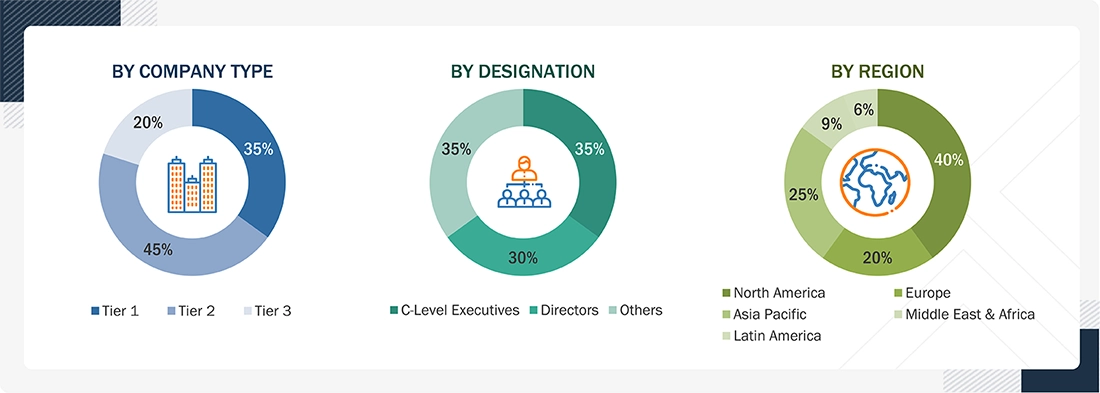
*Others include sales managers, marketing managers, and product managers.
Note: Tier 1 companies’ revenue is more than USD 1 billion; Tier 2 companies’ revenue ranges between USD 500 million to 1 billion; and Tier 3
companies’ revenue ranges between USD 100 million and USD 500 million
To know about the assumptions considered for the study, download the pdf brochure
Internet of Things Market Size Estimation
Multiple approaches were adopted to estimate and forecast the size of the IoT market. The first approach involves estimating market size by summing up the revenue generated by companies through the sale of IoT solutions.
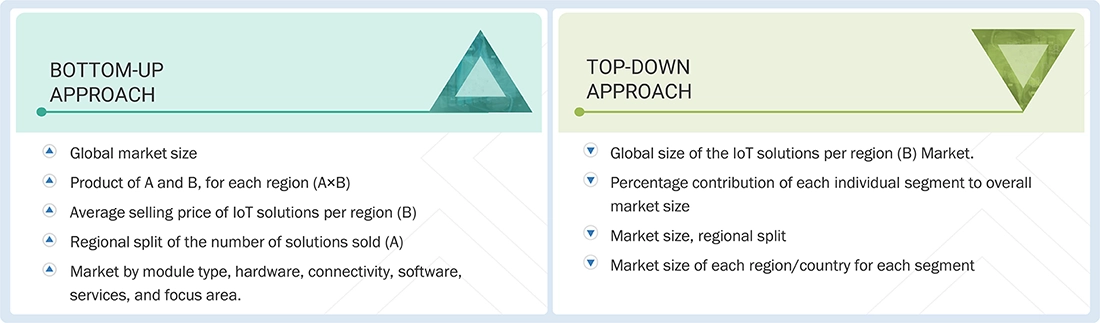
Top-down and bottom-up approaches were used to estimate and validate the total size of the IoT market. These methods were also extensively used to estimate the size of various market segments. The research methodology used to evaluate the market size is listed below.
- Key players in the market have been identified through extensive secondary research.
- In terms of value, the industry’s supply chain and market size have been determined through a combination of primary and secondary research processes.
- All percentage shares, splits, and breakups have been determined using secondary sources and verified through primary sources.
IoT Market : Top-Down and Bottom-Up Approach
Data Triangulation
After determining the overall market size, the IoT market was segmented into several categories and subcategories. A data triangulation procedure was employed to complete the overall market engineering process and derive the exact statistics for all segments and subsegments, as applicable. The data was triangulated by studying various factors and trends from the demand and supply sides. In addition to data triangulation and market breakdown, the market size was validated using both top-down and bottom-up approaches.
Market Definition
Internet of Things (IoT), is a network of physical devices embedded with sensors and software that can collect and exchange data over the internet, enabling them to communicate and interact with each other without human intervention; essentially, it encompasses hardware, software, connectivity, and services used to build and operate IoT systems across various focus areas such as smart transportation, smart energy & utilities, smart manufacturing, smart retail, among others.
Stakeholders
- Government agencies
- IoT service providers
- Telecom companies
- System integrators
- Smart device manufacturers
- Healthcare providers and institutions
- Automotive and mobility solution providers
- Energy and utility companies
- Retailers and E-commerce platforms
- Industrial enterprises
- Construction and real estate developers
- Agricultural enterprises
- Financial institutions and banks
- Research and development institutions
- Educational and training organizations
Report Objectives
- To determine and forecast the global IoT market by module type, hardware, connectivity, software, service, focus area, and region
- To forecast the size of the market segments for North America, Europe, Asia Pacific, Latin America, and the Middle East & Africa
- To provide detailed information about the major factors (drivers, restraints, opportunities, and challenges) influencing the growth of the IoT market
- To analyze each submarket concerning individual growth trends, prospects, and contributions to the overall IoT market
- To analyze the opportunities in the market for stakeholders by identifying the high-growth segments of the IoT market
- To profile the key market players, provide a comparative analysis based on business overviews, regional presence, product offerings, business strategies, and key financials, and illustrate the market’s competitive landscape
- Track and analyze competitive developments in the market, such as mergers and acquisitions, product development, partnerships and collaborations, and research and development (R&D) activities
Available Customizations
With the given market data, MarketsandMarkets offers customizations to meet the company’s specific needs. The following customization options are available for the report:
Geographic Analysis as per Feasibility
- Analysis for additional countries (up to five)
Company Information
- Detailed analysis and profiling of additional market players (up to 5)
Get the Full IoT Market Report
Full forecast, segment splits, and company analysis for all IoT Market.
Need a Tailored Report?
Customize this report to your needs
Get 10% FREE Customization
Customize This Report
