
Japan Intraocular Lens Market (2025-2030)

The Japan Intraocular Lens Market was valued at $172.6 Million in 2025 and projected to reach to $226.7 Million by 2030, representing a compound annual growth rate of CAGR 5.6%. Japan's intraocular lens market is poised for steady expansion through 2030, supported by demographic shifts and increasing surgical volumes.


| Market Size in | USD 26.32 MN |
| Market Forecast in | |
| CAGR | |
| Forecast Period | |
| Units Considered | Value (USD MN) |
Japan Intraocular Lens Market Trends and Insights
- Japan's aging population and rising prevalence of cataracts are driving demand for advanced IOL technologies across the country.
- The market in Japan benefits from high healthcare spending, strong regulatory frameworks, and widespread adoption of premium lens options among Japanese patients seeking improved visual outcomes..
Key Market Statistics
- CAGR (2025-2030) CAGR 5.6%
- Market Size, 2025 ~USD 172.6 Million
- Forecast, 2030 ~USD 226.7 Million
- Country Japan
Japan Intraocular Lens Market Overview
Aging Population Driving Demand :
Japan's rapidly aging demographic, with over 29% of the population aged 65+, is significantly increasing cataract prevalence and IOL implantation procedures, creating sustained market growth opportunities.
Advanced Technology Adoption :
Japanese healthcare providers are increasingly adopting premium IOL technologies including multifocal, toric, and extended depth of focus lenses, driven by high patient expectations and strong purchasing power.
Robust Healthcare Infrastructure :
Japan's universal healthcare system, high medical spending per capita, and stringent regulatory standards ensure consistent market access and premium product positioning for IOL manufacturers.
Market Growth Trajectory :
The Japan IOL market is expanding at 5.6% CAGR from USD 172.6 million (2025) to USD 226.7 million (2030), outpacing many developed markets due to demographic and healthcare factors.
Japan Intraocular Lens Market Dynamics
- The aging population will continue to drive cataract-related procedures, while growing consumer awareness of vision quality improvements fuels demand for premium IOL options.
- Healthcare providers are investing in advanced surgical technologies and training, enhancing adoption of sophisticated lens solutions. The competitive landscape in Japan remains favorable for established and innovative manufacturers.
- Regulatory pathways are well-defined, and reimbursement mechanisms support both standard and premium products.
- Strategic partnerships with Japanese hospitals and ophthalmology centers will be critical for market penetration, as will localized marketing emphasizing quality-of-life improvements for elderly patients..
Market Ecosystem
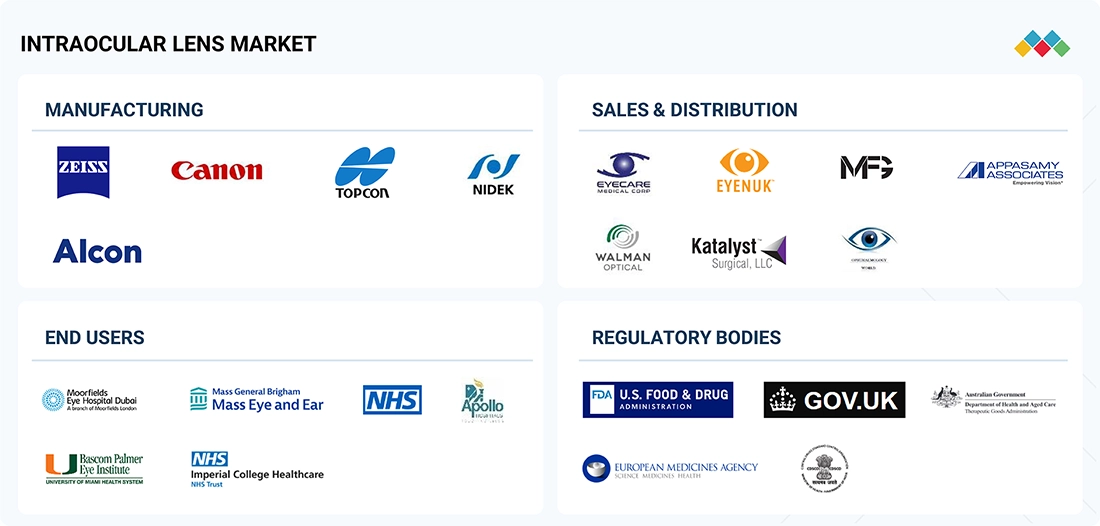
Intraocular Lens Market: COMMERCIAL USE CASES ACROSS INDUSTRIES
| COMPANY | USE CASE DESCRIPTION | BENEFITS |
|---|---|---|
 |
Develops a wide portfolio of monofocal, toric, multifocal, and EDOF IOLs supported by advanced biometry and surgical planning platforms. | Enhances refractive accuracy, improves spectacle independence, and ensures superior visual outcomes for patients undergoing cataract and refractive lens exchange procedures. |
 |
Offers premium IOL technologies, including multifocal, accommodating, and monofocal-plus lenses with proprietary material science. | Provides high-quality vision across distances, reduces dysphotopsia, and boosts patient satisfaction with optimized postoperative performance. |
 |
Designs premium toric and multifocal IOLs integrated with advanced diagnostics such as biometry and image-guided surgery platforms. | Enables precise alignment, reduces refractive error, and improves surgical workflow efficiency through integrated planning and guidance. |
 |
Manufactures hydrophobic acrylic IOLs with aspheric optics, glistening-free materials, and monofocal-plus options. | Ensures stable long-term clarity, reduces the risk of posterior capsular opacification, and delivers enhanced contrast sensitivity. |
 |
Offers innovative monofocal, toric, and EDOF IOLs, including customizable optic technologies and enhanced material designs. | Improves visual quality, reduces visual disturbances, and provides surgeons with flexible solutions for tailored patient outcomes. |
Logos and trademarks shown above are the property of their respective owners. Their use here is for informational and illustrative purposes only.
Related Ecosystem
Medical Devices
- Polymerase Chain Reaction (PCR)
- Magnetic Resonance Imaging (MRI)
- Disposable Autoinjectors
- Pulse Oximeters
- Blood Pressure Monitors
- Medtronic plc
- Abbott Laboratories
- Stryker Corporation
- Becton, Dickinson and Company
- CONMED Corporation
Key Takeaways
- Japan's IOL market is estimated at USD 172.6 million in 2025 and will grow to USD 226.7 million by 2030 at a 5.6% CAGR.
- Japan's aging demographic and high cataract incidence rates are primary growth catalysts for the intraocular lens market.
- Japan demonstrates strong preference for premium and advanced IOL technologies, supporting higher average selling prices.
- Japan's robust healthcare infrastructure and reimbursement policies create a favorable environment for IOL market expansion.
Intraocular Lens Market Report Scope
| Report Metric | Details |
|---|---|
| Base Year | 2025 |
| Fastest Growing Segment | HYDROPHOBIC ACRYLIC IOLS (Material) |
| Forecast Period | 2025–2030 |
| Growth Rate | CAGR of 6% from 2025 to 2030 |
| Largest Segment | CATARACT SURGERY (Application) |
| Market Size Base Year (Billions) | ~USD 4.61 (2025) |
| Revenue Forecast (Billions) | ~USD 6.17 (2030) |
| Segments Covered | Type, Material, Application, End User |
Japan Intraocular Lens Market Report Segmentation
4 segment dimensions are covered across the global market.
By Type
- Accommodating Iols
- Aspheric Monofocal Iols
- Extended Depth-Of-Focus Iols
- Monofocal Iols
- Multifocal Iols
- Other Iols
- Phakic Iols
- Premium Iols
- Spheric Monofocal Iols
By Material
- Hydrophilic Acrylic Iols
- Hydrophobic Acrylic Iols
- Other Materials
- Polymethylmethacrylate
- Silicone Iols
By Application
- Cataract Surgery
- Corneal Disorders
- Other Applications
- Presbyopia
By End User
- Eye Research Institutes
- Hospitals
- Ophthalmology Clinics
- Other End Users
JAPAN: INTRAOCULAR LENS MARKET, BY END USER, 2023–2030
| Segment | 2023 | 2024 | 2025 | 2026 | 2027 | 2028 | 2029 | 2030 | CAGR (%) |
|---|---|---|---|---|---|---|---|---|---|
| EYE RESEARCH INSTITUTES | 16.2 | 16.9 | 17.5 | 18.2 | 19 | 19.8 | 20.6 | 21.5 | 4.2 |
| HOSPITALS | 215.2 | 226.9 | 239.5 | 253.1 | 267.6 | 283.3 | 300 | 318 | 5.8 |
| OPHTHALMOLOGY CLINICS | 31.3 | 32.8 | 34.4 | 36.1 | 37.9 | 39.9 | 42 | 44.2 | 5.2 |
| OTHERS | 11.7 | 12 | 12.3 | 12.7 | 13.1 | 13.5 | 13.9 | 14.4 | 3.1 |
| TOTAL | 274.4 | 288.5 | 303.7 | 320.1 | 337.6 | 356.4 | 376.5 | 398 | 5.6 |
Target Audience
- IOL Manufacturers & Device Companies : Evaluate market size, growth potential, and competitive positioning in Japan to inform product development, pricing strategies, and market entry or expansion decisions.
- Healthcare Investors & Private Equity : Assess investment opportunities in Japan's ophthalmology sector with detailed market forecasts, growth drivers, and risk analysis for portfolio companies and acquisition targets.
- Hospital & Clinic Operators : Plan surgical service expansion and IOL procurement strategies based on demand forecasts, technology trends, and reimbursement insights specific to the Japanese market.
- Market Research & Consulting Firms : Access comprehensive Japan-specific data to support client advisory services, competitive benchmarking, and strategic planning in the ophthalmic devices sector.
- Regulatory & Government Bodies : Monitor market trends, technology adoption, and healthcare outcomes in Japan's IOL market to inform policy decisions and healthcare resource allocation strategies.
Key Companies in the Japan Intraocular Lens Market
| Company | HQ | Ownership | Strongest segments |
|---|---|---|---|
| HALMA PLC | United Kingdom | Public Company | Safety,Environmental & Analysis,Healthcare, |
| FLUOR CORPORATION | United States | ||
| LUMENIS LTD | Israel | Private Company | Surgical (urology/ENT),Ophthalmic,Aesthetic, |
| LENSTEC, INC. | China | Public Company | Smartphone glass covers and appearance structures,Functional modules (fingerprint, touch, biometrics),Smart wearables components, |
| BVI | United States | Private Company | Cataract surgery instruments and consumables,Vitreoretinal surgery tools and accessories,Refractive and diagnostic accessories, |
HALMA PLC
Halma PLC is a United Kingdom-based public company founded in 1894 that employs approximately 9,000 people. The company operates as an established industrial and safety-focused enterprise with a long history of operations.
FLUOR CORPORATION
Fluor Corporation is a United States-based company providing engineering, procurement, and construction services across multiple industries.
LUMENIS LTD
Lumenis Ltd is an Israeli private company founded in 1991 with 954 employees, specializing in laser and light-based medical technologies.
LENSTEC, INC.
Lenstec, Inc. is a China-based public company founded in 1993 with approximately 145,683 employees operating in the optical and lens manufacturing sector.
BVI
BVI is a United States-based private company founded in 1985 providing ophthalmic surgical instruments and equipment.
Reasons to Buy this Report
- Demographic Insights for Japan : Understand how Japan's aging population structure directly impacts IOL demand, procedure volumes, and market sizing through 2030 with country-specific demographic analysis.
- Competitive Landscape in Japan : Identify key players, market share distribution, and competitive strategies specific to the Japanese market, including local manufacturers and international competitors' positioning.
- Regulatory & Reimbursement Framework : Navigate Japan's unique healthcare regulations, PMDA approval pathways, and insurance reimbursement structures that directly influence product launch strategies and pricing.
- Technology Adoption Trends : Analyze Japan-specific adoption rates for premium IOL technologies (multifocal, toric, extended depth of focus) and identify emerging opportunities in advanced lens segments.
- Market Entry & Growth Strategy : Develop targeted go-to-market strategies for Japan with actionable insights on distribution channels, hospital partnerships, and physician engagement specific to the Japanese healthcare system.
Frequently asked questions
What is the current size of Japan's intraocular lens market?
Japan's intraocular lens market is valued at USD 172.6 million in 2025.
What is the projected market size for Japan's IOL market by 2030?
Japan's intraocular lens market is forecast to reach USD 226.7 million by 2030.
What is the growth rate of Japan's intraocular lens market?
Japan's intraocular lens market is expected to grow at a compound annual growth rate of 5.6% from 2025 to 2030.
What factors are driving growth in Japan's IOL market?
Japan's IOL market growth is driven by an aging population, rising cataract prevalence, high healthcare spending, and strong adoption of premium lens technologies.
Why is Japan's IOL market significant in Asia Pacific?
Japan represents a mature, high-value market within Asia Pacific due to advanced healthcare infrastructure, strong reimbursement systems, and consumer preference for premium intraocular lens solutions.
RESEARCH METHODOLOGY
The study involved major activities in estimating the current market size for the intraocular lens market. Exhaustive secondary research was done to collect information on the intraocular lens market. The next step was to validate these findings, assumptions, and sizing with industry experts across the value chain using primary research. Different approaches, including top-down and bottom-up methods, were employed to estimate the total market size. After that, the market breakup and data triangulation procedures were used to estimate the market size of the segments and subsegments of the intraocular lens market.
Secondary Research
This research study involved the extensive use of secondary sources, including directories, databases such as Dun & Bradstreet, Bloomberg Businessweek, and Factiva, as well as whitepapers and company house documents. Secondary research was undertaken to identify and collect information for this extensive, technical, market-oriented, and commercial study of the intraocular lens market. It was also used to obtain important information about top players, market classification, and segmentation according to industry trends, as well as geographic markets and key developments related to the market. A database of the key industry leaders was also prepared using secondary research.
Primary Research
In the primary research process, various supply- and demand-side sources were interviewed to obtain qualitative and quantitative information for this report. Primary sources from the supply side included industry experts such as CEOs, VPs/managing directors, marketing heads/directors and sales directors, marketing/sales managers, regional/area sales managers, export/import heads/managers, and other ophthalmic market-related personnel from various companies and organizations operating in the intraocular lens market. Primary sources from the demand side included the vice presidents of hospitals and clinics, C-level executives, department heads, doctors/eye physicians, supply management teams of hospitals, clinic personnel, and laboratory technicians.
Breakdown of Primary Interviews
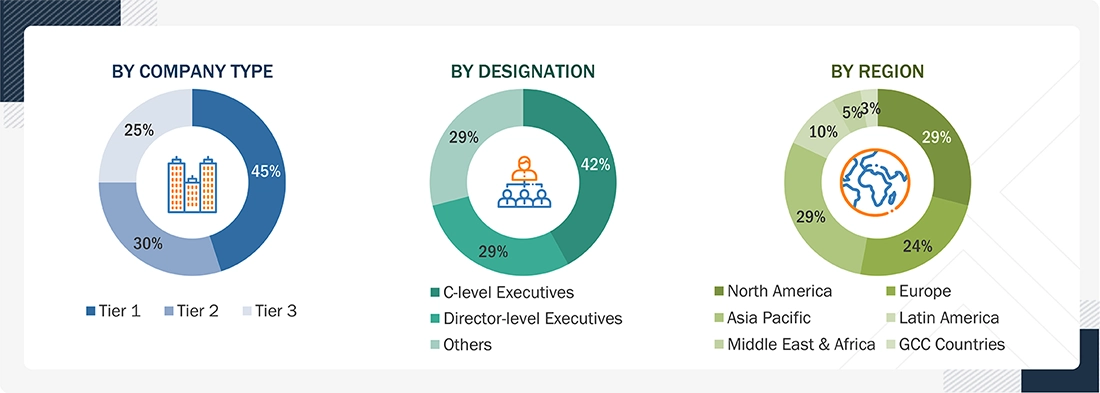
Note 1: C-level executives include CEOs, COOs, and CTOs.
Note 2: Others include sales, marketing, and product managers.
Note 3: Companies are classified into tiers based on their total revenue. As of 2024: Tier 1 = >USD 1 billion, Tier 2 = USD 500 million to USD 1 billion, Tier 3 = < USD 500 million
To know about the assumptions considered for the study, download the pdf brochure
Market Size Estimation
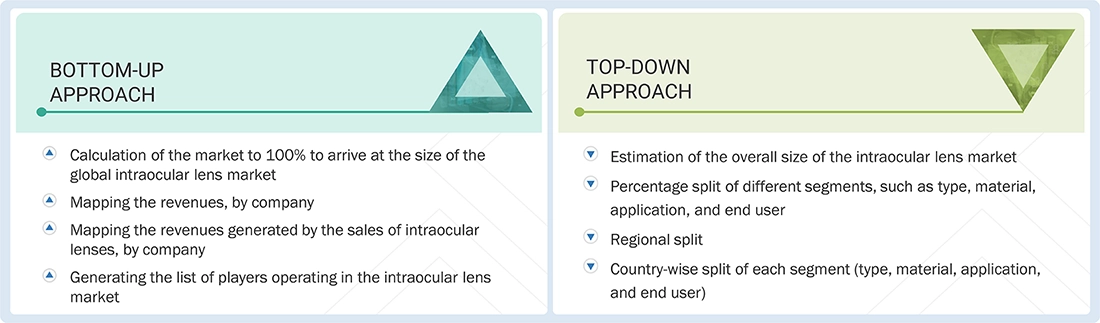
Both top-down and bottom-up approaches were used to estimate and validate the total size of the intraocular lens market. These methods were also used extensively to estimate the size of various subsegments in the market. The research methodology used to estimate the market size includes the following:
Data Triangulation
The entire market was split into four segments when the market size was determined. Data triangulation and market breakdown processes were used where necessary to complete the entire market engineering process and arrive at precise statistics for all segments.
Approach to derive the market size and estimate market growth.
Using secondary data from paid and unpaid sources, the market rankings for the major players were determined following a thorough analysis of their sales of intraocular lenses. Due to data restrictions, the revenue share in certain cases was determined after a thorough analysis of the product portfolio of big corporations and their individual sales performance. This information was verified at each stage by in-depth interviews with professionals in the field.
Market Definition
Intraocular lenses, or IOLs, refer to artificial lenses that are implanted in the eye, usually during cataract surgery or for other problems with vision. These lenses are made of biocompatible materials like silicone or acrylic and are intended to replace the natural lens of the eye that has been clouded by cataracts or to improve focusing ability for clearer vision. IOLs are available in several types: monofocal lenses, which provide clear vision at a single distance (near or far); multifocal lenses, which correct the vision at numerous distances; toric lenses, which correct astigmatism; and accommodating lenses, which replicate the focusing capacity of a natural lens.
Stakeholders
- Manufacturers of Intraocular Lenses
- Eye Research Institutions
- Contract Manufacturing Organizations (CMOs)
- Government Associations
- Market Research and Consulting Firms
- Venture Capitalists and Investors
- Distributors of Intraocular Lenses
- Ophthalmic Device Research & Development (R&D) Companies
- Ophthalmology Hospitals & Clinics
Report Objectives
- To describe, analyze, and forecast the intraocular lens market by type, material, application, end user, and region
- To describe and forecast the intraocular lens market for key regions: North America, Europe, the Asia Pacific, Latin America, the Middle East & Africa, and the GCC Countries
- To provide detailed information regarding drivers, restraints, opportunities, and challenges influencing the growth of the intraocular lens market
- To strategically analyze the ecosystem, regulations, patenting trend, value chain, Porter’s five forces, and prices pertaining to the market under study
- To strategically analyze micromarkets with respect to individual growth trends, prospects, and contributions to the overall market
- To analyze market opportunities for stakeholders and provide details of the competitive landscape for market players
- To profile key players and comprehensively analyze their market shares and core competencies in the intraocular lens market
- To analyze competitive developments such as collaborations, acquisitions, product launches, expansions, and R&D activities in the intraocular lens market
Get the Full Intraocular Lens Market Report
Full forecast, segment splits, and company analysis for all Intraocular Lens Market.
- Canada Intraocular Lens Market
- US Intraocular Lens Market
- Germany Intraocular Lens Market
- France Intraocular Lens Market
- UK Intraocular Lens Market
- Italy Intraocular Lens Market
- Spain Intraocular Lens Market
- China Intraocular Lens Market
- India Intraocular Lens Market
- Australia Intraocular Lens Market
- South Korea Intraocular Lens Market
- Brazil Intraocular Lens Market
- Mexico Intraocular Lens Market
- GCC Countries Intraocular Lens Market
- Rest Of Europe Intraocular Lens Market
- Rest Of Asia Pacific Intraocular Lens Market
- Other Countries Intraocular Lens Market
- Rest Of Latin America Intraocular Lens Market
Need a Tailored Report?
Customize this report to your needs
Get 10% FREE Customization
Customize This Report
