
Brazil Knee Replacement Surgery Market (2025-2030)

The Brazil Knee Replacement Surgery Market was valued at $475.9 Million in 2025 and projected to reach to $591.1 Million by 2030, representing a compound annual growth rate of 4.4%. Brazil's knee replacement surgery market is positioned for steady growth driven by demographic aging and rising osteoarthritis prevalence across the population.


| Market Size in | USD 26.32 MN |
| Market Forecast in | |
| CAGR | |
| Forecast Period | |
| Units Considered | Value (USD MN) |
Brazil Knee Replacement Surgery Market Trends and Insights
- Brazil represents a significant healthcare opportunity within Latin America, driven by an aging population and rising prevalence of osteoarthritis.
- The market in Brazil is supported by improving healthcare infrastructure, increased surgical capacity, and growing patient awareness of joint replacement options. Demand for knee replacement procedures in Brazil is accelerating due to demographic shifts and lifestyle factors contributing to joint degeneration.
- Brazil's healthcare system, both public and private, continues to invest in orthopedic capabilities and surgical technology.
- Between 2025 and 2030, Brazil is expected to see steady adoption of advanced implant materials and minimally invasive surgical techniques, positioning the country as a key growth market in the Latin American region..
Key Market Statistics
- CAGR (2025-2030) 4.4% CAGR
- Market Size, 2025 ~USD 475.9 Million
- Forecast, 2030 ~USD 591.1 Million
- Country Brazil
Brazil Knee Replacement Surgery Market Overview
Market Valuation :
Brazil's knee replacement surgery market is valued at USD 475.9 million in 2025, with projections reaching USD 591.1 million by 2030, representing significant healthcare investment opportunities in Latin America's largest economy.
Aging Population Dynamics :
Brazil's demographic shift toward an older population is driving increased demand for orthopedic interventions, with osteoarthritis prevalence rising substantially among seniors, creating sustained market growth potential.
Healthcare Infrastructure Expansion :
Improving healthcare infrastructure and rising private healthcare adoption in Brazil are enhancing access to knee replacement procedures, supported by growing middle-class purchasing power and insurance coverage expansion.
Growth Trajectory :
At a CAGR of 4.4% through 2030, Brazil's market growth outpaces many emerging economies, though trails the global average of 6.1%, indicating localized market maturation and competitive dynamics specific to the region.
Brazil Knee Replacement Surgery Market Dynamics
- The expanding middle class and increasing healthcare spending are facilitating greater access to surgical interventions, while private healthcare providers continue to invest in orthopedic capabilities.
- Government healthcare initiatives and improved reimbursement policies are further supporting market expansion.
- However, economic volatility and healthcare budget constraints may moderate growth rates compared to developed markets.
- The market is expected to benefit from technological advancements in surgical techniques and implant materials, attracting both domestic and international orthopedic manufacturers seeking to establish stronger footholds in this strategically important Latin American market..
Market Ecosystem
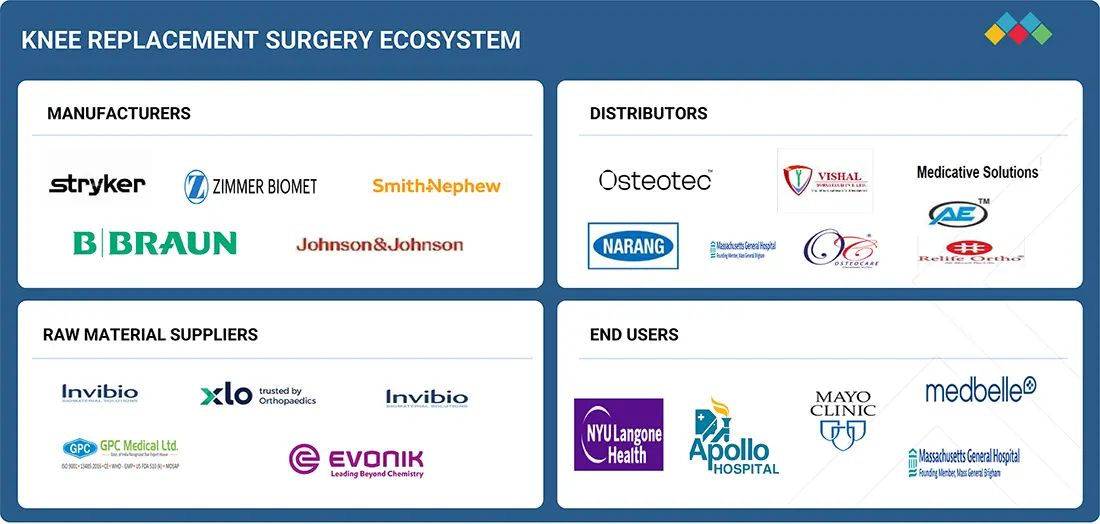
Knee Replacement Surgery Market: COMMERCIAL USE CASES ACROSS INDUSTRIES
| COMPANY | USE CASE DESCRIPTION | BENEFITS |
|---|---|---|
 |
Advanced knee implant systems (e.g., Triathlon Knee System) designed to mimic natural knee kinematics. | Improved implant longevity and patient satisfaction, Enhanced surgical precision, reducing revision rates |
 |
Comprehensive knee portfolio including Persona Knee system offering patient-specific sizing and fit. | Greater customization for individual patient anatomy, Consistent and reproducible results due to robotic guidance. |
 |
Attune Knee System featuring advanced kinematics and proprietary materials | Better implant wear resistance, increasing lifespan of prosthesis, Reduced pain and instability post-surg |
 |
JOURNEY II Total Knee System with OXINIUM technology for enhanced wear resistance | Increased implant durability and reduced risk of metal ion release, Bone preservation due to precise, less invasive resections |
Logos and trademarks shown above are the property of their respective owners. Their use here is for informational and illustrative purposes only.
Related Ecosystem
Medical Devices
- Polymerase Chain Reaction (PCR)
- Magnetic Resonance Imaging (MRI)
- Disposable Autoinjectors
- Pulse Oximeters
- Blood Pressure Monitors
- Medtronic plc
- Abbott Laboratories
- Stryker Corporation
- Becton, Dickinson and Company
- JOHNSON & JOHNSON
Key Takeaways
- Brazil's knee replacement surgery market is valued at USD 475.9 million in 2025 and will reach USD 591.1 million by 2030.
- Brazil is experiencing a 4.4% CAGR, reflecting steady but moderate growth driven by aging demographics and rising osteoarthritis prevalence.
- Brazil's public and private healthcare sectors are expanding orthopedic surgical capacity and adopting advanced implant technologies.
- Brazil represents a key growth opportunity within Latin America, supported by improving infrastructure and increasing patient demand for joint replacement procedures.
Knee Replacement Surgery Market Report Scope
| Report Metric | Details |
|---|---|
| Base Year | 2025 |
| Fastest Growing Segment | REVISION KNEE REPLACEMENT (Procedure) |
| Forecast Period | 2025-2030 |
| Growth Rate | CAGR of 6.1% from 2025 to 2030 |
| Largest Segment | KNEE IMPLANTS (Product) |
| Market Size Base Year (Billions) | ~USD 12.03 (2025) |
| Revenue Forecast (Billions) | ~USD 16.17 (2030) |
| Segments Covered | Product, Type, Procedure, Application, End User |
Brazil Knee Replacement Surgery Market Report Segmentation
5 segment dimensions are covered across the global market.
By Product
- Knee Braces & Support Systems
- Knee Implants
- Orthobiologics
By Type
- Bone Marrow Aspirate Concentrate
- Bone Morphogenetic Proteins
- Ceramic Implants
- Demineralized Bone Matrix
- Hybrid Implants
- Metal Implants
- Plastic Implants
- Platelet Rich Plasma
- Platelet-Rich Plasma
- Viscosupplementation
- Viscosupplementation Products
By Procedure
- Other Knee Replacement Procedures
- Other Procedures
- Partial Knee Replacement
- Revision Knee Replacement
- Total Knee Replacement
By Application
- Cancers
- Degenerative Diseases
- Other Applications
- Rheumatoid Arthritis & Osteoarthritis
By End User
- Ambulatory Surgery Centers
- Hospitals
- Orthopedic Clinics
BRAZIL: KNEE REPLACEMENT SURGERY MARKET, BY END USER, 2023–2030
| Segment | 2023 | 2024 | 2025 | 2026 | 2027 | 2028 | 2029 | 2030 | CAGR (%) |
|---|---|---|---|---|---|---|---|---|---|
| AMBULATORY SURGERY CENTERS | 140.3 | 144.9 | 149.5 | 155.7 | 162.1 | 168.6 | 175.3 | 182.2 | 4 |
| HOSPITALS | 199.6 | 207.8 | 216.1 | 226.9 | 238 | 249.5 | 261.5 | 273.8 | 4.8 |
| ORTHOPEDIC CLINICS | 103.1 | 106.6 | 110.2 | 114.9 | 119.8 | 124.8 | 129.9 | 135.1 | 4.2 |
| TOTAL | 443 | 459.3 | 475.9 | 497.5 | 519.9 | 543 | 566.7 | 591.1 | 4.4 |
Target Audience
- Orthopedic Device Manufacturers : Manufacturers need Brazil-specific market data to assess market size, growth potential, and competitive dynamics for knee implants and surgical instruments, informing product localization and distribution strategies.
- Healthcare Investment Firms : Private equity and venture capital investors require detailed Brazil market analysis to evaluate investment opportunities in orthopedic hospitals, surgical centers, and medical device companies operating in this growing market.
- Hospital & Surgical Center Operators : Healthcare facility operators need market insights to understand demand trends, patient demographics, and competitive positioning in Brazil's knee replacement segment to optimize service offerings and capacity planning.
- Market Entry & Expansion Teams : Companies planning Brazil market entry require localized market intelligence on sizing, growth drivers, regulatory landscape, and competitive environment to develop effective go-to-market strategies and feasibility assessments.
- Healthcare Consultants & Analysts : Consulting firms and research analysts need Brazil-specific market data to support client advisory work, competitive benchmarking, and strategic recommendations for orthopedic and healthcare sector stakeholders.
Reasons to Buy this Report
- Market-Specific Sizing Data : Access precise valuation figures for Brazil's knee replacement market (USD 475.9M in 2025) with detailed forecasts through 2030, enabling accurate financial planning and investment decisions tailored to this specific geography.
- Competitive Landscape Intelligence : Understand Brazil-specific market dynamics, competitive positioning, and regional player strategies to identify partnership opportunities, market entry points, and differentiation strategies within Latin America's largest healthcare market.
- Growth Driver Analysis : Gain insights into Brazil's unique demographic trends, healthcare infrastructure improvements, and economic factors driving the 4.4% CAGR, enabling strategic resource allocation and targeted market expansion initiatives.
- Regulatory & Reimbursement Insights : Obtain Brazil-specific information on healthcare policies, insurance coverage, government reimbursement structures, and regulatory requirements essential for successful market penetration and operational planning.
- Investment & Expansion Strategy : Leverage comprehensive Brazil market data to develop evidence-based expansion strategies, identify high-potential segments, and make informed capital allocation decisions for orthopedic ventures in this emerging market.
Frequently asked questions
What is the current size of Brazil's knee replacement surgery market?
Brazil's knee replacement surgery market is valued at USD 475.9 million in 2025.
What is the projected market size for Brazil by 2030?
Brazil's knee replacement surgery market is projected to reach USD 591.1 million by 2030.
What is the CAGR for Brazil's knee replacement surgery market?
Brazil's knee replacement surgery market is growing at a compound annual growth rate (CAGR) of 4.4% from 2025 to 2030.
What factors are driving growth in Brazil's knee replacement market?
Growth in Brazil is driven by an aging population, rising osteoarthritis prevalence, improved healthcare infrastructure, and increased adoption of advanced surgical technologies.
How does Brazil's market compare to other Latin American countries?
Brazil is the largest market in Latin America for knee replacement surgery, with significant investment in orthopedic capabilities and a large patient population requiring joint replacement procedures.
RESEARCH METHODOLOGY
This study was done through primary and secondary sources. In-depth secondary research gathered insights into the knee treatment surgery industry. The findings, assumptions, and market size estimates were then validated through primary research. Both top-down and bottom-up approaches were used to determine the total market size. Then, market segmentation and data triangulation methods were applied to determine the sizes of segments and sub-segments of the knee replacement surgery market. The research process also involved analyzing industry trends, segmentation types, key players, competitive landscape, market dynamics, and initiatives of key companies.
Secondary Research
The secondary research phase involved analyzing various sources, including industry directories, databases (such as Bloomberg Businessweek, Factiva, and D&B Hoovers), white papers, company filings, annual reports, investor presentations, and SEC filings. This research was essential in collecting technical, commercial, and market-related insights into the knee replacement surgery products sector. It also assisted in knowing key market players, segment classifications, and industry trends. Moreover, secondary research helped track market developments, advanced technologies, and competitive positioning. A database of major industry players was compiled by reviewing paid and publicly available data sources. The market evaluation of orthopedic device providers was based on assessing their product portfolios, performance, and overall quality. Furthermore, secondary research provided critical insights into the industry’s value chain, the key market participants, and classifications from technological and market-driven perspectives.
Primary Research
During the primary research, cross sections of sources from the demand and supply sides were interviewed to gather qualitative and quantitative information for this report. On the supply side, primary sources included industry players such as CEOs, vice presidents, marketing and sales directors, technology and innovation directors, and other key executives from leading companies and organizations in the knee replacement surgery industry. Demand-side sources comprised hospitals, ambulatory surgical centers, and orthopedic clinics. Primary research was conducted to authenticate market segments, monitor key players, and understand market trends. Following market engineering, which included calculation in statistics, segmentation analysis, estimation of the market, forecasting, and data triangulation, primary research was conducted to verify the key information.
A breakdown of the primary respondents is provided below:
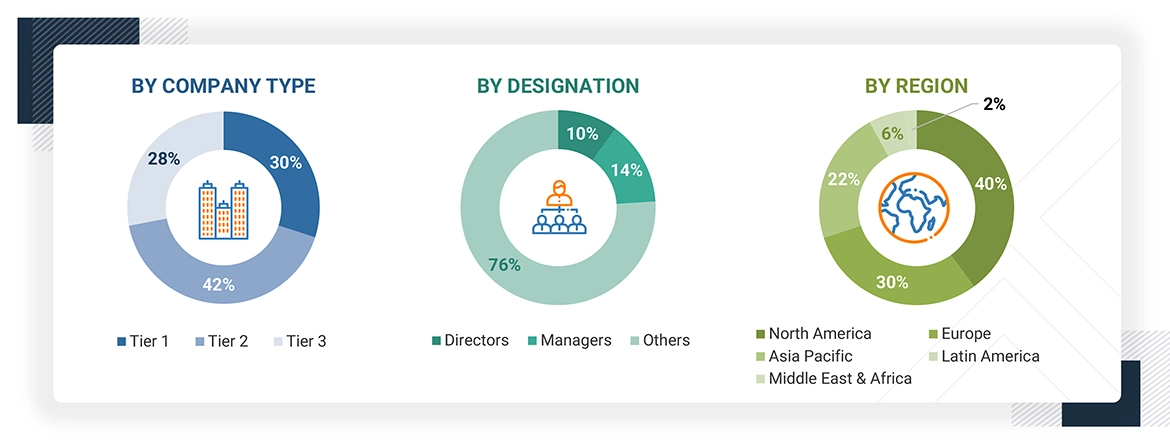
*Others include sales managers, marketing managers, business development managers, product managers, distributors, and suppliers.
Note: Companies are classified into tiers based on their total revenue. As of 2023, Tier 1 = >USD 2 billion, Tier 2 = USD 50 million to USD 2 billion, and Tier 3 = < USD 50 million.
To know about the assumptions considered for the study, download the pdf brochure
Market Size Estimation
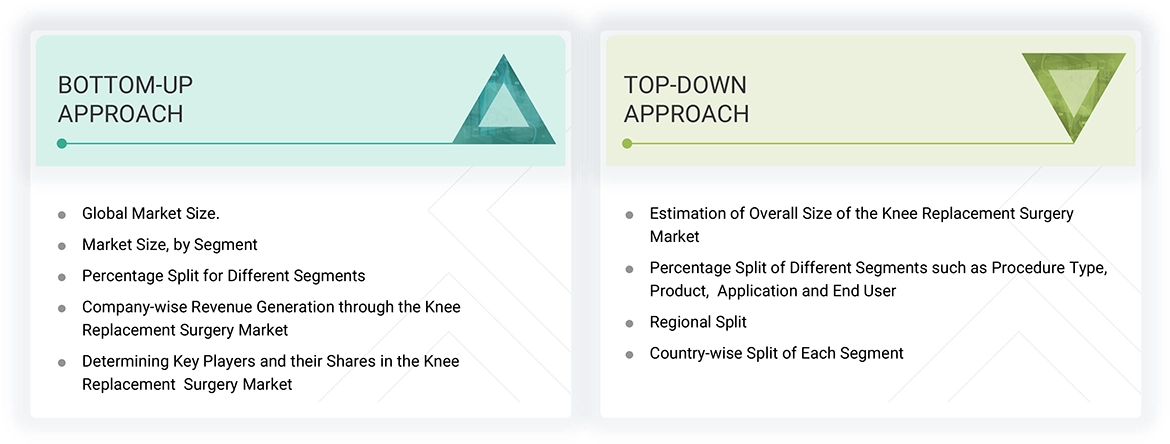
Both top-down and bottom-up approaches were used to estimate and validate the total size of the lab consumable market. These methods were also used extensively to estimate the size of various segments in the knee replacement surgery market.
Revenue share analysis was employed with the leading players to determine the size of the global Knee replacement surgery market. In this case, key players in the market have been identified, with their knee replacement surgery products business revenues determined through various insights gathered during the primary and secondary research phases. Secondary research included the study of top market players' annual and financial reports. On the other hand, primary research incorporated in-depth interviews with key opinion leaders, particularly chief executive officers, directors, and key marketing executives.
The research methodology used to estimate the market size includes the following:
Data Triangulation
After determining the overall market size through the estimation process, the global knee replacement surgery market was categorized into segments. Data triangulation methods were utilized to finalize the market engineering process and obtain precise statistics for each segment. This approach involved analyzing multiple factors and trends from both the demand and supply perspectives. Furthermore, the knee replacement surgery market was verified using a combination of top-down and bottom-up approaches.
Market Definition
Knee surgical interventions utilize an array of devices, including diverse knee implants, orthopedic braces, and supportive products, as well as orthobiologics designed for the stabilization and management of conditions such as osteoarthritis, rheumatoid arthritis, neoplasms, and degenerative diseases, among other clinical applications.
Stakeholders
- Knee Replacement Surgery Product Manufacturing Companies
- Product Distributors and Channel Partners
- Hospitals and Surgical Centers
- Orthopedic Clinics
- Ambulatory Care Centers
- Sports Institutes and Organizations
- Contract Manufacturers and Third-party Suppliers
- Research Laboratories and Academic Institutes
- Clinical Research Organizations (CROs)
- Government and Non-governmental Regulatory Authorities
- Market Research and Consulting Firms
Report Objectives
- To define, describe, and forecast the global knee replacement surgery market based on product, procedure type, application, end user, and region
- To provide detailed information regarding the major factors influencing the market growth (drivers, restraints, opportunities, and challenges) along with the current trends
- To strategically analyze micromarkets1 with respect to their individual growth trends, future prospects, and contributions to the total market
- To analyze opportunities in the market for stakeholders and provide details of the competitive landscape for market leaders
- To forecast the revenue of the market segments for five regions: North America (US and Canada), Europe (Germany, France, UK, Italy, Spain, and Rest of Europe), the Asia Pacific (China, Japan, India, South Korea, Australia, and Rest of Asia Pacific), Latin America (Brazil, Mexico, and Rest of Latin America), and the Middle East & Africa
- To profile the key players and comprehensively analyze their market shares and core competencies2
- To track and analyze competitive developments in the knee replacement surgery market, such as acquisitions, product launches, expansions, agreements, joint ventures, alliances, and collaborations
Get the Full Knee Replacement Surgery Market Report
Full forecast, segment splits, and company analysis for all Knee Replacement Surgery Market.
- Canada Knee Replacement Surgery Market
- US Knee Replacement Surgery Market
- Germany Knee Replacement Surgery Market
- France Knee Replacement Surgery Market
- UK Knee Replacement Surgery Market
- Italy Knee Replacement Surgery Market
- Spain Knee Replacement Surgery Market
- Japan Knee Replacement Surgery Market
- China Knee Replacement Surgery Market
- India Knee Replacement Surgery Market
- Australia Knee Replacement Surgery Market
- South Korea Knee Replacement Surgery Market
- Mexico Knee Replacement Surgery Market
- Rest Of Europe Knee Replacement Surgery Market
- Rest Of Asia Pacific Knee Replacement Surgery Market
- Rest Of Latin America Knee Replacement Surgery Market
Need a Tailored Report?
Customize this report to your needs
Get 10% FREE Customization
Customize This Report
