
UAE LEO PNT Market (2025-2030)

The UAE LEO PNT Market was valued at $0 Million in 2025 and projected to reach to $0.2 Million by 2030, representing a compound annual growth rate of . The UAE LEO PNT market is poised for gradual expansion as the emirate strengthens its space capabilities and integrates advanced positioning technologies into defence and commercial applications.


| Market Size in | USD 26.32 MN |
| Market Forecast in | |
| CAGR | |
| Forecast Period | |
| Units Considered | Value (USD MN) |
UAE LEO PNT Market Trends and Insights
- By 2030, the UAE LEO PNT market is projected to grow to $0.2 million, indicating emerging interest in satellite-based navigation alternatives and space-enabled positioning technologies.
- The UAE's strategic focus on space infrastructure and its position as a regional aerospace hub position it to gradually adopt LEO PNT capabilities, though current market penetration remains limited. The UAE's LEO PNT market growth trajectory reflects broader regional investments in space technology and satellite communications.
- As UAE-based enterprises and government entities explore redundancy and resilience in positioning systems, LEO PNT solutions offer complementary capabilities to traditional GNSS infrastructure.
- The forecast period through 2030 suggests incremental market development, with potential acceleration driven by increased satellite constellation deployments and regulatory frameworks supporting space-based services in the Middle East..
Key Market Statistics
- CAGR (2025-2030)
- Market Size, 2025 ~USD 0 Million
- Forecast, 2030 ~USD 0.2 Million
- Country UAE
UAE LEO PNT Market Overview
Nascent Market Stage :
The UAE LEO PNT market is in its infancy with $0.0 million in 2025, reflecting limited current deployment of Low Earth Orbit positioning and navigation solutions across the emirate's aerospace and defence sectors.
Projected Growth Trajectory :
Market size is expected to reach $0.2 million by 2030, demonstrating emerging adoption of satellite-based navigation alternatives as UAE explores space-enabled positioning technologies for strategic applications.
Strategic Space Initiatives :
UAE's growing investment in space infrastructure and satellite programs positions the nation to leverage LEO PNT capabilities for enhanced autonomous systems, maritime operations, and critical infrastructure positioning.
Global Context :
While the UAE market remains modest, the global LEO PNT sector is expanding at 53.9% CAGR, indicating significant international momentum that could accelerate regional adoption and technology transfer to the emirate.
UAE LEO PNT Market Dynamics
- Government initiatives supporting satellite development and autonomous systems will likely drive incremental adoption of LEO-based navigation solutions.
- The market's growth from $0.0 million in 2025 to $0.2 million by 2030 reflects early-stage commercialization and pilot deployments across select sectors. Future growth will be catalyzed by UAE's strategic focus on space sovereignty, digital transformation initiatives, and the need for independent positioning alternatives to traditional GPS systems.
- Partnerships with international space technology providers and domestic innovation hubs will accelerate LEO PNT integration into maritime, aviation, and critical infrastructure domains, positioning the UAE as a regional hub for advanced navigation technologies..
Market Ecosystem

LEO PNT MARKET: COMMERCIAL USE CASES ACROSS INDUSTRIES
| COMPANY | USE CASE DESCRIPTION | BENEFITS |
|---|---|---|
 |
LEO-based Timing for Telecommunications & Critical Infrastructure: Iridium provides satellite-based positioning and timing through its LEO constellation using Satellite Time and Location (STL) technology. The system is commercially used for timing synchronization, including telecommunications applications where conventional GNSS signals are unavailable or unreliable. | Independent Timing & Operational Continuity: Provides an alternative timing source for 5G networks and critical infrastructure. Stronger LEO signals can support timing reception indoors and during GNSS disruptions, reducing reliance on conventional satellite navigation. |
 |
LEO Precision Positioning for Commercial Navigation: Xona launched its PULSAR-0 satellite in June 2025 to demonstrate high-precision positioning and timing signals. By June 2026, the satellite had completed more than 350 signal transmission passes across four continents, with signals tracked by over 12 commercial receiver models. Applications under evaluation include construction, agriculture, and autonomous mobility. | Precision Positioning & Signal Resilience: Demonstrates stronger navigation signal transmission, authenticated ranging, and compatibility with commercial receivers. Successful in-orbit testing supports the development of future positioning applications, although full constellation coverage is not yet operational. |
 |
LEO PNT Integration for Construction & Precision Agriculture: In February 2026, Topcon signed a commercial agreement with Xona Space Systems for early access to its PULSAR navigation system. The agreement supports preparations to integrate LEO-based positioning into future high-precision workflows used in surveying, construction equipment, and agricultural machinery. | Improved Positioning Availability & Equipment Compatibility: The planned integration could provide additional satellite positioning measurements alongside conventional GNSS, supporting more reliable machine guidance and surveying operations. Commercial integration is under preparation, rather than confirmed widespread operational deployment. |
Logos and trademarks shown above are the property of their respective owners. Their use here is for informational and illustrative purposes only.
Related Ecosystem
Space
- C-Band
- Small Satellite
- Antennas
- Ka-Band
- Microsatellite
- AIRBUS
- L3Harris Technologies, Inc.
- Thales group
- Northrop Grumman Corporation
- LOCKHEED MARTIN CORPORATION
Key Takeaways
- The UAE LEO PNT market is valued at $0.0 million in 2025 and is forecast to reach $0.2 million by 2030, reflecting early-stage market development.
- UAE's investment in space infrastructure and aerospace capabilities positions the emirate as a potential adopter of LEO PNT technologies for enhanced positioning resilience.
- Current market penetration in the UAE remains limited, with growth driven by emerging demand for satellite-based navigation alternatives and government space initiatives.
- The UAE LEO PNT market exhibits zero CAGR through 2030, indicating gradual and incremental expansion rather than rapid acceleration in this segment.
LEO PNT Market Report Scope
| Report Metric | Details |
|---|---|
| Base Year | 2025 |
| Fastest Growing Segment | S-BAND (Frequency) |
| Forecast Period | 2025–2030 |
| Growth Rate | CAGR of 53.9% from 2025 to 2030 |
| Largest Segment | L-BAND (Frequency) |
| Market Size Base Year (Billions) | ~USD 0.07 (2025) |
| Revenue Forecast (Billions) | ~USD 0.57 (2030) |
| Segments Covered | Hardware, Satellite Mass, Frequency, End Use |
UAE LEO PNT Market Report Segmentation
4 segment dimensions are covered across the global market.
By Hardware
- Backhaul Module
- Gnss Module
- Navigation Signal Generator
- Signal Transmission Module
- Time Synchronization
By Satellite Mass
- Cubesat
- Smallsat
By Frequency
- C-Band
- Ku & Ka-Band
- L-Band
- S-Band
- Vhf & Uhf-Band
By End Use
- Automotive & Mobility
- Civil Aviation & Uas
- Construction & Precision Agriculture
- Government & Defense
- Industrial Logistics
- Maritime & Offshore
- Other End Uses
- Telecom & Power
Target Audience
- Aerospace & Defence Manufacturers : Need market intelligence on UAE's adoption of LEO PNT technologies to develop positioning solutions for military platforms, autonomous systems, and next-generation defence applications.
- Space Technology Providers : Require insights into UAE's satellite navigation market potential to identify partnership opportunities, licensing agreements, and commercialization pathways for LEO-based positioning services.
- Government & Policy Makers : Seek data-driven analysis of LEO PNT market trends to inform space policy, technology investment decisions, and strategic initiatives supporting UAE's space sovereignty objectives.
- Investment & Venture Capital Firms : Need market sizing and growth forecasts for UAE's LEO PNT sector to evaluate investment opportunities in space technology startups and emerging positioning solution providers.
- Maritime & Critical Infrastructure Operators : Require market outlook data to assess the viability and timeline for adopting LEO-based positioning alternatives for enhanced navigation, security, and operational resilience in UAE operations.
Key Companies in the UAE LEO PNT Market
| Company | HQ | Ownership | Strongest segments |
|---|---|---|---|
| SAFRAN | France | ||
| THALES ALENIA SPACE | France | ||
| HEXAGON AB | Sweden | ||
| L3HARRIS TECHNOLOGIES, INC. | United States | ||
| AIRBUS | United States | ||
| CACI INTERNATIONAL INC | United States | Public Company | GNSS Module,Time Synchronization,Backhaul Module, |
| MICROCHIP TECHNOLOGY INC. | United States | Public Company | GNSS Module,Time Synchronization,Backhaul Module, |
| GENERAL DYNAMICS CORPORATION | United States | ||
| RUAG GROUP | Switzerland | Private Company | Navigation Signal Generation,Signal Transmission Module,Time Synchronization, |
| NORTHROP GRUMMAN | United States | ||
| HONEYWELL INTERNATIONAL INC. | United States | ||
| FUGRO | United States |
SAFRAN
Safran is a French multinational company operating in aerospace, defense, and security sectors.
THALES ALENIA SPACE
Thales Alenia Space is a French aerospace company specializing in space systems and satellite technology.
HEXAGON AB
Hexagon AB is a Swedish multinational technology company providing digital solutions and services.
L3HARRIS TECHNOLOGIES, INC.
L3Harris Technologies, Inc. is a United States-based defense and aerospace technology company.
AIRBUS
Airbus is an aerospace company based in the United States providing aircraft and related services.
CACI INTERNATIONAL INC
CACI International Inc. is a publicly traded United States company founded in 1962 with 25,000 employees, providing information technology and professional services.
MICROCHIP TECHNOLOGY INC.
Microchip Technology Inc. is a publicly traded United States company founded in 1989 with 17,900 employees, specializing in semiconductor and microcontroller solutions.
GENERAL DYNAMICS CORPORATION
General Dynamics Corporation is a United States-based defense and aerospace company.
RUAG GROUP
RUAG Group is a Swiss private company founded in 1999 with 1,813 employees, operating in the aerospace and defense sectors.
NORTHROP GRUMMAN
Northrop Grumman is a United States-based defense and aerospace technology company.
HONEYWELL INTERNATIONAL INC.
Honeywell International Inc. is a United States multinational conglomerate providing aerospace, building technologies, and industrial solutions.
FUGRO
Fugro is a United States-based company providing geotechnical and survey services.
Reasons to Buy this Report
- Early Market Entry Advantage : Gain first-mover insights into UAE's emerging LEO PNT sector before significant market expansion, enabling strategic positioning and partnership development in this nascent but high-growth domain.
- Government Strategy Alignment : Understand UAE's space initiatives and defence modernization priorities to align product offerings and business development strategies with national positioning technology adoption roadmaps.
- Competitive Intelligence : Identify key players, technology gaps, and market opportunities specific to the UAE market before competitors establish dominant positions in this emerging segment.
- Investment Decision Support : Make informed decisions on R&D investments, market entry timing, and resource allocation for LEO PNT solutions targeting the UAE aerospace, defence, and critical infrastructure sectors.
- Regional Growth Forecasting : Access detailed projections and market drivers specific to UAE to forecast revenue potential and develop realistic business plans for LEO PNT technology deployment in the emirate.
Frequently asked questions
What is the current size of the LEO PNT market in the UAE?
The UAE LEO PNT market is estimated at $0.0 million in 2025, representing an early-stage market with minimal current commercial deployment.
What is the forecast for the UAE LEO PNT market by 2030?
The UAE LEO PNT market is projected to reach $0.2 million by 2030, indicating modest growth over the forecast period.
What is driving growth in the UAE LEO PNT market?
Growth in the UAE LEO PNT market is driven by the emirate's strategic investments in space infrastructure, demand for positioning system redundancy, and emerging satellite constellation deployments.
Why is the UAE LEO PNT market growing slowly compared to global trends?
The UAE LEO PNT market exhibits zero CAGR due to limited current adoption, nascent regulatory frameworks, and the dominance of established GNSS solutions in existing applications.
Which sectors in the UAE are most likely to adopt LEO PNT solutions?
Aerospace, defence, maritime, and government agencies in the UAE are most likely to explore LEO PNT adoption for enhanced positioning resilience and backup navigation capabilities.
RESEARCH METHODOLOGY
The LEO PNT market is estimated at USD 0.17 billion in 2026 and is projected to reach USD 0.95 billion by 2031, at a CAGR of 41.3% during the forecast period. The research study uses secondary sources, including company annual reports, official publications, government databases, procurement records, technical papers, and industry associations, to collect information related to LEO PNT satellite payload hardware. Primary research includes discussions with satellite manufacturers, LEO PNT constellation operators, navigation payload manufacturers, precision timing and RF component suppliers, system integrators, and end users. Interviews with industry experts, company executives, and other market participants are used to validate market estimates, segment trends, technology developments, and competitive positioning. Both qualitative and quantitative inputs are considered to assess the market across satellite mass, hardware, frequency, end use, and region. The market assessment excludes software and services, satellite power systems, satellite buses, and structural components.
Secondary Research
The secondary research process involves identifying and collecting information related to the LEO PNT market from company annual reports, press releases, investor presentations, product documents, government and space agency publications, procurement databases, technical papers, patents, and industry associations. The research focuses on LEO PNT payload manufacturers, constellation operators, precision timing hardware suppliers, navigation signal generation technologies, and RF component manufacturers. The report reviews information on contracts, partnerships, product developments, satellite navigation programs, and constellation deployments to assess market trends, competitive positioning, and regional developments. The collected data is analyzed using bottom-up and top-down approaches to estimate the overall market and its segments by satellite mass, hardware, frequency, end use, and region. Only relevant LEO PNT satellite payload hardware is considered, excluding software and services, satellite power systems, satellite buses, and structural components. Findings from secondary research are further validated through primary research with relevant industry participants and subject-matter experts.
Primary Research
Extensive primary research was conducted after acquiring information on the LEO PNT market through secondary research. Several primary interviews were conducted with market experts from the demand and supply sides across major countries of North America, Europe, Asia Pacific, and the Middle East. Primary data was collected through questionnaires, emails, and telephonic interviews.
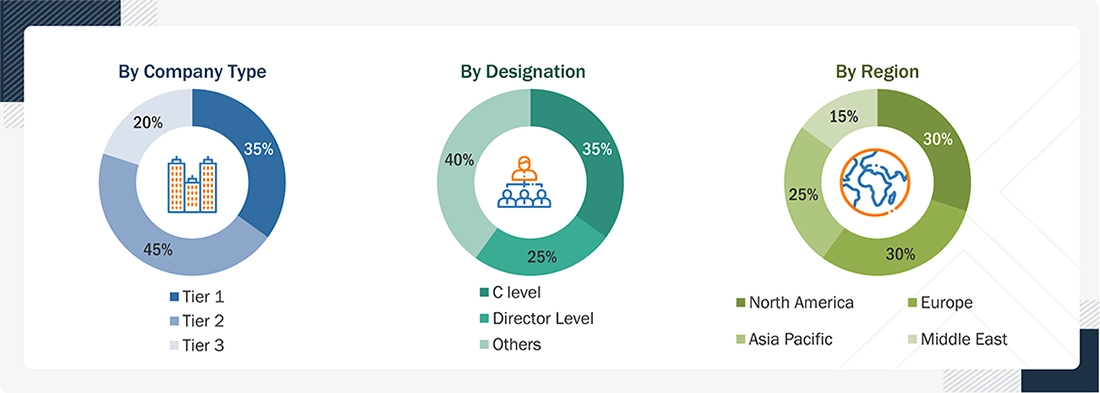
To know about the assumptions considered for the study, download the pdf brochure
Market Size Estimation
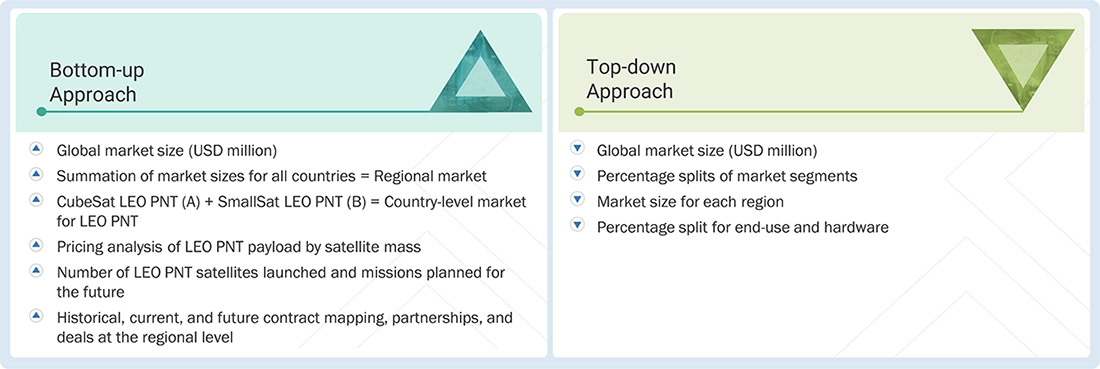
Top-down and bottom-up approaches were used to estimate and validate the size of the LEO PNT market. The research methodology used to estimate the size of the market included the following details:
- Key players in the LEO PNT market were identified through secondary research, and their market shares were determined through a combination of primary and secondary research. This included a study of the annual and financial reports of the top market players, as well as extensive interviews with leaders, including directors, engineers, marketing executives, and other key stakeholders of leading companies operating in the market.
- All percentage shares, splits, and breakdowns were determined using secondary sources and verified through primary sources.
- All possible parameters that affect the markets covered in this research study were accounted for, viewed in extensive detail, verified through primary research, and analyzed to obtain the final quantitative and qualitative data on the LEO PNT market. This data was consolidated, enhanced with detailed input, analyzed by MarketsandMarkets, and presented in this report.
LEO PNT Market: Top-Down and Bottom-Up Approach
Data Triangulation
After determining the overall market size, the total market was classified into several segments and subsegments. The data triangulation and market breakdown procedures explained below were implemented, wherever applicable, to complete the overall market engineering process and arrive at the estimated market numbers for the market segments and subsegments. The data was triangulated by examining various factors and trends on both the demand and supply sides. Additionally, the market size was validated using top-down and bottom-up approaches.
Market Definition
LEO PNT (positioning, navigation, and timing) refers to delivering location information, guidance, and precise timing from satellites in low Earth orbit. As these satellites fly closer than GNSS satellites, their signals are stronger and refresh faster, improving accuracy and resilience to jamming/spoofing. A LEO PNT broadcasts its own navigation signal and can carry short data (e.g., corrections, integrity alerts). The LEO PNT market comprises a specialized payload designed to connect users on Earth using wireless network technologies. The PNT payload handles tasks like receiving, processing, and transmitting signals using specific frequencies. It includes hardware like antennas, RF transmit chain (amplifiers, frequency converters, RF switches), navigation signal generators, and others. These payloads enable coverage and navigation services in remote or underserved areas, supporting commercial, government, and military end users.
Key Stakeholders
- Satellite Component Manufacturers
- Satellite Manufacturers
- Satellite Integrators
- Launch Service Providers
- Government and Civil Organizations
- Small Satellite Companies
- Payload Suppliers
- Scientific Institutions
- R&D Staff
Report Objectives
- To define, describe, segment, and forecast the size of the LEO PNT market based on satellite mass, hardware, end user, frequency, and region
- To forecast the sizes of various segments of the market with respect to North America, Europe, the Asia Pacific, and the Middle East, along with major countries in each of these regions
- To identify and analyze the drivers, restraints, opportunities, and challenges influencing the growth of the market
- To identify industry trends, market trends, and technology trends currently prevailing in the market
- To analyze micromarkets with respect to growth trends, prospects, and their contribution to the overall market
- To analyze opportunities in the market for stakeholders by identifying key market trends
- To profile key market players and comprehensively analyze their market share and core competencies
- To evaluate the degree of competition in the market by analyzing recent developments, such as contracts, agreements, and acquisitions adopted by leading market players
- To identify detailed financial positions, key products, and unique selling points of leading companies in the market
- To provide a detailed competitive landscape of the market, along with market share analysis and revenue analysis of key playerslobally
Available customizations:
MarketsandMarkets offers the following customizations for this market report:
- Additional country-level analysis of the LEO PNT market
- Profiling of other market players (up to five)
Product Analysis
- Product matrix, which provides a detailed comparison of the product portfolios of each company in the LEO PNT market.
Get the Full LEO PNT Market Report
Full forecast, segment splits, and company analysis for all LEO PNT Market.
Need a Tailored Report?
Customize this report to your needs
Get 10% FREE Customization
Customize This Report
