
Brazil LoRa and LoRaWAN IoT Market (2024-2029)

The Brazil LoRa and LoRaWAN IoT Market was valued at $119.2 Million in 2024 and projected to reach to $474.9 Million by 2029, representing a compound annual growth rate of CAGR 31.9%. Brazil's LoRa and LoRaWAN IoT market is positioned for exceptional growth through 2029, driven by the country's vast agricultural landscape, expanding smart city initiatives, and industrial modernization efforts.


| Market Size in | USD 26.32 MN |
| Market Forecast in | |
| CAGR | |
| Forecast Period | |
| Units Considered | Value (USD MN) |
Brazil LoRa and LoRaWAN IoT Market Trends and Insights
- This represents a compound annual growth rate (CAGR) of 31.9%, reflecting Brazil's increasing adoption of low-power wide-area network (LPWAN) technologies across industrial, agricultural, and smart city applications.
- Brazil's strategic position in Latin America, combined with growing digital infrastructure investments, positions the country as a key growth hub for IoT connectivity solutions. The market growth in Brazil is driven by rising demand for cost-effective IoT connectivity in remote and rural regions, particularly in agriculture and resource management sectors.
- Brazil's expanding smart city initiatives and industrial automation projects are accelerating LoRaWAN deployment across municipalities and enterprises.
- Between 2024 and 2029, Brazil is expected to see significant infrastructure development and ecosystem maturation, with increased participation from local and international technology providers establishing LoRa networks and IoT solutions tailored to Brazil's unique market needs..
Key Market Statistics
- CAGR (2024-2029) CAGR 31.9%
- Market Size, 2024 ~USD 119.2 Million
- Forecast, 2029 ~USD 474.9 Million
- Country Brazil
Brazil LoRa and LoRaWAN IoT Market Overview
Rapid Market Expansion :
Brazil's LoRa and LoRaWAN IoT market is growing at 31.9% CAGR, significantly outpacing many global markets. The market is projected to nearly quadruple from USD 119.2 million in 2024 to USD 474.9 million by 2029, driven by increasing digitalization across key sectors.
Agricultural IoT Leadership :
Brazil's agricultural sector is a primary driver of LoRaWAN adoption, with precision farming applications utilizing LPWAN technology for soil monitoring, crop health tracking, and resource optimization across vast plantation areas.
Smart City Infrastructure :
Major Brazilian cities are investing in smart city initiatives leveraging LoRa networks for utilities management, traffic monitoring, and environmental sensing, creating substantial deployment opportunities for IoT solution providers.
Industrial IoT Integration :
Brazil's manufacturing and mining sectors are increasingly adopting LoRaWAN for remote asset tracking, predictive maintenance, and operational efficiency in challenging geographical environments where traditional connectivity is limited.
Brazil LoRa and LoRaWAN IoT Market Dynamics
- The 31.9% CAGR reflects strong demand for cost-effective, long-range connectivity solutions suited to Brazil's geographic and economic characteristics.
- Government support for digital infrastructure and increasing private sector investment in IoT deployments will accelerate market penetration across rural and urban areas. The competitive landscape is intensifying as both international and local players establish LoRaWAN networks and develop region-specific applications.
- Key growth catalysts include agricultural technology adoption, utility company digitalization, and smart city projects in major metropolitan areas.
- Strategic partnerships between telecom operators and IoT solution providers will be critical for capturing market share in this rapidly evolving ecosystem..
Market Ecosystem
Related Ecosystem
Digitalization And Iot
- Sensors
- Remote Monitoring
- Supply Chain Management
- Passenger Information System (PIS)
- Platform as A Service (PaaS)
- International Business Machines Corporation
- Cisco Systems, Inc.
- MICROSOFT CORPORATION
- Oracle Corporation
- HUAWEI TECHNOLOGIES CO LTD
Mobility And Telecom
- Smart Utilities
- Smart Healthcare
- Sensors
- Parking Management System
- Passenger Information System (PIS)
- AT&T Inc.
- Cisco Systems, Inc.
- HUAWEI TECHNOLOGIES CO LTD
- Telefonaktiebolaget LM Ericsson (publ)
- International Business Machines Corporation
Key Takeaways
- Brazil's LoRa and LoRaWAN IoT market will grow from USD 119.2 million in 2024 to USD 474.9 million by 2029, representing a 31.9% CAGR.
- Brazil's agricultural sector is a primary driver of LoRaWAN adoption, leveraging low-power connectivity for precision farming and remote monitoring in vast rural areas.
- Smart city initiatives across major Brazilian municipalities are accelerating LoRa network deployment for utilities, transportation, and environmental monitoring.
- Brazil's competitive advantage lies in its large geographic scale and distributed population, making LPWAN technologies essential for cost-effective IoT connectivity.
LoRa and LoRaWAN IoT Market Report Scope
| Report Metric | Details |
|---|---|
| Base Year | 2024 |
| Fastest Growing Segment | 5G SA (Network Type) |
| Forecast Period | 2024-2029 |
| Growth Rate | CAGR of 32.4% from 2024 to 2029 |
| Largest Segment | SHORT-RANGE IOT DEVICES (Type) |
| Market Size Base Year (Billions) | ~USD 8.04 (2024) |
| Revenue Forecast (Billions) | ~USD 32.7 (2029) |
| Segments Covered | Offering, Hardware, Service, Professional Service, Network Deployment, End User, Application, Component, Type, Deployment Mode, Organization Size, Vertical, Network Type |
Brazil LoRa and LoRaWAN IoT Market Report Segmentation
13 segment dimensions are covered across the global market.
By Offering
- Hardware
- Platforms
- Services
By Hardware
- Networking Gateways
- Other Hardware
- Sensors
- System On Chip
By Service
- Managed Services
- Professional Services
By Professional Service
- Consulting
- Deployment & Integration
- Deployment And Integration
- Support & Maintenance
- Support And Maintenance
By Network Deployment
- Hybrid Network
- Private Network
- Public Network
By End User
- Agriculture
- Automotive And Transportation
- Energy & Utilities
- Energy And Utilities
- Government & Public Safety
- Government And Public Safety
- Healthcare
- Manufacturing
- Other End Users
- Residential
- Retail
- Service Providers
- Supply Chain And Logistics
- Transportation & Logistics
- Vertical
By Application
- Asset Tracking
- Industrial IoT
- Other Applications
- Smart Agriculture And Livestock Management
- Smart Buildings
- Smart Cities
- Smart Healthcare
- Smart Utilities
By Component
- Connectivity
- Hardware
- Platform
- Services
- Solutions
By Type
- Appliances
- Consulting
- Implementation
- Short-Range IoT Devices
- Software
- Training And Support
- Wide-Range IoT Devices
By Deployment Mode
- Cloud
- On-Premises
By Organization Size
- Large Enterprises
- Smes
By Vertical
- Bfsi
- Energy And Utilities
- Government
- Healthcare
- Manufacturing
- Other Verticals
- Retail
- Transportation And Logistics
By Network Type
- 5G Nsa
- 5G Sa
BRAZIL: LORA AND LORAWAN IOT MARKET, BY END USER, 2024–2029
| Segment | 2024 | 2025 | 2026 | 2027 | 2028 | 2029 | CAGR (%) |
|---|---|---|---|---|---|---|---|
| AGRICULTURE | 11.8 | 15.8 | 21 | 27.7 | 36 | 46.4 | 31.6 |
| ENERGY & UTILITIES | 12.4 | 16.5 | 21.8 | 28.5 | 36.8 | 47 | 30.6 |
| GOVERNMENT & PUBLIC SAFETY | 11.6 | 15.9 | 21.6 | 29 | 38.6 | 50.8 | 34.5 |
| HEALTHCARE | 12 | 16.8 | 23.1 | 31.4 | 42.3 | 56.3 | 36.1 |
| MANUFACTURING | 27.8 | 36.7 | 47.9 | 61.8 | 79 | 100 | 29.2 |
| OTHER END USERS | 6.8 | 9.3 | 12.4 | 16.5 | 21.7 | 28.2 | 32.8 |
| RESIDENTIAL | 5.7 | 7.9 | 10.8 | 14.6 | 19.5 | 25.8 | 35.3 |
| RETAIL | 9.1 | 12.4 | 16.7 | 22.3 | 29.4 | 38.5 | 33.5 |
| TRANSPORTATION & LOGISTICS | 22 | 29.3 | 38.5 | 50 | 64.3 | 81.9 | 30 |
| TOTAL | 119.2 | 160.5 | 213.7 | 281.7 | 367.6 | 474.9 | 31.9 |
Target Audience
- IoT Solution Providers & System Integrators : Need Brazil-specific market data to identify high-potential customer segments, develop localized offerings, and plan market expansion. Understanding sector-specific demand helps prioritize development resources and sales strategies.
- Telecom & Network Operators : Require market insights to justify LoRaWAN network investments, identify revenue opportunities, and plan infrastructure rollout across Brazil. Data supports business case development and investor communications.
- Hardware Manufacturers & Chipset Providers : Need demand forecasts and application insights to guide product development, supply chain planning, and market positioning. Brazil-specific data informs manufacturing capacity decisions and go-to-market timing.
- Investment & Private Equity Firms : Require validated market sizing and growth projections to evaluate investment opportunities in Brazilian IoT companies. Data supports due diligence, valuation models, and portfolio strategy development.
- Government & Policy Makers : Need market intelligence to inform digital infrastructure policies, spectrum allocation decisions, and smart city initiatives. Data supports evidence-based policy development and resource allocation for IoT ecosystem growth.
Reasons to Buy this Report
- Market Size & Growth Validation : Obtain precise market valuation for Brazil (USD 119.2M in 2024) with verified 31.9% CAGR projections through 2029. Critical for investment decisions, business planning, and competitive positioning in this high-growth market.
- Sector-Specific Opportunity Mapping : Identify which Brazilian industries—agriculture, smart cities, manufacturing, utilities—offer the highest ROI for LoRaWAN solutions. Understand regional demand drivers and application priorities to tailor market entry strategies.
- Competitive Landscape Intelligence : Analyze key players, market consolidation trends, and partnership opportunities specific to Brazil. Benchmark your positioning against competitors and identify white-space opportunities in underserved segments.
- Risk & Regulatory Insights : Understand Brazil-specific regulatory environment, spectrum allocation policies, and infrastructure challenges affecting LoRaWAN deployment. Mitigate risks through informed market entry and operational planning.
- Strategic Growth Planning : Leverage detailed Brazil market data to develop targeted go-to-market strategies, resource allocation plans, and partnership frameworks. Make data-driven decisions on market expansion, product development, and investment priorities.
Frequently asked questions
What is the current market size of LoRa and LoRaWAN IoT in Brazil?
Brazil's LoRa and LoRaWAN IoT market was valued at USD 119.2 million in 2024 and is expected to grow significantly through 2029.
What is the projected growth rate for Brazil's LoRa and LoRaWAN market?
Brazil's market is projected to grow at a compound annual growth rate (CAGR) of 31.9% from 2024 to 2029.
Which sectors are driving LoRaWAN adoption in Brazil?
Brazil's agriculture, smart cities, industrial automation, and utilities sectors are the primary drivers of LoRaWAN adoption and network expansion.
What will Brazil's LoRa and LoRaWAN market size be by 2029?
Brazil's LoRa and LoRaWAN IoT market is forecast to reach USD 474.9 million by 2029.
Why is LoRaWAN particularly suited for Brazil's market?
Brazil's vast geographic area, distributed rural population, and need for cost-effective long-range connectivity make LoRaWAN an ideal LPWAN solution for the country.
RESEARCH METHODOLOGY
This research study involved the extensive use of secondary sources, directories, and databases, such as Dun & Bradstreet (D&B) Hoovers and Bloomberg BusinessWeek, to identify and collect information useful for a technical, market-oriented, and commercial study of the LoRa and LoRaWAN IoT market. The primary sources have been mainly industry experts from the core and related industries and preferred suppliers, manufacturers, distributors, service providers, technology developers, alliances, and organizations related to all segments of the value chain of this market. In-depth interviews have been conducted with various primary respondents, including key industry participants, subject matter experts, C-level executives of key market players, and industry consultants to obtain and verify critical qualitative and quantitative information.
Secondary Research
The market for companies offering LoRa and LoRaWAN IoT solutions and services to different verticals has been estimated and projected based on the secondary data made available through paid and unpaid sources, as well as by analyzing their product portfolios in the ecosystem of the LoRa and LoRaWAN IoT market. It also involved rating company products based on their performance and quality. In the secondary research process, various sources such as the Institute of Electrical and Electronics Engineers (IEEE), ScienceDirect, ResearchGate, Academic Journals, Scientific.net have been referred to for identifying and collecting information for this study on the LoRa and LoRaWAN IoT industry. The secondary sources included annual reports, press releases, investor presentations of companies, white papers, journals, certified publications and articles by recognized authors, directories, and databases. Secondary research has been mainly used to obtain key information about the supply chain of the market, the total pool of key players, market classification, segmentation according to industry trends to the bottommost level, regional markets, and key developments from both market- and technology-oriented perspectives that have been further validated by primary sources.
Primary Research
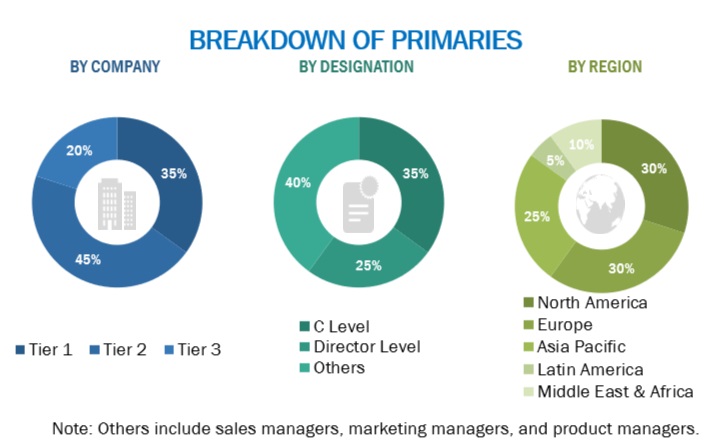
In the primary research process, various primary sources from both the supply and demand sides were interviewed to obtain qualitative and quantitative information on the market. The primary sources from the supply side included various industry experts, including Chief Experience Officers (CXOs); Vice Presidents (VPs); directors from business development, marketing, and product development/innovation teams; related key executives from LoRa and LoRaWAN IoT solution vendors, SIs, professional service providers, and industry associations; and key opinion leaders. Primary interviews were conducted to gather insights, such as market statistics, revenue data collected from solutions and services, market breakups, market size estimations, market forecasts, and data triangulation. Primary research also helped in understanding various trends related to technologies, applications, deployments, and regions. Stakeholders from the demand side, such as Chief Information Officers (CIOs), Chief Technology Officers (CTOs), Chief Strategy Officers (CSOs), and end users using LoRa and LoRaWAN IoT solutions, were interviewed to understand the buyer’s perspective on suppliers, products, service providers, and their current usage of LoRa and LoRaWAN IoT solutions which would impact the overall LoRa and LoRaWAN IoT market.
To know about the assumptions considered for the study, download the pdf brochure
LoRa and LoRaWAN IoT Market Size Estimation
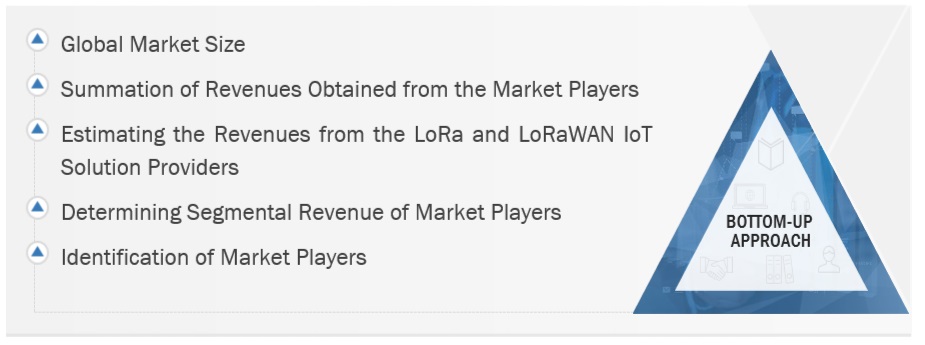
Multiple approaches were adopted to estimate and forecast the size of the LoRa and LoRaWAN IoT industry. The first approach involves estimating market size by summing up the revenue generated by companies through the sale of LoRa and LoRaWAN IoT offerings.
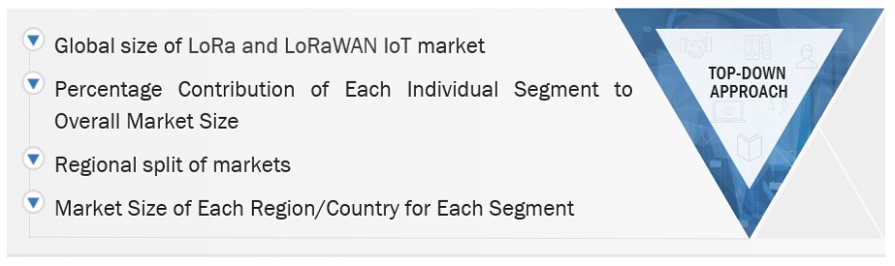
Both top-down and bottom-up approaches were used to estimate and validate the total size of the LoRa and LoRaWAN IoT market. These methods were extensively used to estimate the size of various segments in the market. The research methodology used to estimate the market size includes the following:
- Key players in the market have been identified through extensive secondary research.
- In terms of value, the industry’s supply chain and market size have been determined through primary and secondary research processes.
- All percentage shares, splits, and breakups have been determined using secondary sources and verified through primary sources.
Market Size Estimation Methodology-Bottom-up approach
To know about the assumptions considered for the study, Request for Free Sample Report
Market Size Estimation Methodology-Top-Down Approach
Data Triangulation
After arriving at the overall market size, the LoRa and LoRaWAN IoT market was divided into several segments and subsegments. A data triangulation procedure was used to complete the overall market engineering process and arrive at the exact statistics for all segments and subsegments, wherever applicable. The data was triangulated by studying various factors and trends from the demand and supply sides. Along with data triangulation and market breakdown, the market size was validated by the top-down and bottom-up approaches.
Market Definition
LoRa (Long Range) and LoRaWAN (Long Range Wide Area Network) represent a significant segment in the Internet of Things (IoT) market, offering low-power, long-range communication solutions ideal for various applications. LoRa technology provides the physical layer for long-distance communication, while LoRaWAN offers the protocol and network architecture for secure and scalable connectivity across vast geographic areas. This combination is particularly suited for smart city initiatives, industrial automation, agriculture, and environmental monitoring, where devices need to operate with minimal power consumption while maintaining reliable data transmission over several kilometers. The LoRa and LoRaWAN market is driven by the growing demand for efficient, cost-effective IoT networks that can support a wide range of devices and applications, fostering innovation and operational efficiencies across numerous sectors.
Key Stakeholders
- Manufactures and Vendors
- Network Operators
- Application Developers
- System Integrators (SIs)
- End-Users and Enteprises
- Standardization Bodies and Alliances
- Investment Firms
- LoRa and LoRaWAN IoT Alliances/Groups
Report Objectives
- To determine, segment, and forecast the LoRa and LoRaWAN IoT market by offering, technology, end use, and region in terms of value
- To forecast the size of the market segments with respect to 5 main regions: North America, Europe, Asia Pacific, Middle East & Africa, and Latin America
- To provide detailed information about the major factors (drivers, restraints, opportunities, and challenges) influencing the growth of the market
- To study the complete value chain and related industry segments and perform a value chain analysis of the market landscape
- To strategically analyze the macro and micro-markets with respect to individual growth trends, prospects, and contributions to the total market
- To analyze the industry trends, pricing data, patents, and innovations related to the market
- To analyze the opportunities for stakeholders by identifying the high-growth segments of the market
- To profile the key players in the market and comprehensively analyze their market share/ranking and core competencies
- To track and analyze competitive developments, such as mergers & acquisitions, product launches & developments, partnerships, agreements, collaborations, business expansions, and R&D activities
Available Customizations
With the given market data, MarketsandMarkets offers customizations as per the company’s specific needs. The following customization options are available for the report:
- Country-wise information
- Analysis for additional countries (up to five)
Company Information
- Detailed analysis and profiling of additional market players (up to 5)
Get the Full LoRa and LoRaWAN IoT Market Report
Full forecast, segment splits, and company analysis for all LoRa and LoRaWAN IoT Market.
- US LoRa and LoRaWAN IoT Market
- Germany LoRa and LoRaWAN IoT Market
- China LoRa and LoRaWAN IoT Market
- France LoRa and LoRaWAN IoT Market
- Italy LoRa and LoRaWAN IoT Market
- Nordics LoRa and LoRaWAN IoT Market
- Rest Of Europe LoRa and LoRaWAN IoT Market
- Spain LoRa and LoRaWAN IoT Market
- UK LoRa and LoRaWAN IoT Market
- India LoRa and LoRaWAN IoT Market
- Japan LoRa and LoRaWAN IoT Market
- Rest Of Asia Pacific LoRa and LoRaWAN IoT Market
- South Korea LoRa and LoRaWAN IoT Market
- Southeast Asia LoRa and LoRaWAN IoT Market
- Mexico LoRa and LoRaWAN IoT Market
- Rest Of Latin America LoRa and LoRaWAN IoT Market
- Ksa LoRa and LoRaWAN IoT Market
- Rest Of GCC Countries LoRa and LoRaWAN IoT Market
- UAE LoRa and LoRaWAN IoT Market
- Canada LoRa and LoRaWAN IoT Market
Need a Tailored Report?
Customize this report to your needs
Get 10% FREE Customization
Customize This Report
