
South Korea Magnesium Oxide (MgO) Market (2025-2030)

The South Korea Magnesium Oxide (MgO) Market was valued at $48.3 Million in 2025 and projected to reach to $52.2 Million by 2030, representing a compound annual growth rate of 1.5%. South Korea's magnesium oxide market demonstrates resilient growth potential, supported by the country's robust manufacturing ecosystem and ongoing construction activities.


| Market Size in | USD 26.32 MN |
| Market Forecast in | |
| CAGR | |
| Forecast Period | |
| Units Considered | Value (USD MN) |
South Korea Magnesium Oxide (MgO) Market Trends and Insights
- This modest but steady growth reflects South Korea's established demand across packaging, construction, mining, and industrial gas applications.
- South Korea's advanced manufacturing base and construction sector continue to drive consistent consumption of MgO for refractory materials, flame retardants, and specialized industrial applications. The South Korea MgO market benefits from the country's robust industrial infrastructure and export-oriented economy.
- South Korea's chemical and materials processing industries leverage magnesium oxide for high-performance applications in construction materials and packaging solutions.
- Between 2025 and 2030, South Korea is expected to maintain stable market conditions, with growth tempered by mature market saturation and competition from alternative materials.
- South Korea's focus on sustainability and advanced manufacturing technologies may create niche opportunities for premium-grade MgO products..
Key Market Statistics
- CAGR (2025-2030) 1.5% CAGR
- Market Size, 2025 ~USD 48.3 Million
- Forecast, 2030 ~USD 52.2 Million
- Country South Korea
South Korea Magnesium Oxide (MgO) Market Overview
Steady Market Growth :
South Korea's MgO market is projected to grow from USD 48.3 million in 2025 to USD 52.2 million by 2030, with a CAGR of 1.5%, driven by consistent demand across multiple industrial sectors.
Advanced Manufacturing Base :
South Korea's sophisticated manufacturing infrastructure supports significant MgO consumption in packaging materials, refractory products, and industrial applications, positioning it as a key regional market.
Construction Sector Demand :
The South Korean construction industry continues to drive MgO demand for cement additives, insulation materials, and building composites, supporting stable market expansion.
Mining & Industrial Gas Applications :
South Korea's mining operations and industrial gas production rely on MgO for processing and purification, creating consistent demand from these specialized sectors.
South Korea Magnesium Oxide (MgO) Market Dynamics
- The 1.5% CAGR reflects a mature but stable market with consistent demand from established industrial users.
- South Korea's focus on advanced materials and sustainable manufacturing practices is expected to sustain MgO consumption across packaging, construction, and mining applications through 2030.
- The market benefits from South Korea's position as a regional manufacturing hub and its integration into global supply chains, ensuring steady demand for high-quality MgO products..
Market Ecosystem
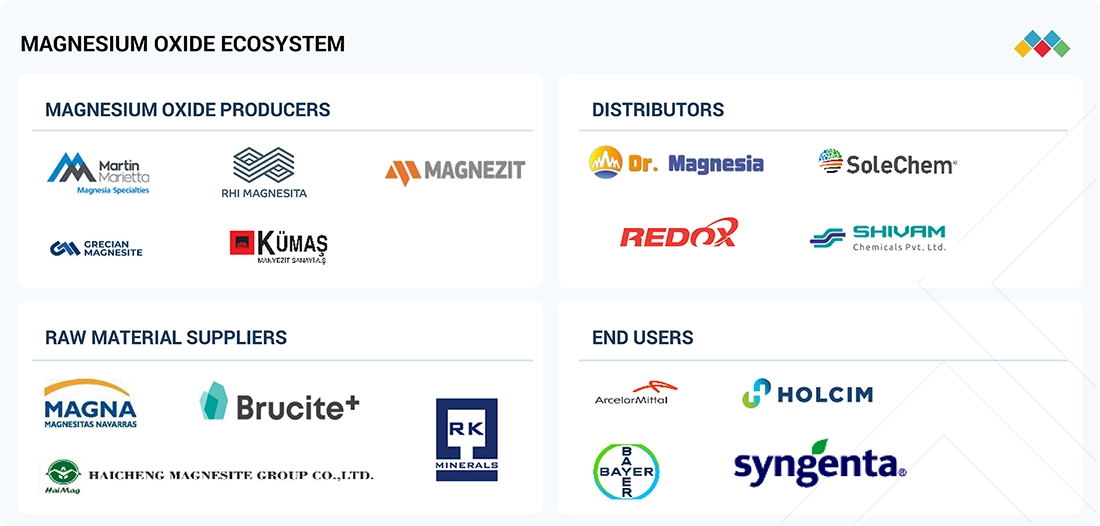
Magnesium Oxide (MgO) Market: COMMERCIAL USE CASES ACROSS INDUSTRIES
| COMPANY | USE CASE DESCRIPTION | BENEFITS |
|---|---|---|
 |
Produces refractory bricks and linings using high-purity MgO for furnaces, kilns, and ladles in steelmaking | Withstands extreme temperatures | Enhances furnace life | Reduces downtime | Improves energy efficiency in steel production |
 |
Supplies MgO as a neutralizing agent and heavy metal stabilizer in industrial wastewater treatment | Provides effective pH control | Reduces heavy metal toxicity | Offers an eco-friendly alternative to caustic chemicals |
 |
Produces MgO supplements for livestock feed and agricultural soil enrichment | Enhances animal nutrition | Prevents magnesium deficiency in cattle | Improves crop yield by balancing soil pH |
 |
Develops pharmaceutical-grade MgO used as an antacid, laxative, and dietary supplement | Supports digestive health | Relieves acidity | Provides a vital source of magnesium for human nutrition |
 |
Produces MgO-based boards and cements for fireproofing and lightweight construction materials | Offers fire resistance | Moisture protection |Sustainability advantages over traditional cement |
Logos and trademarks shown above are the property of their respective owners. Their use here is for informational and illustrative purposes only.
Related Ecosystem
Key Takeaways
- South Korea's MgO market is valued at USD 48.3 million in 2025 and will reach USD 52.2 million by 2030.
- South Korea experiences a 1.5% CAGR, reflecting mature market dynamics and steady industrial demand.
- South Korea's construction and manufacturing sectors are primary drivers of magnesium oxide consumption.
- South Korea's advanced industrial base supports demand for high-purity MgO in specialized applications.
Magnesium Oxide (MgO) Market Report Scope
| Report Metric | Details |
|---|---|
| Base Year | 2025 |
| Fastest Growing Segment | ELECTRONICS (Application) |
| Forecast Period | 2025–2030 |
| Growth Rate | CAGR of 2.3% from 2025 to 2030 |
| Largest Segment | NATURAL (Source) |
| Market Size Base Year (Billions) | ~USD 5.63 (2025) |
| Revenue Forecast (Billions) | ~USD 6.31 (2030) |
| Segments Covered | Product Type, Source, Grade, Application, End-Use Industry |
South Korea Magnesium Oxide (MgO) Market Report Segmentation
5 segment dimensions are covered across the global market.
By Product Type
- Caustic Calcined Magnesia
- Dead Burned Magnesia
- Fused Magnesia
By Source
- Natural
- Synthetic
By Grade
- Food Grade
- Industrial Grade
- Pharmaceutical Grade
- Refractory Grade
By Application
- Animal Feed
- Electronics
- Fertilizers
- Glass & Ceramics
- Other Applications
- Pharmaceuticals
- Steel Making & Cement
By End-Use Industry
- Agriculture
- Construction
- Environmental
- Food & Beverage
- Healthcare
- Other End-Use Industries
Target Audience
- MgO Manufacturers & Suppliers : South Korea-focused producers need market sizing and demand forecasts to optimize production capacity, plan supply chain investments, and identify growth opportunities in packaging and construction sectors.
- Construction & Building Materials Companies : Construction firms and material suppliers require insights into MgO consumption trends in South Korea to develop product portfolios and secure reliable sourcing for cement additives and insulation materials.
- Mining & Industrial Operations : Mining companies and industrial gas producers need South Korea-specific data to understand MgO demand for processing applications and plan procurement strategies.
- Packaging Material Manufacturers : Packaging companies operating in South Korea require market intelligence to assess MgO-based material demand and competitive positioning in this advanced manufacturing market.
- Investment & Strategy Consultants : Consultants advising clients on South Korean market entry or expansion need detailed market data, growth projections, and sector-specific insights to support strategic recommendations.
Key Companies in the South Korea Magnesium Oxide (MgO) Market
| Company | HQ | Ownership | Strongest segments |
|---|---|---|---|
| RHI MAGNESITA | Austria | Public Company | Steel refractories and functional products,Cement, lime, and industrial kilns,Non-ferrous metals, glass, energy, and chemicals, |
| UBE MATERIAL INDUSTRIES, LTD. | Japan | Private Company | Magnesia clinker and refractory raw materials,Calcia and other ceramic materials; fine ceramics and composites,Magnesium and calcium-based chemical products; environmental agents, |
| ICL | Israel | Public Company | Potash,Phosphate Solutions,Industrial Products (Bromine & Phosphorus Derivatives), |
| TATEHO CHEMICAL INDUSTRIES CO., LTD. | Japan | Private Company | Light burned magnesium oxide and industrial magnesium hydroxide,High purity magnesium oxide and MgO ceramics,Magnesium oxide insulators and electrical components, |
| INDUSTRIAS PEñOLES | Mexico | Public Company | Mines of Precious Metal,Base Metals Mines,Metallurgical, |
| KONOSHIMA CHEMICAL CO., LTD. | Japan | Public Company | Ceramic siding, eaves, gable boards, fireproof panels,Non-combustible building materials (other),Magnesium oxide and magnesium carbonate, |
RHI MAGNESITA
RHI Magnesita is a publicly traded Austrian company founded in 1834 with approximately 20,000 employees, making it a major player in the magnesite and refractory materials industry.
UBE MATERIAL INDUSTRIES, LTD.
UBE Material Industries, Ltd. is a private Japanese company with 817 employees that manufactures specialized materials and chemical products.
ICL
ICL is a publicly traded Israeli company founded in 1968 with approximately 12,000 employees, operating as a diversified specialty chemicals and minerals producer.
TATEHO CHEMICAL INDUSTRIES CO., LTD.
Tateho Chemical Industries Co., Ltd. is a private Japanese company founded in 1966 with 273 employees, specializing in chemical manufacturing.
INDUSTRIAS PEñOLES
Industrias Peñoles is a publicly traded Mexican company founded in 1887 with approximately 15,611 employees, operating as a major mining and metals producer.
KONOSHIMA CHEMICAL CO., LTD.
Konoshima Chemical Co., Ltd. is a publicly traded Japanese company founded in 1917 with 448 employees, engaged in chemical manufacturing and specialty materials production.
Reasons to Buy this Report
- Market-Specific Sizing & Forecasts : Access precise valuation data for South Korea's MgO market with 2025-2030 projections, enabling accurate budgeting and investment planning tailored to this specific geography.
- Sector-Level Demand Analysis : Understand MgO consumption patterns across South Korea's packaging, construction, mining, and industrial gas sectors to identify high-potential customer segments and applications.
- Competitive Landscape Intelligence : Gain insights into South Korea's manufacturing base and supply chain dynamics to benchmark against competitors and identify market entry or expansion opportunities.
- Regional Growth Drivers : Identify key factors driving the 1.5% CAGR in South Korea, including construction trends, industrial modernization, and export-oriented manufacturing demand.
- Strategic Decision Support : Make informed decisions on product positioning, pricing strategies, and distribution channels specific to South Korea's mature yet stable MgO market conditions.
Frequently asked questions
What is the current market size of magnesium oxide in South Korea?
South Korea's magnesium oxide market is estimated at USD 48.3 million in 2025.
What is the projected market size for MgO in South Korea by 2030?
South Korea's MgO market is forecast to reach USD 52.2 million by 2030.
What is the CAGR for South Korea's magnesium oxide market?
South Korea's magnesium oxide market is expected to grow at a CAGR of 1.5% from 2025 to 2030.
Which industries drive magnesium oxide demand in South Korea?
South Korea's primary MgO demand comes from packaging, construction, mining, and industrial gas sectors.
Why is South Korea's MgO market growth relatively modest?
South Korea's mature industrial market, market saturation, and competition from alternative materials contribute to the 1.5% CAGR.
RESEARCH METHODOLOGY
The study involved four major activities in estimating the current size of the magnesium oxide (MgO) market: exhaustive secondary research collected information on the market, peer markets, and parent markets. The next step was to validate these findings, assumptions, and sizing with the industry experts across the magnesium oxide value chain through primary research. Both top-down and bottom-up approaches were employed to estimate the complete market size. Thereafter, market breakdown and data triangulation were used to estimate the market size of segments and subsegments.
Secondary Research
Secondary sources for this research study include annual reports, press releases, and investor presentations of companies; white papers; certified publications; articles by recognized authors; gold- and silver-standard websites; magnesium oxide manufacturing companies, regulatory bodies, trade directories, and databases. The secondary research was mainly used to obtain key information about the industry’s supply chain, the pool of key players, market classification, and segmentation according to industry trends, to the bottom-most level and regional markets. It has also been used to obtain information about key developments from a market-oriented perspective.
Primary Research
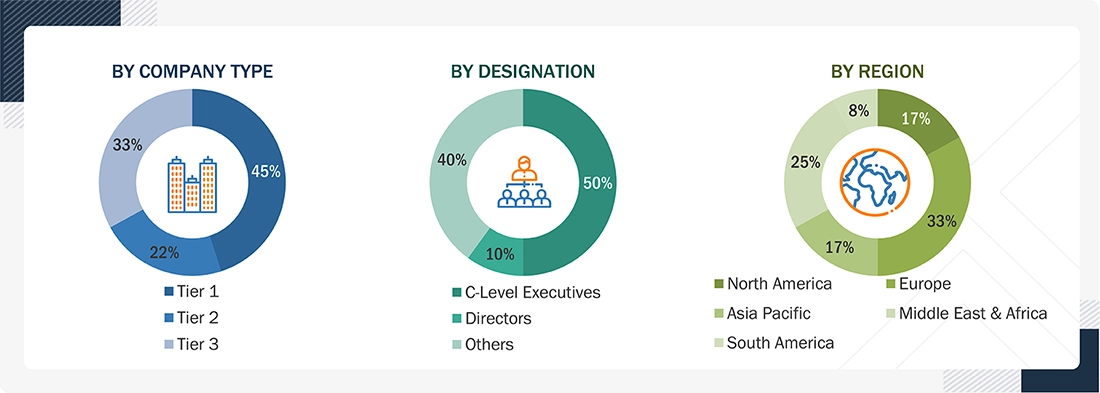
The magnesium oxide (MgO) market comprises several stakeholders, such as raw material suppliers, technology support providers, magnesium oxide manufacturers, and regulatory organizations in the supply chain. Various primary sources from the supply and demand sides of the market were interviewed to obtain qualitative and quantitative information. Primary sources from the supply side included industry experts, such as chief executive officers (CEOs), vice presidents, marketing directors, technology and innovation directors, and related key executives from various companies and organizations operating in the magnesium oxide (MgO) market. Primary sources from the demand side included directors, marketing heads, and purchase managers from various sourcing industries.
The following is the breakdown of the primary respondents:
To know about the assumptions considered for the study, download the pdf brochure
Market Size Estimation
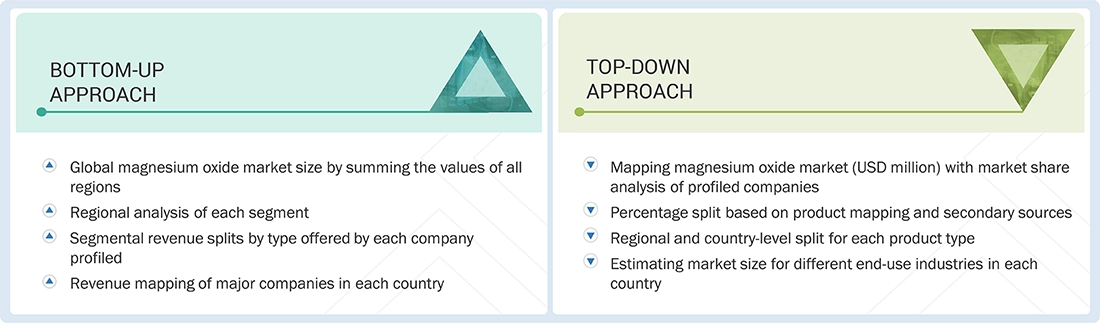
The top-down and bottom-up approaches have been used to estimate and validate the total size of the magnesium oxide (MgO) market. These approaches have also been used extensively to estimate the size of various dependent market subsegments. The research methodology used to estimate the market size included the following:
The following information provides details about the overall market size estimation process employed in this study:
- Key players in the market were identified through secondary research.
- Market shares in the respective regions were identified through primary and secondary research.
- Primary and secondary research determined the value chain and market size of the magnesium oxide (MgO) market, in terms of value and volume.
- All percentage shares, splits, and breakdowns were determined using secondary sources and verified through primary sources.
- All possible parameters that affect the market covered in this research study were accounted for, viewed in extensive detail, verified through primary research, and analyzed to obtain the final quantitative and qualitative data.
- The research included studying the annual and financial reports of the top market players and interviewing industry experts, such as CEOs, VPs, directors, sales managers, and marketing executives, for key insights, both quantitative and qualitative.
Data Triangulation
The magnesium oxide (MgO) market was split into several segments and sub-segments after arriving at the overall market size using the market size estimation processes as explained above. To complete the overall market engineering process and arrive at the exact statistics of each market segment and subsegment, the data triangulation and market breakdown procedures were employed, wherever applicable. The data was triangulated by studying various factors and trends from the demand and supply sides in the oil & gas sector.
Market Definition
Magnesium oxide is an inorganic compound composed of one magnesium (Mg) atom bonded to one oxygen (O) atom, represented as MgO. It is an essential magnesium oxide and is commonly found in nature as the mineral periclase. Magnesium oxide is a white, odorless powder with a high melting point. It is known for its remarkable physical and chemical properties, making it valuable in various industrial and scientific applications.
Stakeholders
- Magnesium oxide manufacturers
- Magnesium oxide traders, distributors, and suppliers
- Government and research organizations
- Associations and industrial bodies
- Research and consulting firms
- R&D institutions
- Environment support agencies
- Investment banks and private equity firms
Report Objectives
- To analyze and forecast the market size of the magnesium oxide (MgO) market, by product type, source, grade, form, purity, application, and end-use industry, in terms of value
- To analyze and forecast the market size of the magnesium oxide (MgO) market, by product type, in terms of volume
- To forecast the size of various market segments based on five major regions: Asia Pacific, Europe, North America, South America, and the Middle East & Africa, along with their respective key countries, in terms of value
- To provide detailed information regarding the major factors influencing the market growth, such as drivers, restraints, challenges, and opportunities
- To analyze the opportunities in the market for stakeholders and provide details of a competitive landscape for market leaders
- To track and analyze the competitive developments, such as acquisitions, partnerships, expansions, and investments, in the market
- To strategically profile the key players and comprehensively analyze their market shares and core competencies
Get the Full Magnesium Oxide (MgO) Market Report
Full forecast, segment splits, and company analysis for all Magnesium Oxide (MgO) Market.
- China Magnesium Oxide (MgO) Market
- Japan Magnesium Oxide (MgO) Market
- India Magnesium Oxide (MgO) Market
- Canada Magnesium Oxide (MgO) Market
- Mexico Magnesium Oxide (MgO) Market
- US Magnesium Oxide (MgO) Market
- Germany Magnesium Oxide (MgO) Market
- UK Magnesium Oxide (MgO) Market
- France Magnesium Oxide (MgO) Market
- Italy Magnesium Oxide (MgO) Market
- Spain Magnesium Oxide (MgO) Market
- Brazil Magnesium Oxide (MgO) Market
- UAE Magnesium Oxide (MgO) Market
- South Africa Magnesium Oxide (MgO) Market
- Rest Of Europe Magnesium Oxide (MgO) Market
- Rest Of Asia Pacific Magnesium Oxide (MgO) Market
Need a Tailored Report?
Customize this report to your needs
Get 10% FREE Customization
Customize This Report
