
France Medical Batteries Market (2024-2029)

The France Medical Batteries Market was valued at $89.6 Million in 2024 and projected to reach to $120.9 Million by 2029, representing a compound annual growth rate of 6.2%. France's medical batteries market is poised for steady expansion through 2029, supported by the country's sophisticated healthcare infrastructure and increasing prevalence of portable medical devices.


| Market Size in | USD 26.32 MN |
| Market Forecast in | |
| CAGR | |
| Forecast Period | |
| Units Considered | Value (USD MN) |
France Medical Batteries Market Trends and Insights
- This growth trajectory reflects France's robust healthcare infrastructure and increasing adoption of advanced medical devices requiring reliable battery solutions.
- France's position as a leading European healthcare hub drives demand for high-performance batteries across diagnostic, therapeutic, and monitoring applications. The French market benefits from strong regulatory frameworks and significant investment in medical technology innovation.
- France's aging population and emphasis on preventive healthcare are key factors accelerating the adoption of portable and implantable medical devices that depend on specialized battery technologies.
- Between 2024 and 2029, France is expected to see enhanced market penetration in cardiac devices, infusion pumps, and remote patient monitoring systems. France's medical batteries sector is characterized by a mix of established manufacturers and emerging innovators focusing on longevity, safety, and biocompatibility.
- The country's commitment to healthcare excellence and digital health integration positions France as a significant growth market within the broader European medical batteries landscape..
Key Market Statistics
- CAGR (2024-2029) 6.2% CAGR
- Market Size, 2024 ~USD 89.6 Million
- Forecast, 2029 ~USD 120.9 Million
- Country France
France Medical Batteries Market Overview
Market Valuation :
France's medical batteries market is valued at $89.6 million in 2024, demonstrating strong demand for reliable power solutions across the French healthcare sector.
Projected Growth :
The market is forecast to reach $120.9 million by 2029, representing a consistent 6.2% CAGR driven by technological advancement and device proliferation in French medical facilities.
Healthcare Infrastructure :
France's advanced healthcare system and high medical device adoption rates create sustained demand for premium battery solutions in hospitals, clinics, and home care settings.
European Leadership :
As a leading European healthcare hub, France drives innovation in medical battery technology, positioning the country as a key market for manufacturers and suppliers.
France Medical Batteries Market Dynamics
- The 6.2% CAGR reflects growing adoption of advanced diagnostic equipment, patient monitoring systems, and implantable devices requiring dependable battery performance.
- French healthcare providers' commitment to quality and reliability ensures sustained investment in high-performance battery solutions. Key growth drivers include an aging population requiring chronic disease management, rising demand for home healthcare solutions, and regulatory emphasis on medical device safety standards.
- France's strong pharmaceutical and medical device manufacturing base further supports market expansion, as domestic producers seek reliable battery suppliers.
- Strategic partnerships between French healthcare institutions and battery manufacturers will continue to shape market dynamics through 2029..
Market Ecosystem
Related Ecosystem
Analytical And Scientific Instrumentation
- Environmental Testing
- Gas Chromatography
- Polymerase Chain Reaction (PCR)
- Automated Liquid Handling Systems
- Flow Cytometry
- Thermo Fisher Scientific Inc.
- Danaher Corporation
- Agilent Technologies, Inc.
- Shimadzu Corporation
- Merck KGaA
Medical Devices
- Polymerase Chain Reaction (PCR)
- Magnetic Resonance Imaging (MRI)
- Disposable Autoinjectors
- Pulse Oximeters
- Blood Pressure Monitors
- Medtronic plc
- Abbott Laboratories
- Stryker Corporation
- Becton, Dickinson and Company
- CONMED Corporation
Pharmaceuticals
- Bioreactors
- Analytical Testing
- Bioanalytical Testing Services
- Cell Counters
- Data Management Services
- Thermo Fisher Scientific Inc.
- SANOFI
- Merck KGaA
- NOVARTIS
- Pfizer Inc.
Key Takeaways
- France's medical batteries market will grow from $89.6M (2024) to $120.9M (2029) at a 6.2% CAGR.
- France's aging demographic and advanced healthcare system drive demand for implantable and portable medical devices.
- France's regulatory environment and innovation focus attract both multinational and domestic battery manufacturers.
- France's market expansion is supported by increasing adoption of remote monitoring and cardiac device technologies.
Medical Batteries Market Report Scope
| Report Metric | Details |
|---|---|
| Base Year | 2024 |
| Fastest Growing Segment | ABOVE 1,200 MAH (Capacity) |
| Forecast Period | 2024-2029 |
| Growth Rate | CAGR of 6.2% from 2024 to 2029 |
| Largest Segment | NON-IMPLANTABLE MEDICAL DEVICES (Application) |
| Market Size Base Year (Billions) | ~USD 2 (2024) |
| Revenue Forecast (Billions) | ~USD 2.7 (2029) |
| Segments Covered | Product, Type, Capacity, Application, End User |
France Medical Batteries Market Report Segmentation
5 segment dimensions are covered across the global market.
By Product
- Alkaline Batteries
- Lithium Batteries
- Nickel-Metal Hydride Batteries
- Other Batteries
- Zinc-Air Batteries
By Type
- Blood Glucose Monitors
- Cardiac Pacemakers
- Cochlear Implants
- Defibrillators
- Electric Wheelchairs
- Energy-Based Aesthetic Devices
- External Defibrillators
- Health & Fitness Trackers
- Hospital Beds
- Implantable Drug Delivery Devices
- Implantable Neuromonitoring Devices
- Infusion Pumps
- Insulin Pumps
- Lithium Metal Batteries
- Lithium-Ion Batteries
- Medical Imaging Systems
- Other Implantable Medical Devices
- Other Non-Implantable Medical Devices
- Other Portable & Wearable Medical Devices
- Oxygen Concentrators
- Patient Monitoring Devices
- Portable Diagnostic Devices
- Powered Surgical Tools
- Respiratory Monitoring Devices
- Wearable Defibrillators
By Capacity
- 600-1,200 Mah
- 600-1200 Mah
- Above 1,200 Mah
- Above 1200 Mah
- Below 600 Mah
By Application
- Implantable Medical Devices
- Non-Implantable Medical Devices
- Portable & Wearable Medical Devices
By End User
- Ambulatory Care Centers
- Clinics & Imaging Centers
- Home Care & Dme Shops
- Hospitals & Surgical Centers
- Other End Users
- Research Institutes
Target Audience
- Medical Battery Manufacturers : Manufacturers need France-specific market data to assess market size, growth potential, and competitive landscape for strategic expansion and product development decisions in this key European market.
- Medical Device Companies : Device manufacturers require detailed France market insights to identify battery supply chain opportunities, optimize sourcing strategies, and align product portfolios with regional healthcare demands.
- Healthcare Investors : Investment firms and venture capitalists need France market analysis to evaluate funding opportunities in medical battery technology, assess portfolio company growth potential, and identify acquisition targets.
- Healthcare Distributors : Distributors and suppliers need France-specific forecasts to plan inventory management, negotiate supplier contracts, and develop regional sales strategies aligned with market growth projections.
- Healthcare Policy Makers : Government agencies and regulatory bodies require market data to inform healthcare technology policies, reimbursement strategies, and infrastructure planning for France's medical device ecosystem.
Reasons to Buy this Report
- Market-Specific Sizing : Access precise valuation data for France's medical batteries market with verified 2024 baseline ($89.6M) and 2029 forecast ($120.9M), enabling accurate budget allocation and revenue projections.
- Competitive Positioning : Understand France's unique market dynamics, healthcare infrastructure advantages, and regulatory environment to develop targeted go-to-market strategies and competitive differentiation.
- Growth Opportunity Assessment : Leverage the 6.2% CAGR insight to identify high-potential segments within France's medical device ecosystem and prioritize investment in emerging battery technology applications.
- Strategic Decision-Making : Make informed decisions on market entry, partnership development, and product localization by understanding France's position as a European healthcare leader and innovation hub.
- Risk Mitigation : Evaluate market stability and growth sustainability in France through comprehensive analysis of healthcare spending trends, regulatory frameworks, and demographic drivers.
Frequently asked questions
What is the current size of France's medical batteries market?
France's medical batteries market was valued at $89.6 million in 2024 and is expected to reach $120.9 million by 2029.
What is the growth rate for medical batteries in France?
France's medical batteries market is projected to grow at a compound annual growth rate (CAGR) of 6.2% from 2024 to 2029.
Which medical devices drive battery demand in France?
France's demand is driven by cardiac implants, infusion pumps, pacemakers, defibrillators, and remote patient monitoring devices.
What factors support market growth in France?
France's aging population, advanced healthcare infrastructure, regulatory support, and digital health initiatives support sustained market growth.
Who are the key players in France's medical batteries market?
France's market includes multinational manufacturers and specialized domestic companies focused on biocompatible, long-life battery solutions for medical applications.
RESEARCH METHODOLOGY
This research study involved the extensive use of both primary and secondary sources. It involved the study of various factors affecting the industry to identify the segmentation types, industry trends, key players, the competitive landscape of market players, and key market dynamics such as drivers, opportunities, challenges, restraints, and key player strategies.
Secondary Research
This research study involved the wide use of secondary sources, directories, databases such as Dun & Bradstreet, Bloomberg Businessweek, and Factiva, white papers, and companies’ house documents. Secondary research was undertaken to identify and collect information for this extensive, technical, market-oriented, and commercial study of the Medical batteries Market. It was also used to obtain important information about the top players, market classification, and segmentation according to industry trends to the bottom-most level, geographic markets, and key developments related to the market. A database of the key industry leaders was also prepared using secondary research.
Primary Research
In the primary research process, various supply side and demand side sources were interviewed to obtain qualitative and quantitative information for this report. Primary sources from the supply side included industry experts such as CEOs, vice presidents, marketing and sales directors, technology & innovation directors, engineers, and related key executives from various companies and organizations operating in the medical batteries market. Primary sources from the demand side included researchers, lab technicians, battery suppliers, purchase managers etc, device manufactureres and stakeholders in corporate & government bodies.
A breakdown of the primary respondents is provided below:
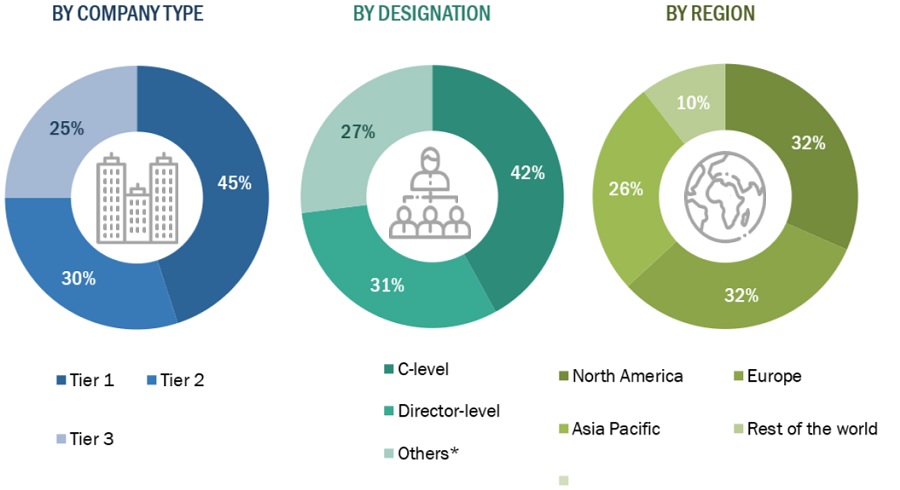
*Others include sales managers, marketing managers, and product managers.
Note: Tiers are defined based on a company’s total revenue, as of 2020: Tier 1 = >USD 1 billion, Tier 2 = USD 500 million to USD 1 billion, and Tier 3 = <USD 500 million.
To know about the assumptions considered for the study, download the pdf brochure
Market Size Estimation
The total size of the Medical Batteries Market was arrived at after data triangulation through the two approaches mentioned below. After the completion of each approach, the weighted average of these approaches was taken based on the level of assumptions used in each approach.
Data Triangulation
The size of the Medical Batteries Market was estimated through segmental extrapolation using the bottom-up approach. The methodology used is as given below:
- Shares of leading players in the Medical Batteries Market were gathered from secondary sources to the extent available. In some instances, shares of medical batteries have been ascertained after a detailed analysis of various parameters, including Service portfolios, market positioning, selling price, and geographic reach & strength.
- Individual shares or revenue estimates were validated through interviews with experts.
The total revenue in the medical batteries was determined by extrapolating the Market share data of major companies.
Global Medical Batteries Market Size: Top-Down Approach
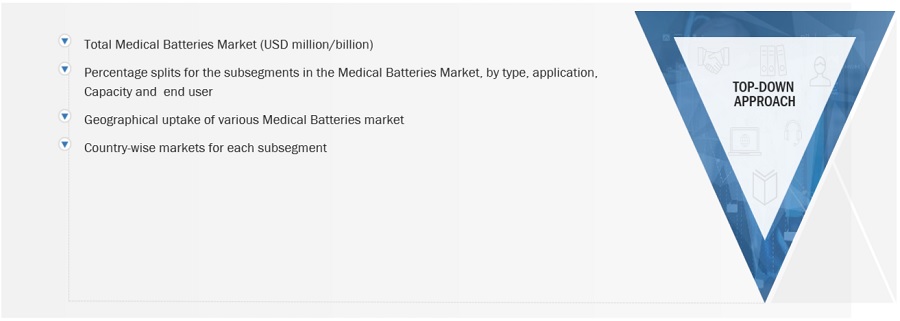
To know about the assumptions considered for the study, Request for Free Sample Report
Market Definition
Medical batteries are specialized power sources designed to meet the unique and stringent requirements of medical devices and equipment. These batteries ensure reliable, safe, and long-lasting energy delivery, essential for the proper functioning of a wide range of medical applications. They are engineered to provide consistent performance, durability, and safety, catering to both portable and implantable medical devices such as monitors, infusion pumps, defibrillators, and diagnostic tools. Medical batteries come in various chemistries, including lithium-ion, nickel-cadmium, and alkaline, each tailored to the specific energy demands and operational conditions of medical environments.
Key Stakeholders
- Medical Device Manufacturers
- Battery Manufacturers
- Healthcare Providers
- Regulatory Bodies
- Research and Development Organizations
- Suppliers and Distributors
- Government Agencies
- Service Providers
- Medical Equipment Technicians
- Non-Governmental Organizations (NGOs)
- Environmental and Recycling Organizations
- Industry Trade Associations
- Academic and Educational Institutions
- Procurement Managers
Objectives of the Study
- To define, describe, and forecast the global medical batteries market on the basis of battery types.
- To define, describe, and forecast the global Medical Batteries Market on the basis of product, disease area, end user, and region.
- To provide detailed information regarding the major factors influencing the growth of the market (drivers, restraints, growth opportunities, and challenges)
- To strategically analyze micromarkets1 with respect to individual growth trends, future prospects, and contributions to the overall market
- To analyze the opportunities in the market for key stakeholders and provide details of the competitive landscape for major market leaders
- To forecast the size of the market segments with respect to four main regions: North America (the US and Canada), Europe (Germany, the UK, France, Italy, Spain, and Rest of Europe), Asia Pacific (Japan, China, India, Australia, South Korea and Rest of Asia Pacific), the Latin America (Brazil, Mexico and Rest of Latin America) and Middle East & Africa.
- To profile key market players and comprehensively analyze their market shares and core competencies2
- To track and analyze competitive developments such as mergers and acquisitions; new product developments; partnerships, agreements, and collaborations; and expansions in the global Medical Batteries Market
Available Customizations
With the given market data, MarketsandMarkets offers customizations as per your company’s specific needs. The following customization options are available for the report:
Company Information
- Detailed analysis and profiling of additional market players (up to 5)
Geographic Analysis
- Further breakdown of the Rest of Europe Medical Batteries Market into Denmark, Norway, and others
- Further breakdown of the Rest of Asia Pacific Medical Batteries Market into Vietnam, New Zealand, and others
Get the Full Medical Batteries Market Report
Full forecast, segment splits, and company analysis for all Medical Batteries Market.
- US Medical Batteries Market
- Canada Medical Batteries Market
- Germany Medical Batteries Market
- UK Medical Batteries Market
- Italy Medical Batteries Market
- Spain Medical Batteries Market
- Japan Medical Batteries Market
- China Medical Batteries Market
- India Medical Batteries Market
- Australia Medical Batteries Market
- South Korea Medical Batteries Market
- Brazil Medical Batteries Market
- Mexico Medical Batteries Market
- Rest Of Europe Medical Batteries Market
- Rest Of Asia Pacific Medical Batteries Market
- Rest Of Latin America Medical Batteries Market
Need a Tailored Report?
Customize this report to your needs
Get 10% FREE Customization
Customize This Report
