
Rest Of Asia Pacific Medical Display Market (2025-2030)

The Rest Of Asia Pacific Medical Display Market was valued at $94.1 Million in 2025 and projected to reach to $125.6 Million by 2030, representing a compound annual growth rate of 5.9%. Rest Of Asia Pacific's medical display market is positioned for sustained expansion as healthcare providers across the region prioritize upgrading diagnostic imaging infrastructure.


| Market Size in | USD 26.32 MN |
| Market Forecast in | |
| CAGR | |
| Forecast Period | |
| Units Considered | Value (USD MN) |
Rest Of Asia Pacific Medical Display Market Trends and Insights
- Rest Of Asia Pacific represents a critical emerging segment within the broader Asia Pacific healthcare technology landscape, driven by increasing adoption of diagnostic imaging systems and digital health infrastructure investments.
- The region's growth trajectory reflects rising healthcare expenditures and modernization of medical facilities across developing economies. Rest Of Asia Pacific's 5.9% compound annual growth rate outpaces the global average, indicating accelerating demand for advanced medical display solutions in clinical settings.
- Throughout the 2025–2030 forecast period, Rest Of Asia Pacific is expected to benefit from expanding telemedicine adoption, regulatory improvements, and growing awareness of diagnostic accuracy.
- Rest Of Asia Pacific's market expansion is supported by both public healthcare initiatives and private sector investments in medical technology infrastructure..
Key Market Statistics
- CAGR (2025-2030) 5.9% CAGR
- Market Size, 2025 ~USD 94.1 Million
- Forecast, 2030 ~USD 125.6 Million
- Country Rest Of Asia Pacific
Rest Of Asia Pacific Medical Display Market Overview
Market Valuation :
Rest Of Asia Pacific medical display market valued at $94.1 million in 2025, demonstrating significant growth potential in emerging healthcare economies across the region.
Projected Growth Trajectory :
Expected to reach $125.6 million by 2030, representing a robust 5.9% CAGR, outpacing the global average of 5.5% and indicating accelerating regional adoption.
Digital Health Infrastructure Expansion :
Rising investments in healthcare digitalization across Rest Of Asia Pacific countries are driving demand for advanced diagnostic imaging displays and telemedicine-enabled medical visualization systems.
Emerging Market Opportunity :
Rest Of Asia Pacific represents a critical growth frontier with increasing adoption of diagnostic imaging systems, modernizing healthcare facilities, and expanding middle-class populations seeking quality medical services.
Rest Of Asia Pacific Medical Display Market Dynamics
- Government initiatives promoting digital health adoption, coupled with rising patient volumes and increasing prevalence of chronic diseases, are creating favorable conditions for medical display deployment.
- The region's emerging economies are investing heavily in healthcare modernization, with medical displays becoming essential components of diagnostic centers, hospitals, and specialty clinics. The forecast period through 2030 will witness accelerated growth driven by technological advancements in display resolution and connectivity, growing telemedicine adoption, and expanding healthcare accessibility in underserved areas.
- Regional manufacturers and distributors are establishing stronger market presence, improving product availability and affordability.
- Strategic partnerships between international medical device companies and local healthcare providers will further catalyze market penetration across Rest Of Asia Pacific..
Market Ecosystem
Related Ecosystem
Key Takeaways
- Rest Of Asia Pacific medical display market valued at $94.1M in 2025, expanding to $125.6M by 2030 at 5.9% CAGR
- Rest Of Asia Pacific's growth rate exceeds global average, driven by healthcare modernization and diagnostic imaging adoption
- Rest Of Asia Pacific benefits from rising healthcare expenditures and telemedicine infrastructure development across emerging economies
- Rest Of Asia Pacific represents a high-growth emerging segment with significant untapped potential in medical technology adoption
Medical Display Market Report Scope
| Report Metric | Details |
|---|---|
| Base Year | 2025 |
| Fastest Growing Segment | OLED (Technology) |
| Forecast Period | 2025–2030 |
| Growth Rate | CAGR of 5.5% from 2025 to 2030 |
| Largest Segment | COLOR (Color) |
| Market Size Base Year (Billions) | ~USD 2.64 (2025) |
| Revenue Forecast (Billions) | ~USD 3.45 (2030) |
| Segments Covered | Technology, Panel Size, Resolution, Type, Color, Application |
Rest Of Asia Pacific Medical Display Market Report Segmentation
6 segment dimensions are covered across the global market.
By Technology
- Ccfl-Backlit Lcd
- Led-Backlit Lcd
- Oled
By Panel Size
- 23.0–26.9 Inches
- 27.0–41.9 Inches
- Above 42 Inches
- Under 22.9 Inches
By Resolution
- 2.1–4Mp
- 4.1–8Mp
- Above 8Mp
- Up To 2Mp
By Type
- 4K
- 8K
- Digital Pathology
- General Radiology
- Mammography
- Multimodality
By Color
- Color
- Monochrome & Grayscale
By Application
- Dentistry
- Diagnostic
- Other Applications
- Surgical/Interventional
Target Audience
- Medical Device Manufacturers : Manufacturers need Rest Of Asia Pacific-specific market data to develop localized product strategies, identify distribution partnerships, and allocate R&D resources for this high-growth emerging market segment.
- Healthcare Facility Operators : Hospital administrators and diagnostic center operators require market insights to benchmark equipment investments, understand technology trends, and make informed procurement decisions for medical displays.
- Investment & Private Equity Firms : Investors evaluating healthcare technology opportunities in Asia Pacific need detailed regional market analysis to assess growth potential, identify acquisition targets, and structure investment theses.
- Healthcare IT Consultants : Consultants advising healthcare organizations on digital transformation require Rest Of Asia Pacific market intelligence to recommend appropriate display technologies and infrastructure solutions.
- Distribution & Channel Partners : Distributors and resellers need region-specific market data to optimize inventory, identify growth opportunities, and develop effective go-to-market strategies within Rest Of Asia Pacific territories.
Key Companies in the Rest Of Asia Pacific Medical Display Market
| Company | HQ | Ownership | Strongest segments |
|---|---|---|---|
| GODREJ GROUP | India | Private Company | LED-Backlit LCD Display, Under 22.9 Inch Panels,4.1-8 MP Resolution Color Displays for Diagnostics,4.1-8 MP Resolution Monochrome Displays for Diagnostics, |
| TIANMA MICROELECTRONICS | China | Public Company | Diagnostics applications – color LED-backlit LCD (4.1–8 MP, <22.9"),Diagnostics applications – monochrome LED-backlit LCD (4.1–8 MP, <22.9"),Dentistry – integrated chair and intraoral system displays (color), |
| BARCO NV | Belgium | Public Company | Diagnostic radiology displays (4.1–8 MP, sub-22.9", color & monochrome),Breast imaging and multimodality diagnostic displays,Dentistry imaging displays, |
| EIZO INC. | Japan | Public Company | LED-backlit LCD diagnostic displays (4.1–8 MP, under 22.9 inch),Dental imaging displays (under 22.9 inch, color),Monochrome specialty diagnostic displays, |
| NOVANTA INC. | United States | Public Company | LED-Backlit LCD Displays for Diagnostics Applications (4.1–8 MP, color & monochrome, under 22.9"),LED-Backlit LCD Displays for Dentistry (4.1–8 MP, color, under 22.9"),Integrated OR and Medical System Subassemblies Including Displays, |
| LG ELECTRONICS | South Korea | Public Company | LED-backlit LCD, color, 4.1–8 MP, under 22.9-inch – diagnostics,LED-backlit LCD, color, under 22.9-inch – dentistry,LED-backlit LCD, monochrome, 4.1–8 MP – diagnostics, |
| ADVANTECH CO., LTD. | Taiwan | Public Company | Diagnostics applications – color LED-backlit LCD, 4.1–8 MP, under 22.9 inch,Diagnostics applications – monochrome LED-backlit LCD, 4.1–8 MP, under 22.9 inch,Dentistry – chairside color displays and panel PCs, |
| STERIS | Ireland | Public Company | Diagnostics applications – under 22.9-inch LED-backlit LCD color displays (4.1–8 MP),Diagnostics applications – under 22.9-inch LED-backlit LCD monochrome displays (4.1–8 MP),Dentistry – under 22.9-inch LED-backlit LCD color displays (4.1–8 MP), |
| SIEMENS HEALTHINEERS | Germany |
GODREJ GROUP
Godrej Group is a private Indian conglomerate founded in 1897 with 13,316 employees. The company operates across multiple business sectors serving domestic and international markets.
TIANMA MICROELECTRONICS
Tianma Microelectronics is a public Chinese company founded in 1983 with 23,538 employees. The company specializes in microelectronics manufacturing and related technologies.
BARCO NV
Barco NV is a public Belgian company founded in 1934 with 3,673 employees. The company designs and manufactures visualization and display technology solutions for professional markets.
EIZO INC.
Eizo Inc. is a public Japanese company founded in 1968 with 2,289 employees. The company manufactures high-quality display monitors and imaging solutions for professional and commercial applications.
NOVANTA INC.
Novanta Inc. is a public United States company founded in 1968 with 3,000 employees. The company provides precision motion control, imaging, and laser-based solutions for industrial and medical markets.
LG ELECTRONICS
LG Electronics is a public South Korean company founded in 1958 with 34,884 employees. The company manufactures consumer electronics, home appliances, displays, and related technology products.
ADVANTECH CO., LTD.
Advantech Co., Ltd. is a public Taiwanese company founded in 1981 with 2,526 employees. The company develops and manufactures industrial computing and automation solutions.
STERIS
Steris is a public company founded in 1985 with headquarters in Ireland. The company provides sterilization and contamination control solutions.
SIEMENS HEALTHINEERS
Siemens Healthineers is a company based in Germany. The company operates in the healthcare and medical technology sector.
Reasons to Buy this Report
- Regional Market Sizing & Forecasting : Obtain precise valuation data specific to Rest Of Asia Pacific ($94.1M in 2025) with detailed 5-year forecasts, enabling accurate business planning and investment decisions tailored to this emerging segment.
- Competitive Landscape Intelligence : Understand regional market dynamics, local competitor strategies, and distribution channels unique to Rest Of Asia Pacific, providing competitive advantages in market entry and expansion planning.
- Growth Driver Analysis : Identify key factors accelerating adoption—digital health infrastructure investments, diagnostic imaging expansion, and telemedicine adoption—to capitalize on emerging opportunities specific to the region.
- Investment & Partnership Opportunities : Discover high-potential markets within Rest Of Asia Pacific for strategic partnerships, joint ventures, and direct investments based on regional growth trajectories and healthcare modernization initiatives.
- Regulatory & Market Entry Insights : Access region-specific regulatory requirements, reimbursement frameworks, and market entry strategies essential for successfully launching or expanding medical display products in Rest Of Asia Pacific.
Frequently asked questions
What is the current market size of medical displays in Rest Of Asia Pacific?
Rest Of Asia Pacific's medical display market is valued at $94.1 million in 2025 and is projected to grow to $125.6 million by 2030.
What is the growth rate for Rest Of Asia Pacific's medical display market?
Rest Of Asia Pacific's medical display market is growing at a compound annual growth rate (CAGR) of 5.9% from 2025 to 2030.
What factors are driving growth in Rest Of Asia Pacific's medical display market?
Rest Of Asia Pacific's market growth is driven by increasing healthcare expenditures, diagnostic imaging adoption, telemedicine expansion, and modernization of medical facilities across developing economies.
How does Rest Of Asia Pacific's growth compare to the global medical display market?
Rest Of Asia Pacific's 5.9% CAGR outpaces the global average of 5.5%, indicating stronger regional demand and market expansion potential.
What is the forecast market size for Rest Of Asia Pacific in 2030?
Rest Of Asia Pacific's medical display market is forecasted to reach $125.6 million by 2030, representing a $31.5 million increase from 2025 levels.
RESEARCH METHODOLOGY
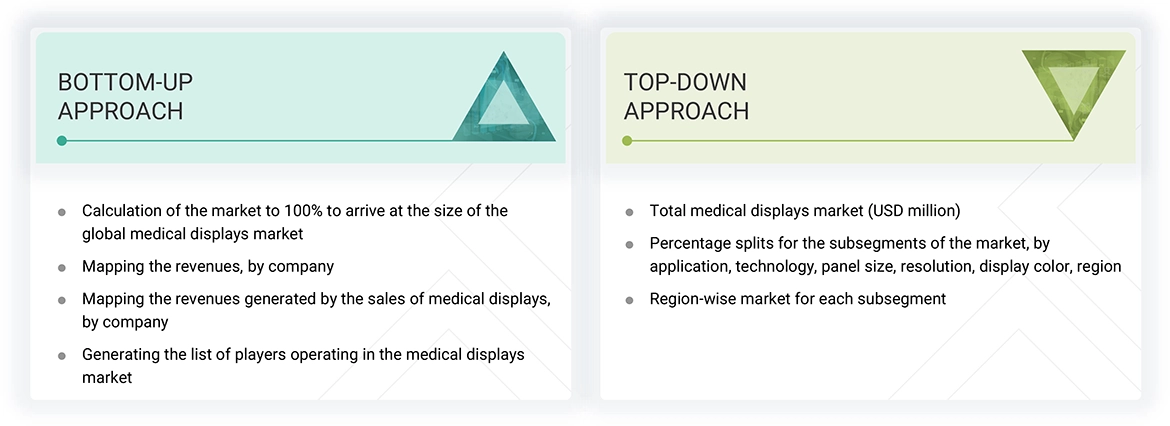
The study focused on estimating the current size of the medical displays market through several key activities. Comprehensive secondary research was conducted to gather relevant information. Following this, the findings, assumptions, and estimates were validated by consulting with industry experts throughout the value chain using primary research methods. Various approaches, including top-down and bottom-up methods, were utilized to determine the overall market size. Subsequently, market segmentation and data triangulation procedures were employed to estimate the sizes of different segments and subsegments of the medical displays market.
Secondary Research
This research study extensively utilized secondary sources, including directories, databases such as Dun & Bradstreet, Bloomberg Business, Factiva, whitepapers, and documents from companies' houses. The secondary research aimed to gather information for a comprehensive technical, market-oriented, and commercial analysis of the medical displays market. It also provided crucial insights about the leading companies, market classification, segmentation based on industry trends down to the smallest details, geographic markets, and significant developments related to the market. Additionally, a database of key industry leaders was compiled using the information obtained through secondary research.
Primary Research
Various supply-side and demand-side sources were interviewed in the primary research process to gather qualitative and quantitative information for this report. On the supply side, primary sources included industry experts such as CEOs, vice presidents, marketing and sales directors, technology and innovation directors, engineers, and other key executives from companies and organizations within the medical displays market. On the demand side, primary sources comprised hospitals, clinics, researchers, lab technicians, purchasing managers, and stakeholders from corporate and government bodies.
Breakdown of Primary Interviews
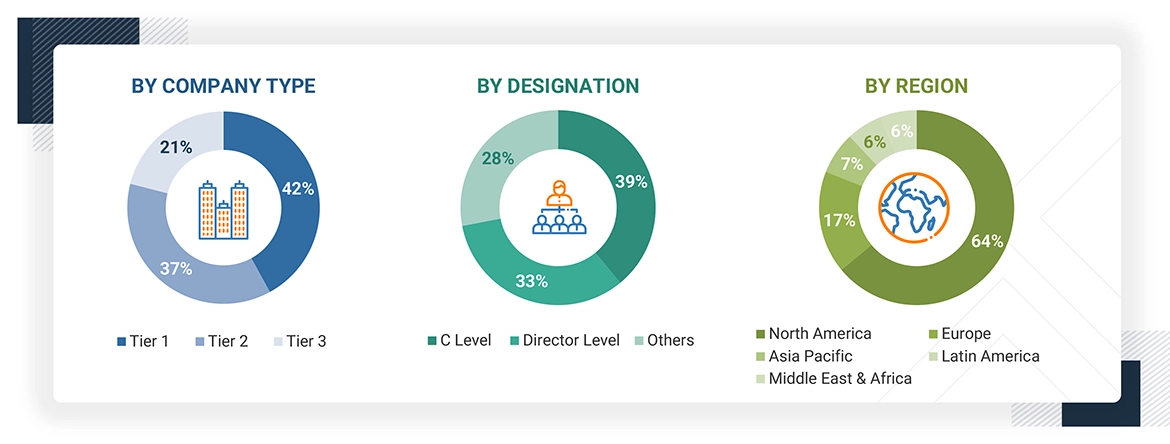
Note 1: C-level executives include CEOs, COOs, and CTOs.
Note 2: Others include sales, marketing, and product managers.
Note 3: Companies are classified into tiers based on their total revenue. As of 2024: Tier 1 = >USD 1 billion, Tier 2 = USD 500 million to USD 1 billion, and Tier 3 = < USD 500 million.
To know about the assumptions considered for the study, download the pdf brochure
Market Size Estimation
Both top-down and bottom-up approaches were used to estimate and validate the total size of the medical displays market. These methods were also used extensively to estimate the size of various subsegments in the market. The research methodology used to estimate the market size includes the following:
Data Triangulation
When the market size was determined, the entire market was split into five segments. Data triangulation and market breakdown processes were used where necessary to complete the entire market engineering process and arrive at precise statistics for all segments.
Approach to derive the market size and estimate market growth.
Market rankings for major players in the medical displays sector were established using secondary data from both paid and unpaid sources. Due to data limitations, the revenue share for some companies was assessed through a detailed analysis of their product portfolios and individual sales performance. This information was validated at each stage through in-depth interviews with industry professionals.
Market Definition
A display is an output device essential for presenting information, which can encompass textual content, images, or graphical data. Medical-grade displays are specialized monitors designed to precisely interpret diagnostic images, such as X-rays, MRIs, and CT scans. These displays adhere to strict standards for resolution, color accuracy, and contrast, enabling healthcare providers to view intricate details crucial for accurate diagnoses. By utilizing medical displays, healthcare professionals can make better-informed decisions regarding patient symptoms, disease diagnoses, and surgical procedures. The enhanced clarity and detail provided by these displays significantly improve the assessment and monitoring of medical conditions. Medical-grade displays are employed across a wide range of applications, including diagnostic imaging, surgical and interventional procedures, dentistry, and clinical reviews. Additionally, they play a vital role in training and educational settings, where precise visual representation is key to effective learning and understanding in the medical field. This ensures that both current and future healthcare providers are well-equipped to deliver high-quality patient care.
Stakeholders
- Raw material providers
- Medical display panel manufacturers
- Medical display-related service providers
- Medical display-related associations, organizations, forums, and alliances
- Government bodies, such as regulating authorities and policymakers
- Venture capitalists and start-ups
- Semiconductor component suppliers
- Medical display panel and device distributors & sales firms
- Medical display device end users
- Research institutes, organizations, and consulting companies
- Healthcare service providers
- Medical display software and service providers
Report Objectives
- To define, describe, and forecast the medical displays market based on application, technology, panel size, resolution, display color, and region
- To provide detailed information regarding the major factors influencing the market growth (drivers, restraints, opportunities, and challenges)
- To analyze the micromarkets with respect to individual growth trends, prospects, and contributions to the overall medical displays market
- To analyze market opportunities for stakeholders and provide details of the competitive landscape for key players
- To forecast the size of the medical displays market in six regions: North America (US and Canada), Europe (Germany, the UK, France, Spain, Italy, and the Rest of Europe), the Asia Pacific (Japan, China, India, Australia & New Zealand, South Korea, and the Rest of Asia Pacific), Latin America (Brazil, Mexico, Colombia, and the Rest of Latin America), the Middle East & Africa, and GCC Countries
- To analyze the impact of Gen AI on the growth of the medical displays market
- To strategically profile the key players in the global market and comprehensively analyze their core competencies
- To track and analyze competitive developments, such as product approvals, launches, expansions, and acquisitions, of the leading players in the market
Get the Full Medical Display Market Report
Full forecast, segment splits, and company analysis for all Medical Display Market.
- Canada Medical Display Market
- US Medical Display Market
- Germany Medical Display Market
- UK Medical Display Market
- France Medical Display Market
- Spain Medical Display Market
- Italy Medical Display Market
- China Medical Display Market
- Japan Medical Display Market
- India Medical Display Market
- South Korea Medical Display Market
- Australia Medical Display Market
- Brazil Medical Display Market
- Mexico Medical Display Market
- GCC Countries Medical Display Market
- Rest Of Europe Medical Display Market
- Rest Of Latin America Medical Display Market
Need a Tailored Report?
Customize this report to your needs
Get 10% FREE Customization
Customize This Report
