
South Korea Mercury Analyzer Market (2024-2029)

The South Korea Mercury Analyzer Market was valued at $12.8 Million in 2024 and projected to reach to $17.4 Million by 2029, representing a compound annual growth rate of 6.4%. South Korea's mercury analyzer market is positioned for steady expansion driven by the country's world-leading semiconductor and electronics manufacturing ecosystem.


| Market Size in | USD 26.32 MN |
| Market Forecast in | |
| CAGR | |
| Forecast Period | |
| Units Considered | Value (USD MN) |
South Korea Mercury Analyzer Market Trends and Insights
- This growth trajectory reflects South Korea's strong semiconductor and electronics manufacturing base, which drives demand for precision analytical instruments.
- South Korea's commitment to environmental compliance and quality control standards in industrial processes continues to support mercury analyzer adoption across manufacturing facilities. The South Korea mercury analyzer market benefits from the country's advanced technological infrastructure and stringent regulatory frameworks governing mercury emissions and contamination monitoring.
- South Korea's position as a global leader in semiconductor production creates substantial demand for mercury analyzers in quality assurance and environmental monitoring applications.
- Between 2024 and 2029, South Korea is expected to maintain a compound annual growth rate of 6.4%, driven by ongoing industrialization, regulatory pressures, and technological innovation in analytical instrumentation..
Key Market Statistics
- CAGR (2024-2029) 6.4% CAGR
- Market Size, 2024 ~USD 12.8 Million
- Forecast, 2029 ~USD 17.4 Million
- Country South Korea
South Korea Mercury Analyzer Market Overview
Market Valuation Growth :
South Korea's mercury analyzer market is valued at USD 12.8 million in 2024, with a projected CAGR of 6.4% through 2029, reaching USD 17.4 million by forecast end.
Manufacturing Excellence :
South Korea's robust semiconductor and electronics manufacturing sector drives consistent demand for precision analytical instruments and quality control equipment.
Environmental Compliance Focus :
Stringent South Korean environmental regulations and quality standards mandate mercury analysis across manufacturing processes, supporting sustained market expansion.
Technology Integration :
South Korean manufacturers increasingly adopt advanced mercury analyzer technologies to meet international export standards and domestic regulatory requirements.
South Korea Mercury Analyzer Market Dynamics
- The 6.4% CAGR reflects growing investments in precision analytical instrumentation as manufacturers enhance quality control processes and environmental compliance measures.
- South Korea's export-oriented industries require sophisticated mercury detection capabilities to meet stringent international standards, particularly for semiconductor fabrication and electronic component manufacturing. Looking ahead, the market will benefit from South Korea's continued technological advancement and regulatory emphasis on environmental protection.
- Government initiatives promoting clean manufacturing practices and the country's commitment to sustainability will further accelerate mercury analyzer adoption.
- Additionally, the expansion of South Korean electronics manufacturers into emerging markets will create sustained demand for reliable analytical instruments, supporting market growth through 2029..
Market Ecosystem
Related Ecosystem
Electronics System And Components
- Sensors
- Temperature Sensors
- Pressure Sensors
- Actuators
- Image Sensors
- Lenovo
- Samsung
- Texas Instruments Incorporated
- HONEYWELL INTERNATIONAL INC.
- Teledyne Technologies Incorporated
Testing Inspection And Certification
- Eddy Current Testing (ECT)
- Safety Testing
- Signal Generators
- Acoustic Emission Testing (AET)
- Automated Test Equipment
- Sgs s.a.
- Intertek Group plc
- Bureau veritas s.a.
- TUV RHEINLAND AG
- TUV SUD AG
Key Takeaways
- South Korea's mercury analyzer market is valued at USD 12.8 million in 2024 and is forecast to reach USD 17.4 million by 2029.
- South Korea maintains a 6.4% CAGR, reflecting strong demand from the semiconductor and electronics manufacturing sectors.
- South Korea's stringent environmental regulations and quality control standards drive adoption of mercury analyzers across industrial applications.
- South Korea's advanced technological infrastructure and global manufacturing leadership position it as a key market for analytical instrumentation.
Mercury Analyzer Market Report Scope
| Report Metric | Details |
|---|---|
| Base Year | 2024 |
| Fastest Growing Segment | PEMS (System Type) |
| Forecast Period | 2024-2029 |
| Growth Rate | CAGR of 6.6% from 2024 to 2029 |
| Largest Segment | CEMS (System Type) |
| Market Size Base Year (Billions) | ~USD 0.31 (2024) |
| Revenue Forecast (Billions) | ~USD 0.43 (2029) |
| Segments Covered | Type, End-Use Application, Sample Type, Monitoring Type, System Type, Offering, Industry |
South Korea Mercury Analyzer Market Report Segmentation
7 segment dimensions are covered across the global market.
By Type
- Cold Vapor Atomic Absorption
- Cold Vapor Atomic Fluorescence
- Cold Vapor Atomic Fluorescence
By End-Use Application
- Environmental Monitoring
- Food
- Healthcare
- Oil & Gas And Petrochemical
- Oil & Gas And Petrochemical Industry
By Sample Type
- Air
- Soil
- Water
By Monitoring Type
- Continuous Monitoring
- Lab Monitoring
By System Type
- Cems
- Pems
By Offering
- Hardware
- Services
- Software
By Industry
- Building Materials
- Chemicals, Petrochemicals, Refineries, And Fertilizers
- Marine & Shipping
- Metals
- Mining
- Oil & Gas
- Pharmaceuticals
- Power Generation
- Pulp & Paper
- Waste Incineration
Target Audience
- Semiconductor Manufacturers : South Korean semiconductor producers require detailed market intelligence on mercury analyzer adoption rates and technological requirements to optimize quality control investments.
- Electronics Equipment Suppliers : Analytical instrument vendors targeting South Korea's manufacturing sector need market sizing and growth forecasts to develop sales strategies and product roadmaps.
- Environmental Compliance Officers : South Korean manufacturing facility managers require market data on mercury analysis solutions to meet regulatory requirements and implement effective environmental monitoring programs.
- Investment & Business Development Teams : Corporate strategists and investors evaluating opportunities in South Korea's precision instrumentation sector need reliable market forecasts and competitive landscape analysis.
- Government & Regulatory Bodies : South Korean environmental and industrial agencies utilize market research to assess compliance effectiveness and inform policy decisions regarding mercury monitoring standards.
Reasons to Buy this Report
- Market-Specific Insights : Gain detailed understanding of South Korea's unique mercury analyzer market dynamics, including country-specific growth drivers, regulatory landscape, and manufacturing sector demands.
- Competitive Intelligence : Identify key players and competitive strategies within South Korea's market, enabling informed business decisions for market entry or expansion in this high-tech manufacturing hub.
- Regulatory Compliance Data : Access comprehensive information on South Korean environmental regulations and quality standards that mandate mercury analysis, critical for compliance-focused operations.
- Investment Opportunity Assessment : Evaluate growth potential and market sizing through 2029 to support investment decisions, partnership development, and resource allocation in South Korea's semiconductor sector.
- Strategic Market Positioning : Leverage country-specific forecasts and trend analysis to develop targeted marketing strategies and product positioning for South Korean manufacturers and exporters.
Frequently asked questions
What is the current size of South Korea's mercury analyzer market?
South Korea's mercury analyzer market was valued at USD 12.8 million in 2024 and is expected to grow to USD 17.4 million by 2029.
What is the projected growth rate for South Korea's mercury analyzer market?
South Korea's mercury analyzer market is projected to grow at a compound annual growth rate (CAGR) of 6.4% from 2024 to 2029.
What industries drive demand for mercury analyzers in South Korea?
South Korea's semiconductor, electronics manufacturing, and industrial sectors drive significant demand for mercury analyzers due to quality control and environmental compliance requirements.
Why is South Korea an important market for mercury analyzers?
South Korea's position as a global leader in semiconductor production, combined with stringent environmental regulations, makes it a critical market for mercury analyzer technology and instrumentation.
What regulatory factors influence South Korea's mercury analyzer market?
South Korea's strict environmental compliance standards and mercury emission regulations across manufacturing sectors significantly influence the adoption and demand for mercury analyzers.
RESEARCH METHODOLOGY
The study involved four major activities in estimating the current size of the mercury analyzers market. Exhaustive secondary research was conducted to collect information on the market, peer market, and parent market. The next step was to validate these findings, assumptions, and sizing with industry experts across the value chain through primary research. Finally, both top-down and bottom-up approaches were employed to estimate the complete market size. After that, market breakdown and data triangulation methods were used to estimate the market size of segments and subsegments.
Secondary Research
In the secondary research process, various secondary sources were referred to identify and collect information relevant to this study. The secondary sources include annual reports, press releases, and investor presentations of companies; white papers, certified publications, and articles from recognized authors; directories; and databases. Secondary research was conducted mainly to obtain key information about the industry’s supply chain, value chain of the market, the total pool of key players, market classification and segmentation according to industry trends, geographic markets, and key developments from both market- and technology-oriented perspectives.
Primary Research
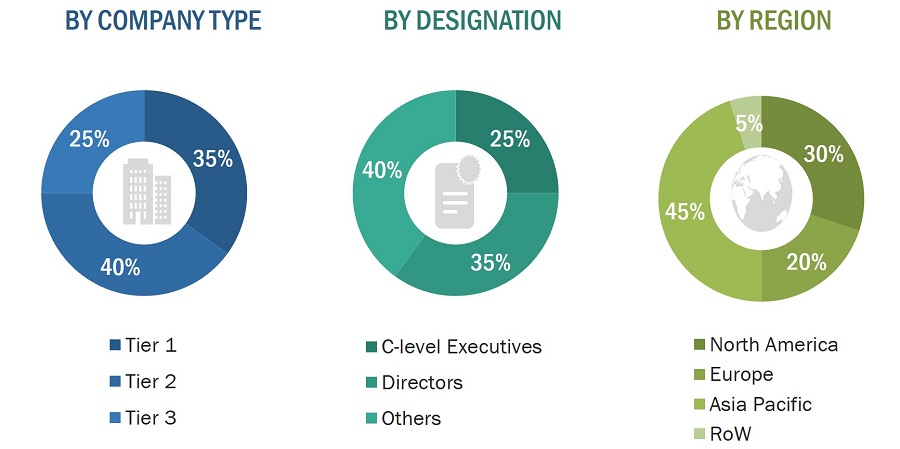
In the primary research process, various primary sources from both supply and demand sides were interviewed to obtain the qualitative and quantitative information relevant to this report. Primary sources from the supply side include experts such as CEOs, VPs, marketing directors, technology and innovation directors, application developers, application users, and related executives from various key companies and organizations operating in the mercury analyzer ecosystem. Following is the breakdown of primary respondents:
To know about the assumptions considered for the study, download the pdf brochure
Market Size Estimation
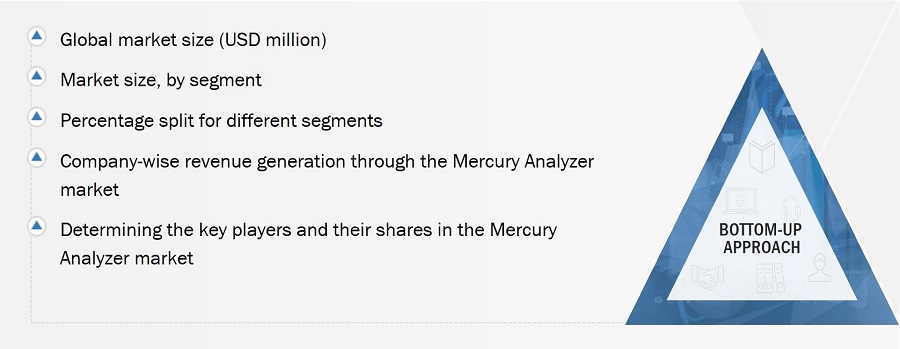
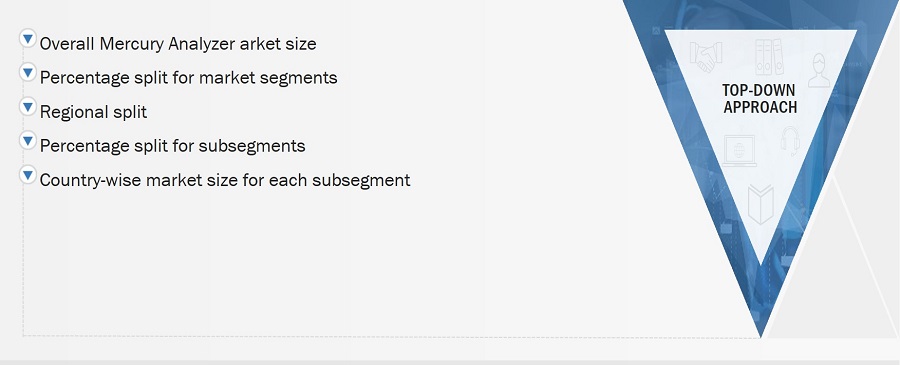
Both the top-down and bottom-up approaches were used to estimate and validate the size of the overall mercury analyzers market and the market based on segments. The research methodology used to estimate the market size was given below:
- Major players operating in the mercury analyzer market were identified and considered for the report through extensive secondary research.
- The supply chain and market size of the mercury analyzers market, both in terms of value and units, were estimated/determined through secondary and primary research processes.
- All estimations and calculations, including percentage share, revenue mix, splits, and breakdowns, were determined through the use of secondary sources, which were further verified through primary sources.
Global Mercury Analyzer Market Size: Bottom-Up Approach
Global Mercury Analyzer Market Size: Top-Down Approach
Market Definition
A mercury analyzer is an instrument designed to detect and measure mercury (Hg) concentration in various sample types, including solids, liquids, and gases. The mercury analyzer utilizes techniques such as cold vapor atomic absorption and cold vapor atomic fluorescence spectrometry to separate atomic mercury from the sample's matrix. These analyzers are utilized across various sectors, including environmental monitoring of air, water, and soil; the food industry; oil, gas, and petrochemical industries; healthcare and cosmetics sectors; and research institutes and laboratories.
Key Stakeholders
- Mercury analyzer product manufacturers
- Mercury analyzer product traders/suppliers
- Raw material suppliers and distributors
- Associations, organizations, forums, and alliances related to mercury analysis
- Government bodies such as regulatory authorities and policy-makers
- Research laboratories and academic institutes
- National and regional pollution control boards and organizations
- Oil producing and distribution companies
- Municipalities and municipal corporations
- Sewage and wastewater treatment plants
- Food industry
- Healthcare establishments
- Cosmetic manufacturers
Data Triangulation
After arriving at the overall market size from the market size estimation process explained above, the total market was split into several segments and subsegments. To complete the overall market engineering process and arrive at the exact statistics for all segments and subsegments, data triangulation and market breakdown procedures were employed, wherever applicable. The data was triangulated by studying various factors and trends from both the demand and supply sides. Along with this, the market was validated using both top-down and bottom-up approaches.
Report Objectives:
- To describe, and forecast the overall mercury analyzer market in terms of value and volume
- To describe, and forecast the mercury analyzer market segmented on the basis of type, end-use industry, and region
- To forecast the market size, in terms of value, for four main regions—North America, Europe, Asia Pacific, and the RoW
- To provide detailed information on the drivers, restraints, opportunities, and challenges influencing market growth
- To provide a detailed overview of the supply chain and ecosystem, along with the average selling price of the mercury analyzer
- To strategically analyze the regulatory landscape, standards, patents, Porter’s five forces, import and export scenarios, trade values, and case studies pertaining to the market under study
- To strategically analyze micromarkets1 concerning individual growth trends, prospects, and contributions to the total market
- To analyze the opportunities for stakeholders and details of the competitive landscape of the market
- To analyze strategic developments such as product launches, partnerships, expansions, and contracts in the mercury analyzers market
- To identify the key players operating in the mercury analyzer market and comprehensively analyze their market ranking and core competencies2
- To analyze strategic developments such as product launches, partnerships, expansions, and contracts in the mercury analyzers market
Available Customizations
Based on the given market data, MarketsandMarkets offers customizations in the reports according to the client’s specific requirements. The available customization options are as follows:
Product Analysis
- Product matrix that gives a detailed comparison of the product portfolio of each company
Company Information
- Detailed analysis and profiling of 25 key players
Get the Full Mercury Analyzer Market Report
Full forecast, segment splits, and company analysis for all Mercury Analyzer Market.
- US Mercury Analyzer Market
- Canada Mercury Analyzer Market
- Mexico Mercury Analyzer Market
- Germany Mercury Analyzer Market
- France Mercury Analyzer Market
- UK Mercury Analyzer Market
- China Mercury Analyzer Market
- Japan Mercury Analyzer Market
- India Mercury Analyzer Market
- Rest Of Europe Mercury Analyzer Market
- Rest Of Asia Pacific Mercury Analyzer Market
- South America Mercury Analyzer Market
- GCC Countries Mercury Analyzer Market
Need a Tailored Report?
Customize this report to your needs
Get 10% FREE Customization
Customize This Report
