
South Korea Methyl Acetate Market (2025-2030)

The South Korea Methyl Acetate Market was valued at $7.7 Million in 2025 and projected to reach to $9.3 Million by 2030, representing a compound annual growth rate of 4.0%. South Korea's methyl acetate market demonstrates steady growth momentum, supported by the country's well-established chemical manufacturing sector and consistent demand from pharmaceutical and specialty coating applications.


| Market Size in | USD 26.32 MN |
| Market Forecast in | |
| CAGR | |
| Forecast Period | |
| Units Considered | Value (USD MN) |
South Korea Methyl Acetate Market Trends and Insights
- This steady growth reflects South Korea's robust chemical manufacturing sector and increasing demand for solvent applications across pharmaceuticals, coatings, and adhesives industries.
- South Korea's strategic position in Asia Pacific and its advanced industrial infrastructure support sustained market expansion through the forecast period. The methyl acetate market in South Korea is driven by rising consumption in paint and coating formulations, where the chemical serves as a key volatile organic compound (VOC) solvent.
- South Korea's emphasis on sustainable manufacturing practices and regulatory compliance with environmental standards is shaping product innovation and market dynamics.
- Between 2025 and 2030, South Korea is expected to maintain moderate growth momentum, supported by domestic demand from electronics, automotive, and consumer goods sectors that rely on methyl acetate-based solutions..
Key Market Statistics
- CAGR (2025-2030) 4.0% CAGR
- Market Size, 2025 ~USD 7.7 Million
- Forecast, 2030 ~USD 9.3 Million
- Country South Korea
South Korea Methyl Acetate Market Overview
Market Size & Growth :
South Korea's methyl acetate market is valued at USD 7.7 million in 2025, with projected growth to USD 9.3 million by 2030, representing a steady 4.0% CAGR driven by expanding chemical manufacturing capabilities.
Key Application Sectors :
Pharmaceutical, coatings, and adhesives industries are primary demand drivers in South Korea, leveraging methyl acetate's solvent properties for manufacturing processes and product formulations.
Industrial Positioning :
South Korea's advanced chemical manufacturing infrastructure and export-oriented economy position the country as a significant methyl acetate consumer within the Asia-Pacific region.
Growth Differential :
South Korea's 4.0% CAGR is notably lower than the global 7.9% CAGR, indicating a mature market with stable demand rather than rapid expansion compared to emerging Asian markets.
South Korea Methyl Acetate Market Dynamics
- The 4.0% CAGR reflects a mature market with stable consumption patterns, driven by domestic production needs and regional export activities. Looking ahead to 2030, South Korea's methyl acetate market will benefit from technological advancements in solvent applications, stricter environmental regulations favoring efficient chemical processes, and continued investment in high-value pharmaceutical and adhesive manufacturing.
- However, growth will remain moderate compared to global rates, as the market has already achieved significant penetration in key industrial segments..
Market Ecosystem
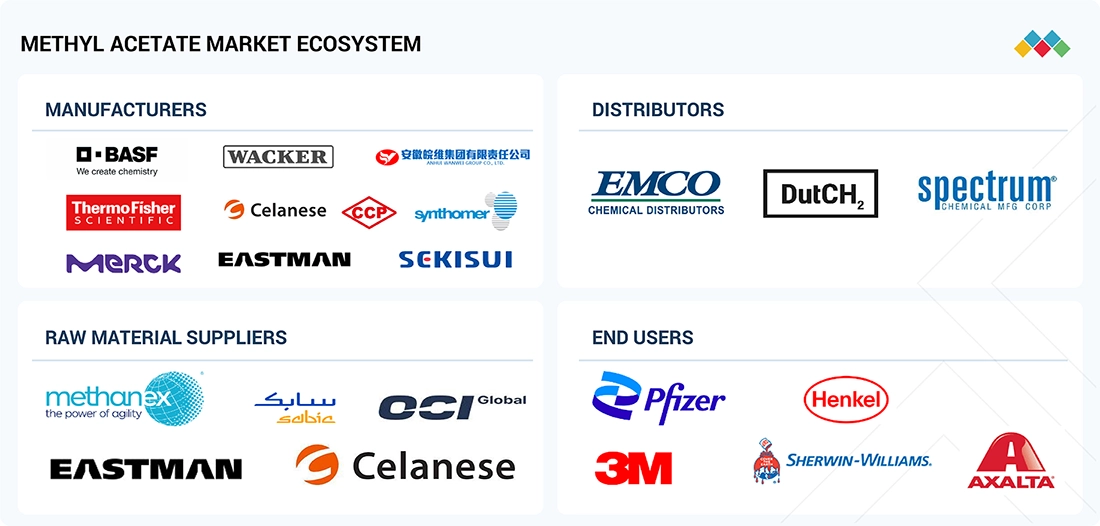
Methyl Acetate Market: COMMERCIAL USE CASES ACROSS INDUSTRIES
| COMPANY | USE CASE DESCRIPTION | BENEFITS |
|---|---|---|
 |
Celanese utilizes methyl acetate in automotive coatings to achieve fast drying times and excellent resin solubility. This application is particularly beneficial in regions with stringent environmental regulations, as methyl acetate's low volatile organic compound (VOC) content helps meet these standards. | Methyl acetate in automotive coatings speeds up production, ensures regulatory compliance, and enhances coating quality through excellent resin compatibility. |
 |
Concern over child ingestion of nail polish remover with 50% methyl acetate prompted a toxicological review to assess cosmetic safety. | Found safe under normal use; recommended child-proof packaging, warning labels, and avoiding attractive coloring to reduce accidental ingestion. |
 |
Modeled a lab-scale methyl acetate reactive distillation (RD) column using the DIVA® simulator to test feasibility and system dynamics. | Validated RD as efficient; revealed nonlinear behaviors; confirmed need for advanced controls and potential for process intensification. |
 |
Eastman incorporates methyl acetate in the formulation of inks for flexible packaging. The solvent's low toxicity and high solvency power make it an ideal choice for creating inks that are both effective and safer for consumers. | Using methyl acetate in packaging inks reduces health risks, ensures vibrant, high-quality prints, and meets safety standards. |
Logos and trademarks shown above are the property of their respective owners. Their use here is for informational and illustrative purposes only.
Related Ecosystem
Speciality Chemicals
- Corrosion Inhibitors
- Polyetheretherketone (PEEK)
- Acrylonitrile Butadiene Styrene (ABS)
- Epoxy Resin
- Polycarbonate
- Basf se
- DOW CHEMICAL COMPANY
- Evonik industries ag
- Clariant ag.
- Solvay sa
Key Takeaways
- South Korea's methyl acetate market is valued at USD 7.7 million in 2025 and will reach USD 9.3 million by 2030.
- South Korea's market is growing at a 4.0% CAGR, reflecting steady demand from coatings, pharmaceuticals, and adhesives sectors.
- South Korea's regulatory focus on VOC reduction and environmental compliance is driving innovation in solvent formulations.
- South Korea's electronics and automotive industries are key end-use segments supporting methyl acetate consumption through 2030.
Methyl Acetate Market Report Scope
| Report Metric | Details |
|---|---|
| Base Year | 2025 |
| Fastest Growing Segment | PERSONAL CARE & COSMETICS (End-Use Industry) |
| Forecast Period | 2025-2030 |
| Growth Rate | CAGR of 7.9% from 2025 to 2030 |
| Largest Segment | OTHER RESIN TYPES (Resin Type) |
| Market Size Base Year (Billions) | ~USD 0.27 (2025) |
| Revenue Forecast (Billions) | ~USD 0.39 (2030) |
| Segments Covered | Grade, End-Use Industry, Technology, Resin Type |
South Korea Methyl Acetate Market Report Segmentation
4 segment dimensions are covered across the global market.
By Grade
- Food-Grade
- Industrial-Grade
- Pharmaceutical-Grade
By End-Use Industry
- Adhesives & Sealants
- Architectural
- Industrial
- Inks
- Other End-Use Industries
- Paints & Coatings
- Personal Care & Cosmetics
- Pharmaceuticals
By Technology
- Other Technologies
- Powder Coatings
- Solventborne Coatings
- Waterborne Coatings
By Resin Type
- Acrylic
- Acrylic Resin
- Alkyd
- Alkyd Resin
- Epoxy
- Epoxy Resin
- Fluoropolymer
- Fluoropolymer Resin
- Other Resin Types
- Polyester
- Polyester Resin
- Polyurethane
- Polyurethane Resin
- Vinyl
Target Audience
- Chemical Manufacturers & Producers : South Korea-based and international chemical producers need market sizing and demand forecasts to optimize production capacity, supply chain planning, and regional distribution strategies.
- Pharmaceutical Companies : Pharmaceutical manufacturers operating in or sourcing from South Korea require solvent market data to secure reliable methyl acetate supply and manage production costs effectively.
- Coatings & Adhesives Manufacturers : Coating and adhesive producers need South Korea-specific demand insights to forecast raw material requirements, plan inventory, and identify growth opportunities in this key application sector.
- Investment & Business Development Teams : Corporate strategists and M&A professionals evaluating South Korea's chemical sector need market intelligence to assess investment viability, competitive positioning, and growth potential.
- Trade & Distribution Partners : Chemical distributors and trading companies operating in South Korea require market forecasts and application insights to optimize product portfolios and customer targeting strategies.
Reasons to Buy this Report
- Market-Specific Sizing & Forecasts : Access precise valuation data for South Korea's methyl acetate market (USD 7.7M in 2025, USD 9.3M in 2030) with granular CAGR analysis to support investment and expansion decisions.
- Sector-Focused Demand Insights : Understand application-specific demand patterns across South Korea's pharmaceutical, coatings, and adhesives industries to identify high-growth customer segments and product opportunities.
- Competitive Landscape Intelligence : Gain insights into South Korea's chemical manufacturing ecosystem, local supplier dynamics, and market positioning relative to regional competitors in Asia-Pacific.
- Regulatory & Compliance Context : Navigate South Korea's environmental regulations and chemical safety standards that influence methyl acetate production, distribution, and application across industries.
- Strategic Growth Planning : Leverage country-specific market intelligence to develop targeted go-to-market strategies, partnership opportunities, and capacity planning for South Korea's stable, mature chemical solvent market.
Frequently asked questions
What is the current size of South Korea's methyl acetate market?
South Korea's methyl acetate market is estimated at USD 7.7 million in 2025 and is expected to grow to USD 9.3 million by 2030.
What is the growth rate of methyl acetate in South Korea?
South Korea's methyl acetate market is projected to grow at a CAGR of 4.0% from 2025 to 2030.
Which industries drive methyl acetate demand in South Korea?
South Korea's primary end-use sectors include coatings and paints, pharmaceuticals, adhesives, electronics, and automotive manufacturing.
How do environmental regulations impact South Korea's methyl acetate market?
South Korea's strict VOC emission standards and environmental compliance requirements are driving manufacturers to develop cleaner formulations and sustainable solvent alternatives.
What market opportunities exist in South Korea for methyl acetate suppliers?
South Korea offers growth opportunities in eco-friendly solvent formulations, specialty coatings for electronics, and pharmaceutical-grade applications aligned with regulatory standards.
RESEARCH METHODOLOGY
The study involved four major activities to estimate the current size of the global methyl acetate market. Exhaustive secondary research was carried out to collect information on the market, the peer product market, and the parent product group market. The next step was to validate these findings, assumptions, and sizes with the industry experts across the value chain of methyl acetate through primary research. The top-down and bottom-up approaches were employed to estimate the overall size of the methyl acetate market. After that, market breakdown and data triangulation procedures were used to determine the size of different segments and sub-segments of the market.
Secondary Research
The market for companies offering methyl acetate is arrived at by secondary data available through paid and unpaid sources, analyzing the product portfolios of the major companies in the ecosystem, and rating the companies by their performance and quality. Various secondary sources, such as Business Standard, Bloomberg, World Bank, and Factiva, were referred to in order to identify and collect information for this study on the methyl acetate market. In the secondary research process, various secondary sources were referred to identify and collect information related to the study. Secondary sources included annual reports, press releases, and investor presentations of door vendors, forums, certified publications, and whitepapers. The secondary research was used to obtain critical information on the industry’s value chain, the total pool of key players, market classification, and segmentation from the market and technology-oriented perspectives.
Primary Research
In the primary research process, various primary sources from both the supply and demand sides were interviewed to obtain qualitative and quantitative information for this report. The primary sources from the supply side included industry experts, such as Chief Executive Officers (CEOs), Vice Presidents (VPs), marketing directors, technology and innovation directors, and related key executives from several key companies and organizations operating in the methyl acetate market. After the complete market engineering (calculations for market statistics, market size estimations, market forecasting, and data triangulation), extensive primary research was conducted to gather information and verify and validate the critical numbers arrived at. Primary research was also conducted to identify the segmentation types, industry trends, competitive landscape of methyl acetate offered by various market players, and key market dynamics, such as drivers, restraints, opportunities, challenges, industry trends, and key player strategies. In the complete market engineering process, the top-down and bottom-up approaches and several data triangulation methods were extensively used to perform the market estimation and market forecasting for the overall market segments and subsegments listed in this report. Extensive qualitative and quantitative analysis was performed on the complete market engineering process to list the key information/insights throughout the report.
The following is the breakdown of primary respondents.
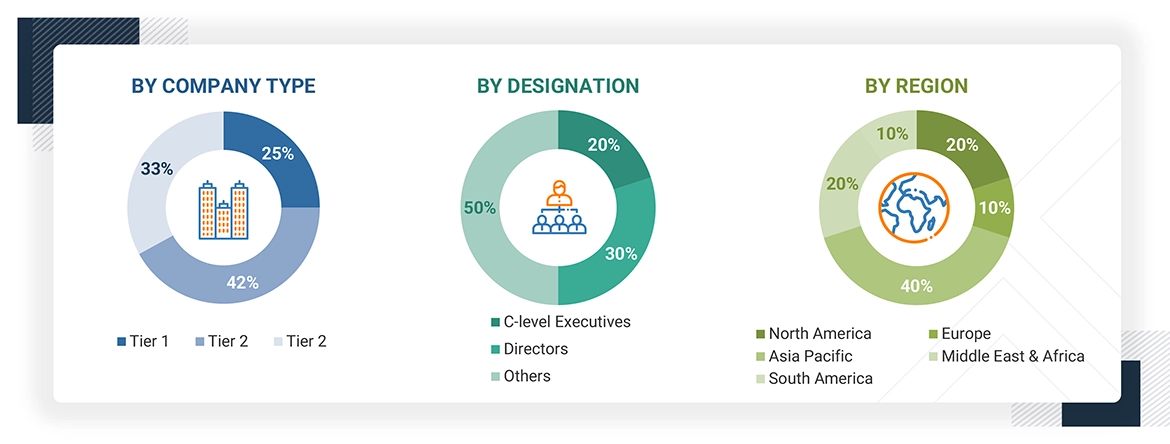
Notes: Other designations include sales, marketing, and product managers.
Tier 1: > USD 1 Billion; Tier 2: USD 500 million to USD 1 Billion; and Tier 3: < USD 500 million
To know about the assumptions considered for the study, download the pdf brochure
Market Size Estimation
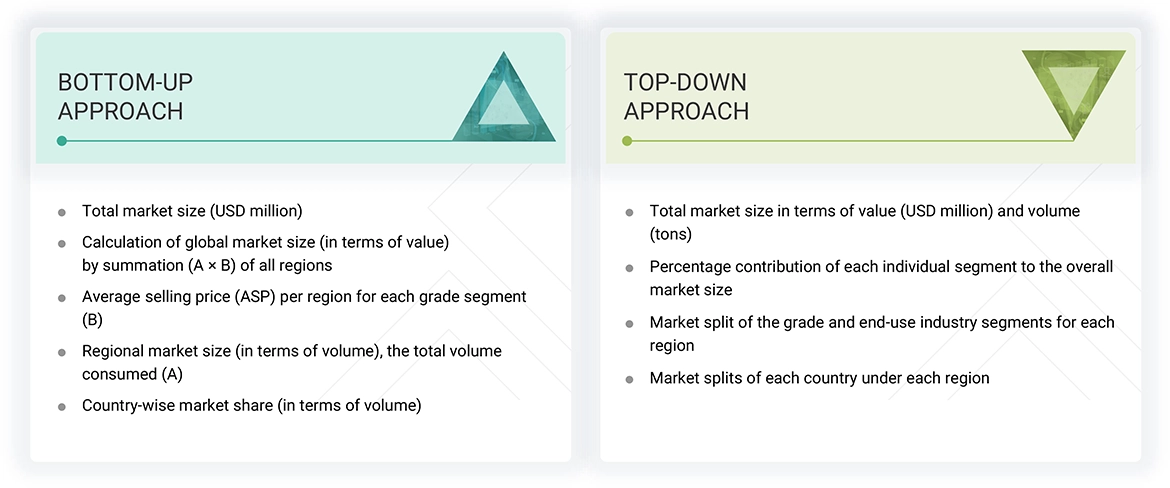
The top-down and bottom-up approaches were used to estimate and validate the size of the global methyl acetate market. These approaches were also used extensively to estimate the size of various dependent market segments. The research methodology used to estimate the market size included the following:
Data Triangulation
After arriving at the overall market size using the market size estimation processes, the market was split into several segments and subsegments. The data triangulation and market breakup procedures were employed, wherever applicable, to complete the overall market engineering process and arrive at the exact statistics of each market segment and subsegment. The data was triangulated by studying various factors and trends from both the demand and supply sides.
Market Definition
Methyl acetate is a rapidly evaporating, low-toxicity organic ester solvent commonly utilized in industrial and commercial applications. The methyl ester of acetic acid possesses a sweet, fruity aroma and dissipates rapidly. These attributes render it highly esteemed in paints and coatings, adhesives, inks, personal care products, and chemical synthesis, where it provides effective solvency, seamless application, and improved performance. Methyl acetate is predominantly synthesized via the esterification of methanol and acetic acid, exhibiting advantageous environmental characteristics, including low photochemical reactivity and the ability to serve as a safer substitute for more harmful solvents like toluene and acetone. Its low surface tension, strong volatility, and broad miscibility with a variety of organic solvents make it suitable for use in a wide range of formulations. The International Union of Pure and Applied Chemistry (IUPAC) recognizes methyl acetate as a volatile organic compound (VOC) and a highly flammable liquid, and it is controlled by authorities such as the United States Environmental Protection Agency (EPA) and the European Chemicals Agency (ECHA).
Stakeholders
- Methyl acetate manufacturers
- Raw material suppliers
- Converters & processors
- Distributors and traders
- Industry associations and regulatory bodies
- End users
Report Objectives
- To define, describe, and forecast the size of the global methyl acetate market, based on grade, purity, sales channel, end-use industry, and region in terms of value and volume
- To provide detailed information on the significant drivers, restraints, opportunities, and challenges influencing the market
- To strategically analyze micromarkets concerning individual growth trends, prospects, and their contribution to the market
- To assess the growth opportunities in the market for stakeholders and provide details on the competitive landscape for market leaders
- To forecast the market size of segments and subsegments for North America, Europe, Asia Pacific, South America, and the Middle East & Africa
- To strategically profile key players and comprehensively analyze their market shares and core competencies
- To analyze competitive developments such as acquisitions, expansions, partnerships, and agreements in the methyl acetate market
- To provide the impact of AI/Gen AI on the market
Get the Full Methyl Acetate Market Report
Full forecast, segment splits, and company analysis for all Methyl Acetate Market.
- China Methyl Acetate Market
- India Methyl Acetate Market
- Japan Methyl Acetate Market
- Germany Methyl Acetate Market
- France Methyl Acetate Market
- UK Methyl Acetate Market
- Spain Methyl Acetate Market
- Canada Methyl Acetate Market
- Mexico Methyl Acetate Market
- US Methyl Acetate Market
- South Africa Methyl Acetate Market
- Brazil Methyl Acetate Market
- Argentina Methyl Acetate Market
- Rest Of Europe Methyl Acetate Market
- Rest Of Asia Pacific Methyl Acetate Market
- GCC Countries Methyl Acetate Market
- -Rest Of The GCC Methyl Acetate Market
- Rest Of South America Methyl Acetate Market
Need a Tailored Report?
Customize this report to your needs
Get 10% FREE Customization
Customize This Report
