
US Micro Combined Heat and Power Market (2024-2029)

The US Micro Combined Heat and Power Market was valued at $443.5 Million in 2024 and projected to reach to $639.2 Million by 2029, representing a compound annual growth rate of 7.6%. The US micro combined heat and power market is positioned for sustained expansion through 2029, driven by heightened awareness of energy efficiency and distributed generation benefits.


| Market Size in | USD 26.32 MN |
| Market Forecast in | |
| CAGR | |
| Forecast Period | |
| Units Considered | Value (USD MN) |
US Micro Combined Heat and Power Market Trends and Insights
- This 7.6% compound annual growth rate reflects increasing adoption of distributed energy solutions across residential and commercial sectors in the US.
- The US market benefits from rising energy costs, regulatory incentives, and growing demand for efficient on-site power generation. In 2024, the US micro CHP market is driven by technological advancements and heightened focus on energy independence.
- By 2029, the US is expected to see accelerated deployment as businesses and homeowners seek to reduce operational costs and carbon footprints.
- The US regulatory environment, including federal tax credits and state-level renewable energy mandates, continues to support market expansion and investment in micro CHP systems..
Key Market Statistics
- CAGR (2024-2029) 7.6% CAGR
- Market Size, 2024 ~USD 443.5 Million
- Forecast, 2029 ~USD 639.2 Million
- Country US
US Micro Combined Heat and Power Market Overview
Market Valuation :
The US micro combined heat and power market is valued at $443.5 million in 2024, with projections reaching $639.2 million by 2029, representing a robust 7.6% CAGR driven by distributed energy adoption.
Regulatory Support :
US federal and state incentives, including tax credits and renewable energy mandates, are accelerating micro CHP adoption across residential and commercial properties, particularly in energy-conscious regions.
Rising Energy Costs :
Escalating electricity and natural gas prices in the US are making micro CHP systems increasingly attractive for cost-conscious consumers and businesses seeking energy independence and operational efficiency.
Sector Growth :
Both residential and commercial sectors in the US are experiencing increased micro CHP penetration, with particular momentum in healthcare facilities, hospitality, and multi-family residential developments.
US Micro Combined Heat and Power Market Dynamics
- Growing adoption among commercial enterprises seeking to reduce operational costs and carbon footprints will fuel market growth.
- Residential applications are also gaining traction as homeowners increasingly invest in resilient, cost-effective energy solutions.
- Technological advancements and declining equipment costs will further democratize micro CHP accessibility across diverse customer segments. Government incentives and net metering policies continue to create favorable conditions for market expansion.
- The shift toward decentralized energy infrastructure aligns with broader US sustainability goals and grid modernization initiatives.
- Strategic partnerships between equipment manufacturers and installation providers are enhancing market penetration.
- By 2029, the US market will likely see increased competition, innovation in system efficiency, and broader geographic adoption beyond early-adopter regions..
Market Ecosystem

MICRO COMBINED HEAT AND POWER MARKET: COMMERCIAL USE CASES ACROSS INDUSTRIES
| COMPANY | USE CASE DESCRIPTION | BENEFITS |
|---|---|---|
 |
Viessmann deploys micro CHP systems (primarily fuel cell-based) in residential buildings and small commercial establishments across Europe, enabling decentralized heating and power generation integrated with smart home energy systems. | High overall efficiency through combined heat and power generation | Reduced carbon emissions with optimized fuel utilization | Quiet and compact systems suitable for residential use | Integration with smart energy management systems for optimized performance |
 |
Panasonic has implemented residential fuel cell micro CHP systems (Ene-Farm) in Japan, widely adopted in households for continuous low-carbon electricity and hot water generation, supported by government incentives. | Continuous and reliable on site power and hot water generation | High efficiency operation leading to lower household energy costs | Significant reduction in carbon emissions | Enhanced energy independence and reduced reliance on grid supply |
 |
Bosch offers micro CHP solutions for residential and light commercial applications, particularly in Europe, combining internal combustion engine-based systems with advanced controls for efficient on-site energy generation. | Reliable decentralized energy generation for residential and light commercial use | Improved fuel efficiency and lower operating costs | Flexible system integration with existing heating infrastructure | Reduced emissions and compliance with evolving energy efficiency standards |
Logos and trademarks shown above are the property of their respective owners. Their use here is for informational and illustrative purposes only.
Related Ecosystem
Decarbonization
- Battery Electric Vehicle (BEV)
- Energy Management Systems
- Fuel Cell
- Fuel Cell Electric Vehicle (FCEV)
- Geographical Information System (GIS)
- TotalEnergies SE
- Siemens ag
- Mitsui & Co., Ltd.
- General Electric Company
- Thyssenkrupp ag
Engines And Gensets
- Fuel Cell
- Agricultural Tractors
- Analytics Software
- Biometric Systems
- Cogeneration
- Wartsila
- General Electric Company
- Cummins Inc.
- Siemens ag
- UNIPER GLOBAL COMMODITIES SE
Power Infrastructure
- Geographical Information System (GIS)
- Cogeneration
- Battery Electric Vehicle (BEV)
- Cellular Network
- Fuel Cell
- Siemens ag
- ABB India Limited
- SCHNEIDER ELECTRIC SE
- General Electric Company
- Eaton Corporation plc
Key Takeaways
- The US micro CHP market is valued at $443.5 million in 2024 and is forecast to reach $639.2 million by 2029, representing a 7.6% CAGR.
- The US market is driven by rising energy costs, federal tax incentives, and growing demand for distributed energy resources among residential and commercial customers.
- Technological improvements in efficiency and reliability are making US micro CHP systems increasingly competitive against traditional grid-supplied power.
- The US regulatory landscape, including state renewable energy standards and federal support programs, is accelerating adoption and investment in micro CHP technologies.
Micro Combined Heat and Power Market Report Scope
| Report Metric | Details |
|---|---|
| Base Year | 2024 |
| Fastest Growing Segment | FUEL CELL-BASED (Type) |
| Forecast Period | 2024–2029 |
| Growth Rate | CAGR of 9.4% from 2024 to 2029 |
| Largest Segment | ENGINE-BASED (Type) |
| Market Size Base Year (Billions) | ~USD 3.06 (2024) |
| Revenue Forecast (Billions) | ~USD 4.8 (2029) |
| Segments Covered | Type, Capacity, Technology, Application |
US Micro Combined Heat and Power Market Report Segmentation
4 segment dimensions are covered across the global market.
By Type
- Engine-Based
- Fuel Cell-Based
By Capacity
- 11–50 Kw
- 5–10 Kw
- <5 Kw
- Below 5 Kw
By Technology
- Internal Combustion (Ic) Engines
- Proton Exchange Membrane Fuel Cells (Pemfcs)
- Rankine Cycle Engines
- Solid Oxide Fuel Cells (Sofcs)
- Stirling Engines
By Application
- Commercial
- Residential
US: MICRO COMBINED HEAT AND POWER MARKET, BY APPLICATION, 2024–2029
| Segment | 2024 | 2025 | 2026 | 2027 | 2028 | 2029 | CAGR (%) |
|---|---|---|---|---|---|---|---|
| COMMERCIAL | 185 | 196.5 | 208.8 | 222.2 | 236.7 | 252.3 | 6.4 |
| RESIDENTIAL | 258.5 | 279.7 | 303 | 328.4 | 356.3 | 387 | 8.4 |
| TOTAL | 443.5 | 476.2 | 511.8 | 550.6 | 593 | 639.2 | 7.6 |
Target Audience
- Equipment Manufacturers : Micro CHP equipment producers need US market data to optimize product portfolios, identify growth segments, and align manufacturing capacity with regional demand forecasts through 2029.
- Energy Service Companies : ESCO providers require detailed US market insights to develop service offerings, identify target customer segments, and structure financing solutions for residential and commercial micro CHP installations.
- Utility Companies : US utilities need market intelligence to understand distributed generation trends, assess grid integration impacts, and develop strategies for managing micro CHP adoption within their service territories.
- Investment & Private Equity Firms : Investors evaluating opportunities in the US distributed energy sector require validated market sizing, growth projections, and competitive landscape analysis to inform funding decisions.
- Policy & Regulatory Bodies : Government agencies and regulatory organizations need comprehensive US market data to design effective incentive programs, assess policy impacts, and support renewable energy and efficiency goals.
Key Companies in the US Micro Combined Heat and Power Market
| Company | HQ | Ownership | Strongest segments |
|---|---|---|---|
| INDO RAMA SYNTHETICS (INDIA) LIMITED | India | Public Company | Polyester (yarns, fibers, PET resin, chips, fabrics),Spun Yarns (cotton, blends, specialty),Fertilizers, |
| WARTSILA | United States | Public Company | Engine and hybrid power plants,Energy storage (Quantum BESS) and GEMS software,Marine power and propulsion solutions, |
| WORLEYPARSONS LIMITED | United States | Public Company | Project delivery (engineering, procurement, construction, installation & commissioning),Asset performance (operations, maintenance, workflow optimization),Professional & consulting (planning, capital project support, digital, environment & sustainability), |
| RICARDO | United Kingdom | Private Company | Energy & Environment (EE),Rail,A&I Established (Conventional Powertrain), |
| WILO SE | Germany | Private Company | Building Services Residential,Building Services Commercial,Original Equipment Manufacturers (OEM), |
| VALMET CORPORATION | Finland | Public Company | Biomaterial Solutions and Services (pulp, paper, tissue, packaging, bioenergy technologies and lifecycle services),Process Performance Solutions – Automation systems and industrial applications,Process Performance Solutions – Flow control (valves, pumps, valve automation), |
| ENEL | Italy | Public Company | Enel Green Power (renewables),Thermal Generation and Trading,Enel Grids (distribution and transmission), |
| MOL GROUP | Hungary | Public Company | Refined fuels (gasoline, diesel, heating oil, bunker diesel, JET A-1, LPG/autogas),Petrochemicals and black products (bitumen, HFO, petrolcoke, residues),Retail convenience, mobility, and digital services (Fresh Corner, e-mobility, car/bike sharing, fleet, digital factory), |
| AISIN CORPORATION | Japan | Public Company | Automatic, CVT and manual transmissions,eAxle and electrified drivetrain modules,Brakes, steering, doors, roofs and body systems, |
| 2G ENERGY AG | Germany | Public Company | Engine-based CHP units (g-box, aura, agenitor, avus),Services, spare parts, maintenance, rental,Heat pumps (afilia) and temperature-oriented applications, |
| YANMAR HOLDINGS CO., LTD. | Japan | Private Company | Agricultural equipment (incl. smart agriculture),Industrial engines (incl. marine commercial),Construction equipment, |
| KYUNGDONG NAVIEN | South Korea | Public Company | Gas and oil boilers (incl. condensing),Electric boilers and water heaters,Heat pumps and hybrid/geothermal boilers, |
| AZELIO | Sweden | Private Company | TES.POD systems (hardware and EPC-linked sales),Project development, engineering and integration services,Aftermarket, O&M and performance optimization, |
| LOCHINVAR | United States | Private Company | Commercial boilers and water heaters,Residential water heaters and boilers,Tanks (indirect, storage, buffer, hot water generators), |
| SENER | Spain | Private Company | Space equipment, subsystems, and engineering,Defence systems and subsystems,Aeronautics and vehicles (civil and military), |
| PANASONIC HOLDINGS CORPORATION | Japan | Public Company | Energy (EV and storage batteries),HVAC & CC (air conditioners, heat pumps, ventilation, showcases),Smart Life (consumer appliances and AV), |
INDO RAMA SYNTHETICS (INDIA) LIMITED
Indo Rama Synthetics (India) Limited is a public company founded in 1974 and based in India. With 6,789 employees, the company operates as a significant industrial enterprise in the Indian market.
WARTSILA
Wärtsilä is a public company founded in 1834 and based in the United States. With 17,938 employees, it operates as a major industrial corporation.
WORLEYPARSONS LIMITED
WorleyParsons Limited is a public company founded in 1971 and headquartered in the United States. The company employs 38,224 people and operates as a large-scale industrial services provider.
RICARDO
Ricardo is a private company established in 1915 and headquartered in the United Kingdom. With 2,600 employees, the company operates as an established industrial enterprise.
WILO SE
Wilo SE is a private company founded in 1872 and based in Germany. The company employs 8,442 people and operates as a significant German industrial manufacturer.
VALMET CORPORATION
Valmet Corporation is a public company founded in 1750 and based in Finland. The company employs 18,370 people and operates as a major industrial corporation.
ENEL
Enel is a public company founded in 1962 and headquartered in Italy. With 61,544 employees, the company operates as a major energy corporation.
MOL GROUP
MOL Group is a public company founded in 1991 and based in Hungary. The company employs 24,744 people and operates as a significant industrial enterprise.
AISIN CORPORATION
Aisin Corporation is a public company founded in 1943 and based in Japan. With 113,292 employees, the company operates as a major global industrial corporation.
2G ENERGY AG
2G Energy AG is a public company founded in 1995 and headquartered in Germany. The company employs 1,074 people.
YANMAR HOLDINGS CO., LTD.
Yanmar Holdings Co., Ltd. is a private company founded in 1912 and headquartered in Japan. The company operates as an established Japanese industrial enterprise.
KYUNGDONG NAVIEN
Kyungdong Navien is a public company founded in 1973 and headquartered in South Korea. The company employs 1,460 people.
AZELIO
Azelio is a private company founded in 2006 and based in Sweden. The company employs 134 people.
LOCHINVAR
Lochinvar is a private company founded in 1939 and based in the United States. The company employs 375 people.
SENER
Sener is a private company founded in 1956 and headquartered in Spain. The company employs 5,558 people.
PANASONIC HOLDINGS CORPORATION
Panasonic Holdings Corporation is a public company founded in 1918 and headquartered in Japan. With 183,685 employees, the company operates as a major global industrial corporation.
Reasons to Buy this Report
- Market Size & Growth Validation : Obtain precise US market valuation data ($443.5M in 2024) and verified 5-year forecasts to support investment decisions, business planning, and competitive positioning in the micro CHP sector.
- Sector-Specific Insights : Understand residential and commercial adoption patterns unique to the US market, including regional variations, customer preferences, and emerging opportunities within specific verticals.
- Regulatory & Incentive Landscape : Access detailed analysis of US federal and state incentive programs, tax credits, and policy drivers that influence micro CHP adoption rates and market dynamics across different regions.
- Competitive Intelligence : Benchmark your organization against market trends, identify key players in the US micro CHP space, and discover gaps in the market for product development and strategic expansion.
- Investment & Expansion Strategy : Leverage comprehensive US market data to justify capital allocation, identify high-growth segments, and develop data-driven go-to-market strategies for micro CHP solutions.
Frequently asked questions
What is the current size of the US micro CHP market?
The US micro combined heat and power market was valued at $443.5 million in 2024 and is expected to grow to $639.2 million by 2029.
What is the growth rate of the US micro CHP market?
The US micro CHP market is projected to grow at a compound annual growth rate (CAGR) of 7.6% from 2024 to 2029.
What factors are driving growth in the US micro CHP market?
Key drivers in the US include rising energy costs, federal tax credits, state renewable energy mandates, technological improvements, and increasing demand for energy independence and distributed generation.
Which sectors are adopting micro CHP systems in the US?
The US micro CHP market serves both residential and commercial sectors, including small businesses, multi-family buildings, hospitals, and industrial facilities seeking efficient on-site power generation.
What regulatory support exists for micro CHP in the US?
The US offers federal Investment Tax Credits (ITC), state-level renewable energy standards, net metering policies, and various incentive programs that encourage micro CHP adoption across different regions.
RESEARCH METHODOLOGY
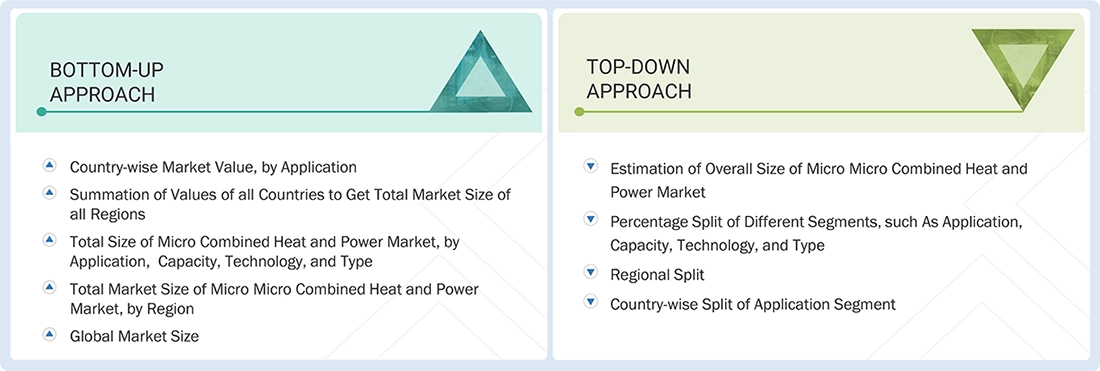
The study involved major activities in estimating the current size of the micro combined heat and power market. Exhaustive secondary research was done to collect information on the peer and parent markets. The next step was to validate these findings, assumptions, and sizing with industry experts across the value chain through primary research. Both top-down and bottom-up approaches were employed to estimate the complete market size. Thereafter, market breakdown and data triangulation were used to estimate the market size of the segments and subsegments.
Secondary Research
This research study on the micro combined heat and power market involved the use of extensive secondary sources, directories, and databases, such as D&B Hoovers, Bloomberg, Businessweek, Factiva, the International Energy Agency, and BP Statistical Review of World Energy, to identify and collect valuable information for a technical, market-oriented, and commercial study of the global micro combined heat and power market. Other secondary sources include annual reports, press releases, and investor presentations of companies, white papers, certified publications, articles by recognized authors, manufacturer associations, trade directories, and databases.
Primary Research
The micro combined heat and power market comprises stakeholders such as micro combined heat and power equipment manufacturers, micro combined heat and power unit manufacturers, control system suppliers, and support providers in the supply chain. Demand for micro combined heat and power solutions is growing as there is a need for energy-efficient, decentralized heating and power solutions in the residential, commercial, and small industrial sectors. This growth is due to increasing energy costs, more stringent emission standards, and the move toward low-carbon systems that provide higher efficiencies, enhance energy security, and reduce dependence on large power grids. Manufacturers are collaborating with energy providers, builders, and utilities as a platform for building new relationships while supporting government programs. Each company focuses on developing innovative products, integrating clean energy, developing collaborative strategies to strengthen market share, and using information from supply and demand side participants. The following is the breakdown of primary respondents:
BREAKDOWN OF PRIMARIES
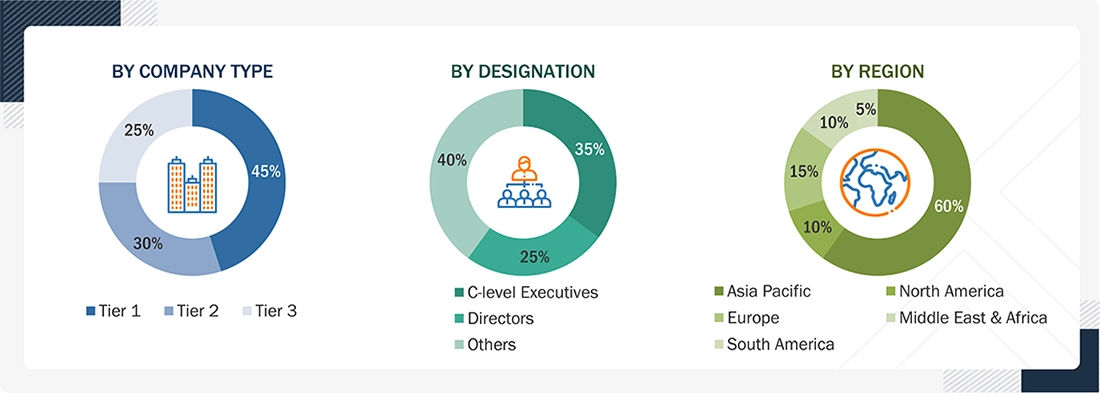
The tiers of the companies are defined based on their total revenue as of 2024: Tier 1: >USD 1 billion, Tier 2: USD 500 million–1 billion, and Tier 3: <USD 500 million.
To know about the assumptions considered for the study, download the pdf brochure
Market Size Estimation
Both top-down and bottom-up approaches were employed to estimate and validate the size of the micro combined heat and power market. Major players in this market were identified through secondary research, and their market share in the respective regions was determined through a combination of primary and secondary research. The research methodology involves analyzing the annual and financial reports of top market players and conducting interviews with industry experts, including chief executive officers, vice presidents, directors, sales managers, and marketing executives, to gather key quantitative and qualitative insights related to the micro combined heat and power market.
Data Triangulation
The entire market has been split up into a number of segments and subsegments after the estimation process described above was used to determine the overall market size. Where appropriate, data triangulation and market breakdown procedures have been used to finish the entire market engineering process and acquire precise information for each segment and subsegment. By examining numerous elements and patterns from the supply and demand sides, the data has been triangulated. Furthermore, top-down and bottom-up methods have been used to validate the market.
Market Definition
Micro combined heat and power (MCHP) is an environmentally friendly technology that generates heat and electricity simultaneously from a single source of input fuel, such as natural gas, liquified petroleum gas (LPG), biomethane, hydrogen, and other liquid fuels. This fuel used to power MCHP units is not a renewable energy source, but the heat and electric energy generated can attain an operational efficiency of around 90%. This results in limited energy wastage and holds the potential to lower the carbon footprint significantly. The energy is produced on a relatively small scale, sufficient to satisfy heat and power requirements from residential and light commercial activities, requiring a small amount of heat and energy. The heat generated can be used for space heating and heating water. The electricity produced could be used on-site or exported to the national grid. Internal combustion engines, Stirling engines, Rankine cycle engines, proton exchange membrane fuel cells (PEMFCs), and solid oxide fuel cells (SOFCs) are key technologies available in the market that convert the input fuel into usable heat and electric energy in an MCHP system.
Key Stakeholders
- Micro CHP equipment manufacturers
- Micro CHP unit manufacturers
- Micro CHP unit distributors and suppliers
- Research institutes and companies
- Hotels, hospitals, care homes, office buildings, retail stores, and other utilities
- Smart grid players
- Industry, energy, and environmental associations
- Government and research organizations
- Investment banks
- Venture capital firms
Report Objectives
- To describe and forecast the micro combined heat and power market, by type, by technology, capacity, and application, in terms of value
- To describe and forecast the micro combined heat and power market for various segments with respect to five main regions: North America, Europe, Asia Pacific, South America, and the Middle East & Africa, in terms of value
- To describe and forecast the micro combined heat and power market, by capacity and region, in terms of volume
- To provide detailed information regarding drivers, restraints, opportunities, and challenges influencing the growth of the market
- To offer a detailed overview of the value chain analysis, use case analysis, key stakeholders and buying criteria, patent analysis, trade analysis, tariff analysis, regulations, macroeconomic outlook, pricing analysis, Porter’s five forces analysis, impact of Gen AI/AI, and the US tariff impact
- To strategically analyze micromarkets with respect to individual growth trends, prospects, and contributions to the total market
- To understand opportunities in the market for various stakeholders by identifying high-growth segments
- To strategically profile key players and comprehensively analyze their market position in terms of ranking and core competencies, along with detailing the market’s competitive landscape
- To analyze growth strategies, such as contracts, investments, expansions, and product launches, adopted by market players in the micro combined heat and power market
Available customizations:
MarketsandMarkets offers customizations tailored to the specific needs of companies using the given market data.
The following customization options are available for the report:
Product Analysis
- Product matrix, which gives a detailed comparison of the product portfolio of each company
Regional Analysis
- Further breakdown of the micro combined heat and power, by country
Company Information
- Detailed analysis and profiling of additional market players (up to five)
Get the Full Micro Combined Heat and Power Market Report
Full forecast, segment splits, and company analysis for all Micro Combined Heat and Power Market.
- Canada Micro Combined Heat and Power Market
- Germany Micro Combined Heat and Power Market
- UK Micro Combined Heat and Power Market
- Netherlands Micro Combined Heat and Power Market
- Italy Micro Combined Heat and Power Market
- South Korea Micro Combined Heat and Power Market
- Japan Micro Combined Heat and Power Market
- Brazil Micro Combined Heat and Power Market
- South Africa Micro Combined Heat and Power Market
- Rest Of Europe Micro Combined Heat and Power Market
Need a Tailored Report?
Customize this report to your needs
Get 10% FREE Customization
Customize This Report
