
UK Microbiome Diagnostics Market (2023-2028)

The UK Microbiome Diagnostics Market was valued at $7.7 Million in 2023 and projected to reach to $15.7 Million by 2028, representing a compound annual growth rate of CAGR 15.3%. The UK microbiome diagnostics market is positioned for sustained expansion as healthcare providers recognize the clinical value of microbiome profiling in disease diagnosis and prevention.


| Market Size in | USD 26.32 MN |
| Market Forecast in | |
| CAGR | |
| Forecast Period | |
| Units Considered | Value (USD MN) |
UK Microbiome Diagnostics Market Trends and Insights
- The UK market is driven by increasing adoption of precision medicine, growing awareness of gut health's role in disease prevention, and rising investment in diagnostic infrastructure across the National Health Service.
- The UK's strong regulatory framework and emphasis on personalized healthcare position the country as a key hub for microbiome diagnostic innovation in Europe. The UK microbiome diagnostics sector benefits from robust research institutions, including leading universities and biotech firms focused on microbiome science.
- The UK market is experiencing accelerated demand from gastroenterology, immunology, and metabolic disease segments.
- Healthcare providers in the UK are increasingly integrating microbiome testing into clinical workflows, supported by growing clinical evidence and reimbursement pathways.
- The UK's competitive advantage lies in its combination of advanced laboratory capabilities, regulatory clarity, and patient demand for non-invasive diagnostic solutions..
Key Market Statistics
- CAGR (2023-2028) CAGR 15.3%
- Market Size, 2023 ~USD 7.7 Million
- Forecast, 2028 ~USD 15.7 Million
- Country UK
UK Microbiome Diagnostics Market Overview
Market Valuation Growth :
The UK microbiome diagnostics market reached $7.7 million in 2023 and is forecast to grow to $15.7 million by 2028, driven by a robust 15.3% CAGR, outpacing many other diagnostic segments in the British healthcare sector.
NHS Infrastructure Investment :
Rising investment in diagnostic infrastructure across the National Health Service is accelerating adoption of microbiome testing, with NHS trusts increasingly integrating these diagnostics into precision medicine protocols and personalized treatment pathways.
Precision Medicine Adoption :
UK healthcare providers are rapidly embracing precision medicine approaches, with microbiome diagnostics becoming integral to understanding individual patient profiles and tailoring therapeutic interventions for improved clinical outcomes.
Gut Health Awareness :
Growing public and clinical awareness of the gut microbiome's role in disease prevention, immune function, and metabolic health is driving demand for diagnostic testing across UK hospitals, private clinics, and wellness centers.
UK Microbiome Diagnostics Market Dynamics
- NHS adoption initiatives and increased funding for diagnostic innovation are creating favorable conditions for market penetration.
- The convergence of precision medicine trends, patient demand for personalized healthcare, and regulatory support for advanced diagnostics will continue to propel growth through 2028.
- UK-based diagnostic companies and international players are investing in localized solutions to capture market share in this emerging segment..
Market Ecosystem
Related Ecosystem
Key Takeaways
- The UK microbiome diagnostics market is projected to double from $7.7M (2023) to $15.7M (2028) at a 15.3% CAGR.
- The UK market is driven by NHS investment in precision diagnostics and growing clinical adoption across multiple therapeutic areas.
- The UK benefits from strong regulatory frameworks and world-leading research institutions supporting microbiome innovation.
- The UK market is experiencing rising demand from gastroenterology, immunology, and metabolic disease applications.
Microbiome Diagnostics Market Report Scope
| Report Metric | Details |
|---|---|
| Base Year | 2023 |
| Fastest Growing Segment | SHOTGUN METAGENOMICS (Technology) |
| Forecast Period | 2023-2028 |
| Growth Rate | CAGR of 15.5% from 2023 to 2028 |
| Largest Segment | DISEASE DIAGNOSTIC APPLICATIONS (Application) |
| Market Size Base Year (Billions) | ~USD 0.15 (2023) |
| Revenue Forecast (Billions) | ~USD 0.3 (2028) |
| Segments Covered | Product, Technology, Sample, Application, Type, End User |
UK Microbiome Diagnostics Market Report Segmentation
6 segment dimensions are covered across the global market.
By Product
- Instruments
- Kits & Reagents
By Technology
- 16S Rrna Sequencing
- Metatranscriptomics
- Other Technologies
- Shotgun Metagenomics
By Sample
- Fecal Samples
- Other Samples
- Saliva Samples
- Skin Samples
By Application
- Disease Diagnostic Applications
- Research Applications
By Type
- Gastrointestinal Disorders
- Metabolic Disorders
- Other Disease Diagnostic Applications
By End User
- Hospitals
- Pharmaceutical & Biotechnology Companies
- Research Institutes
UK: MICROBIOME-BASED DIAGNOSTICS MARKET, BY END USER, 2021–2028
| Segment | 2021 | 2022 | 2023 | 2024 | 2025 | 2026 | 2027 | 2028 | CAGR (%) |
|---|---|---|---|---|---|---|---|---|---|
| HOSPITALS | 3.8 | 4.4 | 5.1 | 5.8 | 6.7 | 7.7 | 8.8 | 10.2 | 14.9 |
| PHARMACEUTICAL & BIOTECHNOLOGY COMPANIES | 0.4 | 0.5 | 0.5 | 0.6 | 0.7 | 0.8 | 0.9 | 1 | 14.9 |
| RESEARCH INSTITUTES | 1.6 | 1.8 | 2.1 | 2.4 | 2.8 | 3.3 | 3.9 | 4.5 | 16.5 |
| TOTAL | 5.8 | 6.7 | 7.7 | 8.8 | 10.2 | 11.8 | 13.6 | 15.7 | 15.3 |
Target Audience
- Diagnostic Companies : In vitro diagnostics and microbiome testing providers need UK-specific market data to develop localized product strategies, identify NHS partnership opportunities, and forecast revenue potential in this high-growth segment.
- Healthcare Investors : Private equity and venture capital firms evaluating UK healthcare investments require detailed market sizing and growth projections to assess the commercial viability of microbiome diagnostic startups and established players.
- NHS Procurement Teams : Hospital trusts and NHS commissioning bodies need market intelligence to evaluate microbiome diagnostic solutions, understand vendor landscapes, and make informed procurement decisions aligned with precision medicine initiatives.
- Pharmaceutical Companies : Pharma firms developing microbiome-targeted therapeutics require UK market data to understand diagnostic adoption rates, identify companion diagnostic opportunities, and plan clinical trial strategies.
- Medical Device Distributors : UK-based and international distributors need market forecasts and competitive analysis to determine product portfolio expansion opportunities and establish partnerships with diagnostic manufacturers.
Reasons to Buy this Report
- NHS Market Opportunity : Understand how NHS procurement strategies and healthcare commissioning are shaping microbiome diagnostic adoption across UK trusts, enabling targeted sales and partnership strategies.
- Competitive Landscape Intelligence : Identify key UK and international players entering the microbiome diagnostics space, their market positioning, and competitive advantages to inform strategic planning and investment decisions.
- Growth Trajectory Insights : Access detailed forecasts showing the UK market expanding from $7.7M to $15.7M by 2028, enabling accurate revenue projections and resource allocation for market entry or expansion.
- Regulatory & Reimbursement Pathways : Gain clarity on UK regulatory requirements, NICE guidance, and NHS reimbursement mechanisms for microbiome diagnostics to navigate market access and pricing strategies effectively.
- Clinical Adoption Drivers : Understand the specific clinical applications, patient segments, and healthcare settings driving microbiome diagnostic adoption in the UK to identify high-potential market niches.
Frequently asked questions
What is the current size of the UK microbiome diagnostics market?
The UK microbiome diagnostics market was valued at $7.7 million in 2023 and is expected to reach $15.7 million by 2028.
What is the growth rate of the UK microbiome diagnostics market?
The UK microbiome diagnostics market is growing at a compound annual growth rate (CAGR) of 15.3% from 2023 to 2028.
What are the main drivers of growth in the UK microbiome diagnostics market?
Key drivers include NHS investment in precision medicine, increasing clinical evidence for microbiome testing, growing patient awareness of gut health, and expanding reimbursement pathways across the UK.
Which therapeutic areas are driving demand in the UK microbiome diagnostics market?
The UK market is experiencing strong demand from gastroenterology, immunology, metabolic disease, and infectious disease diagnostic applications.
How does the UK microbiome diagnostics market compare to Europe?
The UK represents a significant portion of the European microbiome diagnostics market, supported by advanced healthcare infrastructure, regulatory clarity, and strong research capabilities.
RESEARCH METHODOLOGY
The objective of the study is to analyze the key market dynamics such as drivers, opportunities, challenges, restraints, and key player strategies. To track companies’ developments such as product launches and approvals, expansions, and partnerships of the leading players, the competitive landscape of the microbiome diagnostic market to analyze market players on various parameters within the broad categories of business and product strategy. Top-down and bottom-up approaches were used to estimate the market size. To estimate the market size of segments and subsegments, the market breakdown and data triangulation were used.
The four steps involved in estimating the market size are
Collecting Secondary Data
The secondary research data collection process involves the usage of secondary sources, directories, databases (such as Bloomberg Businessweek, Factiva, and D&B), annual reports, investor presentations, and SEC filings of companies. Secondary research was used to identify and collect information useful for the extensive, technical, market-oriented, and commercial study of the microbiome-based diagnostics market. A database of the key industry leaders was also prepared using secondary research.
Collecting Primary Data
The primary research data was collected after acquiring knowledge about the microbiome diagnostics market scenario through secondary research. A significant number of primary interviews were conducted with stakeholders from both the demand side (such as doctors, nurses, and hospital purchase managers) and supply side (such as included various industry experts, such as Directors, Chief X Officers (CXOs), Vice Presidents (VPs) from business development, marketing and product development teams, product manufacturers, wholesalers, channel partners, and distributors) across major countries of North America, Europe, Asia Pacific, Rest of the World. Approximately 40% of the primary interviews were conducted with stakeholders from the demand side while those from the supply side accounted for the remaining 60%. Primary data for this report was collected through questionnaires, emails, and telephonic interviews.
A breakdown of the primary respondents is provided below:
Breakdown of Primary Participants:
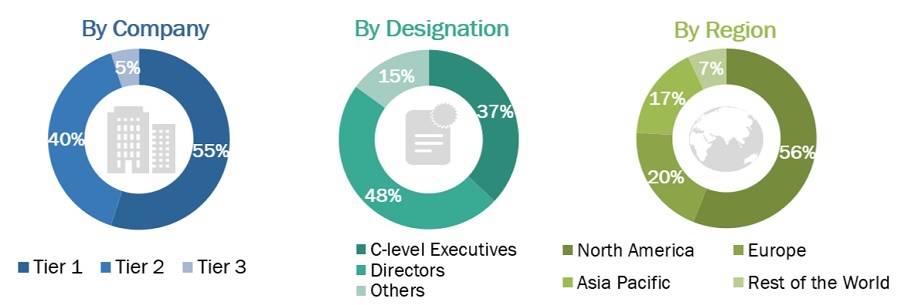
Note 1: Others include sales managers, marketing managers, and product managers.
Note 2: Tiers are defined based on a company’s total revenue. As of 2022: Tier 1 = >USD 1 billion, Tier 2 = USD 500 million to USD 1 billion, and Tier 3 <USD 500 million.
To know about the assumptions considered for the study, download the pdf brochure
|
COMPANY NAME |
DESIGNATION |
|
DNA Genotek (US) |
Manager |
|
Viome Life Sciences (US) |
VP Sales |
|
Genetic Analysis AS (Norway) |
Regional Sales Head |
|
Becton, Dickinson and Company (US) |
Sales Director |
Market Size Estimation
All major product manufacturers offering various microbiome diagnostics were identified at the global/regional level. Revenue mapping was done for the major players and was extrapolated to arrive at the global market value of each type of segment. The market value microbiome-based diagnostics market was also split into various segments and subsegments at the region and country level based on:
- Product mapping of various manufacturers for each type of microbiome diagnostics products at the regional and country level
- Relative adoption pattern of each product type among key application segments at the regional and/or country-level
- Detailed primary research to gather qualitative and quantitative information related to segments and subsegments at the regional and/or country level.
- Detailed secondary research to gauge the prevailing market trends at the regional and/or country-level
Global Microbiome Diagnostics Market Size: Bottom Up Approach
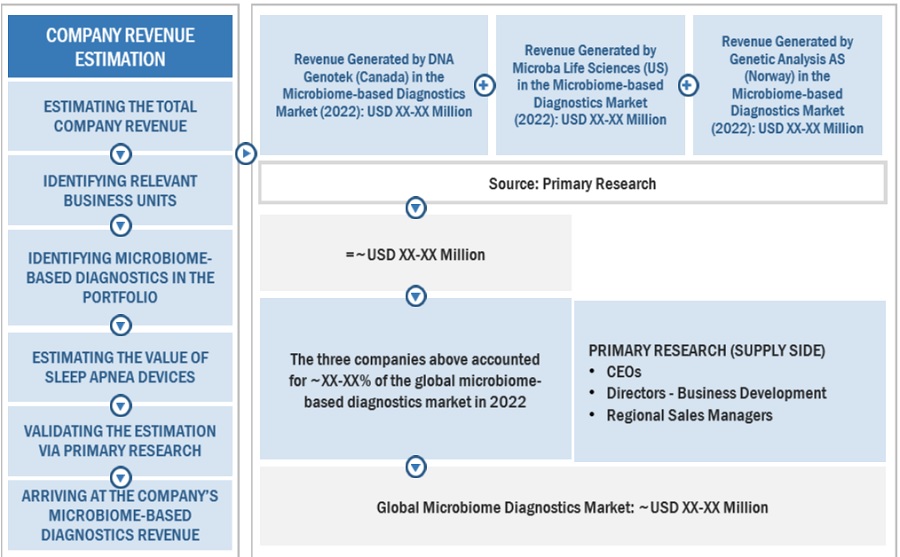
To know about the assumptions considered for the study, Request for Free Sample Report
Global Microbiome Diagnostics Market Size: Top-Down Approach
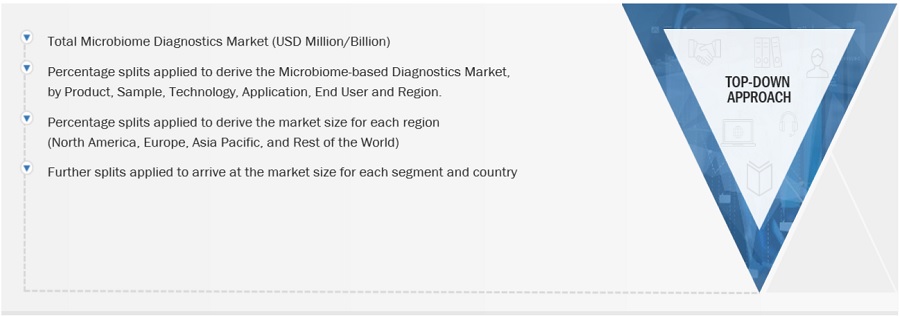
Data Triangulation
After arriving at the overall market size—using the market size estimation processes—the market was split into several segments and subsegments. To complete the overall market engineering process and arrive at the exact statistics of each market segment and subsegment, the data triangulation, and market breakdown procedures were employed, wherever applicable. The data was triangulated by studying various factors and trends from both the demand and supply sides in the microbiome-based diagnostics industry.
Market Definition
Microbiom diagnostic products are used to investigate and understand the complex communities of microorganisms living in and on the human body. Microbiome diagnostics involves collecting samples from various body sites, such as the skin, gut, mouth, and other mucosal surfaces, and analyzing the genetic material such as DNA, RNA of the microorganisms within these samples.
Key Stakeholders
- Manufacturers and distributors of microbiome-based diagnostics products
- Pharmaceutical and Biotechnology Companies
- R & D centers
- Diagnostic laboratories
- Hospitals and clinics
- Academic institutes
- Research institutes
- Market research and consulting firms
Report Objectives
- To define, describe, segment, and forecast the global microbiome diagnostics market by product, sample, application, end user and region.
- To provide detailed information regarding the major factors influencing the market growth (such as drivers, restraints, opportunities, challenges, and trends)
- To analyze the micromarkets1 with respect to individual growth trends, prospects, and contributions to the overall microbiome diagnostics market
- To analyze market opportunities for stakeholders and provide details of the competitive landscape for key players
- To forecast the size of the market segments with respect to four regions, namely, North America, Europe, the Asia Pacific, and the Rest of the World
- To profile the key players and comprehensively analyze their product portfolios, market positions, and core competencies2
- To benchmark players within the market using the proprietary Competitive Leadership Mapping framework, which analyzes market players on various parameters within the broad categories of business and product excellence
Available Customizations
With the given market data, MarketsandMarkets offers customizations as per the company’s specific needs. The following customization options are available for this report:
Geographic Analysis
- Further breakdown of the microbiome-based diagnostics market into specific countries/regions in the Rest of Europe, Rest of Asia Pacific, and Rest of the World.
Company Information
- Detailed analysis and profiling of additional market players (up to 3)
Get the Full Microbiome Diagnostics Market Report
Full forecast, segment splits, and company analysis for all Microbiome Diagnostics Market.
- Canada Microbiome Diagnostics Market
- US Microbiome Diagnostics Market
- Germany Microbiome Diagnostics Market
- France Microbiome Diagnostics Market
- China Microbiome Diagnostics Market
- Japan Microbiome Diagnostics Market
- India Microbiome Diagnostics Market
- Rest Of Europe Microbiome Diagnostics Market
- Rest Of Asia Pacific Microbiome Diagnostics Market
Need a Tailored Report?
Customize this report to your needs
Get 10% FREE Customization
Customize This Report
