
Mexico Modular Automation Market (2024-2029)

The Mexico Modular Automation Market was valued at $51.8 Million in 2024 and projected to reach to $61.7 Million by 2029, representing a compound annual growth rate of 3.6%. Mexico's modular automation market is poised for steady growth as manufacturers increasingly recognize the value of flexible, scalable production systems.


| Market Size in | USD 26.32 MN |
| Market Forecast in | |
| CAGR | |
| Forecast Period | |
| Units Considered | Value (USD MN) |
Mexico Modular Automation Market Trends and Insights
- Mexico's adoption of modular automation solutions reflects the country's expanding manufacturing base and increasing demand for flexible, scalable production systems in the semiconductor and electronics sectors.
- The growth trajectory in Mexico is driven by nearshoring trends, rising labor costs, and the need for manufacturers to enhance operational efficiency while maintaining competitive advantage in North America. During the 2024-2029 forecast period, Mexico is expected to experience steady expansion in modular automation deployment across automotive, electronics, and industrial manufacturing segments.
- Mexico's strategic geographic position and trade agreements position the country as an attractive hub for automation investment.
- The market in Mexico will benefit from technological advancements, increased capital expenditure in manufacturing infrastructure, and growing awareness among Mexican manufacturers of the cost-benefit advantages offered by modular automation systems..
Key Market Statistics
- CAGR (2024-2029) 3.6% CAGR
- Market Size, 2024 ~USD 51.8 Million
- Forecast, 2029 ~USD 61.7 Million
- Country Mexico
Mexico Modular Automation Market Overview
Market Valuation :
Mexico's modular automation market reached $51.8 million in 2024, with projected growth to $61.7 million by 2029, driven by the country's expanding manufacturing infrastructure and electronics sector development.
Growth Trajectory :
The Mexican market is experiencing a 3.6% CAGR through 2029, reflecting steady adoption of modular automation solutions as manufacturers seek flexible and scalable production capabilities to remain competitive.
Manufacturing Expansion :
Mexico's growing semiconductor and electronics manufacturing base is increasingly adopting modular automation to enhance production efficiency, reduce operational costs, and meet rising demand from nearshoring initiatives.
Competitive Positioning :
While Mexico's 3.6% CAGR trails the global 7.9% rate, the country's strategic location and manufacturing advantages position it as a key market for modular automation vendors targeting North American supply chains.
Mexico Modular Automation Market Dynamics
- The country's expanding electronics and semiconductor sectors, coupled with nearshoring trends from the United States, are driving demand for automation solutions that can adapt to changing production requirements.
- Investment in manufacturing infrastructure and workforce development will further support market expansion. The 3.6% CAGR reflects Mexico's measured but consistent adoption of modular automation technologies.
- Key growth drivers include cost optimization pressures, the need for production flexibility, and integration with existing manufacturing ecosystems.
- As global supply chains continue to diversify, Mexico's competitive advantages in labor costs and geographic proximity position the country as an increasingly attractive destination for modular automation deployment..
Market Ecosystem
Related Ecosystem
Industrial Automation
- Sensors
- Image Sensors
- Manufacturing Execution System (MES)
- Actuators
- Flow Sensors
- Siemens ag
- ABB India Limited
- Emerson Electric Co.
- HONEYWELL INTERNATIONAL INC.
- SCHNEIDER ELECTRIC SE
Drones And Robotics
- Sensors
- Articulated Robots
- Cartesian Robots
- Scara Robots
- Actuators
- ABB India Limited
- KUKA AG
- MOMENTIVE PERFORMANCE MATERIALS INC.
- STAUBLI INTERNATIONAL AG
- Fanuc Corporation
Key Takeaways
- Mexico's modular automation market is valued at $51.8 million in 2024 and will reach $61.7 million by 2029 at a 3.6% CAGR.
- Nearshoring and rising labor costs are primary drivers accelerating modular automation adoption across Mexico's manufacturing sector.
- Mexico's strategic location and trade agreements make it an increasingly attractive destination for automation investment in North America.
- The 2024-2029 period will see expanded deployment of modular automation in automotive, electronics, and industrial manufacturing segments in Mexico.
Modular Automation Market Report Scope
| Report Metric | Details |
|---|---|
| Base Year | 2024 |
| Fastest Growing Segment | MODULAR DISTRIBUTED CONTROL SYSTEM (Type) |
| Forecast Period | 2024-2029 |
| Growth Rate | CAGR of 7.9% from 2024 to 2029 |
| Largest Segment | MODULAR TYPE PACKAGE (Type) |
| Market Size Base Year (Billions) | ~USD 4.79 (2024) |
| Revenue Forecast (Billions) | ~USD 7 (2029) |
| Segments Covered | Mobility, Offering, Type, Application |
Mexico Modular Automation Market Report Segmentation
4 segment dimensions are covered across the global market.
By Mobility
- Fully Automatic
- Semi-Automatic
By Offering
- Hardware
- Software
By Type
- Drives And Motors
- I/O Modules
- Modular Distributed Control System
- Modular Type Package
- Robot Controllers
- Safety Components
- Sensors And Actuators
By Application
- Chemical
- Food & Beverage
- Logistics & Warehousing
- Pharmaceutical
MEXICO: MODULAR AUTOMATION MARKET, BY APPLICATION, 2024–2029
| Segment | 2024 | 2025 | 2026 | 2027 | 2028 | 2029 | CAGR (%) |
|---|---|---|---|---|---|---|---|
| CHEMICAL | 38.3 | 39.5 | 40.7 | 41.8 | 42.7 | 43.1 | 2.4 |
| FOOD & BEVERAGE | 37.2 | 38.6 | 40.1 | 41.5 | 42.7 | 43.4 | 3.1 |
| LOGISTICS & WAREHOUSING | 14.2 | 14.6 | 15 | 15.3 | 15.5 | 15.4 | 1.6 |
| OTHERS | 8 | 8 | 8.1 | 8.1 | 8.1 | 8.2 | 0.6 |
| PHARMACEUTICAL | 51.8 | 53.8 | 55.8 | 57.7 | 59.4 | 61.7 | 3.6 |
| TOTAL | 149.5 | 154.6 | 159.7 | 164.3 | 168.4 | 171.8 | 2.8 |
Target Audience
- Manufacturing Executives : Mexican and multinational manufacturing leaders need market data to justify automation investments, benchmark against industry peers, and align capital expenditure with regional growth trends and competitive pressures.
- Automation Equipment Vendors : Modular automation suppliers require Mexico-specific market intelligence to identify customer segments, assess market penetration opportunities, and develop localized sales strategies for the growing Mexican manufacturing base.
- Supply Chain & Operations Managers : Operations professionals evaluating nearshoring and Mexico-based manufacturing need detailed market insights to assess automation technology availability, vendor ecosystem maturity, and implementation feasibility in the region.
- Investment & Strategy Consultants : Consultants advising on Mexico manufacturing investments, facility location decisions, and technology roadmaps require granular market data to support client recommendations and validate strategic business cases.
- Technology Integrators & System Providers : Systems integrators and automation solution providers targeting Mexico need market segmentation data, growth forecasts, and customer insights to prioritize resources and develop Mexico-specific service offerings.
Reasons to Buy this Report
- Market-Specific Sizing Data : Access precise valuation figures for Mexico's modular automation market ($51.8M in 2024) with detailed 5-year forecasts, enabling accurate budget allocation and investment planning for Mexico-focused operations.
- Competitive Intelligence : Understand Mexico's 3.6% CAGR relative to global 7.9% growth, identifying market gaps and opportunities where modular automation adoption lags, presenting strategic entry or expansion possibilities.
- Sector-Specific Insights : Gain deep understanding of modular automation adoption patterns within Mexico's semiconductor and electronics manufacturing sectors, including key drivers, barriers, and growth catalysts unique to the region.
- Nearshoring Strategy Support : Leverage Mexico-specific market intelligence to support nearshoring decisions, supply chain localization strategies, and manufacturing facility planning in response to North American demand shifts.
- Vendor Positioning & Roadmaps : Develop Mexico-tailored go-to-market strategies, product positioning, and sales roadmaps based on localized market dynamics, customer preferences, and competitive landscape analysis specific to the country.
Frequently asked questions
What is the current size of Mexico's modular automation market?
Mexico's modular automation market was valued at $51.8 million in 2024 and is expected to grow to $61.7 million by 2029.
What is the projected growth rate for modular automation in Mexico?
Mexico's modular automation market is projected to grow at a compound annual growth rate (CAGR) of 3.6% from 2024 to 2029.
What are the main drivers of modular automation adoption in Mexico?
Key drivers include nearshoring trends, rising labor costs, demand for flexible manufacturing systems, and Mexico's strategic geographic position within North America.
Which industries in Mexico are adopting modular automation most rapidly?
Automotive, electronics, and industrial manufacturing segments in Mexico are leading the adoption of modular automation solutions during the 2024-2029 period.
How does Mexico's modular automation market compare to the global market?
Mexico's 3.6% CAGR is lower than the global 7.9% CAGR, reflecting Mexico's more mature but steady market growth relative to emerging automation markets worldwide.
RESEARCH METHODOLOGY
This research study extensively used secondary sources, directories, and databases, such as Hoovers, Bloomberg, Businessweek, Factiva, and OneSource. It was used to identify and collect information useful for a technical, market-oriented, and commercial study of the Modular Automation Market. The next step was to validate these findings, assumptions, and sizing with industry experts across the value chain through primary research. Primary sources included experts from core and related industries, preferred suppliers, manufacturers, distributors, service providers, technology developers, and organizations related to all segments of the value chain of the Modular Automation ecosystem. Both top-down and bottom-up approaches were employed to estimate the complete market size. After that, market breakdown and data triangulation were used to estimate the market size of segments and subsegments.
Secondary Research
Secondary sources for this research study included corporate filings (such as annual reports, investor presentations, and financial statements); trade, business, and professional associations; white papers; certified publications; articles by recognized authors; directories; and databases. The secondary data was collected and analyzed to determine the overall market size, further validated through primary research.
List of major secondary sources
|
SOURCE |
WEB LINK |
|
International Society of Automation (ISA) |
https://www.isa.org/ |
|
NAMUR |
https://www.namur.net/en/focus-topics/automation-modular-plants.html |
|
Organization for Machine Automation and Control (OMAC) |
https://www.omac.org/about-omac |
|
OPC Foundation |
https://opcconnect.opcfoundation.org/2020/03/enabling-modular-procedural-automation-at-air-liquide/ |
|
VDI |
https://www.vdi.de/en/home/vdi-standards/ |
|
PROFIBUS |
https://www.profibus.com/technologies/mtp |
Primary Research
Extensive primary research was conducted after gaining knowledge about the current scenario of the Modular Automation Market through secondary research. Several primary interviews were conducted with experts from both demand and supply sides across four major regions—North America, Europe, Asia Pacific, and RoW. This primary data was collected through questionnaires, emails, and telephonic interviews.
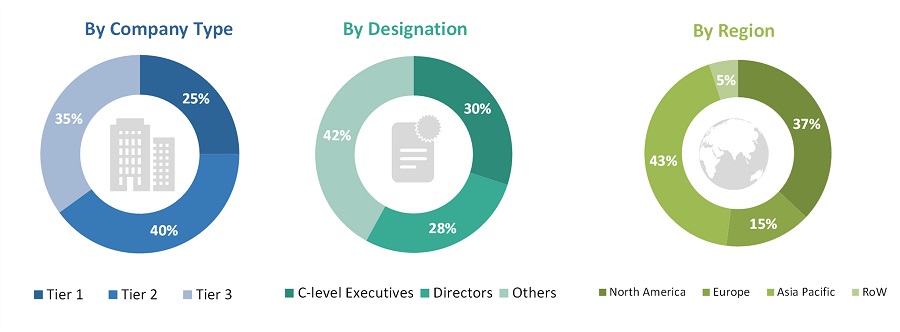
To know about the assumptions considered for the study, download the pdf brochure
Market Size Estimation
To estimate and validate the size of the Modular Automation Market and its various submarkets, both top-down and bottom-up methods were employed. Leading market players were identified through secondary research, with their market share in specific regions determined through a combination of primary and secondary research. This comprehensive process included reviewing annual and financial reports from key industry players and conducting in-depth interviews with senior industry executives, including CEOs, VPs, directors, and marketing executives. Percentage distributions and breakdowns were initially derived from secondary data and subsequently validated through primary sources. Every relevant parameter influencing the markets in this study was meticulously considered, verified through primary research, and examined to derive final quantitative and qualitative data. The resulting data was aggregated and enhanced with detailed insights and analysis from MarketsandMarkets, ultimately forming the basis of this report.
Bottom-Up Approach
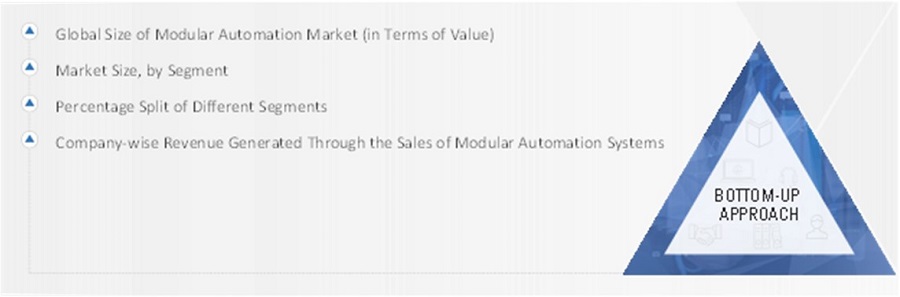
The bottom-up approach was used to determine the overall size of the revenues of key players and their shares in the market. The overall market size was calculated based on the revenues of key players identified in the market.
- The first step involved identifying companies that offer modular automation systems, followed by mapping their products according to various parameters, such as type, mobility, and components.
- The size of the Modular Automation Market was calculated based on the demand from various application areas and the revenue generated by companies within the modular automation ecosystem.
- Primary interviews were conducted with a few major players in the Modular Automation Industry to confirm the global market size.
- Secondary sources, including the International Society of Automation (ISA), NAMUR, Organization for Machine Automation and Control (OMAC), OPC Foundation, VDI, and PROFIBUS, were also used to cross-check market size. Other secondary sources comprised company websites, press releases, and research journals.
- To determine the Compound Annual Growth Rate (CAGR) of the Modular Automation Market, both historical and projected market trends were analyzed by examining the industry's penetration rate and supply and demand in various application areas.
- All estimates at each stage were confirmed through discussions with key opinion leaders, including corporate executives (CXOs), directors, sales heads, and industry experts from MarketsandMarkets.
- Several paid and unpaid information sources, such as annual reports, press releases, white papers, and databases, were also reviewed during the research process.
Top-Down Approach
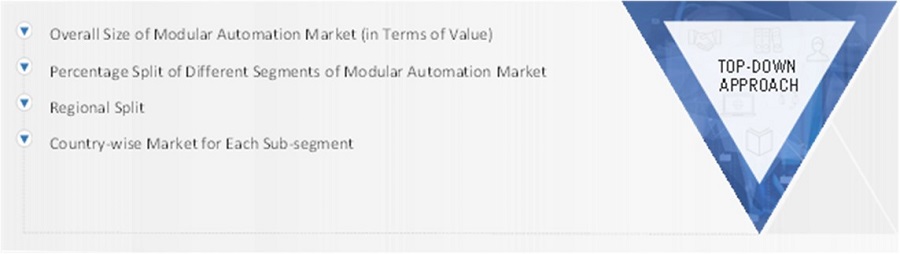
In the top-down approach, the total size of the Modular Automation Market, derived from percentage splits obtained through both secondary and primary research, was used to estimate the sizes of individual markets, as detailed in the market segmentation.
The top-down approach used the overall market size as a reference point to estimate the size of specific market segments. This approach was also applied to secondary research data to confirm the estimated market sizes for different segments.
Each company's market share was calculated to validate the revenue distribution used earlier in the top-down approach. Using data triangulation and validation through primary research, the study established and confirmed the sizes of both the entire parent market and the individual segments. The data triangulation process employed for this study is detailed in the following section.
- Revenue information from leading manufacturers and providers of Modular Automation systems and solutions was gathered and analyzed to estimate the global size of the Modular Automation Market.
- The Modular Automation Market is projected to exhibit a steady growth trend during the forecast period, reflecting its maturity and the presence of numerous well-established players across various sectors.
- The revenues, geographic footprint, key market sectors, and product offerings of all identified players in the Modular Automation Market were studied to estimate the percentage distribution of different market segments.
- Secondary research identified major players in each category (by component type and end-user industry) within the Modular Automation Market, and information was confirmed through brief discussions with industry experts.
- Several discussions with key opinion leaders from leading companies involved in developing Modular Automation systems were conducted to validate the market segmentation based on type, mobility, component, end-use industry, and geography.
- Geographic splits were estimated using secondary sources, considering various factors, such as the number of companies offering Modular Automation systems in a specific country or region and the types of Modular Automation components provided by these players.
Data Triangulation
After arriving at the overall size of the Modular Automation Market from the market size estimation process explained above, the total market was split into several segments and subsegments. The market breakdown and data triangulation procedures were employed wherever applicable to complete the overall market engineering process and arrive at the exact statistics for all segments and subsegments. The data was triangulated by studying various factors and trends from both the demand and supply sides. In addition to this, the market size was validated using top-down and bottom-up approaches.
Market Definition
Modular automation is a versatile and scalable strategy in industrial automation where production systems consist of interchangeable modules. Each module can function independently or in synergy with others, facilitating effortless customization, swift reconfiguration, and incremental upgrades. This approach allows manufacturers to optimize production processes, minimize downtime, and quickly respond to evolving market demands, thereby improving operational efficiency and cost-effectiveness. Moreover, modular automation promotes innovation by allowing for seamless integration of new technologies
Key Stakeholders
- Component Manufacturers
- Government and Research Organizations
- Modular Automation System Providers
- Modular Automation Software Providers
- Original Equipment Manufacturers (OEMs)
- Professional Services/Solution Providers
- Research Institutions and Organizations
- System Integrators
Report Objectives
- To estimate and forecast the size of the Modular Automation Market in terms of value based on type, mobility, component, end-use industry, and region.
- To describe and forecast the market size, in terms of volume, based on hardware type.
- To describe and forecast the market size, in terms of value, for four major regions-North America, Europe, Asia Pacific, and RoW
- To provide detailed information regarding major factors such as drivers, restraints, opportunities, and challenges influencing the market growth
- To provide a detailed overview of the value chain of the Modular Automation Market
- To strategically analyze micromarkets regarding individual market trends, growth prospects, and contributions to the total market
- To strategically profile key players and comprehensively analyze their market position regarding ranking and core competencies, along with a detailed competitive landscape for the market leaders.
- To analyze major growth strategies such as product launches, expansions, joint ventures, agreements, and acquisitions adopted by the key market players to enhance their position in the market.
- To analyze the impact of the recession on the Modular Automation Market
Available Customizations:
With the given market data, MarketsandMarkets offers customizations according to the specific requirements of companies. The following customization options are available for the report:
- Detailed analysis and profiling of additional market players (up to 5)
- Additional country-level analysis of the Modular Automation Market Product Analysis
- Product matrix, which provides a detailed comparison of the product portfolio of each company in the Modular Automation Market.
Get the Full Modular Automation Market Report
Full forecast, segment splits, and company analysis for all Modular Automation Market.
- Canada Modular Automation Market
- US Modular Automation Market
- France Modular Automation Market
- Germany Modular Automation Market
- UK Modular Automation Market
- China Modular Automation Market
- Japan Modular Automation Market
- South Korea Modular Automation Market
- Rest Of Europe Modular Automation Market
- Rest Of Asia Pacific Modular Automation Market
Need a Tailored Report?
Customize this report to your needs
Get 10% FREE Customization
Customize This Report
